
RTB Architecture
7 Architecture Mistakes That Slow Down Ad Tech Systems
Published · Last updated
Next scheduled review:
Advertising architecture problems often appear as slow bids, inconsistent budgets, incomplete reports or rising operating costs. Trace each symptom through the request path and its dependencies before adding capacity. Review bidding logic, storage, caching, logging, network placement and failure handling against measured production behavior.
Key facts
- The only audited DSP take rate is The Trade Desk's. Revenue of $2,896.3 million on gross platform spend of $13,394.7 million in 2025 implies 21.6%, up from 20.3% in 2024 ($2,444.8 million on $12,040.9 million) (The Trade Desk 10-K, FY2025). The company says its take rate is "consistently around 20%" (AdExchanger, 28 April 2025).
- Regulator data puts self-service DSP fees at 4% to 16% and managed DSPs at 20% to 42%. The UK CMA's 2019 fee data gave a weighted DSP average of 14% and a DV360 range of 5% to 15% plus third-party fees (CMA, Appendix R, 1 July 2020).
- Amazon's managed service is reported at a $50,000 minimum with a 15% service fee and a 10% platform fee, per documentation summarised in July 2025; the buying product was renamed DVA inside Amazon Ads Agent on 29 September 2026 (PPC Land, 15 October 2026).
- Third-party data is a second fee layer. Google's DV360 help pages quote $0.50 to more than $2 CPM for third-party lists (Google DV360 Help, accessed 17 October 2026). The Trade Desk's Audience Unlimited charges 3.3% or 4.4% of impression cost in Control Mode and says heavy data users spend "nearly 20%" of media on data (PPC Land, 29 September 2025).
- In the ANA's log-level benchmark, DSP platform fees averaged 6.0% of spend and DSP data costs 2.7% in Q3 2025, with SSP platform fees at 12.8% (ANA Programmatic Transparency Benchmark, Q3 2025).
- Flat-fee software starts at $250 a month. Epom's white-label DSP is $250 or $2,000 a month or 5% of ad spend, whichever is higher, with a possible $500 setup fee (Epom DSP pricing, accessed 17 October 2026). Beeswax charges "a flat fee based on tech usage instead of a spend fee" (PPC Land, 17 December 2020).
Definition
An ad tech architecture assessment checks whether data dependencies, request paths, state management and operational controls can satisfy the system's actual load and timing requirements.

Diagram by AdSovereign, CC BY 4.0.
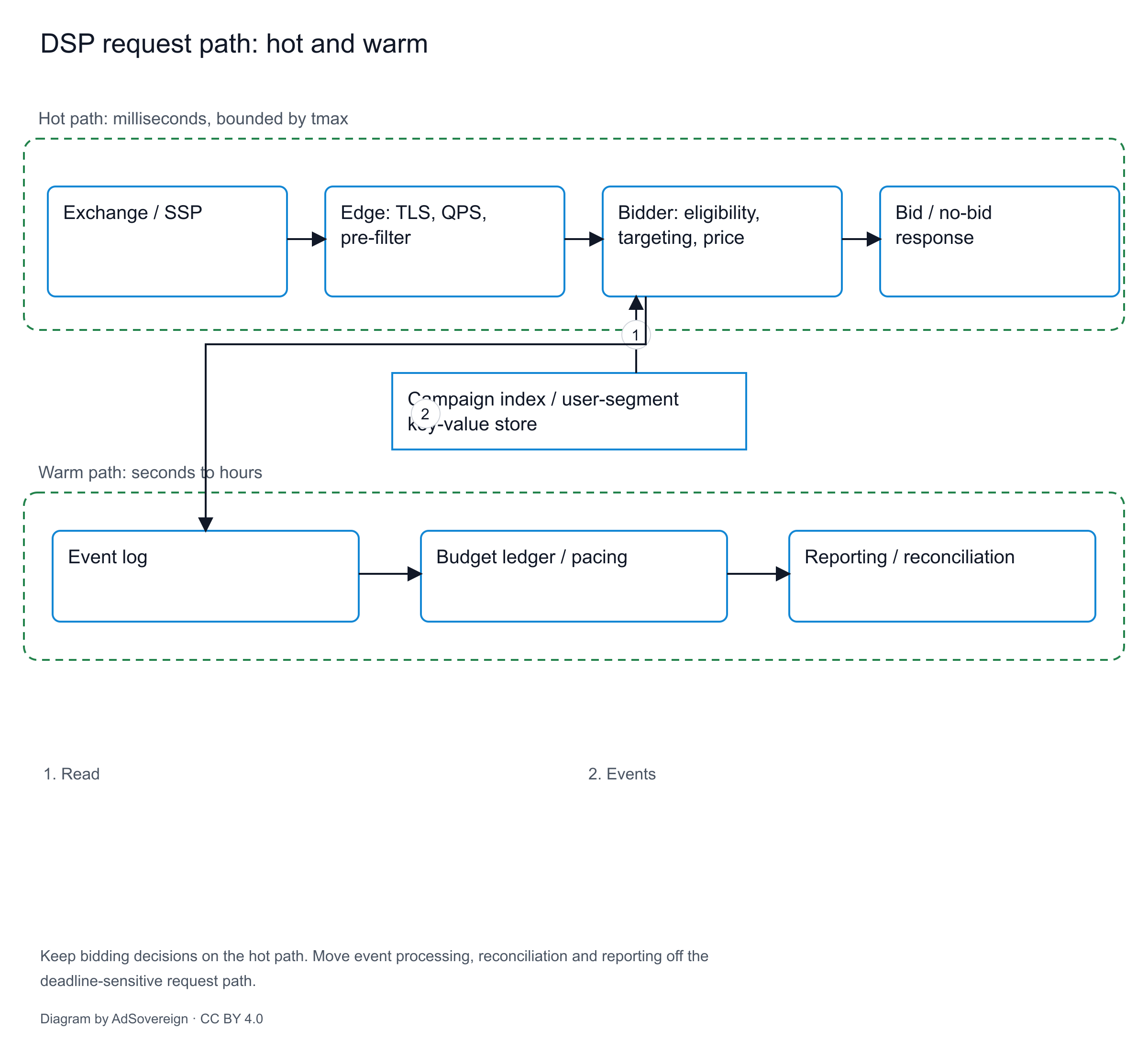
Evaluate the workflow
Performance degradation in AdTech systems isn't a matter of if, it's when. Without proper architecture, even the best-funded platforms eventually hit walls of latency, scale, and cost. Here are seven critical mistakes that slow down real-time bidding systems and how to fix them.
Mistake #1: Overloaded Bidding Logic
The Fix:
- Refactor algorithms from decision trees to hash map lookups
- Pre-compute audience segments offline
- Cache targeting rules in memory (Redis/Memcached)
- Use probabilistic data structures (Bloom filters) for quick exclusions
Mistake #2: Insufficient Data Indexing
The Fix:
- Create composite indexes on (user_id, timestamp, campaign_id)
- Optimize query patterns (use EXPLAIN to identify slow queries)
- Deploy read replicas to distribute query load
- Implement database sharding for horizontal scaling
Mistake #3: Wrong Cloud-to-Edge Ratio
The Fix:
- Deploy edge computing nodes in major markets (US-East, US-West, EU, APAC)
- Use CDN for static assets (creatives, scripts)
- Implement geographic load balancing with latency-based routing
- Replicate critical data to edge locations
Mistake #4: Missing Real-Time Caching Layer
The Problem: Every bid request hits the database directly, no caching strategy. Database becomes overwhelmed at scale.
The Fix:
Multi-Tier Caching Architecture:
┌─────────────────────────────────────────┐ │ L1: In-Memory Cache (Application) │ │ - Hot data (campaign budgets, etc.) │ │ - Latency: measure on your workload │ │ - Hit rate: measure on this workload │ └─────────────────────────────────────────┘ ↓ (miss) ┌─────────────────────────────────────────┐ │ L2: Redis/Memcached │ │ - Warm data (user profiles, segments) │ │ - Latency: measure on your workload │ │ - Hit rate: measure on your workload │ └─────────────────────────────────────────┘ ↓ (miss) ┌─────────────────────────────────────────┐ │ L3: Database (PostgreSQL/MySQL) │ │ - Cold data (historical, archived) │ │ - Latency: measure on your workload │ │ - Hit rate: measure on your workload │ └─────────────────────────────────────────┘
Combined cache hit rate: measure from workload logs Database load reduction: measure query volume and misses
Mistake #5: Inefficient Logging and Monitoring
The Problem: Synchronous logging to disk on every request, verbose debug logs running in production. Logging itself becomes a performance bottleneck.
The Fix:
- Async logging with message queues (log events don't block requests)
- Structured logging in JSON format for easier parsing
- Distributed tracing for end-to-end visibility (OpenTelemetry)
Mistake #6: Latency Trade-Offs in Hybrid Systems
The Fix:
- Data replication: sync DMP data to on-premise cache nightly
- Async enrichment: bid immediately with cached data, enrich post-auction
- Colocation: place critical cloud services in same datacenter as on-premise infrastructure
- Smart routing: only call cloud for truly dynamic data
Mistake #7: No Capacity Planning or Load Testing
The Fix:
- Predictive autoscaling based on traffic patterns (historical + ML)
- Circuit breakers to prevent cascading failures
- Graceful degradation: shed non-critical features under load
- Regular chaos engineering exercises (Netflix's Chaos Monkey approach)
Preventive Engineering Principles
To avoid these mistakes from day one:
- Implement chaos engineering , Break things deliberately to learn how they fail
- Conduct quarterly architecture reviews , Tech debt compounds faster than you think
- Maintain runbooks for common failures , Document solutions before you need them
- Practice incident response drills , When the real outage happens, muscle memory matters
Before/After Performance Comparison
| Metric | Before (Broken) | After (Fixed) |
|---|
Conclusion: Architecture Debt Compounds
These seven mistakes are not hypothetical, they're patterns we see repeatedly in enterprise AdTech systems. The good news? They're all fixable with proper architecture and engineering discipline.
Request Your Infrastructure Review
Request Free AuditRead the current references
Read the rtb architecture guide for the broader decision framework.
FAQ
How much does Amazon DSP cost? Amazon does not publish a rate card. Its product page says "Your current pricing structure is carried forward" into Amazon Ads Agent and refers pricing questions to an account executive (Amazon Ads, accessed 17 October 2026). Documentation summarised in July 2025 put the managed service at a $50,000 minimum, a 15% service fee and a 10% platform fee (PPC Land, 15 October 2026). Reports on the self-service minimum conflict: one dated guide says Amazon removed it in November 2025 (Nova Data, updated 8 October 2026), while Digiday reported on 11 November 2025 that the DSP kept its minimums (PPC Land, 15 October 2026). Ask for both in writing.
What is The Trade Desk's take rate? About one fifth of spend. Revenue of $2,896.3 million against gross spend of $13,394.7 million in 2025 implies 21.6%, and 20.3% in 2024 (The Trade Desk 10-K, FY2025). The company said in April 2025 that the rate "has been consistently around 20% of spend on our platform" (AdExchanger, 28 April 2025). Individual contracts vary; Needham has estimated a 12% to 15% range for the platform fee alone (PPC Land, 4 September 2026).
Does DV360 charge a platform fee? Yes, but Google does not publish it. The UK CMA, using 2019 data supplied by Google, estimated the DV360 take rate at 5% to 15% plus third-party fees (CMA, Appendix R, 1 July 2020). Google's own help pages are specific only about data: third-party lists cost "$0.50 to more than $2 CPM" (Google DV360 Help, accessed 17 October 2026).
How much does it cost to start a DSP? From $250 a month for a white-label front end with a 5% of spend floor (Epom DSP pricing, accessed 17 October 2026), to a usage-based flat fee for a bidder-as-a-service (PPC Land, 17 December 2020), to a build whose cost is staff and infrastructure rather than a license. No vendor publishes a bidder-as-a-service or self-hosted price; the figure comes from an RFP.
Are DSP fees negotiable? Yes. The Trade Desk's filing lists "pricing competition, volume discounts and shifts in media, client and channel mix" among the reasons its revenue may not grow in line with spend (The Trade Desk 10-K, FY2025). The CMA found DSP take rates ranging from 5% to 42% across platforms in 2019 (CMA, Appendix R, 1 July 2020). What is rarely negotiable without log-level data is visibility into the fees taken after the DSP.
How this works on owned infrastructure
AdSovereign provides an enterprise RTB stack for deployment inside a customer’s own infrastructure. Use the architecture to map the relevant components, the security controls to evaluate access and data boundaries, and the pilot to define a bounded evaluation. Compare the operating responsibilities and commercial terms against your own requirements. Infrastructure control does not establish demand access, legal permission or a measured performance improvement on its own.
Sources
- The Trade Desk, Inc., Form 10-K for fiscal year 2025 (filed February 2026). https://www.sec.gov/Archives/edgar/data/1671933/000167193326000014/ttd-20251231.htm
- PPC Land, "Trade Desk posts $2.9B in 2025 revenue but growth slows to 18%" (27 February 2026). https://ppc.land/trade-desk-posts-2-9b-in-2025-revenue-but-growth-slows-to-18/
- AdExchanger, "As CTV Blooms, It's Knives Out For The Trade Desk's Take Rate" (28 April 2025). https://www.adexchanger.com/online-advertising/as-ctv-blooms-its-knives-out-for-the-trade-desks-take-rate/
- PPC Land, "Explaining take rate" (4 September 2026). https://ppc.land/take-rate/
- PPC Land, "The Trade Desk launches data marketplace overhaul with AI scoring" (29 September 2025). https://ppc.land/the-trade-desk-launches-data-marketplace-overhaul-with-ai-scoring/
- Amazon Ads, Amazon DSP / Amazon Ads Agent product page (accessed 17 October 2026). https://advertising.amazon.com/solutions/products/amazon-dsp
- PPC Land, "Meta named a future that never came. Amazon Ads Agent names one that exists" (15 October 2026). https://ppc.land/meta-named-a-future-that-never-came-amazon-ads-agent-names-one-that-exists/
- Nova Data, "Amazon DSP guide 2026: minimum spend, setup, benchmarks" (published 6 November 2025, updated 8 October 2026). https://novadata.io/resources/blog/amazon-dsp-guide
- Media Planning Tool, "Amazon DSP Review 2026" (accessed 17 October 2026). https://www.mediaplanningtool.com/amazon-dsp
- Amazon Ads, "unBoxed 2025 recap" (11 November 2025). https://advertising.amazon.com/library/news/unboxed-2025-recap
- Google, Display & Video 360 Help, "Tips for using third-party audience lists" (accessed 17 October 2026). https://support.google.com/displayvideo/answer/6212219?hl=en
- Google, Display & Video 360 Help, "About commerce audiences" (accessed 17 October 2026). https://support.google.com/displayvideo/answer/16640028?hl=en
- UK Competition and Markets Authority, "Online platforms and digital advertising market study, Appendix R: fees in the adtech stack" (1 July 2020). https://assets.publishing.service.gov.uk/media/5fe49625e90e071207e10eff/Appendix_R_-_fees_in_the_adtech_stack_WEB.pdf
- StackAdapt, "Plans and packages" (accessed 17 October 2026). https://www.stackadapt.com/plans-and-packages
- Basis Technologies, platform page (accessed 17 October 2026). https://basis.com/technology/platform
- Epom, "DSP pricing" (accessed 17 October 2026). https://epom.com/pricing/dsp
- Epom, "White-label DSP" (accessed 17 October 2026). https://epom.com/demand-side-platform/white-label
- TeqBlaze, "White-label DSP" (accessed 17 October 2026). https://teqblaze.com/white-label-dsp
- PPC Land, "FreeWheel to acquire Beeswax" (17 December 2020). https://ppc.land/freewheel-to-acquire-beeswax/
- Beet.TV, "FreeWheel Buying Beeswax to Enable Publisher Audience Extension" (18 December 2020). https://www.beet.tv/2020/12/freewheel-buying-beeswax-to-boost-ad-demand.html
- Microsoft Learn, "Log Level Data Feeds" (updated 22 October 2025). https://learn.microsoft.com/en-us/xandr/log-level-data/log-level-data-feeds
- PPC Land, "Microsoft Monetize's survival bet: LinkedIn data on Amazon DSP CTV" (7 May 2026). https://ppc.land/microsoft-monetizes-survival-bet-linkedin-data-on-amazon-dsp-ctv/
- ANA and TAG TrustNet, "Programmatic Transparency Benchmark: Q3 2025 Benchmark Findings" (November 2025). https://s3.amazonaws.com/media.mediapost.com/uploads/Q32025ProgrammaticTransparencyBenchmark.pdf
- ANA and TAG TrustNet, "Programmatic Transparency Benchmark: Q1 2025 Benchmark Findings" (data to 31 March 2025). https://s3.amazonaws.com/media.mediapost.com/uploads/ANAQ12025Programmatic.pdf
- ISBA and PwC, "Programmatic Supply Chain Transparency Study, executive summary" (May 2020). https://www.isba.org.uk/system/files/media/documents/2020-12/executive-summary-programmatic-supply-chain-transparency-study.pdf
- Fiducia, "ANA Programmatic Transparency Benchmark: Q2 2026 Working-Media Efficiency Reaches a Record 45%" (ANA release of 6 August 2026). https://www.fiducia.eco/post/ana-programmatic-transparency-benchmark-q2-2026-working-media-efficiency-reaches-a-record-45
- Adalytics, "How much in fees are ad tech companies charging publishers & advertisers?" (April 2022; coverage in AdExchanger, 14 April 2022). https://adalytics.io/blog/adtech-supply-fees
Changelog
October 18, 2026: aligned the approved search title and heading; retained the original publication date.
October 17, 2026: updated search phrasing, source-linked reference context, author and dates. Withheld numerical claims without inline sources.