
RTB Architecture
RTB Latency Budget: QPS, Sizing and Measurement
Published · Last updated
Next scheduled review:
RTB latency is an end-to-end budget. Network travel, request handling, data lookups, bidding and response delivery must fit inside the exchange deadline. QPS describes load, while tail latency shows how that load affects slower requests. Size the system from measured behavior and test failure conditions before committing capacity.
Key facts
- Two current releases. Prebid Server Go v4.10.0 shipped on 13 October 2026 and requires Go 1.26.2 or newer; Prebid Server Java v4.3.0 shipped on 7 October 2026 and requires JDK 25 (prebid-server releases; prebid-server README; prebid-server-java releases; prebid-server-java README; all accessed 17 October 2026).
- Hundreds of adapters. Prebid.org's overview says "230+" server-side bid adapters; the full bidder list has 394 entries including aliases and duplicates (Prebid Server overview; bidder list; accessed 17 October 2026).
- The implementations differ. Prebid's feature index shows 16 features available only in Java (including the USGen privacy module, circuit breaker and request logging endpoints) and 4 only in Go (TCF geo-fencing, OpenRTB 2.4 and 2.5 schain compatibility, experimental Ads.Cert 2.0) (Prebid Server feature index, accessed 17 October 2026).
- It is not turn-key. Prebid.org says "Prebid Server is not a turn-key solution," that neither Prebid Server nor Prebid Cache terminates SSL, and that hosts should check for updates at least quarterly because releases arrive almost weekly (Prebid Server hosting, accessed 17 October 2026).
- A 2026 security advisory applies. pkg.go.dev flags GO-2026-6139, a server-side request forgery issue in bidder adapters, against PBS-Go v4.0.0 through v4.3.0 (pkg.go.dev, prebid-server versions, accessed 17 October 2026).
- Managed is an option. Prebid.org lists 21 managed-service providers, and Microsoft's Prebid Server Premium runs on open-source PBS-Go with access to over 200 demand partners (Prebid.org managed services, accessed 17 October 2026; Microsoft Learn, 21 October 2025).
Definition
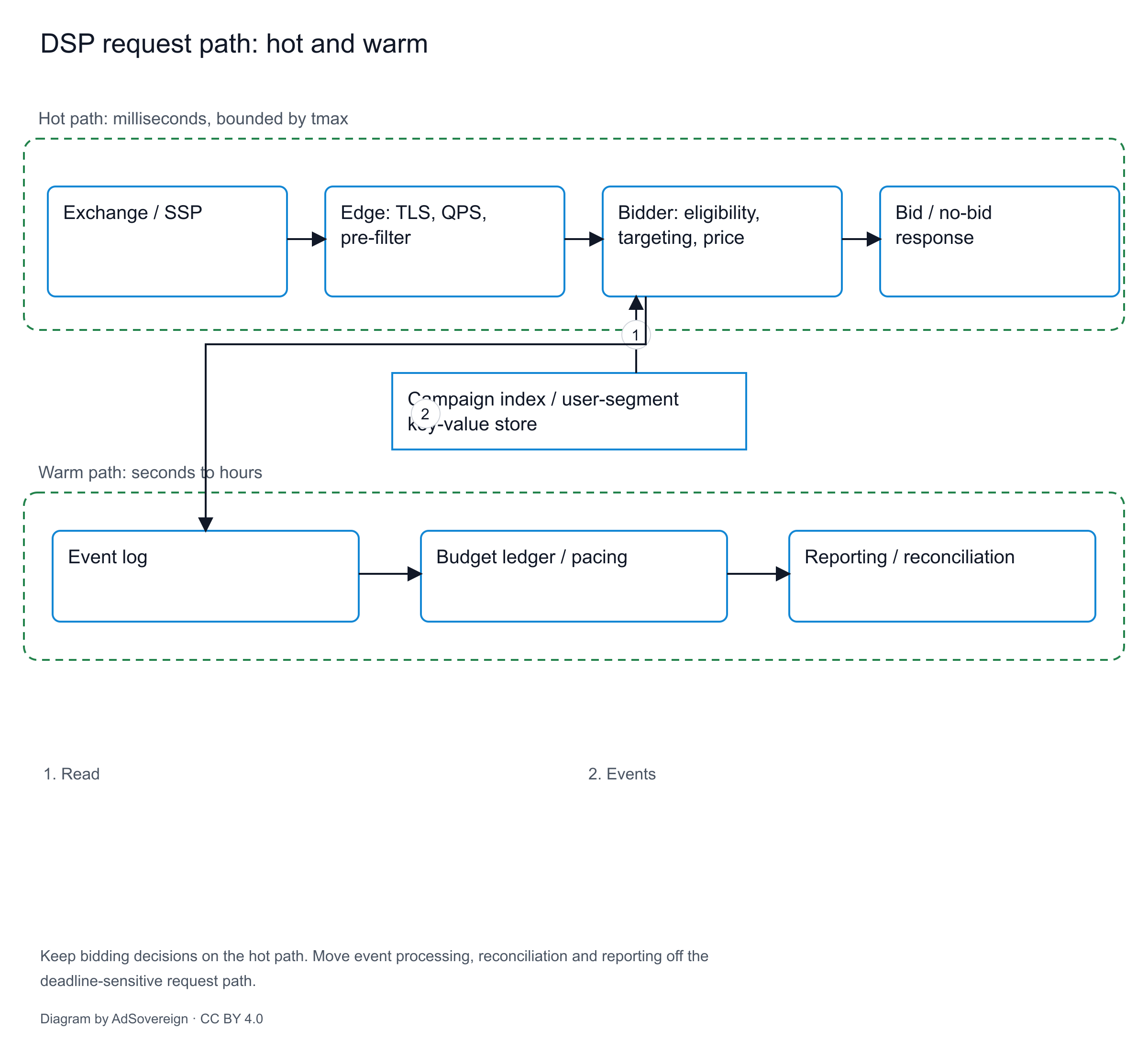
RTB latency is the elapsed time required for a request to travel through the buying path and for the exchange to receive the resulting bid or no-bid response.

Diagram by AdSovereign, CC BY 4.0.
Evaluate the workflow
What QPS Really Means in AdTech
QPS vs Fill Rate: The Critical Relationship
Example calculation:
How Latency Impacts Revenue
The Revenue Cost of Latency
* Based on industry benchmarks and Google research on latency impact
Network, Storage, and Compute Bottlenecks
Performance bottlenecks hide in three layers: network (connectivity), storage (database/disk), and compute (CPU/memory). Identifying the constraint is the first step to optimization.
┌─────────────────────────────────────────────────────────┐
│  PERFORMANCE BOTTLENECK IDENTIFICATION                  │
├─────────────────────────────────────────────────────────┤
│                                                         │
│  START: High latency or low QPS detected               │
│                                                         │
│  1. Check Network                                       │
│     ├─ Packet loss? → CDN or direct connection         │
│     ├─ High ping? → Geographic routing issue           │
│     └─ OK? → Continue to storage                       │
│                                                         │
│  2. Check Storage                                       │
│     ├─ Slow queries? → Add indexes or optimize SQL     │
│     ├─ High IOPS? → Upgrade to SSD/NVMe                │
│     ├─ Replication lag? → Scale read replicas          │
│     └─ OK? → Continue to compute                       │
│                                                         │
│  3. Check Compute                                       │
│     ├─ High CPU? → Optimize algorithms or scale out    │
│     ├─ Memory swapping? → Increase RAM or reduce load  │
│     ├─ Cache misses? → Tune cache size or TTL          │
│     └─ OK? → Check application logic                   │
│                                                         │
│  4. Application Logic                                   │
│     ├─ Complex loops? → Refactor to O(1) lookups       │
│     ├─ Blocking I/O? → Switch to async/non-blocking    │
│     └─ External API calls? → Cache or batch            │
│                                                         │
└─────────────────────────────────────────────────────────┘
Network Bottlenecks
- Fix: Edge nodes in major markets, optimized routing, CDN for static assets
Storage Bottlenecks
- Fix: Upgrade to SSD/NVMe, optimize queries, add composite indexes, use read replicas
Compute Bottlenecks
- CPU saturation: Reduces QPS capacity, increases latency variability
- Memory bandwidth: Critical for in-memory caching and large datasets
- Fix: Horizontal scaling, algorithm optimization, GPU for ML-based bidding
15-Point Performance Audit Checklist
Use this checklist to audit your RTB infrastructure performance. Each item includes target benchmarks and common fixes.
Identify peak traffic patterns (hourly, daily, seasonal)
Audit database query performance (slow query log)
Low hit rate = wasted cache capacity or wrong TTL
Test network latency to major exchanges
Use traceroute and ping tests from production servers
Monitor disk I/O wait times
High iowait = storage bottleneck, consider SSD upgrade
Check load balancer distribution
Uneven load = routing issue or unhealthy node
Review bidding algorithm complexity (O(n) vs O(n²))
Test disaster recovery failover time
Measure data replication lag
Audit logging overhead
Test geographic redundancy
Simulate datacenter failure, does traffic failover correctly?
Review rate limiting policies
Protect against DDoS without blocking legitimate traffic
Get Performance Audit Template
Download our comprehensive Excel template with pre-configured formulas, benchmark ranges, and automated health scoring for your RTB infrastructure.
Download TemplateKey Takeaways
- ✓ Bottlenecks hide in network, storage, or compute, systematic diagnosis required
- ✓ Multi-tier caching (in-memory, Redis, database) is critical for scale
- ✓ Predictive monitoring and autoscaling prevent performance degradation before it happens
Read the current references
Read the rtb architecture guide for the broader decision framework.
FAQ
Is Prebid Server free? The software is free under the Apache-2.0 license for both implementations (prebid-server README; prebid-server-java README). Running it is not: Prebid.org says it "is not a turn-key solution" and that the host must build its own data pipeline for accounts and stored requests (Prebid Server hosting). The worksheet above prices the infrastructure.
Should I choose Prebid Server Go or Java? Prebid.org says to pick the language your team prefers if the features and adapters you need exist in both (PBS-Go versions page). The feature index lists 16 Java-only features and 4 Go-only ones; US state privacy (USGen module), the circuit breaker and per-account stored requests are Java-only, while geo-fencing and legacy schain locations are Go-only (feature index). Microsoft runs its commercial service on Go (Microsoft Learn, 21 October 2025).
How much does it cost to run Prebid Server on AWS? It depends on request rate, regions and egress, none of which Prebid.org benchmarks. The sourced unit prices are $0.145 per hour for a c7g.xlarge and $0.082 per hour for an m7g.large on demand, $0.0225 per hour plus $0.008 per LCU-hour for an Application Load Balancer, and $0.1752 per node-hour for a cache.r7g.large in AWS's own example (Vantage; AWS ELB pricing; AWS ElastiCache pricing).
How many bidders does Prebid Server support? Prebid.org's overview says "230+" server-side adapters; the bidder list page carries 394 entries, some of which are aliases or duplicates (Prebid Server overview; bidder list). Each adapter declares its endpoint, GVL ID, media types and user-sync method in a bidder-info file (adding a new bidder, Go).
Do I need Prebid Server to get AdX bids after the Google ruling? Not necessarily, but it is one of the two court-ordered paths. Google must build an API so Prebid can solicit real-time AdX bids and a DFP-to-Prebid-Server link (Google's estimate 12 to 15 months from the Effective Date), and separately must send AdX bids to rival ad servers (6 or 12 months, disputed) (Memorandum Opinion, Dkt. 1858, p. 58; PPC Land, 6 October 2026). A Prebid Server you host, or one a managed host runs for you, is where the first path lands; open-web display only.
How this works on owned infrastructure
AdSovereign provides an enterprise RTB stack for deployment inside a customer’s own infrastructure. Use the architecture to map the relevant components, the security controls to evaluate access and data boundaries, and the pilot to define a bounded evaluation. Compare the operating responsibilities and commercial terms against your own requirements. Infrastructure control does not establish demand access, legal permission or a measured performance improvement on its own.
Sources
- GitHub, prebid/prebid-server, README and Releases (accessed 17 October 2026). https://github.com/prebid/prebid-server and https://github.com/prebid/prebid-server/releases
- GitHub, prebid/prebid-server-java, README and Releases (accessed 17 October 2026). https://github.com/prebid/prebid-server-java and https://github.com/prebid/prebid-server-java/releases
- GitHub, prebid/prebid-server, docs/developers/configuration.md (accessed 17 October 2026). https://github.com/prebid/prebid-server/blob/master/docs/developers/configuration.md
- GitHub, prebid/prebid-server, config/config.go defaults (accessed 17 October 2026). https://raw.githubusercontent.com/prebid/prebid-server/master/config/config.go
- GitHub, prebid/prebid-server-java, docs/config-app.md (accessed 17 October 2026). https://github.com/prebid/prebid-server-java/blob/master/docs/config-app.md
- pkg.go.dev, github.com/prebid/prebid-server/v4 versions, with GO-2026-6139 advisory (accessed 17 October 2026). https://pkg.go.dev/github.com/prebid/prebid-server/v4?tab=versions
- Prebid.org, "Prebid Server overview" (accessed 17 October 2026). https://docs.prebid.org/prebid-server/overview/prebid-server-overview.html
- Prebid.org, "Prebid Server hosting" (accessed 17 October 2026). https://docs.prebid.org/prebid-server/hosting/pbs-hosting.html
- Prebid.org, "Prebid Server feature index" (accessed 17 October 2026). https://docs.prebid.org/prebid-server/features/pbs-feature-idx.html
- Prebid.org, "Prebid Server bidder list" (accessed 17 October 2026). https://docs.prebid.org/dev-docs/pbs-bidders.html
- Prebid.org, "Adding a new bidder (PBS-Go)" (accessed 17 October 2026). https://docs.prebid.org/prebid-server/developers/add-new-bidder-go.html
- Prebid.org, "Stored requests (PBS-Go)" (accessed 17 October 2026). https://docs.prebid.org/prebid-server/features/pbs-storedreqs-go.html
- Prebid.org, "Prebid Server cookie sync" (accessed 17 October 2026). https://docs.prebid.org/prebid-server/developers/pbs-cookie-sync.html
- Prebid.org, "Prebid Server privacy features" (accessed 17 October 2026). https://docs.prebid.org/prebid-server/features/pbs-privacy.html
- Prebid.org, "Prebid Server price floors" (accessed 17 October 2026). https://docs.prebid.org/prebid-server/features/pbs-floors.html
- Prebid.org, "Prebid Server adapter (s2sConfig)" (accessed 17 October 2026). https://docs.prebid.org/dev-docs/modules/prebidServer.html
- Prebid.org, "PBS-Go versions" (accessed 17 October 2026). https://docs.prebid.org/prebid-server/versions/pbs-versions-go.html
- Prebid.org, "Managed services" (accessed 17 October 2026). https://prebid.org/managed-services/
- Microsoft Learn, "Prebid Server Premium" (21 October 2025). https://learn.microsoft.com/en-us/xandr/monetize/prebid-server-premium
- Vantage (EC2Instances.info), c7g.xlarge and m7g.large (updated 17 October 2026). https://instances.vantage.sh/aws/ec2/c7g.xlarge and https://instances.vantage.sh/aws/ec2/m7g.large
- AWS, Elastic Load Balancing pricing (accessed 17 October 2026). https://aws.amazon.com/elasticloadbalancing/pricing/
- AWS, ElastiCache pricing (accessed 17 October 2026). https://aws.amazon.com/elasticache/pricing/
- AWS, EC2 on-demand pricing, data transfer section (accessed 17 October 2026). https://aws.amazon.com/ec2/pricing/on-demand/
- United States v. Google LLC, No. 1:23-cv-00108 (E.D. Va.), Memorandum Opinion, Dkt. 1858 (2 September 2026). https://www.courthousenews.com/wp-content/uploads/2026/09/google-judge-memo.pdf
- PPC Land, "DOJ seeks 6 months, Google 12, to open its ad exchange to rivals" (6 October 2026). https://ppc.land/doj-seeks-6-months-google-12-to-open-its-ad-exchange-to-rivals/
Changelog
October 18, 2026: aligned the approved search title and heading; retained the original publication date.
October 17, 2026: updated search phrasing, source-linked reference context, author and dates. Withheld numerical claims without inline sources.