
Publisher Independence
Prebid Server Self-Hosting Guide: AWS, On-Prem, Managed
Published · Last updated
Next scheduled review:
Prebid Server is open-source, Apache-licensed server-side header bidding software in two implementations, Go and Java. Self-hosting means running it behind a load balancer with Prebid Cache, a stored-request database and metrics, in a region near your users. The software is free; you pay for compute, cache, egress and the engineers who keep it current, because releases arrive almost weekly.
This guide covers the decision (host, cloud or managed), the components, the configuration, a latency budget and a cost worksheet in which every price is sourced and every volume is an input you replace with your own.
Key facts
- Two current releases. Prebid Server Go v4.10.0 shipped on 13 October 2026 and requires Go 1.26.2 or newer; Prebid Server Java v4.3.0 shipped on 7 October 2026 and requires JDK 25 (prebid-server releases; prebid-server README; prebid-server-java releases; prebid-server-java README; all accessed 17 October 2026).
- Hundreds of adapters. Prebid.org's overview says "230+" server-side bid adapters; the full bidder list has 394 entries including aliases and duplicates (Prebid Server overview; bidder list; accessed 17 October 2026).
- The implementations differ. Prebid's feature index shows 16 features available only in Java (including the USGen privacy module, circuit breaker and request logging endpoints) and 4 only in Go (TCF geo-fencing, OpenRTB 2.4 and 2.5 schain compatibility, experimental Ads.Cert 2.0) (Prebid Server feature index, accessed 17 October 2026).
- It is not turn-key. Prebid.org says "Prebid Server is not a turn-key solution," that neither Prebid Server nor Prebid Cache terminates SSL, and that hosts should check for updates at least quarterly because releases arrive almost weekly (Prebid Server hosting, accessed 17 October 2026).
- A 2026 security advisory applies. pkg.go.dev flags GO-2026-6139, a server-side request forgery issue in bidder adapters, against PBS-Go v4.0.0 through v4.3.0 (pkg.go.dev, prebid-server versions, accessed 17 October 2026).
- Managed is an option. Prebid.org lists 21 managed-service providers, and Microsoft's Prebid Server Premium runs on open-source PBS-Go with access to over 200 demand partners (Prebid.org managed services, accessed 17 October 2026; Microsoft Learn, 21 October 2025).
Definition
Prebid Server: "an open-source solution for server-to-server header bidding," which validates and enriches an OpenRTB request, calls server-side bid adapters in parallel, and returns bids with currency conversion, price-bucket targeting and cached creatives for mobile app, AMP, web (with Prebid.js), CTV, digital out-of-home and audio (Prebid Server overview, accessed 17 October 2026). It is an auction layer, not an ad server; the ad server still decides between the winning header bid and direct campaigns.
Why it matters more in 2026: the court order in US v. Google requires Google to build an API so Prebid can solicit real-time AdX bids for all indirect open-web display inventory, and a server-to-server link from DFP to Prebid Server, "functionally equivalent" and on "materially identical terms" to the way DFP calls AdX today, with no added latency; Google committed to 12 to 15 months for the Prebid work (Memorandum Opinion, Dkt. 1858, 2 September 2026, pp. 58 and 62; PPC Land, 6 October 2026). A Prebid Server you host is where that adapter will land. The timeline is in Google ad tech remedies explained for publishers.
PBS-Go vs PBS-Java
9 of 9 rows
Download JSONTable by AdSovereign, CC BY 4.0.
Latest release | v4.10.0, 13 Oct 2026 (GitHub) | v4.3.0, 7 Oct 2026 (GitHub) |
Language requirement | Go 1.26.2 or newer; cgo, a C compiler and libatomic needed to build (README) | JDK 25 (Oracle or Corretto), Maven, built on Vert.x (README) |
Default port | 8000 (README) | 8080 for the app, 8090 for admin (README) |
Configuration | Environment variables ( | Spring-style YAML passed with |
Only-here features | TCF 2 geo-fencing; OpenRTB 2.4 and 2.5 schain compatibility; Ads.Cert 2.0 (experimental) (feature index) | Bidder currency filter; custom targeting prefix; TCF 2 geo-lookup; USGen and US custom-logic privacy modules; GPP activity conditions; application storage cache; unique stored requests per account; stored-response JSON on request; preferred media type; client-side analytics; circuit breaker; request-logging admin endpoints; request and response correction modules (feature index) |
Metrics backends | InfluxDB, Prometheus (hosting page) | InfluxDB, Graphite, Prometheus, console (hosting page) |
Stored-request backends | Filesystem, Postgres, HTTP endpoint (stored requests, Go) | Filesystem, MySQL or Postgres database (config-app.md) |
Recent breaking change | None flagged in v4.5.0 to v4.10.0; v4.6.0 moved from Go 1.24 to 1.26 (releases) | v4.0.0 (6 Aug 2026): Rubicon adapter renamed Magnite, URL macros changed from double to single braces, modules renamed, new mandatory |
Who runs it commercially | Microsoft Prebid Server Premium (Microsoft Learn, 21 Oct 2025) | n/d |
Prebid.org's own guidance is to pick the language your team prefers if the feature set and adapters you need are present in both (PBS-Go versions page, accessed 17 October 2026). In practice the choice is driven by the Java-only list: if you need the USGen module for US state privacy, the circuit breaker or per-account stored requests, pick Java; if you need the legacy schain locations or geo-fencing, pick Go.
Hosting options: AWS, on-prem, managed
3 of 3 rows
Download JSONTable by AdSovereign, CC BY 4.0.
Self-hosted on a public cloud (AWS used here) | PBS instances, Prebid Cache, cache backend, stored-request database, load balancers, metrics, in one or more regions | The cloud provider's network and pricing | Compute, cache, load balancer, egress; priced below | Multi-region traffic; teams already on the cloud; need to own bid data |
Self-hosted on-premises or colocation | Everything above on your own hardware behind your own edge | Nothing, except peering | Capital hardware plus bandwidth and staff; no per-GB egress | Publishers with existing data centres or sovereignty requirements; the trade-offs are in managed vs on-prem |
Managed Prebid Server host | Nothing; the host runs PBS and gives you account configuration and reporting | Software version, bidder enablement, bid-stream visibility, cookie-sync domain | Revenue share or fee (none of the 21 providers publishes a price) (Prebid.org managed services) | Publishers without platform engineers; short time to value |
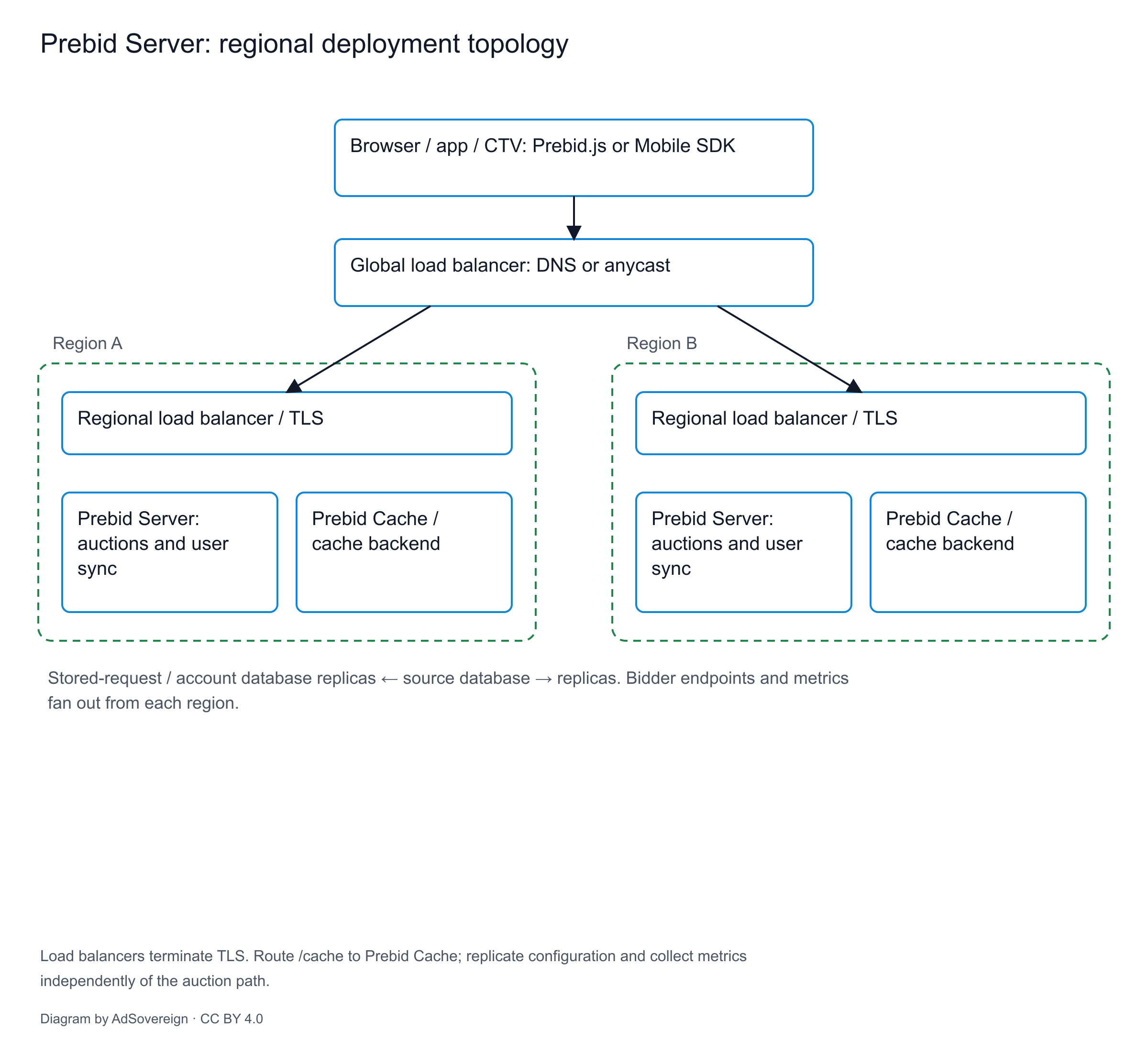
The host must handle production networking and monitoring, populate account and stored-request data, and "assess the legal implications of ad tech" in its market; no open-source tooling exists for the data pipeline that fills the stored-request database (Prebid Server hosting, accessed 17 October 2026). A multi-region deployment needs a global load balancer and a source database that replicates to each region (same). And the uids cookie that carries bidder IDs is set on the Prebid Server host's domain, so with a managed host the identity cookie belongs to the host's domain, not yours (Prebid Server cookie sync, accessed 17 October 2026).

Diagram by AdSovereign, CC BY 4.0.
Components
Prebid Server. CPU and network bound; needs "a fair amount of memory" to cache stored requests and several GDPR vendor-list versions; can host geo lookup for GDPR scope (Prebid Server hosting). Endpoints: /openrtb2/auction, /openrtb2/amp, /openrtb2/video, /cookie_sync, /setuid, /getuids, /status, /version, /info (Prebid Server overview).
Prebid Cache. Stores VAST and bids for video and AMP; uses "very little CPU or memory" and translates between Prebid's protocol and the backend, which can be Redis, Aerospike, Cassandra or Apache Ignite; cluster size depends on traffic volume, mix and how long objects stay cached (Prebid Server hosting).
Stored requests. Blocks of OpenRTB stored server-side and merged into incoming requests, used for mobile app and AMP and for keeping ad-unit definitions out of tags. PBS-Go supports filesystem (stored_requests.filesystem.enabled: true, files under stored_requests/data/by_id/), Postgres (stored_requests.postgres with a query) and HTTP (stored_requests.http.endpoint), with an in-memory cache (in_memory_cache.ttl_seconds, request_cache_size_bytes, imp_cache_size_bytes) and an HTTP events feed for invalidation (http_events.refresh_rate_seconds) (stored requests, Go, accessed 17 October 2026). A request references a stored imp with imp[].ext.prebid.storedrequest.id; request values win on conflict (same).
// stored_requests/data/by_id/stored_imps/leaderboard-top.json
{
  "id": "leaderboard-top",                         // referenced by imp.ext.prebid.storedrequest.id
  "banner": { "format": [ { "w": 728, "h": 90 }, { "w": 970, "h": 250 } ] },
  "ext": { "prebid": { "bidder": {
      "magnite":  { "accountId": 0, "siteId": 0, "zoneId": 0 },   // your Magnite IDs
      "pubmatic": { "publisherId": "0", "adSlot": "leaderboard" } // your PubMatic IDs
  } } }
}
The bidder parameter names above follow the Prebid bidder docs for each adapter; the IDs are placeholders (Prebid bidder list).
Bidder adapters. Each adapter ships with a static/bidder-info/{bidder}.yaml declaring endpoint, maintainer.email, gvlVendorID (IAB Europe Global Vendor List ID), capabilities (app, site, dooh with banner, video, audio, native), userSync (iframe or redirect URL with a userMacro), openrtb.version (2.6 if supported), endpointCompression (gzip) and modifyingVastXmlAllowed (Prebid.org, adding a new bidder, Go, accessed 17 October 2026). In PBS-Java "by default all bidders are disabled" and are switched on per adapter with adapters.<bidder>.enabled (config-app.md, accessed 17 October 2026). Enable only the bidders you have contracts with; the uids cookie and the GVL ID govern what each may receive under TCF.
Cookie sync. Prebid.js sends the bidder list and privacy signals to /cookie_sync; if privacy rules allow, PBS returns sync pixels for bidders missing an ID; each bidder endpoint redirects to /setuid, which stores the bidder's ID in the uids cookie on the PBS host domain; later auctions place that ID in user.buyeruid for the bidder. userSyncLimit in s2sConfig caps syncs per call, coopSync (default true) lets PBS sync bidders not on the current page, and PBS checks TCF Purpose 1 on both /cookie_sync and /setuid (Prebid Server cookie sync; Prebid Server adapter docs; Prebid Server privacy; all accessed 17 October 2026).
Privacy. PBS enforces TCF 2.0 and 2.2 by purpose (Purpose 1 for cookie sync, Purpose 2 for the auction, Purposes 2 to 10 for passing user IDs, Purpose 7 for analytics, Special Feature 1 for precise geo), supports GPP unwrapping, the US Privacy string, COPPA (removes IDs and geo when regs.coppa is 1) and LMT, and passes Sec-GPC without acting on it by default; gdpr.enabled defaults to true and gdpr.default_value is required with no default (Prebid Server privacy; configuration.md). The EU side of this is covered in GDPR, ePrivacy and the bidstream.
Floors. Floor rules live in ext.prebid.floors on the request or stored request, or are fetched dynamically from a URL (fetch.enabled, fetch.url, fetch.period_sec default 3600, fetch.max_age_sec default 86400); enforcement rejects bids below the floor after currency and bid adjustments, and skipRate bypasses signalling for A/B tests (Prebid Server floors, accessed 17 October 2026).
Latency budget
The numbers that exist are Prebid.org's. Prebid.js sends Prebid Server a timeout of 75% of bidderTimeout or 750 ms, whichever is less, unless you set s2sConfig.timeout; the server timeout "should be approximately 200ms-300ms less than your Prebid.js timeout" (Prebid Server adapter docs, accessed 17 October 2026). On the server, PBS-Go's auction_timeouts_ms.default and .max both default to 0 (meaning use the request's tmax), and tmax_adjustments lets you reserve milliseconds for bidder network latency and response preparation (config.go, accessed 17 October 2026).
What this means for siting: the round trip from user to your PBS region plus the slowest bidder you wait for must fit inside the server timeout. Prebid.org's hosting page says a global load balancer is needed "if you serve more than one geographic region, so users reach the nearest cluster" (Prebid Server hosting). The engineering background on request rates and bid latency is in QPS, latency and bid performance, and the broader architecture in RTB architecture explained.
Cost worksheet
Prebid.org publishes no cost or capacity figures (Prebid Server hosting). The worksheet below therefore separates prices, which are sourced, from volumes, which are inputs you must measure in your own load test.
Sourced prices (US East, on demand, accessed 17 October 2026)
6 of 6 rows
Download JSONTable by AdSovereign, CC BY 4.0.
EC2 c7g.xlarge (4 vCPU, 8 GiB) for Prebid Server | $0.145 per hour on demand; $0.096 per hour 1-year reserved | |
EC2 m7g.large (2 vCPU, 8 GiB) for Prebid Cache | $0.082 per hour on demand; $0.054 per hour 1-year reserved | |
Application Load Balancer | $0.0225 per hour plus $0.008 per LCU-hour | |
ElastiCache cache.r7g.large (cache backend) | $0.1752 per node-hour in AWS's US East pricing example | |
Data transfer out to the internet | First 100 GB per month free across AWS; per-GB tiers above that are shown on the EC2 pricing page and were not readable by our fetcher (n/d here) | |
Prebid Server and Prebid Cache software | $0 (Apache-2.0) |
Inputs you supply (illustrative values, not benchmarks)
6 of 6 rows
Download JSONTable by AdSovereign, CC BY 4.0.
Peak auction requests per second | R | 2,000 | From your Prebid.js analytics or ad server request logs at the busiest hour |
Requests per second one c7g.xlarge sustains at your latency target | S | 1,000 | Load test with your stored requests and bidder list; Prebid.org gives no figure |
Headroom factor | H | 2 | Your policy for failover and traffic spikes |
Regions | G | 2 | US plus EU for a transatlantic audience |
Hours per month | T | 730 | Calendar |
Egress per auction response in KB | E | 10 | Measure; depends on bidder count and creative caching |
Formulas
- Prebid Server instances per region = ceil(R ÷ S × H). Example: ceil(2,000 ÷ 1,000 × 2) = 4.
- Monthly Prebid Server compute = instances × G × T × price. Example: 4 × 2 × 730 × $0.145 = $846.80 on demand, or 4 × 2 × 730 × $0.096 = $560.64 reserved (Vantage).
- Prebid Cache nodes = 2 per region as a minimum for availability (your policy). Example: 2 × 2 × 730 × $0.082 = $239.44 on demand (Vantage).
- Cache backend = nodes per region × G × T × price. Example: 2 × 2 × 730 × $0.1752 = $511.58 (AWS ElastiCache pricing).
- Load balancers = G × T × $0.0225 plus LCU-hours × $0.008. Example fixed part: 2 × 730 × $0.0225 = $32.85; the LCU part depends on your connection and byte volumes (AWS ELB pricing).
- Egress GB per month = R × 3,600 × T × E ÷ 1,048,576 at peak rate (an upper bound; use your actual request distribution). Example upper bound: 2,000 × 3,600 × 730 × 10 ÷ 1,048,576 ≈ 50,130 GB, of which the first 100 GB is free; multiply the remainder by the per-GB tier from the AWS page (AWS EC2 on-demand pricing).
- Staff = the fraction of an engineer who tracks weekly releases, quarterly updates at minimum, adapter changes and the stored-request pipeline (Prebid Server hosting).
The example infrastructure lines above sum to roughly $1,600 a month on demand before egress and the LCU component, with egress likely to be the largest single line at the example volumes. The point of the worksheet is that egress and staff, not compute, decide the comparison with a managed host, and that a managed host's revenue share should be compared against this total plus the value of owning the bid stream. A capacity-planning calculator that automates the formulas is planned at bidder capacity planner.
Sample configuration (PBS-Go, annotated)
Keys below are from Prebid Server's configuration documentation and config.go; values marked "yours" are placeholders (configuration.md; config.go; stored requests, Go; all accessed 17 October 2026).
# pbs.yaml (PBS-Go). Equivalent env vars use the PBS_ prefix, e.g. PBS_PORT.
host: ""                       # listen on all addresses (default "")
port: 8000                     # default 8000
external_url: "https://pbs.example-publisher.com"   # public URL for user-sync callbacks and event URLs (yours)

auction_timeouts_ms:
  default: 0                   # 0 = use the request's tmax (default 0)
  max: 0                       # 0 = no cap (default 0); set e.g. 1000 to protect bidders

tmax_adjustments:
  enabled: false               # default false; enable to reserve ms for network and response prep
  bidder_network_latency_buffer_ms: 0
  pbs_response_preparation_duration_ms: 0

gdpr:
  enabled: true                # default true
  default_value: "1"           # REQUIRED, no default: "1" = treat requests without a GDPR flag as in scope (EU-safe)

ccpa:
  enforce: false               # default false; set true to honour US Privacy opt-outs

stored_requests:
  postgres:                    # or filesystem.enabled: true, or http.endpoint
    host: "db.internal"        # yours
    port: 5432
    user: "pbs"
    dbname: "pbs"
    query: "SELECT id, requestData, type FROM stored_requests WHERE id IN %REQUEST_ID_LIST% OR id IN %IMP_ID_LIST%"
  in_memory_cache:
    type: "lru"                # default none
    ttl_seconds: 3600          # default 0
    request_cache_size_bytes: 104857600   # default 0; 100 MB
    imp_cache_size_bytes: 104857600

cache:
  scheme: "https"
  host: "pbs-cache.example-publisher.com"   # Prebid Cache behind the /cache route (yours)
  query: "uuid=%PBS_CACHE_UUID%"
  expected_millis: 10          # default 10

metrics:
  prometheus:
    port: 9100                 # default 0 (disabled); expose to your scraper only

compression:
  request:
    enable_gzip: true          # default false; bidders with endpointCompression: gzip benefit
  response:
    enable_gzip: true          # default false

http_client:
  max_idle_connections: 400              # default 400
  max_idle_connections_per_host: 10      # default 10
  idle_connection_timeout_seconds: 60    # default 60

adapters:
  appnexus:
    disabled: false            # adapters are enabled unless disabled; bidder params come from stored requests
  magnite:
    disabled: false
  # Leave bidders you have no contract with disabled; the AdX adapter will be added by Google's release.
Two cautions. The Postgres query shape and the adapters.<bidder> keys follow the current documentation and defaults; confirm against the config/config.go structures for the version you deploy, because the docs say that file is the complete definition (configuration.md). And gdpr.default_value has no default on purpose; a missing value is a startup error, which is the safer failure.
Monitoring and operations
- Health.
/statusreturns 200 when the server is up (Java exposes it on 8080; Go on 8000) (prebid-server-java README; prebid-server README). - Metrics. Export to Prometheus or InfluxDB (both implementations) or Graphite (Java) and hook both Prebid Server and Prebid Cache into the same monitoring (Prebid Server hosting). Track per-bidder timeout rate, bid rate, error rate and p95 adapter latency, plus stored-request cache hit rate and Prebid Cache write latency.
- Floors telemetry. Bids rejected by floors are reported to analytics and logged as a sampled metric (Prebid Server floors).
- Updates. Check at least quarterly; releases are almost weekly (Prebid Server hosting). Treat GO-2026-6139 as the model: PBS-Go v4.0.0 to v4.3.0 carried an SSRF alert, fixed from v4.4.0 (pkg.go.dev).
- Supply chain. Every bidder you enable is a seller relationship that must appear in ads.txt and, for your own seat, in your partners' sellers.json; validate with the ads.txt and sellers.json validator.
- Where it sits in the stack. The comparison between client-side, server-side and Open Bidding is in header bidding vs server-side bidding; the ad servers it can feed are in Google Ad Manager alternatives; the migration sequence that puts Prebid Server in before the ad server changes is in how to switch ad servers without losing AdX demand; and the hub is publisher independence.
FAQ
Is Prebid Server free? The software is free under the Apache-2.0 license for both implementations (prebid-server README; prebid-server-java README). Running it is not: Prebid.org says it "is not a turn-key solution" and that the host must build its own data pipeline for accounts and stored requests (Prebid Server hosting). The worksheet above prices the infrastructure.
Should I choose Prebid Server Go or Java? Prebid.org says to pick the language your team prefers if the features and adapters you need exist in both (PBS-Go versions page). The feature index lists 16 Java-only features and 4 Go-only ones; US state privacy (USGen module), the circuit breaker and per-account stored requests are Java-only, while geo-fencing and legacy schain locations are Go-only (feature index). Microsoft runs its commercial service on Go (Microsoft Learn, 21 October 2025).
How much does it cost to run Prebid Server on AWS? It depends on request rate, regions and egress, none of which Prebid.org benchmarks. The sourced unit prices are $0.145 per hour for a c7g.xlarge and $0.082 per hour for an m7g.large on demand, $0.0225 per hour plus $0.008 per LCU-hour for an Application Load Balancer, and $0.1752 per node-hour for a cache.r7g.large in AWS's own example (Vantage; AWS ELB pricing; AWS ElastiCache pricing).
How many bidders does Prebid Server support? Prebid.org's overview says "230+" server-side adapters; the bidder list page carries 394 entries, some of which are aliases or duplicates (Prebid Server overview; bidder list). Each adapter declares its endpoint, GVL ID, media types and user-sync method in a bidder-info file (adding a new bidder, Go).
Do I need Prebid Server to get AdX bids after the Google ruling? Not necessarily, but it is one of the two court-ordered paths. Google must build an API so Prebid can solicit real-time AdX bids and a DFP-to-Prebid-Server link (Google's estimate 12 to 15 months from the Effective Date), and separately must send AdX bids to rival ad servers (6 or 12 months, disputed) (Memorandum Opinion, Dkt. 1858, p. 58; PPC Land, 6 October 2026). A Prebid Server you host, or one a managed host runs for you, is where the first path lands; open-web display only.
How this works on owned infrastructure
The topology above is the sell-side half of what AdSovereign deploys: Prebid Server and Prebid Cache, the stored-request and account database, the metrics stack and the log store run on the publisher's own servers or sovereign cloud account, with the exchange and ad server beside them so the bid stream never leaves the perimeter. The architecture page shows the full component map, integrations lists the bidder and DSP connectors maintained for the stack, security covers hardening and update cadence, the TCO page reproduces this worksheet with the product's own staffing assumptions, and the pilot page describes a 60-day deployment that can run beside an existing wrapper. This guide stays neutral; the product is mentioned only here.
Sources
- GitHub, prebid/prebid-server, README and Releases (accessed 17 October 2026). https://github.com/prebid/prebid-server and https://github.com/prebid/prebid-server/releases
- GitHub, prebid/prebid-server-java, README and Releases (accessed 17 October 2026). https://github.com/prebid/prebid-server-java and https://github.com/prebid/prebid-server-java/releases
- GitHub, prebid/prebid-server, docs/developers/configuration.md (accessed 17 October 2026). https://github.com/prebid/prebid-server/blob/master/docs/developers/configuration.md
- GitHub, prebid/prebid-server, config/config.go defaults (accessed 17 October 2026). https://raw.githubusercontent.com/prebid/prebid-server/master/config/config.go
- GitHub, prebid/prebid-server-java, docs/config-app.md (accessed 17 October 2026). https://github.com/prebid/prebid-server-java/blob/master/docs/config-app.md
- pkg.go.dev, github.com/prebid/prebid-server/v4 versions, with GO-2026-6139 advisory (accessed 17 October 2026). https://pkg.go.dev/github.com/prebid/prebid-server/v4?tab=versions
- Prebid.org, "Prebid Server overview" (accessed 17 October 2026). https://docs.prebid.org/prebid-server/overview/prebid-server-overview.html
- Prebid.org, "Prebid Server hosting" (accessed 17 October 2026). https://docs.prebid.org/prebid-server/hosting/pbs-hosting.html
- Prebid.org, "Prebid Server feature index" (accessed 17 October 2026). https://docs.prebid.org/prebid-server/features/pbs-feature-idx.html
- Prebid.org, "Prebid Server bidder list" (accessed 17 October 2026). https://docs.prebid.org/dev-docs/pbs-bidders.html
- Prebid.org, "Adding a new bidder (PBS-Go)" (accessed 17 October 2026). https://docs.prebid.org/prebid-server/developers/add-new-bidder-go.html
- Prebid.org, "Stored requests (PBS-Go)" (accessed 17 October 2026). https://docs.prebid.org/prebid-server/features/pbs-storedreqs-go.html
- Prebid.org, "Prebid Server cookie sync" (accessed 17 October 2026). https://docs.prebid.org/prebid-server/developers/pbs-cookie-sync.html
- Prebid.org, "Prebid Server privacy features" (accessed 17 October 2026). https://docs.prebid.org/prebid-server/features/pbs-privacy.html
- Prebid.org, "Prebid Server price floors" (accessed 17 October 2026). https://docs.prebid.org/prebid-server/features/pbs-floors.html
- Prebid.org, "Prebid Server adapter (s2sConfig)" (accessed 17 October 2026). https://docs.prebid.org/dev-docs/modules/prebidServer.html
- Prebid.org, "PBS-Go versions" (accessed 17 October 2026). https://docs.prebid.org/prebid-server/versions/pbs-versions-go.html
- Prebid.org, "Managed services" (accessed 17 October 2026). https://prebid.org/managed-services/
- Microsoft Learn, "Prebid Server Premium" (21 October 2025). https://learn.microsoft.com/en-us/xandr/monetize/prebid-server-premium
- Vantage (EC2Instances.info), c7g.xlarge and m7g.large (updated 17 October 2026). https://instances.vantage.sh/aws/ec2/c7g.xlarge and https://instances.vantage.sh/aws/ec2/m7g.large
- AWS, Elastic Load Balancing pricing (accessed 17 October 2026). https://aws.amazon.com/elasticloadbalancing/pricing/
- AWS, ElastiCache pricing (accessed 17 October 2026). https://aws.amazon.com/elasticache/pricing/
- AWS, EC2 on-demand pricing, data transfer section (accessed 17 October 2026). https://aws.amazon.com/ec2/pricing/on-demand/
- United States v. Google LLC, No. 1:23-cv-00108 (E.D. Va.), Memorandum Opinion, Dkt. 1858 (2 September 2026). https://www.courthousenews.com/wp-content/uploads/2026/09/google-judge-memo.pdf
- PPC Land, "DOJ seeks 6 months, Google 12, to open its ad exchange to rivals" (6 October 2026). https://ppc.land/doj-seeks-6-months-google-12-to-open-its-ad-exchange-to-rivals/