
Publisher Independence
Header Bidding vs Open Bidding vs Server-Side: 2026 Compared
Published · Last updated
Next scheduled review:
Header bidding lets demand partners compete before the publisher ad server makes its decision. Client-side and server-side setups place the auction in different locations. Open Bidding is Google’s server-side exchange bidding product. Compare demand access, identity handling, latency and fee transparency, rather than assuming that one location is always faster.
Key facts
- No divestiture. The two-page order of 2 September 2026 (Document 1857) rejected the sale of AdX, the open-sourcing of DFP's final auction logic and the contingent divestiture of "DFP Remainder"; the 106-page opinion (Document 1858) was unsealed on 16 September 2026 (PPC Land, 2 September 2026; AdExchanger, 16 September 2026).
- Prebid becomes the pipe. Google must build integrations so Prebid can solicit real-time AdX bids for all indirect open-web display inventory, "in a functionally equivalent manner and on materially identical terms" as DFP does today; Google committed to 12 to 15 months and the court deferred to that estimate over the plaintiffs' 18 (Memorandum Opinion, Dkt. 1858, 2 September 2026, pp. 58 and 62).
- Rival ad servers get AdX bids. AdX must submit real-time bids to non-Google publisher ad servers for all indirect demand; the government proposed 6 months and Google 12, and the 2 October 2026 joint filing still shows both numbers in brackets (PPC Land, 6 October 2026).
- Six years, worldwide, 60 days after entry. The judgment runs six years (the plaintiffs asked for 15), applies globally, and takes effect 60 days after entry, except that work to appoint the Monitor and Technical Committee starts immediately (Memorandum Opinion, Dkt. 1858, pp. 102 to 103).
- Open-web display only. Data-sharing and portability cover open-web display; video and in-app are excluded, and DV360 is untouched (PPC Land, 17 September 2026; Digiday, 17 September 2026).
- Publishers scored it 5 out of 10. Seven publisher revenue and sell-side executives surveyed by Digiday gave the package an average of 5/10, with "open AdX bidding to rival ad servers" at 6/10 and Header Bidding Trafficking for everyone at 7/10 (Digiday, 23 September 2026).
Definition
Header bidding is a publisher auction arrangement that lets demand partners compete before the final ad-server decision; client-side and server-side implementations place that work in different locations.

Diagram by AdSovereign, CC BY 4.0.
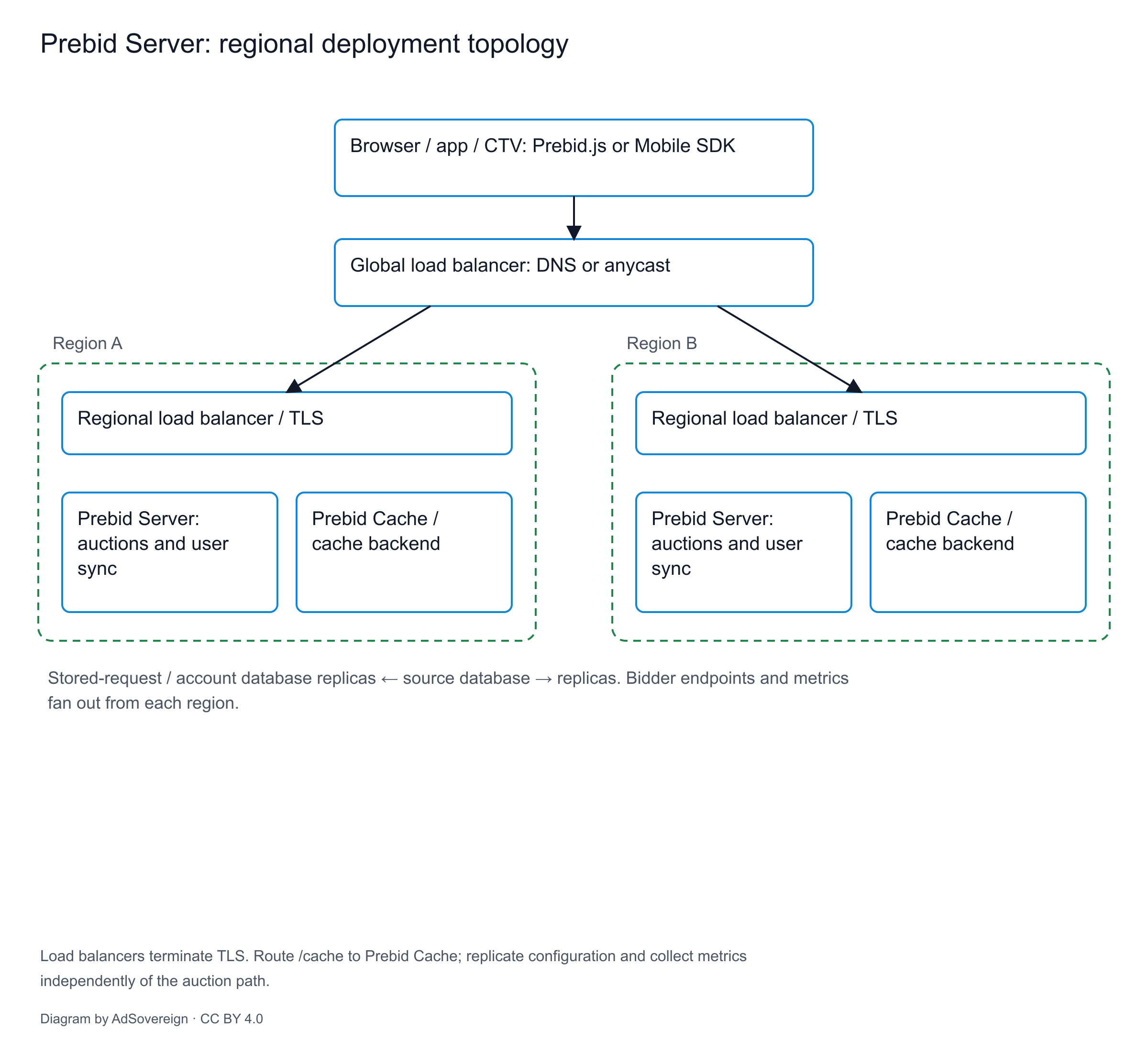
Evaluate the workflow
Publishers face a critical infrastructure decision: should programmatic auctions run in users' browsers (header bidding) or on remote servers (server-side bidding)? This guide breaks down the technical architecture, performance implications, and strategic trade-offs of each approach. Understanding how SSPs orchestrate these auctions, and how DMPs integrate for audience targeting, is essential for maximizing yield.
Client-Side Header Bidding Explained
Header bidding (also called pre-bid or advanced bidding) is a client-side auction mechanism where JavaScript code in the user's browser sends bid requests to multiple SSPs simultaneously before the ad server call. Prebid.js, the most widely adopted open-source header bidding wrapper, enables publishers to manage SSP partner integrations and auction timeouts in a standardized way.
How Header Bidding Works
Within the bidstream, SSPs receive bid requests from publishers, fan out to connected demand sources, and run unified auctions using first-price or second-price logic. On the supply side, OpenRTB defines how bid requests flow from SSPs to DSPs, including inventory characteristics, user signals, and floor pricing rules.
- User loads webpage → header bidding script executes in browser
- Each SSP conducts real-time auction among connected DSPs
- Winning bids return to browser with creatives
- Publisher's ad server selects highest bid (including direct deals)
- Winning creative renders on page
Popular frameworks: Prebid.js (open-source), Amazon TAM, Index Exchange Universal Header. In sophisticated setups, DMPs provide real-time audience segments directly to the SSP, enabling buyer-side targeting without exposing raw user data in the bidstream.
Advantages of Client-Side Header Bidding
- ✓ Transparency: Publishers see all bid responses and can audit performance
- ✓ Full auction participation: All SSPs compete equally (no bias)
- ✓ No intermediary fees: Direct browser-to-SSP connections
- ✓ Rich user data: First-party cookies, device signals available to all bidders
- ✓ Easy setup: Drop JavaScript tag, configure partners, launch
Disadvantages of Client-Side Header Bidding
- ✗ Browser resource consumption: CPU/memory impact on user experience
- ✗ Ad blocker vulnerability: Easier for blockers to detect client-side auction logic
- ✗ Cookie syncing overhead: Each SSP needs to match user IDs
Server-Side Bidding Explained
Server-side bidding moves the auction from the user's browser to a centralized server (usually publisher's or SSP's infrastructure). The browser makes one request to the server, which then orchestrates parallel auctions.
How Server-Side Bidding Works
- User loads webpage → lightweight JavaScript pings server-side endpoint
- Server receives request with user data (passed from client or server-enriched)
- SSPs conduct auctions and return bids to server
- Server selects winning bid and returns creative URL to browser
- Browser renders ad with minimal client-side processing
Popular platforms: Google Open Bidding, Amazon UAM (Unified Ad Marketplace), Prebid Server
Advantages of Server-Side Bidding
- ✓ Lower browser resource usage: No JavaScript bloat, better mobile performance
- ✓ Advanced optimization: Machine learning models can run server-side for bid prioritization
- ✓ Video & CTV friendly: Server-side auctions work better for long-form video and connected TV
Disadvantages of Server-Side Bidding
- ✗ Reduced transparency: Publishers see aggregated results, not individual SSP responses
- ✗ Limited user data: Some browser signals (device fingerprints, local storage) unavailable
- ✗ Setup complexity: Requires server infrastructure and ongoing maintenance
Performance Benchmarks: Latency, Page Load, Revenue
| Metric | Client-Side Header Bidding | Server-Side Bidding | Hybrid |
|---|---|---|---|
| Mobile performance | Fair (high CPU) | Excellent | Good |
| Setup complexity | Low | High | Medium |
Pros & Cons: Detailed 12-Factor Comparison
2. Revenue Maximization
Winner: Hybrid. Combines client-side data richness with server-side scale.
3. Transparency
Winner: Client-side. Publishers see every bid response in browser console.
4. Identity Resolution
Winner: Client-side. Direct access to first-party cookies and local storage.
Hybrid Approach: Best of Both Worlds
Leading publishers increasingly adopt hybrid configurations that combine client-side and server-side auctions:
Hybrid Architecture Strategy
- Dynamic routing: AI models decide per-impression whether to prioritize client-side (high-value users) or server-side (speed-critical)
- Unified auction: Combine client-side and server-side bids in single decisioning layer
Choosing the Right Approach for Your Traffic
Decision framework based on publisher characteristics:
Choose Client-Side Header Bidding If:
- • Privacy-first strategy (minimize data leakage to intermediaries)
Choose Server-Side Bidding If:
- • Video or CTV inventory (long-form, in-stream ads)
- • Page speed is critical (news, e-commerce, SEO-focused)
Choose Hybrid If:
- • Mixed traffic (desktop + mobile + video)
- • You want to maximize revenue without sacrificing UX
- • Engineering resources available to manage complexity
- • Enterprise publisher with sophisticated ad ops team
Optimize Your Bidding Strategy
Explore Bidding ArchitectureRead the current references
Read the publisher independence guide for the broader decision framework.
FAQ
Did Google have to sell AdX? No. On 2 September 2026 the court rejected the divestiture of AdX, the open-sourcing of DFP's auction logic and a contingent divestiture of the rest of DFP, and accepted the overlapping conduct remedies "as modified by this Court" (PPC Land, 2 September 2026). The opinion says the plaintiffs identified no viable buyer and that comparable migrations took five to eight years (NatLawReview, 18 September 2026).
When does Google have to open AdX to Prebid? The court accepted Google's commitment of 12 to 15 months for the Prebid integrations over the plaintiffs' 18, but the joint filing of 2 October 2026 still shows the plaintiffs asking for 6 months and Google for 12 for the AdX-to-Prebid adapter (Memorandum Opinion, Dkt. 1858, p. 58; PPC Land, 6 October 2026). The clock starts at the Effective Date, 60 days after a judgment that has not yet been entered.
Does the ruling cover video, CTV and in-app ads? No. The liability finding and the remedies concern open-web display. The data-portability remedy is confined to open-web display, with video and in-app excluded, and Digiday lists CTV, in-app and retail media publishers among the groups that gain nothing (PPC Land, 17 September 2026; Digiday, 18 September 2026).
Will the remedies apply in the EU? The judgment is worldwide; the court rejected Google's comity argument (Memorandum Opinion, Dkt. 1858, p. 104). Google has asked for up to 24 months to implement outside the US, which the plaintiffs oppose (AdExchanger, 5 October 2026). The European Commission's own case produced a €2.95 billion fine on 5 September 2025 and is under appeal (PPC Land, 17 September 2026).
Can Google appeal, and does an appeal pause the remedies? Google has said it disagrees with the liability ruling and will appeal once judgment is entered (Reuters via The Star, 17 September 2026). An appeal does not by itself pause the judgment; a stay would. Google's draft of the final judgment tolls the Effective Date during any stay ordered by the district court, the Fourth Circuit or the Supreme Court, which is one of the bracketed disputes (PPC Land, 6 October 2026).
How this works on owned infrastructure
AdSovereign provides an enterprise RTB stack for deployment inside a customer’s own infrastructure. Use the architecture to map the relevant components, the security controls to evaluate access and data boundaries, and the pilot to define a bounded evaluation. Compare the operating responsibilities and commercial terms against your own requirements. Infrastructure control does not establish demand access, legal permission or a measured performance improvement on its own.
Sources
- United States v. Google LLC, No. 1:23-cv-00108 (E.D. Va.), Memorandum Opinion, Document 1858, filed 2 September 2026, unsealed 16 September 2026 (106 pages; mirror hosted by Courthouse News). https://www.courthousenews.com/wp-content/uploads/2026/09/google-judge-memo.pdf
- PPC Land, "DOJ loses AdX divestiture bid as Brinkema accepts behavioral remedies" (2 September 2026). https://ppc.land/doj-loses-adx-divestiture-bid-as-brinkema-accepts-behavioral-remedies/
- PPC Land, "Judge spares Google's ad exchange and rewrites its auction rules instead" (3 September 2026). https://ppc.land/judge-spares-googles-ad-exchange-and-rewrites-its-auction-rules-instead/
- PPC Land, "Google faces six-year worldwide ad tech decree instead of AdX sale" (17 September 2026). https://ppc.land/google-faces-six-year-worldwide-ad-tech-decree-instead-of-adx-sale/
- PPC Land, "PubMatic CEO says Google needs up to 15 months to open AdX to Prebid" (17 September 2026). https://ppc.land/pubmatic-ceo-says-google-needs-up-to-15-months-to-open-adx-to-prebid/
- PPC Land, "Brinkema forces Google to honor all 19 fixes it drafted, Messer's tally shows" (27 September 2026). https://ppc.land/brinkema-forces-google-to-honor-all-19-fixes-it-drafted-messers-tally-shows/
- PPC Land, "DOJ seeks 6 months, Google 12, to open its ad exchange to rivals" (6 October 2026). https://ppc.land/doj-seeks-6-months-google-12-to-open-its-ad-exchange-to-rivals/
- AdExchanger, "The Court Just Unsealed Judge Brinkema's Remedies Decision in the Google Ad Tech Antitrust Case. Here's Your TL;DR" (16 September 2026, corrected 17 September 2026). https://www.adexchanger.com/platforms/the-court-just-unsealed-judge-brinkemas-remedies-decision-in-the-google-ad-tech-antitrust-case-heres-your-tldr/
- AdExchanger, "Google and the DOJ Filed Their Proposed Final Judgments in the Ad Tech Case. Here's What They're Still Arguing About" (5 October 2026). https://www.adexchanger.com/publishers/google-and-the-doj-filed-their-proposed-final-judgments-in-the-ad-tech-case-heres-what-theyre-still-arguing-about/
- Digiday, "Google's ad tech remedies decoded: what changes, what doesn't and what will take years" (17 September 2026). https://digiday.com/media-buying/googles-ad-tech-remedies-decoded-what-changes-what-doesnt-and-what-will-take-years/
- Digiday, "Who wins and loses from the remedies to Google's ad tech monopoly" (18 September 2026). https://digiday.com/media-buying/who-wins-and-loses-from-the-remedies-to-googles-ad-tech-monopoly/
- Digiday, "Publishers' scorecard on Google's ad tech remedies: they're progress, but far from a clean win" (23 September 2026). https://digiday.com/media/publishers-scorecard-on-googles-ad-tech-remedies-theyre-progress-but-far-from-a-clean-win/
- Tech Policy Press, "A Deep Dive into the Antitrust Remedies that Spared Google's Ad Tech Business" (20 September 2026). https://techpolicy.press/a-deep-dive-into-the-antitrust-remedies-that-spared-googles-ad-tech-business
- National Law Review (Chamber of Progress), "Court Declines to Order AdX Divestiture in Google Ad Tech Case" (18 September 2026). https://natlawreview.com/article/court-declines-order-adx-divestiture-google-ad-tech-case
- Courthouse News, "Google dodges antitrust breakup of ad tech business" (2 September 2026). https://www.courthousenews.com/google-dodges-antitrust-breakup-of-ad-tech-business/
- Reuters via The Star, "Google should relax ad tech rules, appoint antitrust monitor, US judge finds" (17 September 2026). https://www.thestar.com.my/tech/tech-news/2026/09/17/google-should-relax-ad-tech-rules-appoint-antitrust-monitor-us-judge-finds
- US Department of Justice, "Department of Justice Prevails in Landmark Antitrust Case Against Google" (17 April 2025). https://www.justice.gov/opa/pr/department-justice-prevails-landmark-antitrust-case-against-google
- ExchangeWire, "Digest: Court Unseals Google Ad Tech Remedies Decision; Taboola Acquires Rival" (21 September 2026). https://www.exchangewire.com/blog/2026/09/21/digest-court-unseals-google-ad-tech-remedies-decision-taboola-acquires-rival/
- The Current, "What Google's unsealed ad tech antitrust ruling reveals about AI, YouTube" (25 September 2026). https://www.thecurrent.com/ad-tech/google-ad-tech-decision-takeaways
- Playwire, "Behavioral remedies won't fix Google's ad tech grip" (15 September 2026; vendor commentary). https://www.playwire.com/blog/behavioral-remedies-wont-fix-googles-ad-tech-grip
- Prebid.org, "Untangling Google's Anticompetitive Tying: Overview of Remedies to Google's Ad Tech Dominance" (16 May 2025). https://prebid.org/untangling-googles-anticompetitive-tying-overview-of-remedies-to-googles-ad-tech-dominance/
- Google Ad Manager Help, "Data Transfer reports" (accessed 17 October 2026). https://support.google.com/admanager/answer/1733124
Changelog
October 18, 2026: aligned the approved search title and heading; retained the original publication date.
October 17, 2026: updated search phrasing, source-linked reference context, author and dates. Withheld numerical claims without inline sources.