
Publisher Independence
How to Switch Ad Servers Without Losing AdX Demand
Published · Last updated
Next scheduled review:
Keep a Google Ad Manager account as the AdX demand source while you migrate, move the auction to Prebid Server, run the new ad server in parallel with a holdout, and cut over when revenue per thousand requests matches. After the final judgment takes effect, Google must deliver AdX bids to Prebid and rival servers, which removes the dependency.
This playbook is written for open-web display publishers, because that is the only inventory the court order covers. If your revenue is video or CTV, the parallel-run and contract sections still apply, but the post-remedies path does not.
Key facts
- AdX is the demand you cannot drop. AdX handled 63% to 71% of worldwide open-web display transactions among the exchanges that produced data for the case between 2018 and 2022, about nine times its nearest rival's 6%, and charged a 20% take rate (Memorandum Opinion, Dkt. 1858, 2 September 2026, p. 26).
- Lack of AdX access is why ad server migrations failed. Equativ testified that the "main reason" it lost large publisher ad server clients to DFP was that they "didn't have access to Google AdX" (Memorandum Opinion, Dkt. 1858, p. 66).
- That dependency ends on a schedule. Google must build an AdX adapter for Prebid and send AdX bids to rival ad servers; the plaintiffs want 6 months from the Effective Date, Google wants 12, and Google's engineers estimate 12 to 15 months for the Prebid work (PPC Land, 6 October 2026; Memorandum Opinion, Dkt. 1858, p. 58).
- Your data has a 60-day life in Google's hands. Data Transfer files arrive hourly with 5 to 15 hours of latency and are purged after 60 days; the court-ordered export of configuration and historical data is due within 3 months of the Effective Date and free (Google Ad Manager Help, accessed 17 October 2026; PPC Land, 6 October 2026).
- Your baseline moves on 17 February 2027. Ad Manager stops counting unrendered display impressions on that date, with comparison data available from 12 August 2026 (PPC Land, 3 September 2026).
- Latency is a budget, not a feeling. Prebid.js sends Prebid Server a timeout of 75% of
bidderTimeoutor 750 ms, whichever is less, and Prebid.org recommends the server timeout sit 200 to 300 ms below the page timeout (Prebid.org, Prebid Server adapter docs, accessed 17 October 2026).
Definition
Ad server migration: moving the decisioning, trafficking and reporting of a publisher's advertising from one ad server to another, while keeping the demand sources (direct campaigns, exchanges, header bidding partners) connected and the revenue per request unchanged. An AdX-safe migration is one in which Google's exchange keeps bidding on every impression throughout.
Why AdX is the constraint
Until the court order is in force, there is exactly one way to receive an AdX bid: through a Google Ad Manager account. Google's contractual and technical tie between DFP and AdX was the conduct the court found unlawful, and the opinion records that Google refused to give rival ad servers or Prebid real-time access to AdX bids (Memorandum Opinion, Dkt. 1858, pp. 1 and 66). A publisher who switched servers before the order therefore had to route the new server's remnant impressions back into a Google Ad Manager account so that AdX could bid on them, which added a hop, a second auction and a second set of fees. That is why most migrations stopped at "run a second server for direct and keep GAM for programmatic."
The order changes the mechanics in three places. First, Google must build an API so Prebid can solicit real-time AdX bids for all indirect open-web display inventory, "functionally equivalent" and on "materially identical terms" to the way DFP solicits them, with no added latency (Memorandum Opinion, Dkt. 1858, p. 62). Second, AdX must submit real-time bids to non-Google publisher ad servers for all indirect demand (PPC Land, 6 October 2026). Third, Google must build tools that let a publisher choose AdX via Prebid or via DFP, not both, and may not vary revenue share, latency, response rate or information by which path you use (PPC Land, 17 September 2026; Memorandum Opinion, Dkt. 1858, p. 74). The deadlines, and which of them are still disputed, are tracked in Google ad tech remedies explained for publishers.

Diagram by AdSovereign, CC BY 4.0.
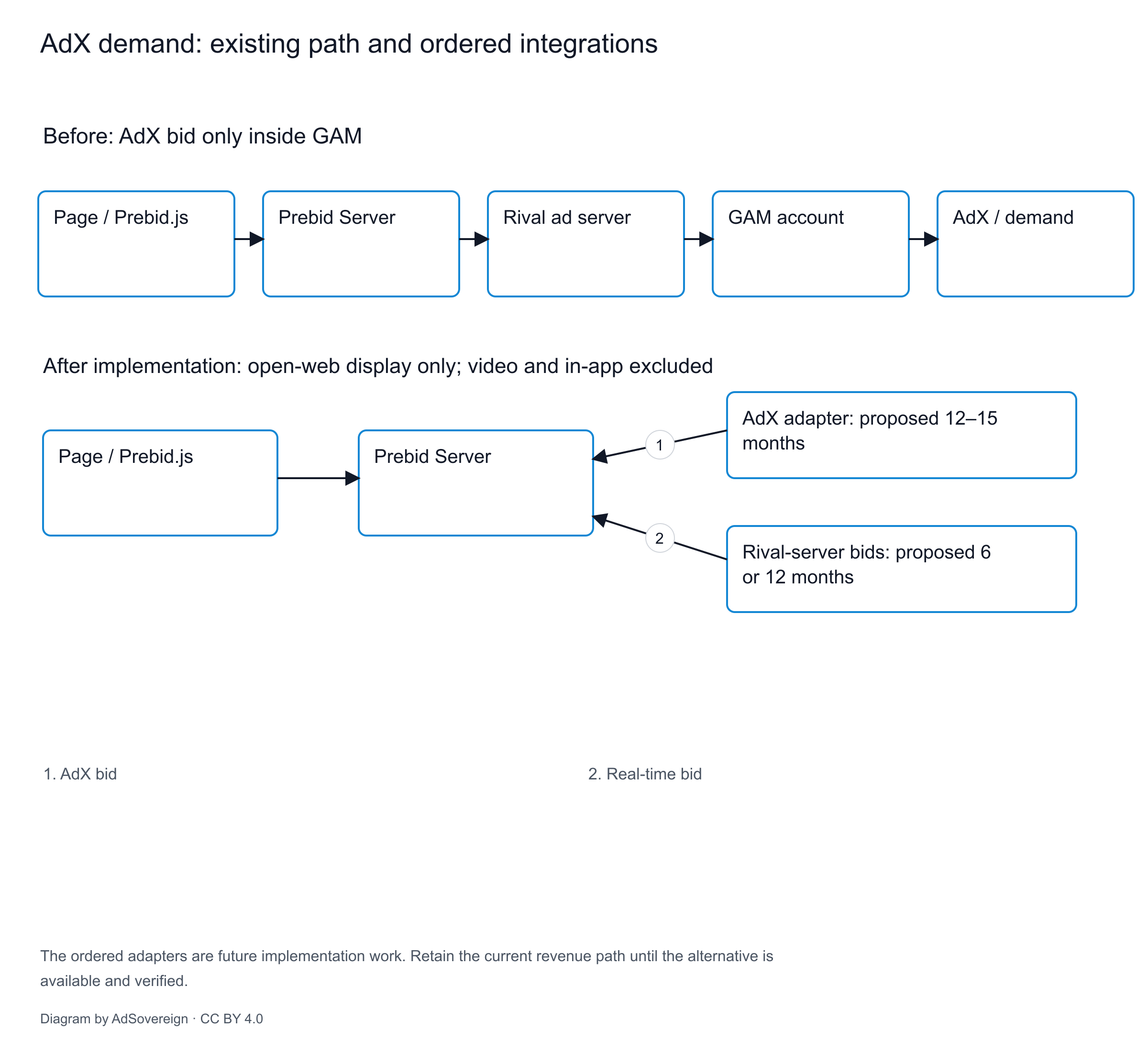
Two paths: before and after the Effective Date
7 of 7 rows
Download JSONTable by AdSovereign, CC BY 4.0.
Where the AdX bid enters | Only inside a Google Ad Manager account | Prebid Server (AdX adapter) or the rival ad server directly (PPC Land, 6 Oct 2026) |
Role of GAM during migration | Stays live as the AdX demand source; new server handles direct and header bidding, with remnant passed to GAM | Optional; can be retired for open-web display once the adapter is live |
Direct and programmatic direct | Stay in GAM or move to the new server; programmatic guaranteed stays in GAM | Programmatic guaranteed and preferred deals routable through Prebid at 15 months (PPC Land, 6 Oct 2026) |
Data | Data Transfer (paid, 60-day purge) and Ad Manager API exports (Google Help) | Free configuration and historical export within 3 months; AdX win-and-loss bid data and 7-day auction file within 12 months (PPC Land, 6 Oct 2026) |
Contract | Bundled AdX and DFP terms | Separate contracts from 6 months; written notice that the bundle is optional within 3 months (PPC Land, 6 Oct 2026) |
Fees on the AdX path | 20% AdX take rate, plus any second-hop cost (Dkt. 1858, p. 4) | AdX revenue share may not vary by path (Dkt. 1858, p. 74) |
Video, CTV, in-app | Unchanged | Unchanged: excluded from the order (PPC Land, 17 Sep 2026) |
Decision rule. If you can wait, do the preparation steps (1 to 7 below) now and the cutover steps (8 to 12) after the AdX adapter ships; that avoids the second hop entirely. If you cannot wait, because a contract ends, a vendor is closing, or the second-hop cost is already being paid, run the pre-remedies path with GAM kept as an AdX-only network, and plan the switch of the AdX feed as a second project. Either way the auction should move to Prebid Server first, because that is where the AdX adapter will land; the options are in the Prebid Server self-hosting guide and the server candidates in Google Ad Manager alternatives.
The 12 migration steps
- Measure the dependency. From Data Transfer or Ad Manager reports, split the last 90 days of revenue by path (AdX via DFP, Open Bidding, Prebid, direct, programmatic guaranteed), by format and by geography. Only the open-web display rows are affected by the order (PPC Land, 17 September 2026). Record revenue per thousand ad requests (RPM on requests, not impressions) as the metric you will protect; impression-based RPM will shift on 17 February 2027 when Google changes its counting (PPC Land, 3 September 2026).
- Freeze and export the configuration. Pull ad units, key-values, line items, creatives, deals, floors and yield groups through the Ad Manager API; the current version is v202608 (Google Ad Manager API release notes, accessed 17 October 2026). Store the export outside Google, because Data Transfer files older than 60 days are deleted (Google Ad Manager Help, accessed 17 October 2026). When the court-ordered export becomes available (3 months after the Effective Date), request it too; the two sides still disagree on whether "considering or evaluating" a rival server is enough to trigger it (AdExchanger, 5 October 2026).
- Stand up Prebid Server. Self-hosted or managed; the AdX adapter Google must build will land in Prebid Server, and the DFP-to-Prebid-Server link lets you keep GAM in the loop while the auction moves (PPC Land, 6 October 2026). Configure stored requests so ad-unit definitions live in your database rather than in a tag; the mechanics are in the self-hosting guide.
- Shortlist and contract the target ad server. Use the catalog in Google Ad Manager alternatives. Make the vendor's dated plan for receiving AdX bids a scored RFP item; none had announced one as of 17 October 2026. The contract clauses are in the section below.
- Rebuild the direct business on the new server. Recreate ad units and key-values one-to-one from the step 2 export so that targeting on both servers stays identical during the parallel run. Programmatic guaranteed stays in GAM until the 15-month Prebid link exists (PPC Land, 6 October 2026).
- Keep an AdX-only Google Ad Manager network. Strip the GAM account down to the line items that call AdX and Open Bidding. Under the order, Google must send you written notice within 3 months that the bundle is optional and offer separate contracts from 6 months, so ask for an AdX-only agreement as soon as the notice arrives (PPC Land, 6 October 2026).
- Update the supply chain files. Every new path adds lines: the new ad server or its SSP in ads.txt, your seller IDs in the partners' sellers.json, and new nodes in the SupplyChain object. The
seller_idin sellers.json must match the ID in ads.txt and thesidin the chain, and each ID may map to only one legal entity (IAB Tech Lab, sellers.json 1.0). Validate before go-live with the ads.txt and sellers.json validator; Google says file changes take "a few days" and up to a month on low-traffic sites to be reflected (Google AdSense Help, accessed 17 October 2026). - Design the parallel run and holdout. See the next section. Decide the split, the metric, the duration and the stop rule before any traffic moves.
- Run the parallel period. Serve the test slice from the new server with Prebid Server as the auction and GAM as the AdX source (pre-remedies) or with the AdX adapter (post-remedies). Compare request RPM, fill, latency and discrepancy daily.
- Cut over in stages. Move inventory by ad unit or section, not all at once; keep the ability to route a slice back to GAM. After the order, Google's routing tools must let you choose AdX via Prebid or via DFP per slice (PPC Land, 17 September 2026).
- Decommission. Retire GAM line items only after a full billing cycle of parity. Keep the AdX-only network until the AdX adapter has run cleanly for a cycle, then decide whether GAM has any remaining role (for example video, which the order does not cover).
- Audit. When the AdX win-and-loss bid data and the per-ad decision file arrive (12 months after the Effective Date), reconcile them against your own logs and the new server's logs; that is the first time you can test whether AdX bid the same way through each path (PPC Land, 6 October 2026). The warehouse design for this is in first-party data strategy for publishers.
Parallel-run and holdout test design
A parallel run answers "does the new stack work." A holdout answers "does it pay." You need both, and they should not share a control group.
Unit of randomisation. Split by user (a hashed cookie or first-party ID bucket) when you can, because it keeps frequency and session effects balanced; split by ad unit or section when the page template cannot carry two tags; split by geography only as a last resort, because demand differs by country. Prebid Server's floors module exposes a skipRate that bypasses floor signalling on a sampled share of requests "for A/B testing," which is a ready-made sampling hook if floors are part of the change (Prebid.org, Prebid Server floors, accessed 17 October 2026).
Primary metric. Revenue per thousand ad requests, net of all fees on the path. Impression RPM hides fill and will be distorted by Google's render-based counting change on 17 February 2027 (PPC Land, 3 September 2026). Secondary metrics: fill rate, bid rate and win rate by bidder, time to first ad, viewability, discrepancy between server and partner counts, and page weight.
Latency guardrail. Set the Prebid Server timeout 200 to 300 ms below the Prebid.js timeout, and hold the new path to the same page timeout as the old one; a stack that wins on RPM by waiting longer for bids is not a like-for-like winner (Prebid.org, Prebid Server adapter docs, accessed 17 October 2026). The background on QPS and bid latency is in QPS, latency and bid performance.
Duration and confounders. Run across at least one full weekly cycle and avoid known shocks: the 17 February 2027 counting change, seasonal campaign starts, and any Google change to the AdX path during implementation. Log the dates of every configuration change on both stacks. If the test straddles the Effective Date, treat pre- and post-period data separately, because Google's own obligations (floors, UPR, non-discrimination) change the control.
Stop rules. Decide in advance the loss you will tolerate on the test slice and for how long; a pre-agreed rule is what makes a parallel run defensible to finance. Decide also what "parity" means: for most publishers it is request RPM within the week-to-week noise you already see in the control, measured over the full cycle.
What to do with the result. Parity or better on open-web display: extend the slice and continue the cutover. A gap in RPM with equal latency: look first at bidder coverage (which exchanges and deals are missing on the new path), then at floors, then at creative and discrepancy. A gap caused by AdX bidding differently through the new path after the Effective Date is a non-discrimination issue; the Monitor reports quarterly and Google must respond to a complaint within at least 30 days before the court is involved (Memorandum Opinion, Dkt. 1858, p. 90; AdExchanger, 5 October 2026). A worked example of a demand-path change measured this way is in case: publisher fill rate +20%.
Risk register
12 of 12 rows
Download JSONTable by AdSovereign, CC BY 4.0.
1 | AdX demand gap during the pre-remedies path because the second hop into GAM loses bids or adds fees | High | High | Keep GAM live as an AdX-only network; defer cutover of the AdX feed until the adapter ships | |
2 | Google ships the Prebid adapter late or in a degraded form | Medium | High | The order requires functional equivalence, identical terms and no added latency; document gaps for the Monitor | |
3 | The court picks 12 months rather than 6 for AdX-to-rival-server access | Open | Medium | Plan on 12; treat 6 as upside | |
4 | A stay pending appeal delays the Effective Date | Medium | High | Google's draft tolls the Effective Date during any stay; keep the pre-remedies path viable | |
5 | Configuration and historical data lost because Data Transfer purges after 60 days | High if unmanaged | Medium | Export before you start; store outside Google | |
6 | Baseline shift from render-based impression counting on 17 Feb 2027 | Certain | Medium | Use request RPM; build the correction from the 12 Aug 2026 baseline | |
7 | ads.txt or sellers.json errors block the new path | Medium | High | Validate before launch; allow days to a month for crawlers | |
8 | Latency increase from an extra server hop | Medium | Medium | Hold the page timeout constant; server timeout 200 to 300 ms below it | |
9 | Direct campaigns under-deliver during the split | Medium | High | Mirror line items on both servers; move guaranteed last; PG via Prebid only at 15 months | |
10 | The new vendor closes or is acquired | Low per vendor, real in aggregate | High | Portability and exit clauses; Microsoft Invest closed 28 Feb 2026 nine months after announcement | |
11 | Consent and privacy signals handled differently on the new path | Medium | High in the EU | Test TCF 2.2 strings end to end; Prebid Server gates cookie sync and auctions on TCF purposes | |
12 | Video and CTV revenue assumed to follow display | Medium | High for mixed publishers | Scope the project to open-web display; video stays where it is |
Checklist
Before you start
- Revenue split by path, format and geography for 90 days, with request RPM as the baseline.
- Full configuration export via the Ad Manager API, stored outside Google.
- Data Transfer or equivalent event-level logs retained beyond 60 days.
- Prebid Server environment live, with stored requests mirroring the GAM ad units.
- Target ad server contracted with the clauses below.
- Test design signed off by revenue, engineering and finance, including stop rules.
- ads.txt, app-ads.txt and sellers.json updated and validated.
During the parallel run
- Daily comparison of request RPM, fill, latency, discrepancy and viewability by slice.
- Change log for every configuration change on both stacks.
- Weekly review against stop rules.
- Consent-string tests on EU traffic.
- Direct campaign delivery monitored on both servers.
After cutover
- One full billing cycle of parity before retiring GAM line items.
- AdX-only GAM network retained until the AdX adapter has run for a cycle.
- Court-ordered data (export, bid data, auction file) requested on each deadline and reconciled.
- Supply chain files re-validated after decommissioning.
- Post-migration audit written up for the Monitor if any discrimination was observed.
What to put in the contracts
With Google (Ad Manager and AdX). Ask for the separate AdX contract as soon as the written notice arrives; under the order the bundle must be declared optional within 3 months and separate contracts offered from 6 months after the Effective Date (PPC Land, 6 October 2026). Have the AdX revenue share stated as a number that does not depend on the ad server or on Prebid; the order prohibits varying share, latency, response rate or information by path, and Google's own draft adds "insofar as technically possible," so write the parity into your agreement rather than relying on the decree (Memorandum Opinion, Dkt. 1858, p. 74; PPC Land, 6 October 2026). Add a data clause covering the court-ordered exports and bid files, with formats and delivery cadence.
With the new ad server vendor. A dated commitment to receive AdX bids under the order, with a remedy if it slips. A latency service level for the auction call. Full log-level data access, in a format you can load, at no extra charge or at a stated price. A portability clause: configuration and historical data exportable at any time in a documented schema, and for a stated period after termination. An exit clause with notice that is longer than your migration time; Microsoft announced the closure of Microsoft Invest on 14 May 2025 for 28 February 2026, nine months later, which is a reasonable floor for notice (PPC Land, 22 June 2025). Pricing that does not depend on which demand you route through the vendor's own exchange, because the three largest CTV ad servers are owned by companies that also sell demand (PPC Land, 5 November 2025).
With a managed Prebid Server host. The same data and portability clauses; a statement of which bidders are enabled by default and who sees the bid stream; cookie-sync behavior and host-domain ownership, since the uids cookie is set on the host's domain (Prebid.org, cookie sync, accessed 17 October 2026); and the right to move to self-hosting with your stored requests and account configuration. The hosting choices are compared in the Prebid Server self-hosting guide, and the EU consent requirements for any new processor are in GDPR, ePrivacy and the bidstream.
With your exchanges and deal partners. Confirm that deal IDs, private marketplace and programmatic guaranteed deals are re-papered to the new seat before cutover; running deals on an owned exchange is covered in the private ad exchange setup guide. The broader comparison of client-side, server-side and Open Bidding paths is in header bidding vs server-side bidding, and the hub for this direction is publisher independence.
FAQ
Can I use AdX without Google Ad Manager? Not today. AdX bids are available only inside a Google Ad Manager account, which is the tie the court found unlawful (Memorandum Opinion, Dkt. 1858, p. 1). After the final judgment's Effective Date, Google must deliver AdX bids to Prebid (Google's estimate 12 to 15 months) and to rival ad servers (6 or 12 months, still disputed) for open-web display (PPC Land, 6 October 2026). Until then, keep an AdX-only Ad Manager network.
How long does an ad server migration take? The order's own timetable is the best public benchmark: data export at 3 months, separate contracts and Header Bidding Trafficking at 6 months, Prebid links at 12 and 15 months after the Effective Date (PPC Land, 6 October 2026). The court also noted that comparable migrations in past cases took five to eight years, which is why it preferred conduct remedies (NatLawReview, 18 September 2026). Plan the preparation now and the cutover around the adapter's arrival.
Will I lose revenue when I switch ad servers? You will if AdX stops bidding on the migrated inventory, which is what happened to rival ad servers' clients before the order (Memorandum Opinion, Dkt. 1858, p. 66). The holdout design above exists to detect that early on a small slice. Digiday's sources expect publisher revenue to rise once AdX competes inside Prebid auctions, but "cautiously," and not for more than a year (Digiday, 18 September 2026; Digiday, 17 September 2026).
Should I wait for the remedies before switching? Do the preparation now (export, Prebid Server, vendor contract, supply chain files, test design) and the AdX cutover after the adapter ships. Scott Messer's tally shows the cheap obligations (notices, export) at 3 months and the four high-value ones at about a year (PPC Land, 27 September 2026). Waiting entirely means a year of no preparation; switching entirely now means paying the second hop.
What happens to my direct-sold campaigns? They move to the new server on your schedule; the order does not touch non-programmatic direct deals. Programmatic guaranteed and preferred deals can be routed through Prebid only once the second DFP-to-Prebid link exists, 15 months after the Effective Date (PPC Land, 6 October 2026). Until then keep them in Ad Manager or re-paper them on the new server's seat.
How this works on owned infrastructure
The playbook assumes three things you control: the Prebid Server that receives AdX bids, the ad server that decides between direct and programmatic, and the log store where the court-ordered bid files meet your own request logs. AdSovereign is an enterprise RTB stack that runs all three on the publisher's own infrastructure or sovereign cloud, so the holdout, the parallel run and the post-migration audit are measured from one dataset rather than three vendor reports. The architecture page shows the components, security covers data handling, the TCO page sets out the cost model, the migration playbook is the product-side companion to this article, and the pilot page describes a 60-day parallel run beside Google Ad Manager. This article stays neutral; the product is mentioned only here.
Sources
- United States v. Google LLC, No. 1:23-cv-00108 (E.D. Va.), Memorandum Opinion, Dkt. 1858 (2 September 2026, unsealed 16 September 2026). https://www.courthousenews.com/wp-content/uploads/2026/09/google-judge-memo.pdf
- PPC Land, "DOJ seeks 6 months, Google 12, to open its ad exchange to rivals" (6 October 2026). https://ppc.land/doj-seeks-6-months-google-12-to-open-its-ad-exchange-to-rivals/
- PPC Land, "Google faces six-year worldwide ad tech decree instead of AdX sale" (17 September 2026). https://ppc.land/google-faces-six-year-worldwide-ad-tech-decree-instead-of-adx-sale/
- PPC Land, "Judge spares Google's ad exchange and rewrites its auction rules instead" (3 September 2026). https://ppc.land/judge-spares-googles-ad-exchange-and-rewrites-its-auction-rules-instead/
- PPC Land, "Brinkema forces Google to honor all 19 fixes it drafted, Messer's tally shows" (27 September 2026). https://ppc.land/brinkema-forces-google-to-honor-all-19-fixes-it-drafted-messers-tally-shows/
- PPC Land, "Microsoft's Xandr DSP closure opens doors for independent players" (22 June 2025). https://ppc.land/microsofts-xandr-dsp-closure-opens-doors-for-independent-players/
- PPC Land, "Seven video ad servers compete for dominance in 2025 CTV marketplace" (5 November 2025). https://ppc.land/seven-video-ad-servers-compete-for-dominance-in-2025-ctv-marketplace/
- AdExchanger, "Google and the DOJ Filed Their Proposed Final Judgments in the Ad Tech Case" (5 October 2026). https://www.adexchanger.com/publishers/google-and-the-doj-filed-their-proposed-final-judgments-in-the-ad-tech-case-heres-what-theyre-still-arguing-about/
- Digiday, "Google's ad tech remedies decoded" (17 September 2026). https://digiday.com/media-buying/googles-ad-tech-remedies-decoded-what-changes-what-doesnt-and-what-will-take-years/
- Digiday, "Who wins and loses from the remedies to Google's ad tech monopoly" (18 September 2026). https://digiday.com/media-buying/who-wins-and-loses-from-the-remedies-to-googles-ad-tech-monopoly/
- National Law Review (Chamber of Progress), "Court Declines to Order AdX Divestiture in Google Ad Tech Case" (18 September 2026). https://natlawreview.com/article/court-declines-order-adx-divestiture-google-ad-tech-case
- Google Ad Manager Help, "Data Transfer reports" (accessed 17 October 2026). https://support.google.com/admanager/answer/1733124
- Google Ad Manager API, release notes (v202608 current; accessed 17 October 2026). https://developers.google.com/ad-manager/api/rel_notes
- Google AdSense Help, "ads.txt guide" (accessed 17 October 2026). https://support.google.com/adsense/answer/7532444
- Prebid.org, "Prebid Server adapter (s2sConfig)" (accessed 17 October 2026). https://docs.prebid.org/dev-docs/modules/prebidServer.html
- Prebid.org, "Prebid Server price floors" (accessed 17 October 2026). https://docs.prebid.org/prebid-server/features/pbs-floors.html
- Prebid.org, "Prebid Server privacy features" (accessed 17 October 2026). https://docs.prebid.org/prebid-server/features/pbs-privacy.html
- Prebid.org, "Prebid Server cookie sync" (accessed 17 October 2026). https://docs.prebid.org/prebid-server/developers/pbs-cookie-sync.html
- IAB Tech Lab, sellers.json specification 1.0 (July 2019). https://iabtechlab.com/wp-content/uploads/2019/07/Sellers.json_Final.pdf