
Publisher Independence
First-Party Data Strategy for Publishers: 2026 Guide
Published · Last updated
Next scheduled review:
A publisher’s first-party data strategy starts with a useful reader relationship and permission to use the resulting information. Separate collection, audience building, activation and measurement. Document which signals may leave your systems, how long they remain useful, and how readers can change their preferences.
Key facts
- Cookies stayed. On 22 April 2025 Google said it would "maintain our current approach to offering users third-party cookie choice in Chrome" and would not roll out a standalone prompt (Privacy Sandbox blog, 22 April 2025).
- The APIs went. On 17 October 2025 Google retired ten Privacy Sandbox technologies "in light of their low levels of adoption", keeping CHIPS, FedCM and Private State Tokens (Privacy Sandbox blog, 17 October 2025).
- Deprecation landed in Chrome 144, removal is set for Chrome 150. The blink-dev intent for Topics was filed on 7 November 2025 and approved on 12 November with a six-milestone window; a June 2026 update reported deprecation in Chrome 144, removal planned for Chrome 150 and usage at 4.9% of page loads (blink-dev, Intent to Deprecate and Remove: Topics API). Chrome 144 reached stable on 13 January 2026 and Chrome 150 on 30 June 2026 (Chromium Dash, M144; M150).
- The UK regulator closed its case. The CMA released Google's Privacy Sandbox commitments on 17 October 2025, concluding its competition concerns no longer arise (CMA case page).
- Two browsers already block. Safari has blocked all third-party cookies by default since 24 March 2020 (WebKit, 24 March 2020); Firefox has partitioned them by default since 14 June 2022 (Mozilla, 14 June 2022). Together they held 21.07% of worldwide browser share in September 2026 against Chrome's 66.36% (StatCounter, September 2026).
- Consent strings are personal data. The CJEU ruled on 7 March 2024 that a TC String is personal data when it can be linked to an IP address (CJEU C-604/22), which frames every identity solution in this page.
Definition
A publisher first-party data strategy defines how information from its direct reader relationships is collected, governed, activated and measured for specified purposes.

Diagram by AdSovereign, CC BY 4.0.
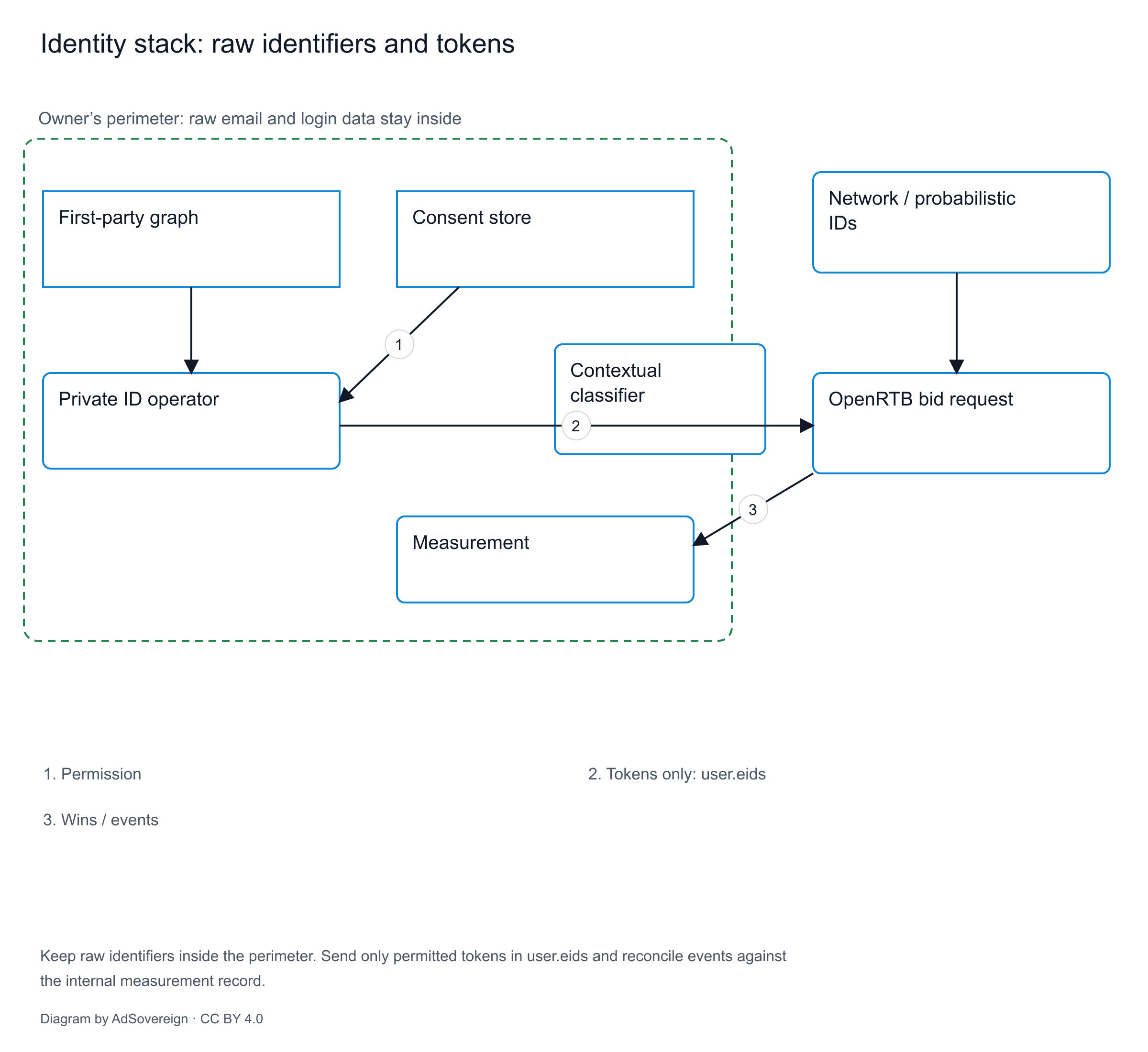
Evaluate the workflow
What is First-Party Data?
First-party data is information publishers collect directly from their audience through owned properties (websites, apps, newsletters). It includes:
Identity Data
- • Email address
- • Name, age, gender
- • Location (city, state)
- • Phone number
- • Account username
Behavioral Data
- • Pages viewed
- • Articles read (topics)
- • Video watch time
- • Search queries
- • Time on site
Intent/Preference Data
- • Newsletter subscriptions
- • Content preferences
- • Purchase history
- • Survey responses
- • App usage patterns
Key distinction: First-party data is collected with user consent directly from your properties. Third-party data is purchased from data brokers (cookies from other sites). Only first-party data survives privacy regulations.
Data Collection Methods: Registration, Subscriptions, Surveys
Publishers use these proven tactics to motivate users to share data:
1. Registration Walls (Gated Content)
Require email + basic profile data to access premium content (e.g., NYT, WSJ model).
- • Data captured: Email, name, age, interests
- • Value exchange: User gets unlimited articles, newsletters, or ad-free experience
2. Newsletter Subscriptions
Offer daily/weekly email digests in exchange for email + preferences.
- • Data captured: Email, topic interests (e.g., "Send me tech news, not politics")
- • Value exchange: Curated content delivered to inbox (saves user time)
3. Interactive Tools & Quizzes
Offer personalized results (e.g., "What type of investor are you?") in exchange for email + profile data.
- • Data captured: Email + psychographic data (risk tolerance, preferences, lifestyle)
- • Value exchange: Personalized insights or recommendations
- • Best practice: Partner with brands for sponsored quizzes (they pay for data)
4. Loyalty Programs & Rewards
Gamify engagement, users earn points for reading, commenting, or referring friends.
- • Data captured: Granular activity data (which articles, how long, comments)
- • Value exchange: Redeem points for premium content, event tickets, or swag
- • Best practice: Require loyalty signup for exclusive content or community access
5. Surveys & Feedback Forms
Ask users about preferences, purchasing plans, or opinions on topics.
Building Audience Segments from First-Party Data
| Segment Type | Definition | CPM Premium | Example |
|---|
Monetization Strategies: PMPs, Direct Deals, Data Clean Rooms
Publishers monetize first-party data through three primary channels:
1. Private Marketplaces
Sell audience-targeted inventory via programmatic deals
- • Method: Create PMP deal IDs tied to first-party segments
2. Direct Brand Partnerships
License audience segments directly to advertisers for activation
- • Method: Brand pays for access to "in-market auto buyers" segment
3. Data Clean Rooms
Privacy-safe data collaboration with advertisers (no raw data shared)
- • Method: Advertiser uploads CRM → clean room matches → aggregated insights
Identity Resolution Without Cookies
To track users across sessions and devices, publishers need identity resolution strategies that don't rely on third-party cookies. Identity resolution systems within DMPs match records across sources using deterministic (email, device ID) and probabilistic models, creating unified user profiles for cross-channel targeting.
Authenticated User IDs (Primary Strategy)
When users log in, publisher assigns persistent first-party ID stored in first-party cookie or local storage.
- • Durability: Works across sessions, browsers (if user logs in)
UID2
- • Adoption: Supported by Trade Desk, LiveRamp, major publishers. DMPs sync segments to multiple DSPs simultaneously, ensuring consistent audience targeting across demand sources.
Contextual + Cohort Targeting
For anonymous users, fall back to privacy-safe contextual signals (page content, time, location) or cohorts (groups of similar users).
- • Contextual: "User reading sports article" → serve sports betting ads
- • Cohorts (Google Topics API): "User in 'auto enthusiasts' cohort" (no individual tracking)
Build Your First-Party Data Infrastructure
Explore DMP FeaturesRead the current references
Read the publisher independence guide for the broader decision framework.
FAQ
Is Google still getting rid of third-party cookies? No. On 22 April 2025 Google said Chrome would keep its current third-party cookie settings and would not introduce a standalone prompt (Privacy Sandbox blog, 22 April 2025). The CMA released Google's commitments on 17 October 2025 and closed its case (CMA). Incognito still blocks third-party cookies, and users can block them in settings.
What Privacy Sandbox APIs still exist? CHIPS (partitioned cookies, Chrome 114+), FedCM (Chrome 108+) and Private State Tokens continue; the Storage Access API (Chrome 119+) is also supported. Topics, Protected Audience, Attribution Reporting, Private Aggregation, Shared Storage, SelectURL and Related Website Sets were retired on 17 October 2025, deprecated in Chrome 144 (13 January 2026) and set for removal in Chrome 150 (30 June 2026) (Privacy Sandbox status page, updated 14 August 2026; Chromium Dash).
What is the difference between UID2 and EUID? Both are open-source frameworks that turn a hashed email or phone into a rotating token, and both have a public operator run by The Trade Desk plus a private-operator option. UID2's consent model follows US state law such as the CCPA; EUID's is "driven by the General Data Protection Regulation" and the IAB TCF, with a Transparency and Control Portal for opt-out, and it uses a separate namespace (EUID docs). EU and UK publishers use EUID.
Is ID5 better than UID2?
They are different tools. UID2 and EUID are deterministic and need an email or phone, so they work on authenticated traffic. ID5 links publisher signals and hashed emails where present with probabilistic methods, so it reaches unauthenticated pages; Sincera counted it on about 100,000 sites in January 2025, a vendor-selected figure (PPC Land, 22 August 2026). Most stacks pass both in user.eids and let the bidder weigh them.
Do universal IDs comply with GDPR? They can, if the controller has a lawful basis for the hashed identifier and the token, passes a valid TCF signal, and can prove it. The CJEU held on 7 March 2024 that a consent string is itself personal data (CJEU C-604/22), and the Norwegian DPA's October 2026 Xandr decision found that a platform cannot rely on another party's consent (EDPB, 16 October 2026). Compliance is a property of your consent records and contracts, not of the ID format.
How this works on owned infrastructure
AdSovereign provides an enterprise RTB stack for deployment inside a customer’s own infrastructure. Use the architecture to map the relevant components, the security controls to evaluate access and data boundaries, and the pilot to define a bounded evaluation. Compare the operating responsibilities and commercial terms against your own requirements. Infrastructure control does not establish demand access, legal permission or a measured performance improvement on its own.
Sources
- Chromium Blog, "Building a more private web: A path towards making third party cookies obsolete" (14 January 2020). https://blog.chromium.org/2020/01/building-more-private-web-path-towards.html
- Google, "An updated timeline for Privacy Sandbox milestones" (24 June 2021). https://blog.google/products/chrome/updated-timeline-privacy-sandbox-milestones/
- Google, "Expanding testing for the Privacy Sandbox for the Web" (27 July 2022). https://blog.google/products/chrome/update-testing-privacy-sandbox-web/
- Google, "The next step toward phasing out third-party cookies in Chrome" (14 December 2023). https://blog.google/products/chrome/privacy-sandbox-tracking-protection/
- Privacy Sandbox, "Update on the plan for phase-out of third-party cookies on Chrome" (23 April 2024). https://privacysandbox.google.com/blog/update-on-the-plan-for-phase-out-of-third-party-cookies-on-chrome
- Privacy Sandbox, "A new path for Privacy Sandbox on the web" (22 July 2024). https://privacysandbox.google.com/blog/privacy-sandbox-update
- Privacy Sandbox, "Next steps for Privacy Sandbox and tracking protections in Chrome" (22 April 2025). https://privacysandbox.google.com/blog/privacy-sandbox-next-steps
- Privacy Sandbox, "Update on Plans for Privacy Sandbox Technologies" (17 October 2025). https://privacysandbox.google.com/blog/update-on-plans-for-privacy-sandbox-technologies
- Privacy Sandbox, "Feature status" (last updated 14 August 2026). https://privacysandbox.google.com/overview/status
- blink-dev, "Intent to Deprecate and Remove: Topics API" (7 November 2025; LGTM 12 November 2025; status update 11 June 2026). https://groups.google.com/a/chromium.org/g/blink-dev/c/_R85yctz4Rs
- Chromium Dash, milestone schedule M144 (stable 13 January 2026). https://chromiumdash.appspot.com/fetch_milestone_schedule?mstone=144
- Chromium Dash, milestone schedule M150 (stable 30 June 2026). https://chromiumdash.appspot.com/fetch_milestone_schedule?mstone=150
- UK Competition and Markets Authority, "Investigation into Google's Privacy Sandbox browser changes" (case page; commitments released 17 October 2025). https://www.gov.uk/cma-cases/investigation-into-googles-privacy-sandbox-browser-changes
- PPC Land, "Chrome kills most Privacy Sandbox technologies after adoption fails" (18 October 2025). https://ppc.land/chrome-kills-most-privacy-sandbox-technologies-after-adoption-fails/
- WebKit, "Full Third-Party Cookie Blocking and More" (24 March 2020). https://webkit.org/blog/10218/full-third-party-cookie-blocking-and-more/
- Mozilla, "Firefox rolls out Total Cookie Protection by default to all users worldwide" (14 June 2022). https://blog.mozilla.org/en/mozilla/firefox-rolls-out-total-cookie-protection-by-default-to-all-users/
- StatCounter, "Browser Market Share Worldwide" (September 2026). https://gs.statcounter.com/browser-market-share
- Apple Developer, "User Privacy and Data Use" (App Tracking Transparency). https://developer.apple.com/app-store/user-privacy-and-data-use/
- UID2 documentation, "Public and Private Operators". https://unifiedid.com/docs/ref-info/ref-operators-public-private
- UID2, homepage with partner announcements (2022 to 2025). https://unifiedid.com/
- EUID documentation, "EUID Overview" (last updated 12 October 2026). https://euid.eu/docs/intro
- EUID documentation, "Public and Private Operators". https://euid.eu/docs/ref-info/ref-operators-public-private
- The Current, "EUID adoption spreads across the programmatic supply chain" (25 November 2024). https://www.thecurrent.com/marketing/euid-adoption-programmatic-supply-chain-ssps-publishers
- AdExchanger, "Alternative Identity Provider ID5 Nabs $20 Million In Series B Funding" (9 April 2024). https://adexchanger.com/identity/alternative-identity-provider-id5-nabs-20-million-in-series-b-funding
- PPC Land, "Explaining ID5" (22 August 2026, clarified 5 September 2026). https://ppc.land/explaining-id5/
- Business Wire, "ID5's 2025 State of Digital Identity Report Finds Usage of Alternatives Growing" (29 September 2025; returned 403 to the fetcher, figures from search index). https://www.businesswire.com/news/home/20250929910958/en/
- PPC Land, "The Trade Desk integrates Utiq's telco identity signals across EMEA" (1 June 2026; Utiq figures as of 15 November 2025). https://ppc.land/the-trade-desk-integrates-utiqs-telco-identity-signals-across-emea/
- Mobile Marketing Magazine, "Utiq now reaches over 55 million people across Europe" (2025). https://mobilemarketingmagazine.com/utiq-now-reaches-over-55-million-people-across-europe/
- Utiq, homepage (consent description). https://utiq.com/
- CJEU, Case C-604/22, IAB Europe v Gegevensbeschermingsautoriteit (7 March 2024). https://eur-lex.europa.eu/legal-content/EN/TXT/?uri=CELEX:62022CJ0604
- EDPB, "Norwegian DPA fines Xandr EUR 8 600 000 for unlawful processing of personal data" (16 October 2026; decision 2 October 2026). https://www.edpb.europa.eu/news/norwegian-dpa-fines-xandr-eur-8-600-000-for-unlawful-processing-of-personal-data_en
- EDPB, "EDPB: 'Consent or Pay' models should offer real choice" (17 April 2024; Opinion 08/2024). https://www.edpb.europa.eu/news/news/2024/edpb-consent-or-pay-models-should-offer-real-choice_en
- European Commission, "Commission finds Apple and Meta in breach of the Digital Markets Act" (23 April 2025). https://ec.europa.eu/commission/presscorner/detail/en/ip_25_1085
- IAB Europe, "TCF v2.2" (launched 16 May 2023; deadline 20 November 2023). https://iabeurope.eu/tcf-2-2/
- IAB Europe, "Transparency & Consent Framework" (v2.3 launched April 2025; deadline 28 February 2026). https://iabeurope.eu/transparency-consent-framework/
- IAB Tech Lab, press releases (GPP updates and DDRF v2, 23 October 2025; privacy standards portfolio update, 11 August 2026). https://iabtechlab.com/press-releases/
- IAB Tech Lab, OpenRTB 2.6 specification (
user.eids). https://raw.githubusercontent.com/InteractiveAdvertisingBureau/openrtb2.x/main/2.6.md
Changelog
October 18, 2026: aligned the approved search title and heading; retained the original publication date.
October 17, 2026: updated search phrasing, source-linked reference context, author and dates. Withheld numerical claims without inline sources.