
Identity and Privacy
Privacy Sandbox and Cookies: Identity Options for 2026
Published · Last updated
Next scheduled review:
Chrome kept third-party cookies as Google changed its Privacy Sandbox plans. Retirement announcements, API deprecation and browser removal are different events. Check each API’s status and supported browser versions before changing identity or measurement integrations. Compare first-party data, consented IDs and contextual approaches against the permissions and signals your workflow actually has.
This page is general information for programmatic and privacy teams. It is not legal advice.
Key facts
- Cookies stayed. On 22 April 2025 Google said it would "maintain our current approach to offering users third-party cookie choice in Chrome" and would not roll out a standalone prompt (Privacy Sandbox blog, 22 April 2025).
- Retirement was announced. On 17 October 2025 Google announced retirement of ten Privacy Sandbox technologies "in light of their low levels of adoption", keeping CHIPS, FedCM and Private State Tokens (Privacy Sandbox blog, 17 October 2025).
- Check each API separately. A Topics intent thread described an earlier removal target (blink-dev, June 2026 update). Later Chrome release notes, September 8, 2026 list deprecation and removal of Protected Audience, Attribution Reporting, Shared Storage and Related Website Sets. The feature-status page, updated August 14, 2026 is a separate status record. These documents do not establish one removal milestone for every API.
- The UK regulator closed its case. The CMA released Google's Privacy Sandbox commitments on 17 October 2025, concluding its competition concerns no longer arise (CMA case page).
- Two browsers already block. Safari has blocked all third-party cookies by default since 24 March 2020 (WebKit, 24 March 2020); Firefox has partitioned them by default since 14 June 2022 (Mozilla, 14 June 2022). Together they held 21.07% of worldwide browser share in September 2026 against Chrome's 66.36% (StatCounter, September 2026).
- Consent strings are personal data. The CJEU ruled on 7 March 2024 that a TC String is personal data when it can be linked to an IP address (CJEU C-604/22), which frames every identity solution in this page.
Definition
Identity solution (advertising): a method of recognising the same person or household across impressions, sites, apps or devices for targeting, frequency control or measurement, without relying on a third-party cookie. Solutions differ by input (login email, phone, telco network, first-party login, page context), by who operates the matching infrastructure, and by the consent model they require.
Timeline: every Privacy Sandbox decision, with Chrome versions
16 of 16 rows
Download JSONTable by AdSovereign, CC BY 4.0.
14 January 2020 | Chrome announces a plan to make third-party cookies obsolete within two years | n/a | |
24 June 2021 | Phase-out pushed to late 2023 | n/a | |
27 July 2022 | Phase-out pushed to second half of 2024 | n/a | |
4 January 2024 | Tracking Protection restricts third-party cookies for 1% of users | Chrome 120 | |
23 April 2024 | Google will not complete deprecation in 2024; cites CMA review | n/a | |
22 July 2024 | "New path": a user-choice experience instead of deprecation | n/a | |
22 April 2025 | No standalone prompt; current cookie settings stay; Incognito keeps blocking; IP Protection planned for Q3 2025 | n/a | |
13 June 2025 | CMA publishes notice of intention to release Google's commitments and a summary of third-party testing | n/a | |
17 October 2025 | Google retires Topics, Protected Audience, Attribution Reporting, Private Aggregation (incl. Shared Storage), Related Website Sets, SelectURL, IP Protection, On-Device Personalization, Protected App Signals, SDK Runtime; keeps CHIPS, FedCM, Private State Tokens | n/a | |
17 October 2025 | CMA releases Google's commitments; case closed | n/a | |
7 to 12 November 2025 | blink-dev "Intent to Deprecate and Remove: Topics API" filed and approved with a six-milestone deprecation period | Target 144 to 150 | |
13 January 2026 | Chrome 144 stable: APIs deprecated | Chrome 144 | |
11 June 2026 | blink-dev status update: Topics deprecated in 144, removal planned in 150, usage 4.9% of page loads | Chrome 150 | |
30 June 2026 | Chrome stable milestone corresponding to the earlier Topics removal target; this date alone does not confirm removal | Chrome 150 | |
8 September 2026 | Later release notes list deprecation and removal for Protected Audience, Attribution Reporting, Shared Storage and Related Website Sets | Chrome 153 release notes | |
14 August 2026 | Privacy Sandbox status page last updated; Topics, Protected Audience, Attribution Reporting, Private Aggregation, Shared Storage and Related Website Sets listed under "intent to deprecate and remove" with no milestone shown; Android counterparts "scheduled for phaseout" | n/a |
Two things to read from the table. First, the retirement was not a surprise: Google had spent 2024 moving from deprecation to "choice", and the CMA's June 2025 testing summary reported publisher revenue falling by around 30% when Privacy Sandbox tools replaced cookies (PPC Land, 18 October 2025, citing the CMA). Second, an earlier removal target is not confirmation of every API’s availability. As of the status page's 14 August 2026 update, the deprecated APIs still appear without a removal milestone, so a team should test rather than assume that document.browsingTopics() has gone from every Chrome 150 build.
What is retired and what remains
10 of 10 rows
Download JSONTable by AdSovereign, CC BY 4.0.
Topics API | Retirement announced; verify implementation against the individual status entry | Scheduled for phase-out | Plan alternative targeting paths; test the API on the browser versions you support |
Protected Audience (FLEDGE) | Retirement announced; verify implementation against the individual status entry | Scheduled for phase-out | Plan alternative remarketing paths; identifier availability and permission remain separate questions |
Attribution Reporting API | Retirement announced; verify implementation against the individual status entry | Scheduled for phase-out | Compare measurement paths without assuming that every browser API changed on the same date |
Private Aggregation and Shared Storage (incl. SelectURL) | Retired | n/a | Verify the specific primitive and browser version before relying on it |
Related Website Sets | Retired | n/a | Check current cross-site access behavior and the applicable permissions |
IP Protection | "Scheduled for phase-out" on the status page | n/a | IP remains visible to third parties in regular browsing; Incognito behavior separate |
CHIPS (partitioned cookies) | Supported (Chrome 114+; also Edge 114, Firefox 141, Safari 26.2 per the status page) | n/a | Embedded services keep state per top-level site |
FedCM | Supported (Chrome 108+) | n/a | Browser-mediated login; useful for first-party identity |
Private State Tokens | Maintained | n/a | Fraud and bot signals without identity |
Storage Access API | Supported (Chrome 119+) | n/a | Cross-site cookie access with a user prompt |
Sources for status: Privacy Sandbox blog, 17 October 2025; Privacy Sandbox status page, updated 14 August 2026.
Browser status, October 2026
6 of 6 rows
Download JSONTable by AdSovereign, CC BY 4.0.
Chrome | Allowed by default in regular browsing; blocked in Incognito; user can block in settings | 22 April 2025 decision (Privacy Sandbox blog) | 66.36% (StatCounter) | Cookie-based IDs still work for most Chrome users; no browser API alternative |
Safari | Blocked by default (ITP) | 24 March 2020 (WebKit) | 18.27% | Addressable only via first-party login, consented ID or context |
Edge | Chromium default; allows third-party cookies with tracking-prevention settings | n/a | 6.04% | Same as Chrome |
Firefox | Partitioned by default (Total Cookie Protection) | 14 June 2022 (Mozilla) | 2.8% | Cross-site cookie IDs do not work |
iOS apps | Advertising identifier (IDFA) requires App Tracking Transparency permission | iOS 14.5 (Apple developer) | n/a | Opt-in rate decides addressability |
Android apps | Advertising ID available; Android Privacy Sandbox APIs scheduled for phase-out | 17 October 2025 (Privacy Sandbox blog) | n/a | GAID remains the app identifier |
The arithmetic matters for planning. Roughly a fifth of global browsing was already cookieless before 2025 and remains so. Chrome's decision froze the open web's addressability at that level rather than cutting it further.
The identity solutions compared
The table lists the solutions a buyer or publisher will meet in 2026. Adoption figures are only given where a dated source exists; "n/d" means no disclosed figure.
8 of 8 rows
Download JSONTable by AdSovereign, CC BY 4.0.
UID2 | UID2 administration; The Trade Desk runs the public operator (UID2 docs) | Hashed, salted email or phone | Local law (CCPA/CPRA in the US); opt-out portal | Not designed for the EU; EUID is the EU variant (EUID docs) | Integration announcements on the UID2 site run from P&G (1 September 2022) to Spotify (22 October 2024), Perion (15 March 2025) and Databricks (13 November 2025) (UID2 partners); share figures n/d | Public operator (hosted by the administration) or private operator in your own environment |
EUID | EUID administration; The Trade Desk runs the public operator (EUID docs) | Hashed, salted email or phone | "Driven by the GDPR" plus the IAB TCF and local guidance; Transparency and Control Portal for opt-out (EUID docs) | Designed for the EU and UK | SSP integrations announced October 2024: Criteo Commerce Grid, Google Ad Manager, Index Exchange, Microsoft Monetize; publishers named include Reach, Funke, Figaro, ¡Hola!, Atresmedia (The Current, 25 November 2024); share figures n/d | Public or private operator; private operator keeps hashed data inside the participant's environment |
ID5 ID | ID5 (private company; $20 million Series B on 9 April 2024, TransUnion and S4S Ventures) (AdExchanger, 9 April 2024) | Publisher-side signals, hashed email where available, probabilistic linking, encrypted ID | Consent captured by the publisher (TCF in the EU); encrypted so only permissioned vendors decrypt (company claim) | Positions GDPR posture as its differentiator; depends on publisher consent capture (PPC Land, 22 August 2026) | Sincera counted the ID5 ID on 66,000+ sites in early 2024 and near 100,000 sites in January 2025 (vendor-selected citation); company claim of about 1.5 billion users and 665 million households after the TrueData acquisition (AdExchanger, 9 April 2024; PPC Land, 22 August 2026) | ID5's own infrastructure |
RampID (LiveRamp) | LiveRamp (NYSE: RAMP) | Hashed email and offline PII through Authenticated Traffic Solution | Publisher-captured consent; LiveRamp opt-out | Used in the EU with TCF signals; offline matching depends on local data rules | n/d (no dated public figure retrieved) | LiveRamp's infrastructure |
Utiq | Utiq (joint venture of Deutsche Telekom, Orange, Telefónica, Vodafone) | Mobile or fixed network identity from participating operators | Explicit per-site opt-in; not enabled by default; central consenthub to withdraw (Utiq) | Built for the EU; signals have limited lifespans and contracts prohibit re-identification | About 70 million users, six markets (Germany, Austria, France, Spain, UK, Italy), 300+ publishers, 30+ operators as of 15 November 2025 (company figures via PPC Land, 1 June 2026); 55 million and 26 operators in mid-2025 (Mobile Marketing Magazine, 2025) | Operator networks plus Utiq's token service |
First-party identity graph | The publisher, retailer or bank itself | Login, loyalty, CRM, transaction data | Your own consent and legitimate-interest analysis; no third-party dependency | Fully viable; the only model where you are sole controller for the graph | n/a | Yours |
Contextual | Vendor or in-house classifier | Page and content signals; no user identifier | No consent needed for the signal itself; still needs ePrivacy care for any device access | Fully viable | n/a | Vendor or yours |
Topics API (retired) | Google Chrome | Browser-inferred interests | Browser setting | n/a | 4.9% of page loads in June 2026 (blink-dev) | n/a |
UID2 vs cookies
A cookie is set and read by a domain and dies with Safari, Firefox, Incognito and cookie clearing. UID2 is a token derived from a hashed email, so it survives across devices and browsers but only exists where a user has logged in or supplied an email. The practical difference is coverage: cookies reach most Chrome users without a login; UID2 reaches authenticated users on any browser. UID2 also moves the privacy risk from the browser to the operator. The public operator is run by The Trade Desk; a private operator keeps the hashing and token generation inside your own environment (UID2 docs). For an EU deployment the relevant framework is EUID, which is "driven by the General Data Protection Regulation" and the TCF rather than US state law (EUID docs).
ID5 vs UID2
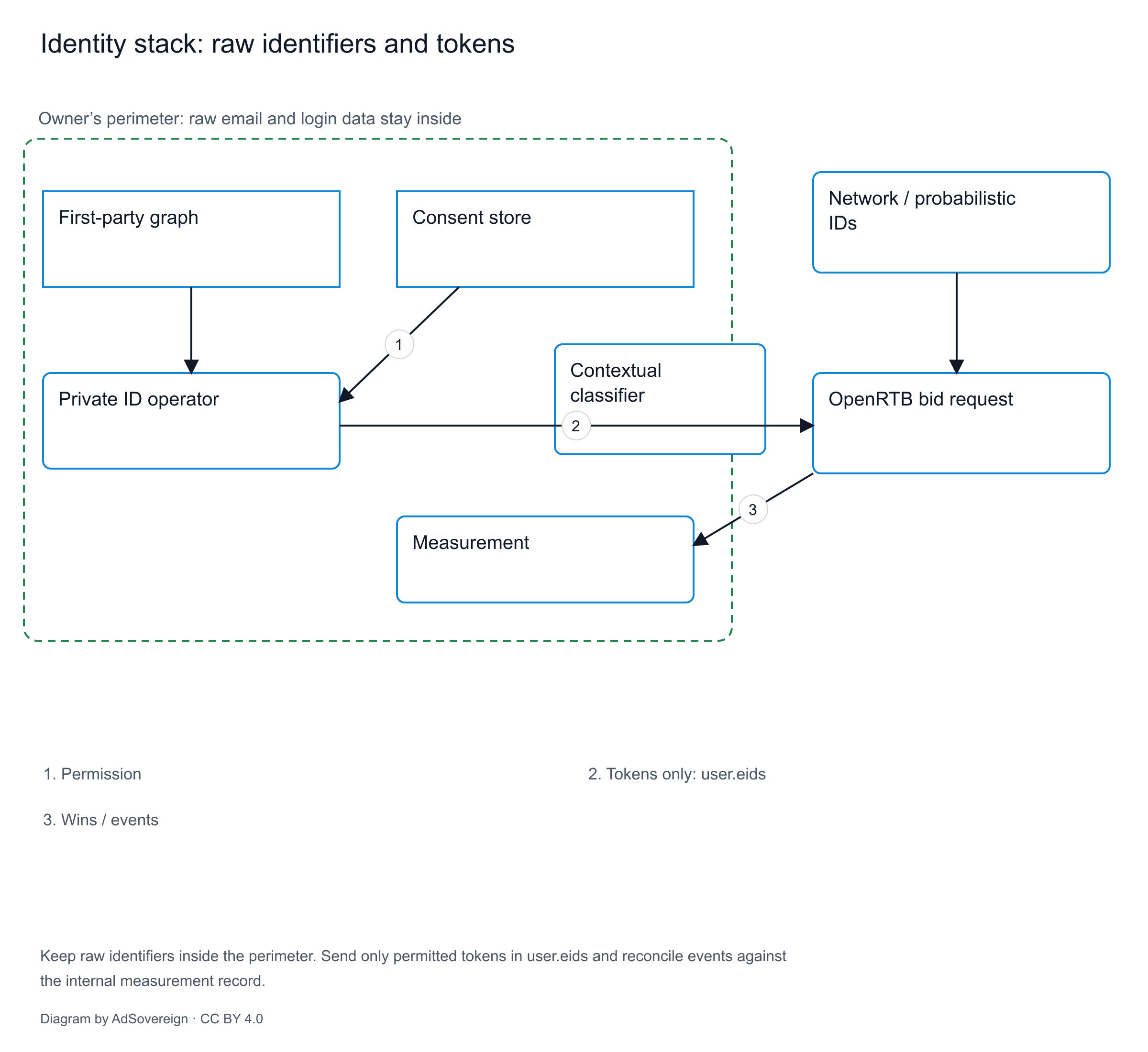
The two solve different problems. UID2 and EUID are deterministic: no email, no ID. ID5 combines publisher signals and hashed emails where present with probabilistic linking, which is why its site coverage is wide and why its EU position depends on the publisher's consent capture rather than on a login (PPC Land, 22 August 2026). Deterministic IDs give higher match quality on authenticated inventory; ID5 gives reach on unauthenticated inventory. Most buyers in 2026 pass several IDs in the OpenRTB user.eids array and let the bidder choose (IAB Tech Lab, OpenRTB 2.6).
The legal frame that any identity solution has to fit
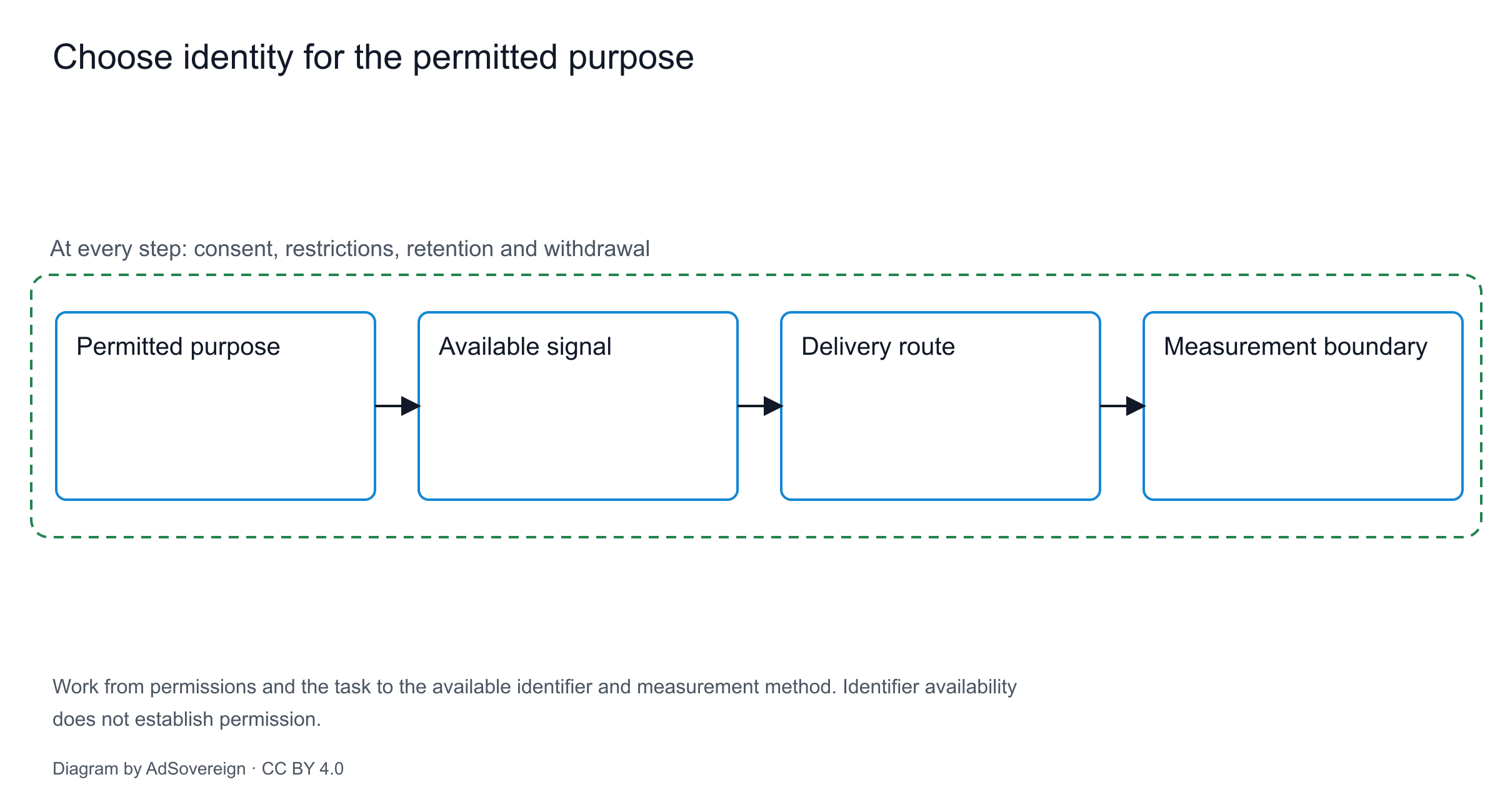
Four decisions set the boundaries. None of them is about Privacy Sandbox. All of them apply to its replacements.
- The consent signal is itself personal data. On 7 March 2024 the CJEU held that a TC String is personal data when it can be linked to an IP address, and that IAB Europe is a joint controller for it (CJEU C-604/22). An ID framework that carries a consent string carries personal data.
- Platforms in the chain cannot borrow consent. The Norwegian DPA fined Xandr €8.6 million in a decision of 2 October 2026 for real-time bidding with Grindr users' advertising ID and IP, finding Xandr a joint controller that could not rely on the app's consent: "accountability cannot be outsourced" (EDPB, 16 October 2026). Every operator in the identity table is in the same position.
- "Consent or pay" needs a real alternative. The EDPB's Opinion 08/2024 of 17 April 2024 says large platforms should offer an equivalent alternative without behavioural advertising, and should give "significant consideration" to a free one (EDPB, 17 April 2024). The Commission fined Meta €200 million on 23 April 2025 under the DMA on the same model (European Commission, 23 April 2025).
- The TCF keeps tightening. TCF v2.2 removed legitimate interest for personalized advertising purposes 3 to 6 and became mandatory on 20 November 2023 (IAB Europe, TCF v2.2); v2.3 made the Disclosed Vendors segment mandatory with a deadline of 28 February 2026 (IAB Europe). The field-level rules are in GDPR, ePrivacy and the bidstream; the wider set of pages is in the identity and privacy hub.
The standards bodies are moving in step. IAB Tech Lab released GPP updates and the Data Deletion Request Framework v2 on 23 October 2025 and put a privacy standards portfolio update out for public comment on 11 August 2026 (IAB Tech Lab press releases).
What an identity stack looks like in 2027
The question is no longer "which ID replaces the cookie". It is which combination of signals you can operate under your own consent and control. A workable 2027 stack has six layers.
6 of 6 rows
Download JSONTable by AdSovereign, CC BY 4.0.
| Links logins, loyalty IDs, CRM and transactions into one household or person key | Build; see First-party data strategy for publishers | Your warehouse |
| Records TCF v2.3 strings, GPP sections, preference center choices, with timestamps | Buy a CMP, own the records | Your warehouse, EU-hosted for EU users |
| Converts hashed email or phone into EUID or UID2 tokens for open-web buying | Private operator | Inside your perimeter; tokens leave, raw hashes do not |
| Adds telco signals (Utiq) or probabilistic IDs (ID5) for unauthenticated traffic | Buy | Vendor side; pass through |
| Classifies pages and content for targeting without a user identifier | Build or buy | Yours or vendor |
| Server-side event collection, clean-room matching, incrementality | Build the collection, buy the clean room if needed; see Clean room architectures compared | Your warehouse; aggregates to partners |
Three design rules follow from the legal frame above.
- Own the consent record. If a regulator asks why an ID was in a bid request, the answer must come from your log, not the vendor's. The Xandr decision makes that explicit.
- Keep raw identifiers inside the perimeter. A private operator for EUID or UID2 means hashed emails never leave your environment; only tokens do. The same rule applies to the clean room. For EU organizations this also closes a sovereignty gap, described in EU sovereign ad tech.
- Expect roughly a fifth of browsing to have no identifier at all. Safari and Firefox were 21.07% of worldwide browsing in September 2026 (StatCounter). Contextual and first-party login are the only answers there. Budget for them rather than treating them as fallback.
The wider planning context is in Programmatic advertising strategy 2027 and in DSP, DMP and external data in explainable RTB.
What to do now, by role
Publishers. Cookies still work in Chrome, so the revenue cliff that 2024 plans assumed did not arrive. The CMA's June 2025 testing summary put the cost of the Sandbox alternative at around 30% of revenue (PPC Land, 18 October 2025), which is the gap that logins, EUID or UID2 tokens and a telco signal now have to close on the cookieless fifth of traffic. The work is authentication rate, not API migration.
Buyers. Retargeting and conversion measurement lost their browser-native replacements. Both now depend on identifiers passed in user.eids and on server-side event collection. Audit which IDs each DSP accepts, which consent signal it checks, and where it stores the match. The Xandr decision shows that "the SSP had consent" is not an answer a DPA accepts.
Retailers, banks and telcos with first-party graphs. The retirement removed the one path that would have let Chrome, not you, hold the audience. A private operator for EUID or UID2 and a clean room for partner matching keep the graph inside your perimeter while still reaching the open web. The commerce-media context is in Commerce media networks directory.
Diagram spec

Diagram by AdSovereign, CC BY 4.0.
FAQ
Is Google still getting rid of third-party cookies? No. On 22 April 2025 Google said Chrome would keep its current third-party cookie settings and would not introduce a standalone prompt (Privacy Sandbox blog, 22 April 2025). The CMA released Google's commitments on 17 October 2025 and closed its case (CMA). Incognito still blocks third-party cookies, and users can block them in settings.
What Privacy Sandbox APIs still exist? CHIPS (partitioned cookies, Chrome 114+), FedCM (Chrome 108+) and Private State Tokens continue; the Storage Access API (Chrome 119+) is also supported. Topics, Protected Audience, Attribution Reporting, Private Aggregation, Shared Storage, SelectURL and Related Website Sets were retired on 17 October 2025, deprecated in Chrome 144 (13 January 2026) and set for removal in Chrome 150 (30 June 2026) (Privacy Sandbox status page, updated 14 August 2026; Chromium Dash).
What is the difference between UID2 and EUID? Both are open-source frameworks that turn a hashed email or phone into a rotating token, and both have a public operator run by The Trade Desk plus a private-operator option. UID2's consent model follows US state law such as the CCPA; EUID's is "driven by the General Data Protection Regulation" and the IAB TCF, with a Transparency and Control Portal for opt-out, and it uses a separate namespace (EUID docs). EU and UK publishers use EUID.
Is ID5 better than UID2?
They are different tools. UID2 and EUID are deterministic and need an email or phone, so they work on authenticated traffic. ID5 links publisher signals and hashed emails where present with probabilistic methods, so it reaches unauthenticated pages; Sincera counted it on about 100,000 sites in January 2025, a vendor-selected figure (PPC Land, 22 August 2026). Most stacks pass both in user.eids and let the bidder weigh them.
Do universal IDs comply with GDPR? They can, if the controller has a lawful basis for the hashed identifier and the token, passes a valid TCF signal, and can prove it. The CJEU held on 7 March 2024 that a consent string is itself personal data (CJEU C-604/22), and the Norwegian DPA's October 2026 Xandr decision found that a platform cannot rely on another party's consent (EDPB, 16 October 2026). Compliance is a property of your consent records and contracts, not of the ID format.

Diagram by AdSovereign, CC BY 4.0.
How this works on owned infrastructure
Every layer of the 2027 stack above can be rented or operated. AdSovereign is an enterprise, on-premise RTB stack (DSP, SSP, exchange, DMP and clean room) in which the first-party graph, the consent store and the ID bridge run inside your perimeter: it ships a private-operator integration for EUID and UID2, reads TCF v2.3 and GPP signals natively, passes user.eids to buyers under per-buyer rules, and logs the consent state behind every bid request for audit. Telco and probabilistic IDs plug in through the integrations catalogue. The architecture page shows how the identity components sit next to the bidder, and the pilot page describes a 90-day evaluation on your own data.
Sources
- Chromium Blog, "Building a more private web: A path towards making third party cookies obsolete" (14 January 2020). https://blog.chromium.org/2020/01/building-more-private-web-path-towards.html
- Google, "An updated timeline for Privacy Sandbox milestones" (24 June 2021). https://blog.google/products/chrome/updated-timeline-privacy-sandbox-milestones/
- Google, "Expanding testing for the Privacy Sandbox for the Web" (27 July 2022). https://blog.google/products/chrome/update-testing-privacy-sandbox-web/
- Google, "The next step toward phasing out third-party cookies in Chrome" (14 December 2023). https://blog.google/products/chrome/privacy-sandbox-tracking-protection/
- Privacy Sandbox, "Update on the plan for phase-out of third-party cookies on Chrome" (23 April 2024). https://privacysandbox.google.com/blog/update-on-the-plan-for-phase-out-of-third-party-cookies-on-chrome
- Privacy Sandbox, "A new path for Privacy Sandbox on the web" (22 July 2024). https://privacysandbox.google.com/blog/privacy-sandbox-update
- Privacy Sandbox, "Next steps for Privacy Sandbox and tracking protections in Chrome" (22 April 2025). https://privacysandbox.google.com/blog/privacy-sandbox-next-steps
- Privacy Sandbox, "Update on Plans for Privacy Sandbox Technologies" (17 October 2025). https://privacysandbox.google.com/blog/update-on-plans-for-privacy-sandbox-technologies
- Privacy Sandbox, "Feature status" (last updated 14 August 2026). https://privacysandbox.google.com/overview/status
- blink-dev, "Intent to Deprecate and Remove: Topics API" (7 November 2025; LGTM 12 November 2025; status update 11 June 2026). https://groups.google.com/a/chromium.org/g/blink-dev/c/_R85yctz4Rs
- Chromium Dash, milestone schedule M144 (stable 13 January 2026). https://chromiumdash.appspot.com/fetch_milestone_schedule?mstone=144
- Chromium Dash, milestone schedule M150 (stable 30 June 2026). https://chromiumdash.appspot.com/fetch_milestone_schedule?mstone=150
- UK Competition and Markets Authority, "Investigation into Google's Privacy Sandbox browser changes" (case page; commitments released 17 October 2025). https://www.gov.uk/cma-cases/investigation-into-googles-privacy-sandbox-browser-changes
- PPC Land, "Chrome kills most Privacy Sandbox technologies after adoption fails" (18 October 2025). https://ppc.land/chrome-kills-most-privacy-sandbox-technologies-after-adoption-fails/
- WebKit, "Full Third-Party Cookie Blocking and More" (24 March 2020). https://webkit.org/blog/10218/full-third-party-cookie-blocking-and-more/
- Mozilla, "Firefox rolls out Total Cookie Protection by default to all users worldwide" (14 June 2022). https://blog.mozilla.org/en/mozilla/firefox-rolls-out-total-cookie-protection-by-default-to-all-users/
- StatCounter, "Browser Market Share Worldwide" (September 2026). https://gs.statcounter.com/browser-market-share
- Apple Developer, "User Privacy and Data Use" (App Tracking Transparency). https://developer.apple.com/app-store/user-privacy-and-data-use/
- UID2 documentation, "Public and Private Operators". https://unifiedid.com/docs/ref-info/ref-operators-public-private
- UID2, homepage with partner announcements (2022 to 2025). https://unifiedid.com/
- EUID documentation, "EUID Overview" (last updated 12 October 2026). https://euid.eu/docs/intro
- EUID documentation, "Public and Private Operators". https://euid.eu/docs/ref-info/ref-operators-public-private
- The Current, "EUID adoption spreads across the programmatic supply chain" (25 November 2024). https://www.thecurrent.com/marketing/euid-adoption-programmatic-supply-chain-ssps-publishers
- AdExchanger, "Alternative Identity Provider ID5 Nabs $20 Million In Series B Funding" (9 April 2024). https://adexchanger.com/identity/alternative-identity-provider-id5-nabs-20-million-in-series-b-funding
- PPC Land, "Explaining ID5" (22 August 2026, clarified 5 September 2026). https://ppc.land/explaining-id5/
- Business Wire, "ID5's 2025 State of Digital Identity Report Finds Usage of Alternatives Growing" (29 September 2025; returned 403 to the fetcher, figures from search index). https://www.businesswire.com/news/home/20250929910958/en/
- PPC Land, "The Trade Desk integrates Utiq's telco identity signals across EMEA" (1 June 2026; Utiq figures as of 15 November 2025). https://ppc.land/the-trade-desk-integrates-utiqs-telco-identity-signals-across-emea/
- Mobile Marketing Magazine, "Utiq now reaches over 55 million people across Europe" (2025). https://mobilemarketingmagazine.com/utiq-now-reaches-over-55-million-people-across-europe/
- Utiq, homepage (consent description). https://utiq.com/
- CJEU, Case C-604/22, IAB Europe v Gegevensbeschermingsautoriteit (7 March 2024). https://eur-lex.europa.eu/legal-content/EN/TXT/?uri=CELEX:62022CJ0604
- EDPB, "Norwegian DPA fines Xandr EUR 8 600 000 for unlawful processing of personal data" (16 October 2026; decision 2 October 2026). https://www.edpb.europa.eu/news/norwegian-dpa-fines-xandr-eur-8-600-000-for-unlawful-processing-of-personal-data_en
- EDPB, "EDPB: 'Consent or Pay' models should offer real choice" (17 April 2024; Opinion 08/2024). https://www.edpb.europa.eu/news/news/2024/edpb-consent-or-pay-models-should-offer-real-choice_en
- European Commission, "Commission finds Apple and Meta in breach of the Digital Markets Act" (23 April 2025). https://ec.europa.eu/commission/presscorner/detail/en/ip_25_1085
- IAB Europe, "TCF v2.2" (launched 16 May 2023; deadline 20 November 2023). https://iabeurope.eu/tcf-2-2/
- IAB Europe, "Transparency & Consent Framework" (v2.3 launched April 2025; deadline 28 February 2026). https://iabeurope.eu/transparency-consent-framework/
- IAB Tech Lab, press releases (GPP updates and DDRF v2, 23 October 2025; privacy standards portfolio update, 11 August 2026). https://iabtechlab.com/press-releases/
- IAB Tech Lab, OpenRTB 2.6 specification (
user.eids). https://raw.githubusercontent.com/InteractiveAdvertisingBureau/openrtb2.x/main/2.6.md - Chrome for Developers: Chrome 153 release notes (September 8, 2026; checked October 18, 2026)
Changelog
18 October 2026: separated the retirement announcement, historical Topics target and API-specific browser status. Added the later primary release notes; did not infer runtime removal from a calendar date.
18 October 2026: aligned the title and heading and applied recorded source-URL corrections where needed. Factual research cutoff remains 17 October 2026.
17 October 2026. First edition of the tracker, replacing the 2024 UID2 article. Timeline through the 14 August 2026 status page update. Next review 15 January 2027: confirm Chrome 150 removal status, Android phase-out dates, IP Protection, and new adoption disclosures.