
Identity and Privacy
Data Clean Room Architecture: 12 Providers Compared (2026)
Published · Last updated
Next scheduled review:
A data clean room is a controlled environment where two or more parties run approved queries over combined data without either side seeing the other's records. Architectures differ on four axes: where the data sits, who runs the compute, which privacy technique limits the output, and which protocol connects the room to partners. Twelve options are compared here.
Key facts
- The hyperscaler rooms are three to four years old and still changing monthly. AWS Clean Rooms went GA on 21 March 2023 and has shipped intermediate tables (30 June 2026), exportable query logs (11 August 2026) and minimum aggregation thresholds inside custom analysis rules (13 August 2026) this year alone (AWS Clean Rooms user guide, document history).
- Prices are public for one of them. AWS's pricing examples use $2.00 per CRPU-hour for Spark SQL in US East, $4.00 per CRPU-hour for PySpark jobs with a 10-minute minimum, and $0.25 per 1,000 profiles per generated lookalike segment; there is no free tier (AWS Clean Rooms pricing). Snowflake's application is free and bills the analysis runner for compute (InfoWorld, 28 March 2024; Snowflake docs). Databricks publishes no clean-room price list.
- Google's room is the strictest about output. Ads Data Hub drops rows under about 20 unique users with noise injection, 50 under legacy difference checks and 10 for click and conversion-only queries (Google, ADH privacy checks).
- Two matching protocols now exist. IAB Tech Lab finalized PAIR v1.0 in January 2025, retired OPJA in its favor and added an Open PAIR module for Prebid in v1.1 (IAB Tech Lab, PAIR). ADMaP v1.0 Final, for attribution matching, was published in February 2025 (IAB Tech Lab, ADMaP v1.0).
- Confidential computing is the newest hosting model. Microsoft's Azure Confidential Clean Rooms runs Spark SQL inside attested enclaves and is in limited preview, with a documented ban on personal data during the preview (doc dated 22 May 2026) (Microsoft Learn). Decentriq has sold enclave-based rooms from Zürich "since 2019" (Decentriq, accessed 17 October 2026).
- The trade bodies have caught up. IAB published "Data Clean Rooms in Commerce: Common Use Cases" and IAB Europe published "Clean Rooms: Myths and Realities," both on 29 September 2026 (IAB Europe, 29 September 2026).
Definition
Data clean room: a technical and contractual environment in which two or more organizations contribute datasets that stay under their own control, a matching step joins records without revealing identifiers, and only aggregated or policy-approved outputs leave the environment. See the glossary entry for clean room.
IAB Europe's Commerce Media Measurement Standards V2.1 list clean rooms as one of three ways a network can deliver measurement to brands and note that they give "the largest amount" of incrementality models but that "interoperability of platforms is limited," they are "expensive," and they carry "data leakage risk" (IAB Europe, V2.1, January 2026). That is why architecture matters. For whether a clean room replaces a CDP, see Clean rooms vs CDP for the enterprise.
The four axes
1. Where the data sits. Warehouse-native rooms (Snowflake, Databricks, AWS Clean Rooms) query data where it already lives. Walled-garden rooms (Google Ads Data Hub, Amazon Marketing Cloud) hold the platform's event data and let you bring yours in. Vendor-hosted rooms (LiveRamp, InfoSum, Optable, Decentriq) run the join on the vendor's infrastructure, sometimes with the data staying in each party's own cloud account.
2. Who runs the compute. In AWS Clean Rooms the "member who can query" runs the job and a configurable payer is billed (AWS Clean Rooms pricing). In Snowflake the analysis runner pays (Snowflake docs). In enclave rooms the compute is a trusted execution environment that neither party nor the cloud operator can inspect (Microsoft Learn).
3. Which privacy technique limits the output. Allowed-column lists, query approval, minimum aggregation thresholds, noise injection or formal differential privacy, and cryptographic matching so that no party holds the other's cleartext identifier. AWS offers all of these as configuration; its differential privacy went GA on 10 April 2024 (AWS What's New, 10 April 2024) and reached the Spark engine on 16 July 2025 (AWS doc history).
4. Which protocol connects the room to partners. A room that joins your data with one partner's is a project; a room that can produce PAIR IDs or accept ADMaP requests is infrastructure.
Comparison table
12 of 12 rows
Download JSONTable by AdSovereign, CC BY 4.0.
AWS Clean Rooms (incl. Clean Rooms ML and Entity Resolution) | Managed service; data stays in members' S3, Glue, Athena or Snowflake tables; GA 21 Mar 2023 (AWS doc history) | AWS account required for every member; Snowflake and Athena as sources since 1 Dec 2024; cross-Region since 3 Oct 2025 (AWS doc history) | n/d on PAIR or ADMaP in AWS docs; provider-based matching via LiveRamp through Entity Resolution (AWS pricing) | Analysis rules (aggregation, list, custom), minimum aggregation thresholds, allowed-column controls, differential privacy (GA 10 Apr 2024), cryptographic computing, synthetic data (30 Nov 2025), lookalike and custom ML (AWS doc history) | Per CRPU-hour; examples $2.00 Spark SQL and $4.00 PySpark (US East), DP example +$2.00 per CRPU-hour; lookalike $0.04 per 1,000 training profiles and $0.25 per 1,000 per segment; custom ML $10 per million records; Entity Resolution $0.50 per 1,000 matched plus $100 base; no free tier (AWS pricing, accessed 17 Oct 2026) | Overlap, attribution, lookalike modeling, custom model training, multiparty collaborations (members can be added since 3 Sep 2025) | Amazon Marketing Cloud is "built on AWS Clean Rooms" (Amazon Ads, accessed 17 Oct 2026) |
Amazon Marketing Cloud (AMC) | Walled-garden room on AWS Clean Rooms; Amazon Ads signals plus advertiser inputs | AWS (Amazon-operated); advertiser needs Amazon Ads account; 20 markets listed incl. US, UK, DE, FR, IT, ES, NL (Amazon Ads) | n/d | Pseudonymised inputs only; aggregated outputs; built-in aggregation thresholds (values not published); advertiser signals not exportable (Amazon Ads) | "No cost to eligible advertisers"; Paid Features (beta) with Experian and NCS, price n/d (Amazon Ads) | Path-to-conversion, reach and frequency, audience building for Amazon DSP; 25-month lookback | Case studies cite UNICEF, SimpliSafe and Tinuiti for Poppi (vendor claims, Amazon Ads) |
Snowflake Data Clean Rooms (ex-Samooha) | Snowflake Native App; collaboration defined by YAML; roles Owner, Data provider, Analysis runner (Snowflake docs) | All parties on Snowflake; cross-cloud and cross-region via Cross-Cloud Auto-Fulfillment; AWS, Azure and Google Cloud (Snowflake product page) | n/d on PAIR or ADMaP in Snowflake docs | Column exposure policies per data offering; templates (JinjaSQL) and approved Python code specs; differential privacy from the LeapYear acquisition was in preview at GA (InfoWorld, 28 Mar 2024) | Application free in the Snowflake Marketplace since 28 Mar 2024; analysis runner pays compute; data providers need Enterprise Edition (InfoWorld, 28 Mar 2024; Snowflake docs) | Audience overlap, segmentation, incrementality, lookalike templates | Indeed, Roku, Horizon Media, Booking.com, Snap, Dentsu, Instacart, Samsung Ads named on product page (Snowflake, accessed 17 Oct 2026) |
Databricks Clean Rooms | Delta Sharing-based; data stays in place; serverless clean-room cluster; outputs via Unity Catalog (Databricks, 9 Jun 2025) | GA on AWS and Azure Feb 2025, Google Cloud 9 Jun 2025; cross-cloud and non-Databricks partners via federated sharing (Databricks, 5 Feb 2025; Databricks, 9 Jun 2025) | n/d; identity partners Epsilon, Deloitte, LiveRamp, Acxiom (Databricks, 9 Jun 2025) | Approved notebooks, egress controls, audit logging, fine-grained privileges in Unity Catalog; HIPAA features (Databricks, 5 Feb 2025) | n/d; no public price list for the clean room itself | Multi-party (up to 10 organizations), ML on combined data, healthcare and finance collaborations | Mastercard, Intuit, AppsFlyer, Integral Ad Science, CoreLogic quoted at GA (Databricks, 5 Feb 2025) |
Google Ads Data Hub (ADH) | Walled-garden room; Google event data joined with yours; results written to BigQuery in your project (Google, ADH intro) | Google Cloud project required | n/d; PAIR itself originated in Google Ads and is now an IAB Tech Lab standard (IAB Tech Lab, PAIR) | Static query checks, aggregation thresholds (about 20 users with noise injection, 50 with difference checks, 10 for click/conversion-only), filtered-row summaries (Google, ADH privacy checks) | n/d; BigQuery storage and compute billed to your project | Reach and frequency, attribution and audience analysis across DV360, Google Ads, CM360, YouTube | n/d (Google does not publish an adopter list) |
Microsoft Azure Confidential Clean Rooms | Fully managed; confidential Spark SQL in TEEs on Confidential ACI inside AKS; governance via Confidential Consortium Framework; open-source container images (Microsoft Learn, doc dated 22 May 2026) | Azure; limited preview; not for personal or regulated data during preview | n/d | Remote attestation, | n/d (preview) | Media and advertising, banking, healthcare, public sector scenarios listed by Microsoft | None named |
LiveRamp Clean Room (ex-Habu) | Vendor-hosted orchestration over customers' clouds; LiveRamp identity resolution; habu.com now redirects to liveramp.com (LiveRamp, accessed 17 Oct 2026) | Partners listed: AWS, Snowflake, Google Cloud (LiveRamp, accessed 17 Oct 2026) | n/d on the LiveRamp site; AWS lists LiveRamp as a provider-based matcher inside Clean Rooms (AWS pricing) | Identity resolution with claimed 99.5% match on full PII (vendor claim), aggregated outputs (LiveRamp) | n/d | Cross-cloud measurement, retail media closed-loop reporting | Named a Leader in the 2025 IDC MarketScape for clean rooms (vendor statement, LiveRamp) |
InfoSum (WPP) | Decentralised: each party's data stays in its own environment; products Beacons (cross-cloud), Data Collaboration Platform, Private Path (multi-company) (InfoSum, accessed 17 Oct 2026) | Cross-cloud per Beacons; specifics n/d | n/d | Non-movement of data; aggregated outputs | n/d | Publisher and broadcaster audience matching, retail media (Tesco and Heineken case study) | Logos: ITV, Channel 4, Boots, Deliveroo, Disney Ad Sales, Samsung Ads, Amazon Ads (InfoSum); footer reads "A WPP Company" |
Optable | Vendor-hosted data collaboration platform with clean room, ID Switchboard, Audience Agent; AdCP founding member (Optable, accessed 17 Oct 2026) | n/d; "Optable Audience Agent" is the only Private-deployment entry in the IAB Tech Lab registry's first ten (PPC Land, 11 Mar 2026) | AdCP yes; UID2 yes (Triton case study); PAIR and ADMaP n/d (Optable) | Clean-room joins "without exposing raw data"; details n/d | n/d; "no per-impression fees for identity" (vendor claim) | Publisher audience enrichment, direct deals, agentic marketplace | Unity, Triton Digital and iHeartMedia, The Globe and Mail and VIA Rail (vendor case studies, Optable) |
Decentriq | Vendor-hosted on confidential computing; "sharing without sharing"; Zürich, since 2019 (Decentriq, accessed 17 Oct 2026) | n/d (enclave hardware; specific cloud n/d on site) | n/d | Confidential computing, homomorphic encryption (vendor statements), no-code and Python/R analyzes, SOC 2 Type 2 | n/d (pricing page not available) | Publisher and retailer audience collaboration in DACH and wider EU, healthcare | IKEA Austria, Samsung, PostFinance; partners ProSiebenSat.1, Goldbach, Publicis Media, Scout24 (Decentriq) |
Samooha (historical) | Native-app clean room on Snowflake; acquired by Snowflake 18 Dec 2023, closed 20 Dec 2023, terms undisclosed (Snowflake, 18 Dec 2023) | Snowflake | n/a | Industry templates | n/a | Became Snowflake Data Clean Rooms | Co-founders Kamakshi Sivaramakrishnan and Abhishek Bhowmick joined Snowflake (Snowflake, 18 Dec 2023) |
Self-hosted clean room | Operator runs the join and the query engine on owned or dedicated infrastructure; see requirements below | None by design; can sit in a sovereign or on-premise environment | Must implement PAIR and ADMaP yourself from the IAB Tech Lab specifications (IAB Tech Lab, PAIR; ADMAP on GitHub) | Whatever you build: commutative encryption or PSI for matching, aggregation thresholds, DP libraries, approval workflow, audit log | Capital and staff cost; no per-query fee | Regulated data (GLBA, HIPAA, CPNI), EU residency without a US processor, retail media networks that own the match | n/d |
"n/d" means the vendor publishes nothing on that cell as of 17 October 2026; "vendor claim" marks figures from the vendor's own site.
Snowflake vs AWS Clean Rooms, the comparison most people search for
The differences are structural.
Membership. AWS requires every member to hold an AWS account, although since 1 December 2024 a member's data can live in Snowflake or Athena (AWS doc history). Snowflake requires every party to be on Snowflake, with Enterprise Edition for data providers, but clouds and regions can differ (Snowflake docs).
Privacy controls. AWS is more prescriptive: analysis rules are first-class objects, minimum aggregation thresholds and comparison controls can now be set inside custom rules (13 August 2026), and differential privacy is a managed feature (AWS doc history). Snowflake controls exposure through the data offering specification and approved templates; its differential privacy capability came from LeapYear and was in preview at GA in March 2024 (InfoWorld, 28 March 2024).
Machine learning. AWS Clean Rooms ML has shipped lookalike modeling (3 April 2024), custom models (7 November 2024), incremental and distributed training (1 July 2025) and synthetic datasets (30 November 2025) (AWS doc history). Snowflake rooms run approved Python code specs (Snowflake docs).
Cost. AWS publishes worked examples: $3,504 a year for a daily three-minute Spark SQL query on 32 CRPUs, and $7,000 a week for a lookalike workflow of 50 million training profiles and ten 2-million-profile segments (AWS Clean Rooms pricing). Snowflake's application is free; you pay the warehouse that runs the analysis (InfoWorld, 28 March 2024).
Lock-in. Both keep data in place. Both also assume the counterparty is on the same platform. Databricks is the one warehouse vendor that markets collaboration with non-Databricks partners through federated sharing (Databricks, 9 June 2025).
The protocols: PAIR, ADMaP and what shows up in the bid request
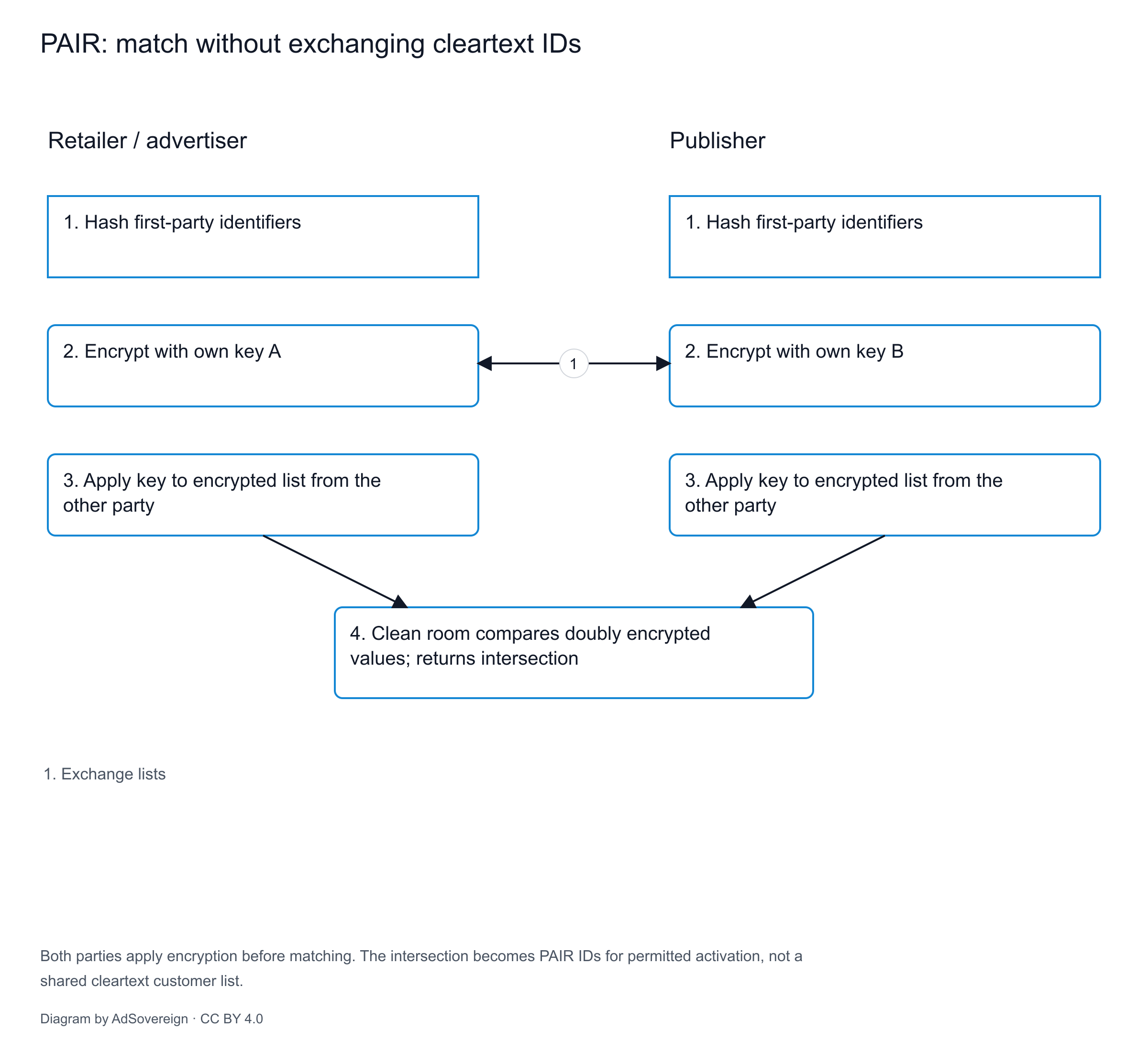
PAIR (Publisher Advertiser Identity Reconciliation). PAIR lets an advertiser and a publisher match their first-party identifiers without either side learning the other's list and without a third-party cookie. It uses commutative encryption: each party encrypts its hashed identifiers with its own key, the ciphertexts are exchanged and encrypted again with the other party's key, and the doubly encrypted values can be compared because the order of encryption does not change the result. The matched, encrypted IDs are what the publisher's ad server or SSP can act on. IAB Tech Lab says the protocol "was originally developed by Google Ads team," finalized v1.0 in January 2025 under its Rearc Addressability and PETs Working Group, has since finalized v1.1 with clarifications and an Open PAIR module for Prebid, and has retired the earlier OPJA specification because both solved the same problem (IAB Tech Lab, PAIR, accessed 17 October 2026). Reference cryptographic libraries in Java (Bouncy Castle elliptic-curve operations) and Python (pairid, Curve25519 and Ristretto) are listed in the IABTechLab PAIR repository (IABTechLab/pair on GitHub, accessed 17 October 2026).
ADMaP (Attribution Data Matching Protocol). ADMaP is the attribution counterpart: a privacy-safe way for an advertiser and a publisher or platform to match exposure and conversion records so that attribution can be computed without exchanging cleartext identifiers. IAB Tech Lab published v1.0 Final in February 2025 and moved the specification to GitHub in September 2025 (IAB Tech Lab, ADMaP v1.0, accessed 17 October 2026; InteractiveAdvertisingBureau/ADMAP on GitHub). A webinar replay on "Privacy Safe Secure Attribution with ADMaP" was published on 10 April 2025 (IAB Tech Lab, 10 April 2025).
What the bidstream sees. A clean-room-matched identifier reaches a DSP through the OpenRTB user.eids array. The 2.6-202409 snapshot of 23 September 2024 added three attributes to the EID object for exactly this purpose: inserter (the domain of the entity that added the ID), matcher (the technology that performed the match) and mm (the match method) (openrtb2.x releases; OpenRTB 2.6, section 3.2.27). The 2.6-202505 snapshot of 20 May 2025 added cids to the Data object for content IDs (openrtb2.x releases). An annotated example:
{
  "user": {
    "eids": [
      {
        "source": "pair-protocol.iabtechlab.com",
        "inserter": "publisher.example",
        "matcher": "cleanroom.example",
        "mm": 1,
        "uids": [
          { "id": "BASE64_DOUBLY_ENCRYPTED_PAIR_ID", "atype": 3 }
        ]
      }
    ]
  }
}
Field notes: source identifies the ID namespace; inserter and matcher tell the buyer who put the ID in the request and who did the match; mm is the match-method enumeration from the AdCOM list; atype 3 is a "person-based" agent type. The exact source value for PAIR IDs should be taken from the PAIR v1.1 specification, not from this example. For where this sits in the request lifecycle, see the RTB architecture hub.
Agentic enrichment is the alternative path. IAB Tech Lab's ARTF runs a partner's container inside the host's perimeter instead of exporting from a clean room; Adform and Adsquare shipped the first public integration on 27 May 2026 (ExchangeWire, 27 May 2026). See AAMP vs AdCP.

Diagram by AdSovereign, CC BY 4.0.
Walled-garden rooms: AMC and ADH
Both are free at the point of use and both are one-directional: the platform's data never leaves, and your own signals, once uploaded to AMC, cannot be exported (Amazon Ads, accessed 17 October 2026). Treat them as measurement surfaces for spend on those platforms. A network reporting to brands across Amazon, Google and its own channels needs one of the other options as the hub; see Retail media measurement standards explained.
The self-hosted option: what you must build
This section is neutral. It lists what a clean room must provide, as a requirements checklist, for teams that cannot or will not place regulated data in a hyperscaler or vendor room: a US bank under GLBA, a pharmacy under HIPAA and state health-privacy laws, or an EU retailer whose counsel has read the CLOUD Act (18 U.S.C. § 2713) and concluded that a Frankfurt region run by a US company does not settle the question (Cornell LII, 18 U.S.C. § 2713). See Data sovereignty defines the future of ad tech and the glossary entries for data residency and the CLOUD Act.
Minimum requirements, derived from what the managed rooms above expose as features:
- Isolated compute with attested execution. Either physical isolation under your control or a TEE with remote attestation, so a partner can verify what code runs on its data (the model Azure and Decentriq use).
- A matching layer that never sees cleartext on both sides. Implement PAIR (commutative encryption) for activation matches and ADMaP for attribution matches from the IAB Tech Lab specifications; reuse the reference libraries (IABTechLab/pair; InteractiveAdvertisingBureau/ADMAP). Private set intersection is the fallback for partners that support neither.
- Analysis rules as data, not as code review. Allowed columns, allowed joins, allowed aggregations, minimum group sizes (the hyperscalers settle between 10 and 50; pick and document yours), and comparison controls on which columns can be compared to literals.
- A query approval workflow with a tamper-evident log. Every data owner approves every template that touches its tables; every run is logged with template hash, parameters, row counts and runner. Partners will ask for exportable, redacted execution logs, which AWS added on 11 August 2026 (AWS doc history).
- Output controls. Row suppression below the threshold, optional noise or differential privacy with a per-table budget (AWS's "data access budgets" of 1 October 2025 are the managed equivalent), and an agreed result destination.
- Identity and entity resolution. Normalisation and hashing rules for email, phone and address; deterministic match first; a documented probabilistic fallback with disclosed error, as the IAB/MRC guidelines require (IAB/MRC, January 2024).
- Multi-party membership and change control. Adding a member, changing abilities or changing the payer requires approval from every existing member (AWS's change-request model since 18 December 2025).
- Residency and key custody. Data, keys and logs in the jurisdiction the regulator expects; key material held by the data owner, not the operator.
- Egress and retention. Hard limits on what leaves (aggregates, PAIR IDs, model scores), retention periods per table, and deletion that a partner can verify.
- Cost and capacity planning. A managed room bills per query; a self-hosted room bills in hardware and the engineers who maintain the crypto, the approval UI and the audit trail.
Selection checklist
- Where are the partners? List the five partners you must match with in the next 12 months and which room each uses; the answer is usually the room with the most overlap plus a protocol bridge for the rest.
- Which protocol do they speak? Ask each vendor, in writing, whether it produces PAIR v1.1 IDs and accepts ADMaP v1.0 requests; no vendor page we reviewed stated either as of 17 October 2026.
- What leaves the room? Aggregates only, or row-level encrypted IDs for activation? The second is more useful and more regulated.
- What is the threshold and who sets it? Minimum group size, and whether it applies per query, per table or per collaboration.
- Who pays and what is the unit? CRPU-hours, warehouse credits, per-profile fees or a license; run your own volumes through a worked example like AWS's.
- Can you leave? Export of your tables, templates and logs at termination.
- Where does it run? Region, cloud, operator nationality, and exposure to the CLOUD Act or an equivalent.
- Is personal data allowed? Azure's preview says no (Microsoft Learn); check the terms.
- Does the output meet the measurement standard you report against? IAB/MRC requires disclosure of attribution basis, windows and extrapolation (IAB/MRC, January 2024); IAB Europe V2.1 requires disclosure of the delivery tool (IAB Europe, V2.1).
For how these rooms are bundled by retail media vendors, see Retail media network platforms compared; for the non-retail networks that depend on them, see the commerce media networks directory.
Where these architectures are used
Clean rooms recur across this site because they are the only measurement layer that works when records cannot move. The non-retail networks in the commerce media networks directory use them for offsite overlap and incrementality; HIPAA-compliant programmatic advertising and The pixel problem in healthcare marketing rely on them to keep health data inside the covered entity; GLBA and advertising with bank data and How a bank can launch a media network without moving customer data place them at the partner boundary; EU sovereign ad tech adds the residency and control tests; and Identity after Privacy Sandbox explains why matched identifiers, not cookies, feed them.
FAQ
What is a data clean room in simple terms? It is a locked room where two companies put their customer lists on the table, a referee matches them without reading either aloud, and only the totals come out. Data stays under each owner's control, a cryptographic or isolated-compute step performs the join, and output rules suppress anything small enough to identify a person. IAB and IAB Europe published plain-language guides on 29 September 2026 (IAB Europe, 29 September 2026).
Snowflake clean room vs AWS Clean Rooms: what is the difference? AWS Clean Rooms is a managed service with explicit analysis rules, managed differential privacy and a published per-CRPU-hour price; all members need AWS accounts, though data can be in Snowflake or Athena (AWS pricing; AWS doc history). Snowflake Data Clean Rooms is a free native app where the analysis runner pays compute; all parties need Snowflake, Enterprise Edition for data providers, but clouds and regions can differ (Snowflake docs; InfoWorld, 28 March 2024). Pick by where your partners already are.
What is PAIR and do I need it? PAIR is IAB Tech Lab's standard for matching an advertiser's and a publisher's first-party identifiers with commutative encryption so neither sees the other's list; v1.0 was finalized in January 2025 and v1.1 adds a Prebid module (IAB Tech Lab, PAIR). You need it if you want to activate a match on a publisher's inventory through programmatic rather than only measure an overlap. You need ADMaP, published February 2025, if you want attribution across the two sides (IAB Tech Lab, ADMaP).
Are data clean rooms GDPR compliant? A clean room is a tool, not a legal basis. Pseudonymised data is still personal data under GDPR, so you need a lawful basis, a controller or processor agreement with the operator, and, if the operator or its parent is outside the EU, a Chapter V transfer mechanism. The room helps with minimization and purpose limitation; it does not replace consent or legitimate interest. Vendors that keep data in each party's own environment (InfoSum) and EU-based enclave vendors (Decentriq, Zürich) are often chosen for that reason (InfoSum; Decentriq).
How much does a data clean room cost? AWS publishes examples: about $3,504 a year for one three-minute Spark SQL query a day on 32 CRPUs at $2.00 per CRPU-hour, and $21.33 per run for a monthly PySpark measurement job (AWS Clean Rooms pricing, accessed 17 October 2026). Snowflake's app is free plus compute (InfoWorld, 28 March 2024). AMC is free to eligible advertisers (Amazon Ads). Vendor-hosted rooms do not publish prices.
Continue reading
Use the identity and privacy guide to compare the related operating models, definitions and evidence before making this decision.
How this works on owned infrastructure
Every option in the table either moves your data into someone else's account or moves the compute into someone else's enclave. AdSovereign is an enterprise, on-premise RTB stack (DSP, SSP, exchange, DMP and clean room) in which the clean room is the single surface a partner touches: the match runs on your hardware or in your dedicated cloud tenancy, PAIR and ADMaP are implemented at the room boundary, the resulting IDs feed an owned bidder through user.eids, and the approval log is yours to show an auditor. The architecture page describes the deployment model, the security page the controls and certifications, and use cases lists the regulated configurations we recommend and the ones we do not. This comparison stays neutral; the product is mentioned only here.
Sources
- AWS, "Document history for the AWS Clean Rooms User Guide" (entries 12 January 2023 to 6 October 2026; accessed 17 October 2026). https://docs.aws.amazon.com/clean-rooms/latest/userguide/doc-history.html
- AWS, "AWS Clean Rooms pricing" (accessed 17 October 2026). https://aws.amazon.com/clean-rooms/pricing/
- AWS, "AWS Clean Rooms Differential Privacy is now generally available" (10 April 2024). https://aws.amazon.com/about-aws/whats-new/2024/04/aws-clean-room-differential-privacy
- Amazon Ads, "Amazon Marketing Cloud" (accessed 17 October 2026). https://advertising.amazon.com/solutions/products/amazon-marketing-cloud
- Snowflake, "Snowflake to acquire Samooha" (18 December 2023; closing note 20 December 2023). https://www.snowflake.com/en/blog/snowflake-to-acquire-samooha/
- InfoWorld, "Snowflake's Data Clean Room promises to ease analysis of PII data" (28 March 2024). https://www.infoworld.com/article/2336670/snowflakes-data-clean-room-promises-to-ease-analysis-of-pii-data.html
- Snowflake documentation, "Snowflake Data Clean Rooms: introduction" (accessed 17 October 2026). https://docs.snowflake.com/en/user-guide/cleanrooms/introduction
- Snowflake, "Data Clean Rooms" product page (accessed 17 October 2026). https://www.snowflake.com/en/product/features/data-clean-rooms/
- Databricks, "Databricks Clean Rooms: now generally available on AWS and Azure" (5 February 2025). https://www.databricks.com/blog/databricks-clean-rooms-now-generally-available-aws-and-azure
- Databricks, "What's new with Databricks Clean Rooms" (9 June 2025). https://www.databricks.com/blog/whats-new-databricks-clean-rooms
- Google, "Ads Data Hub: introduction" (legacy documentation, accessed 17 October 2026). https://developers.google.com/ads-data-hub/guides/intro
- Google, "Ads Data Hub: privacy checks" (accessed 17 October 2026). https://developers.google.com/ads-data-hub/guides/privacy-checks
- Microsoft Learn, "Perform protected multiparty data collaboration on Azure" (Azure Confidential Clean Rooms; doc dated 22 May 2026). https://learn.microsoft.com/en-us/azure/confidential-computing/confidential-clean-rooms
- LiveRamp, home page (accessed 17 October 2026; habu.com redirects here). https://liveramp.com/
- InfoSum, home page (accessed 17 October 2026). https://www.infosum.com/
- Optable, home page (accessed 17 October 2026). https://www.optable.co/
- Decentriq, home page (accessed 17 October 2026). https://www.decentriq.com/
- IAB Tech Lab, "PAIR: Publisher Advertiser Identity Reconciliation" (v1.0 January 2025; v1.1; accessed 17 October 2026). https://iabtechlab.com/pair/
- IABTechLab, "pair" repository (accessed 17 October 2026). https://github.com/IABTechLab/pair
- IAB Tech Lab, "Attribution Data Matching Protocol (ADMaP) v1.0 Final" (February 2025). https://iabtechlab.com/standards/addressability-and-pets/attribution-data-matching-protocol-admap-v1-0/
- IAB Tech Lab, "Webinar replay: privacy safe secure attribution with ADMaP" (10 April 2025). https://iabtechlab.com/standards/addressability-and-pets/webinar-replay-privacy-safe-secure-attribution-with-admap/
- InteractiveAdvertisingBureau, "ADMAP" repository (accessed 17 October 2026). https://github.com/InteractiveAdvertisingBureau/ADMAP/tree/main
- IAB Tech Lab, openrtb2.x releases (2.6-202409, 23 September 2024; 2.6-202505, 20 May 2025; accessed 17 October 2026). https://github.com/InteractiveAdvertisingBureau/openrtb2.x/releases
- IAB Tech Lab, OpenRTB 2.6 specification, section 3.2.27 EID (accessed 17 October 2026). https://raw.githubusercontent.com/InteractiveAdvertisingBureau/openrtb2.x/refs/heads/main/2.6.md
- ExchangeWire, "Adform and Adsquare launch industry-first Agentic Real-Time Framework integration" (27 May 2026). https://www.exchangewire.com/blog/2026/05/27/adform-adsquare-launch-industry-first-agentic-real-time-framework-integration/
- PPC Land, "IAB Tech Lab's agent registry hits 10 with Amazon and new deployment types" (11 March 2026). https://ppc.land/iab-tech-labs-agent-registry-hits-10-with-amazon-and-new-deployment-types/
- IAB Europe, "Data clean rooms for retail and commerce media: two guides, one journey" (29 September 2026). https://iabeurope.eu/data-clean-rooms-for-retail-and-commerce-media-two-guides-one-journey/
- IAB, "Data Clean Rooms in Commerce: Common Use Cases" (29 September 2026). https://www.iab.com/guidelines/data-clean-rooms-in-commerce-common-use-cases/
- IAB Europe, "Commerce (incl. Retail) Media Measurement Standards V2.1" (page dated 22 January 2026; PDF May 2026). https://iabeurope.eu/knowledge_hub/iab-europes-commerce-incl-retail-media-measurement-standards-v2/
- IAB/MRC, "Retail Media Measurement Guidelines" (January 2024). https://www.iab.com/wp-content/uploads/2024/01/IAB_Retail_Media_Measurement_Guidelines_January2024.pdf
- IAB, "Retail Media Advanced Measurement and Data Collaboration" (31 October 2024). https://www.iab.com/guidelines/retail-media-advanced-measurement-and-data-collaboration/
- Cornell Legal Information Institute, 18 U.S.C. § 2713 (CLOUD Act). https://www.law.cornell.edu/uscode/text/18/2713
Changelog
18 October 2026: aligned the title and heading and applied recorded source-URL corrections where needed. Factual research cutoff remains 17 October 2026.
17 October 2026. First edition at this URL, replacing
/blog/data-clean-rooms-2025(301). 12 options compared, 32 sources. Next review 15 January 2027.