
Retail Media
Retail Media Measurement Guidelines Explained: IAB, MRC, EU
Published · Last updated
Next scheduled review:
Three documents set the baseline: the IAB/MRC Retail Media Measurement Guidelines (January 2024), the IAB and IAB Europe In-Store Retail Media Standards (December 2024), and IAB Europe's Commerce Media Measurement Standards V2.1 (January 2026). They require MRC viewability, disclosed attribution windows, gross or net sales labelling, and incrementality from an approved method. Demand all four in writing.
Key facts
- The US guidelines are two years old and still the reference. IAB and MRC released the draft for public comment on 13 September 2023 and the final version in January 2024, with an explainer co-written with Boston Consulting Group (IAB, 28 February 2024).
- Viewability is not optional. The guidelines adopt the MRC standard: at least 50% of pixels for one continuous second for display and two continuous seconds for video, directly measured where applicable (IAB/MRC, January 2024, chapter 3). IAB Europe V2.1 adopts the same thresholds and notes that sponsored products are sold on CPC yet viewability still affects ROAS (IAB Europe, V2.1).
- Europe sets a default window; the US does not. IAB Europe recommends a 30-day post-view and post-click lookback as the default, with flexible shorter windows such as 7 days for FMCG, and a 7-day default for quick commerce (IAB Europe, V2.1). The IAB/MRC guidelines require only that windows be "empirically supported" and logical for the category's sales cycle (IAB/MRC, January 2024, section 3.6).
- In-store got its own rulebook on 3 December 2024. The joint IAB and IAB Europe standards define five store zones, set gross impression as audience multiplied by ad play, and recommend sales reporting for 30 days before, during and 30 days after a campaign (IAB, 3 December 2024; PDF).
- Incrementality has a dedicated standard since 3 November 2025. IAB and IAB Europe's Guidelines for Incremental Measurement in Commerce Media accept four approaches: experiments, model-based counterfactuals, econometric models and hybrid proxies (IAB, 3 November 2025).
- Certification exists and is small. IAB Europe's Retail Media Certification Programme launched in beta on 30 October 2024 with auditors ABC, AAM and CESP; Albert Heijn and Nectar360 are certified and Moloco became the third certified company and the first technology provider on 7 October 2026, with five more under audit (IAB Europe, 30 October 2024; IAB Europe, 7 October 2026).
Definition
Retail media measurement standard: a published set of metric definitions, measurement methods and disclosure requirements that a retail media network, or the technology provider reporting on its behalf, agrees to follow so that a brand can compare results across networks. The IAB/MRC guidelines define retail media itself as "marketing to consumers near their point of purchase or choice between brands or products," online and in-store (IAB/MRC, January 2024). For the KPIs a network should run its business on, as opposed to report to brands, see five KPIs of a successful retail media network.
The three documents, and who wrote them
IAB/MRC Retail Media Measurement Guidelines (January 2024). Written by the IAB Retail Media Measurement Working Group with contributors from Mars, Albertsons Media Collective, Colgate-Palmolive, Walmart Connect, Google, Uber, TikTok and the Alliance for Audited Media, among others (IAB/MRC, January 2024, acknowledgements). Six chapters: data quality, audience measurement, delivery and viewability, incrementality, reporting, and in-store environments. It binds "retail media measurement organizations," meaning the network or the vendor that measures for it.
IAB and IAB Europe In-Store Retail Media: Definitions and Measurement Standards (3 December 2024). Developed by IAB Retail Media Committee members, the Retailer Council and the working group, jointly with IAB Europe. It covers store zones, media, ad-serving, impression and sales metrics for digital screens, audio and connected shopping; printed and experiential formats are deferred (IAB, 3 December 2024).
IAB Europe Commerce (incl. Retail) Media Measurement Standards V2.1 (January 2026). First published in April 2024 as the Retail Media Measurement Standards, updated after a public comment period from September to November 2025, renamed to cover commerce media, and extended with a measurement funnel, gross and net sales definitions, quick commerce metrics and a formal incrementality definition. Networks may comply with V1 or V2 until the end of July 2026; after that only V2 applies (IAB Europe, V2.1). The standards are tied to IAB Europe's certification program, which the document describes as the only way to guarantee adherence.
Two supporting documents matter: the IAB and IAB Europe Guidelines for Incremental Measurement in Commerce Media (3 November 2025), which V2.1 makes binding on any network that offers incrementality (IAB, 3 November 2025; IAB Europe, V2.1), and IAB Europe's in-store V2 and travel proposals of 17 September 2026, open for comment until 23 October 2026 (IAB Europe, 17 September 2026).
Summary table: what each standard requires
19 of 19 rows
Download JSONTable by AdSovereign, CC BY 4.0.
Ad impression | An ad successfully delivered to a device that has begun to render (IAB/MRC, §3.1) | Count on render, not on request; filter invalid traffic | IAB/MRC Jan 2024; IAB Europe V2.1 |
Viewable impression | 50% of pixels for 1 continuous second (display) or 2 continuous seconds (video), per the MRC Viewable Ad Impression standard | Measure directly where applicable; report viewability by placement, time and geography; disclose non-measured impressions (IAB/MRC, §3.2 and §5) | IAB/MRC Jan 2024; IAB Europe V2.1 |
Invalid traffic | GIVT and SIVT per MRC Invalid Traffic Detection and Filtration guidelines | Disclose IVT decision rates; where signals are insufficient, report "unknown IVT" (IAB/MRC, §3.4); report GIVT and SIVT separately and state if SIVT is not measured (IAB Europe, V2.1) | Both |
Click | User-initiated action on an ad, including to a brand, product or cart page | Measure per IAB/MRC Click Measurement Guidelines; tie clicks to valid impressions (IAB/MRC, §3.5) | Both |
Video completion rate | Videos viewed to completion divided by videos launched | Report against the IAB/MRC standard (IAB Europe, V2.1) | IAB Europe V2.1 |
Sale | Checkout completed and order issued; gross or net | Gross assumed unless net stated; net = gross minus returns, cancellations, refunds; search, social and programmatic always report gross (IAB Europe, V2.1) | IAB Europe V2.1 |
Attributable sales, ROAS, conversions | Outcomes attributed to a click or viewable ad, associated with SKUs in the creative or set by the brand | Disclose whether attribution is based on viewability or extrapolation; split click-based and view-based ROAS; same-SKU (parent SKU) attribution (IAB/MRC, outcomes table; IAB Europe, V2.1) | Both |
Attribution window | Time over which exposure counts toward attribution | US: must be empirically supported and logical for campaign length and category sales cycle; time-decay curves revalidated at least annually (IAB/MRC, §3.6). EU: 30-day post-view and post-click default, flexible shorter windows on request, 7 days default for quick commerce (IAB Europe, V2.1) | Both |
Modelled attribution and extrapolation | Rules used to estimate media impact on non-identified users | Disclose the method, the metrics it is extrapolated through, minimum sample sizes and quality thresholds (IAB/MRC, §3.6; IAB Europe, V2.1) | Both |
Halo and brand lift | Same brand, same category, as defined by the retailer catalogue | Report halo products transparently and separately from the advertised SKU (IAB/MRC, §3.6; IAB in-store, Dec 2024) | Both |
New-to-brand, new-to-category | Shopper with no purchase of the brand or category in a defined pre-period | Disclose the time frame; EU offers a set of recommended time frames to choose from (IAB/MRC, outcomes table; IAB Europe, V2.1) | Both |
Incrementality | Causal impact of marketing above a baseline, isolated from other factors | US: RCT, synthetic control, matched-market or ML with disclosure of method, test duration and pre-campaign holdout (IAB/MRC, chapter 4). EU: optional, but if offered must use a method from the November 2025 guidelines (IAB Europe, V2.1) | Both, plus IAB/IAB Europe Nov 2025 |
Reporting parameters | Day = midnight to midnight; disclosed time zone | Disclose data formats, promotions affecting measurement, audits applied and projections used (IAB/MRC, §5) | IAB/MRC Jan 2024 |
Delivery tool | Network reporting, open APIs or data clean rooms | Network must disclose which it provides; clean rooms are noted as expensive, with limited interoperability and leakage risk (IAB Europe, V2.1) | IAB Europe V2.1 |
Data quality | Audits and confidence intervals | At least annual internal and external data-quality audits; disclose sampling and non-sampling error (IAB/MRC, chapter 1 and §4.4) | IAB/MRC Jan 2024 |
In-store zones | Five zones from exterior to in-aisle and "other and connected store" | Overlay zones per store format; report audience per zone and in aggregate (IAB in-store, Dec 2024, §4; IAB/MRC, §6.1) | In-store Dec 2024; IAB/MRC ch. 6 |
In-store impression | Gross impression = audience in the display exposure zone × ad play; OTS = single opportunity to view; LTS = OTS adjusted for likelihood of noticing | Disclose the impression calculation and the footfall source (transaction data, panels, sensors, door counters, beacons) (IAB in-store, Dec 2024, §5) | In-store Dec 2024 |
In-store audio | Audio played, not audio heard | Count presence in the audible zone while the ad played (IAB/MRC, §6.3) | IAB/MRC ch. 6 |
In-store sales window | 30 days pre-exposure, campaign, 30 days post | Exclude stores where media was not active; provide flexible windows on request (IAB in-store, Dec 2024, §6). Proposed change to a 28-day window and removal of sales lift and brand sales lift metrics (IAB Europe proposals, 17 September 2026) | In-store Dec 2024; proposals Sept 2026 |
What the IAB/MRC guidelines actually say about attribution
The US document sets no lookback window. It says the window "must be empirically supported" and "logical with regard to campaign objectives and length as well as category sales cycles," and it notes that IAB and MRC may later prescribe standard windows for product categories (IAB/MRC, January 2024, section 3.6). What it does demand is disclosure: whether an attributable sale rests on a viewable impression or on extrapolation; the time-decay curve and the research behind it, revalidated at least annually; how sales from overlapping campaigns for the same brand are separated; and, at a minimum, SKU-level reporting with halo products shown transparently. The outcomes table defines new-to-brand and new-to-category as shoppers with no purchase of the brand or category in a time frame "that needs to be disclosed by the retailer," and marks before-and-after category share analysis as directional only (IAB/MRC, January 2024, outcomes table).
IAB Europe V2.1 fills the gap the US left. ROAS is "typically based on a last click or view model," and networks "should provide a split between click-based and view-based ROAS." The default lookback is 30 days post-view and post-click for endemic onsite and offsite, with the explicit example that an FMCG brand might ask for 7 days and a consumer-electronics brand for 30; off-site partners that cannot support custom windows must say so in reporting (IAB Europe, V2.1). For quick commerce the default drops to 7 days. Gross sales are assumed unless the network states net.
Incrementality: the methods the standards accept
The US chapter 4 and the November 2025 joint guidelines agree that incrementality is "the potential causal impact of marketing," measured against a baseline that must be estimated without bias (IAB/MRC, January 2024, chapter 4). The November 2025 guidelines group methods into experiments, model-based counterfactuals, econometric models and hybrid proxies, and rest on three principles: credible counterfactuals, control of bias, and separation of signal from noise (IAB, 3 November 2025). The glossary entries for incrementality and iROAS carry the short definitions.
9 of 9 rows
Download JSONTable by AdSovereign, CC BY 4.0.
Randomised holdout (RCT) | Randomly split the eligible audience into exposed and held-out groups; compare outcomes. The exposed group is an intention-to-treat group, since not every member will see the ad (IAB/MRC, ch. 4) | Least biased baseline; the reference method | Needs scale, a holdout the sales team will accept, and clean separation of exposed and unexposed; cannot measure off-platform halo | IAB/MRC ch. 4; IAB/IAB Europe Nov 2025 (experiments); IAB in-store (test vs control at store level) |
Geo test | Treat and withhold media by geography (stores, regions) and compare | Works where user-level holdouts are impossible, including in-store and offsite | Regions differ; needs pre-period matching and controls for price, promotion and feature space (IAB in-store, Dec 2024, test-vs-control best practices) | IAB in-store Dec 2024; IAB Oct 2024 (match-market testing) |
Matched-market test | Pair test and control markets on pre-period sales, size, format and range; analyze with difference-in-differences | Practical for networks with store estates; transparent | Imperfect matches bias the estimate; must exclude stores with other activity (IAB/MRC, ch. 4) | IAB/MRC ch. 4; IAB Oct 2024 |
Synthetic control | Build a counterfactual for the exposed group from the purchase behavior of unexposed consumers with similar pre-period characteristics, often with propensity-score matching | No holdout needed; usable after the fact | Depends on observed covariates; the guidelines stress that a synthetic control is not synthetic data (IAB/MRC, ch. 4) | IAB/MRC ch. 4; IAB/IAB Europe Nov 2025 (model-based counterfactuals) |
Marketing mix modeling (MMM) | Econometric model of sales against media, price, promotion and seasonality over time | Cross-channel view; the US guidelines ask networks to supply data for brands' MMM (IAB/MRC, §3.5) | Low granularity; slow; needs long history | IAB/IAB Europe Nov 2025 (econometric models); IAB Oct 2024 |
Machine learning counterfactuals | Models trained on deterministic exposure, outcome and covariate data to estimate what would have happened | Scales to many campaigns | Opaque unless documented; MRC transparency on probabilistic data applies (IAB/MRC, ch. 4) | IAB/MRC ch. 4 |
Hybrid proxies | Combine a small experiment with modelled extrapolation | Cheaper than full experiments | Must disclose the extrapolation rules | IAB/IAB Europe Nov 2025 |
Before-and-after (sales variance) | Compare sales before, during and after | Simple | Not incrementality; the in-store standard allows it only when incremental studies are not possible (IAB in-store, Dec 2024, §6) | IAB in-store Dec 2024 (as a fallback) |
Shadow-mode testing | Run the decisioning without serving, to measure what the model would have changed | Useful for algorithm changes | Not an outcome measurement on its own | IAB Oct 2024 (IAB, 31 October 2024) |
Whichever method is used, the US guidelines require disclosure of the methodology and data, including whether exposures were limited to viewable impressions, test duration, pre-campaign holdout periods and limitations (IAB/MRC, January 2024, chapter 4). The in-store standard adds the store-matching criteria for test-versus-control designs: pre-period sales, other in-store activity, price promotions, and store size and format (IAB in-store, December 2024). Where the data for any of these methods has to be joined with a brand's own data, the join runs in a clean room; the options and their costs are in Clean room architectures compared.
In-store: what changed in December 2024 and what is proposed for 2026
The December 2024 standard defines in-store retail media as advertising inventory that uses retail data for planning, execution and measurement in a store, digital or static, and names five zones from exterior to in-aisle and "other and connected store" (IAB in-store, December 2024, section 4). Gross impression is audience in the display exposure zone multiplied by ad play; opportunity to see is "a single opportunity to view an advert"; LTS impressions adjust OTS for the likelihood a shopper noticed the ad, usually from sensors. The worked OTS example multiplies 50,000 weekly footfall by 100 stores, 4 weeks, 80% aisle penetration, 100% share of voice, 80% touchpoint compliance and 1 OTS per visit to reach 12,800,000 (IAB in-store, December 2024, section 5). Footfall may come from transaction data, panels, sensors, door counters or beacons, and the source must be disclosed.
IAB Europe's September 2026 proposals, written after a 1 July 2026 workshop, keep the five zones, simplify OTS to six inputs (footfall, store count, campaign duration, placements, aisle penetration, share of voice), base impressions on footfall and "opportunity for visual contact with an ad," tier aisle penetration from full beacon deployment down to market research, remove sales lift and brand sales lift, and set a 28-day sales window (IAB Europe, 17 September 2026). The same release carries a Travel Media Addendum drafted with Skyscanner, KAYAK, Expedia, Koddi, Booking.com and Sojern: 7-day attribution for sponsored products, 30 days for display and offsite, a three-year new-to-advertiser lookback and gross bookings before cancellation. Comment closes 23 October 2026. The US IAB published a phased in-store maturity framework on 9 December 2025 (IAB, 9 December 2025).
What to demand from a platform
Put these in writing, whether you buy from a network or choose the platform that produces the reports; the platforms are compared in Retail media network platforms compared.
- Which standard, which version. IAB/MRC January 2024 for US onsite and offsite; IAB Europe V2 (V2.1) for EU and UK, since V1 compliance ended in July 2026; the December 2024 in-store standard for stores (IAB Europe, V2.1).
- Viewability measured, not assumed, to MRC thresholds, with non-measured impressions disclosed, and viewability reported by placement.
- IVT handling with GIVT and SIVT reported separately and an explicit statement if SIVT is not measured.
- Attribution basis per line item: click or view, viewable or extrapolated, window length, time-decay curve, and the date the curve was last validated.
- Sales basis: gross or net, same-SKU or parent-SKU, halo reported separately, new-to-brand time frame stated.
- Incrementality method from the accepted list, with design, duration, holdout size and limitations disclosed; refuse before-and-after comparisons labelled as incrementality.
- In-store calculation shown as a formula with each input and its source, and the zone taxonomy used.
- Delivery tool: dashboard, API or clean room, and the data available in each; if a clean room, who pays and which protocols it supports.
- Audit: the date and scope of the last internal and external data-quality audit, and whether the network or vendor holds IAB Europe certification or MRC accreditation.
- Change log: notice before any change to a definition, window or model, with restated history.

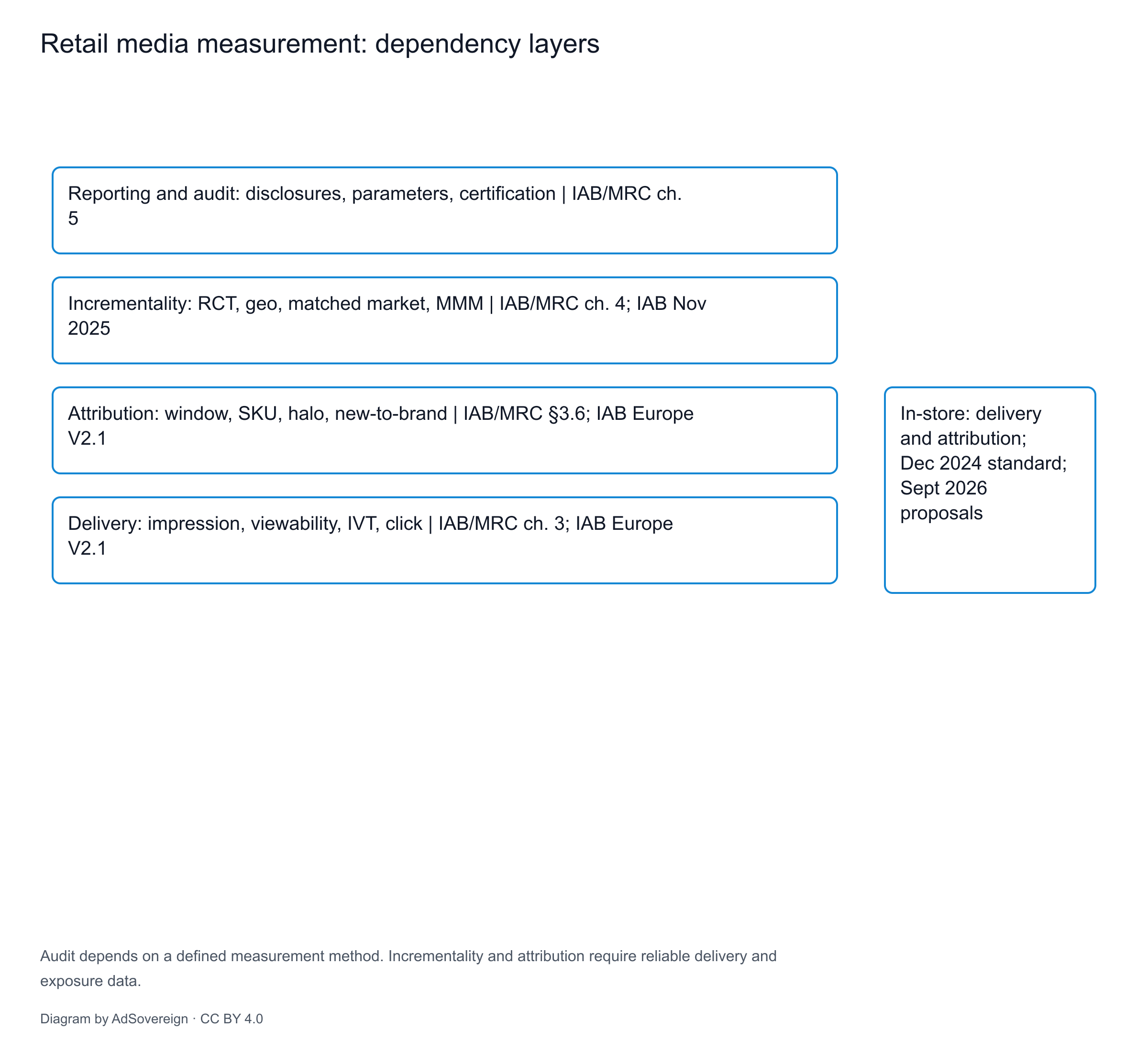
Diagram by AdSovereign, CC BY 4.0.
FAQ
What are the IAB retail media measurement guidelines? They are the IAB/MRC Retail Media Measurement Guidelines, drafted for public comment on 13 September 2023 and finalized in January 2024, covering data quality, audience measurement, viewability, attribution, incrementality, reporting and in-store measurement (IAB, 28 February 2024). They apply to any organization measuring retail media and lean on existing MRC standards for viewability, invalid traffic, clicks and digital place-based audiences. Our retail media hub links the related pages.
What attribution window do retail media networks use? In Europe the default is 30 days post-click and post-view, with shorter windows on request and 7 days for quick commerce (IAB Europe, V2.1). In the US the guidelines set no number and instead require the window to be empirically supported and disclosed (IAB/MRC, January 2024). Networks often publish 14-day windows for sponsored products; treat any window as a disclosure item, not a standard.
How is incrementality measured in retail media? With one of the methods the standards accept: randomised holdouts, geo or matched-market tests, synthetic controls, econometric models such as MMM, or hybrid proxies, each with the counterfactual, the bias controls and the noise treatment disclosed (IAB, 3 November 2025). In the US the guidelines ask for the test duration and pre-campaign holdout periods to be disclosed (IAB/MRC, January 2024). The closed-loop advantage of a retailer, defined in the glossary under closed-loop measurement, makes holdouts cheaper than elsewhere, which is why brands expect them.
How is in-store retail media measured? By zone. Gross impressions are the audience in the display exposure zone multiplied by ad plays; opportunity to see is a single chance to view; both must be computed from a disclosed footfall source such as transaction data, panels, sensors or door counters (IAB in-store, December 2024). Sales are reported 30 days before, during and 30 days after, with test-versus-control stores matched on pre-period sales, promotions and format. IAB Europe's September 2026 proposals would move to a 28-day window and a six-input OTS model (IAB Europe, 17 September 2026).
What is the difference between ROAS and iROAS? ROAS divides attributed sales by media cost; attributed sales are whatever the attribution rules credit to a click or a viewable impression within the window, so ROAS rises with longer windows and looser rules. iROAS divides incremental sales, the sales above a measured baseline, by media cost, and is only as good as the counterfactual behind it. The IAB/MRC guidelines require networks to disclose whether attributable sales rest on viewability or extrapolation (IAB/MRC, January 2024); IAB Europe requires the click-based and view-based split (IAB Europe, V2.1). See the glossary entries for ROAS and iROAS.
How this works on owned infrastructure
Every disclosure above is easier when the network controls the pipeline from impression log to sales match. AdSovereign is an enterprise, on-premise RTB stack (DSP, SSP, exchange, DMP and clean room) in which the ad server records render and viewability events to MRC definitions, the attribution engine exposes window, SKU and halo rules as configuration with a change log, holdout groups are assigned at auction time inside the owned bidder, and the clean room produces the brand-facing report without loyalty data leaving the retailer's perimeter. The architecture page describes the components, use cases lists the retail media configurations we recommend, and the pilot page describes a 60-day evaluation that includes a measurement audit against the standards on this page. This explainer stays neutral; the product is mentioned only here.
Sources
- IAB, "Final IAB/MRC Retail Media Measurement Guidelines available for download" (page dated 28 February 2024; final January 2024; draft 13 September 2023). https://www.iab.com/guidelines/final-iab-mrc-retail-media-measurement-guidelines-available-for-download/
- IAB/MRC, "Retail Media Measurement Guidelines" (January 2024, PDF). https://www.iab.com/wp-content/uploads/2024/01/IAB_Retail_Media_Measurement_Guidelines_January2024.pdf
- IAB and BCG, "IAB/MRC Retail Media Measurement Guidelines Explainer" (January 2024, PDF). https://www.iab.com/wp-content/uploads/2024/01/IAB-MRC-Retail-Media-Measurement-Guidelines-Explainer-January-2024.pdf
- IAB, "In-Store Retail Media: Definitions and Measurement Standards" (3 December 2024). https://www.iab.com/guidelines/in-store-retail-media/
- IAB and IAB Europe, "In-Store Retail Media Standards" (December 2024, PDF). https://www.iab.com/wp-content/uploads/2024/12/IAB-Europe_IAB-In-Store-Retail-Media-Standards_FINAL-DECEMBER-2024.pdf
- IAB Europe, "Commerce (incl. Retail) Media Measurement Standards V2.1" (page dated 22 January 2026; PDF filename May 2026). https://iabeurope.eu/knowledge_hub/iab-europes-commerce-incl-retail-media-measurement-standards-v2/
- IAB, "Guidelines for Incremental Measurement in Commerce Media" (3 November 2025). https://www.iab.com/guidelines/guidelines-for-incremental-measurement-in-commerce-media/
- IAB, "Demystifying Incrementality in Commerce Media" (9 September 2025). https://www.iab.com/guidelines/demystifying-incrementality-in-commerce-media/
- IAB, "Retail Media Advanced Measurement and Data Collaboration" (31 October 2024). https://www.iab.com/guidelines/retail-media-advanced-measurement-and-data-collaboration/
- IAB, "A Viable Framework for Maturing In-Store Media Measurement" (9 December 2025). https://www.iab.com/guidelines/framework-for-maturing-in-store-media-measurement/
- IAB Europe, "IAB Europe In-Store and Travel Media Measurement open for public comment" (17 September 2026; comment to 23 October 2026). https://iabeurope.eu/iab-europe-in-store-and-travel-media-measurement-open-for-public-comment/
- IAB Europe, "IAB Europe launches new Retail Media Certification Programme in beta phase" (30 October 2024). https://iabeurope.eu/iab-europe-launches-new-retail-media-certification-programme-in-beta-phase-to-drive-transparency-and-accountability-in-retail-media-measurement/
- IAB Europe, "Moloco becomes first technology provider to achieve IAB Europe Retail Media Certification" (7 October 2026). https://iabeurope.eu/moloco-becomes-first-ad-tech-company-to-achieve-iab-europe-retail-media-certification-marking-major-expansion-of-the-programme/
- IAB Europe, "Retail and Commerce Media Definitions one-pager" (5 May 2026). https://iabeurope.eu/knowledge_hub/iab-europes-retail-commerce-media-definitions-one-pager/
- IAB Europe, "Data clean rooms for retail and commerce media: two guides, one journey" (29 September 2026). https://iabeurope.eu/data-clean-rooms-for-retail-and-commerce-media-two-guides-one-journey/