
Retail Media
Retail Media Network Platforms Compared: 18 Vendors 2026
Published · Last updated
Next scheduled review:
Eighteen platforms run retail media networks today, from Criteo and Epsilon, which bundle demand with the ad server, to API-first vendors such as Kevel, Topsort and Pentaleap, to the retail-owned services of Amazon and Instacart. They differ on formats, self-serve, clean rooms, measurement, hosting and pricing. This page compares them on thirteen criteria, with a self-hosted stack as neutral row.
Every customer name in the table has a source. Every "n/d" means the vendor publishes nothing on that point as of 17 October 2026, which is itself useful information when you write the RFP.
Key facts
- The market is concentrated, and the platforms sell to everyone else. Tinuiti estimates that Amazon and Walmart take roughly 80% of US retail media spend (Tinuiti, 18 May 2026); a Kevel 2026 report cited by Osmos attributes 75.7% of e-commerce ad spend to Amazon and 4.9% to Walmart (Osmos, 4 June 2026); IAB says hundreds of commerce media networks compete for budgets concentrated among a few large platforms (IAB, 14 April 2026).
- Criteo is the largest third-party network. It had "over 200" retailers when it became Google's first onsite retail media partner on 10 September 2025 (Criteo, 10 September 2025), deployed $1.1 billion of media spend in Q2 2026 (Criteo, 5 August 2026) and added Lidl, Loblaw Advance, Massmart and Hyundai Department Store in 2026 (Criteo press releases).
- The retailers that own ad tech are now selling it. Amazon Retail Ad Service is in beta with Asda as the first UK retailer (Amazon Ads, accessed 17 October 2026); Gopuff will use Instacart's Carrot Ads as it joins the Instacart Marketplace (Instacart, 22 September 2026).
- Walmart is buying the buy side. It closed Vizio for about $2.3 billion on 3 December 2024 (Walmart, 3 December 2024) and completed the acquisition of the self-serve CTV platform Vibe.co on 4 August 2026, announced 23 June 2026 (Vibe.co, 4 August 2026).
- Measurement certification has reached the platforms. Moloco became the first technology provider certified under IAB Europe's Retail Media Certification Programme on 7 October 2026, after Albert Heijn and Nectar360 (IAB Europe, 7 October 2026).
- One incumbent is gone. Microsoft's PromoteIQ domain no longer resolves (checked 17 October 2026); Tinuiti still lists it among legacy platforms (Tinuiti, 18 May 2026).
Definition
Retail media network platform: the software a retailer uses to sell, serve, target, report and bill advertising on its own properties and, through extensions, on third-party media and in its stores, using its first-party shopper data. The platform may be licensed (Kevel, Topsort), bundled with a demand network (Criteo, Epsilon), supplied by another retailer (Amazon, Instacart) or built. See the glossary entries for retail media network and take rate. For the strategic choice behind the vendor choice, see Retail media infrastructure: build vs buy.
How to read the table
- Onsite sponsored products, display, offsite, in-store. "Yes" means the vendor's own page names the format as a product. "Partner" means delivered through a named third party. "n/d" means not stated.
- Self-serve portal. A brand-facing console the retailer can white-label.
- Clean room. Whether the vendor offers a clean room or names a partner; the options themselves are compared in Clean room architectures compared.
- Measurement and incrementality. What the vendor says it measures; whether it has been certified against a standard. The standards are explained in Retail media measurement standards explained.
- Data residency and self-hosting. Whether the vendor states where data is processed and whether the retailer can run the stack itself.
- Pricing model. Only where public or stated by a cited source; vendor comparisons are marked as such.
- Notable customers. Only names that appear on the vendor's site or in a dated release; logos are reported as logos.
Comparison table
18 of 18 rows
Download JSONTable by AdSovereign, CC BY 4.0.
Criteo Commerce Max and Commerce Grid (Criteo, Paris; redomicile to Luxembourg announced 31 Oct 2025 (Criteo, 31 Oct 2025)) | Yes (Criteo, 19 May 2026) | Yes | Yes (Commerce Max DSP; Google SA360 demand in beta since 10 Sep 2025 (Criteo)) | n/d | Yes | n/d | n/d on certification | n/d | No | Percentage of spend plus platform fees (vendor comparison, Osmos, 4 Jun 2026) | "Over 200" retailers (Criteo, 10 Sep 2025); Lidl (19 May 2026); Loblaw Advance, 18M PC Optimum members, 2,500 stores (5 Aug 2026); Massmart (22 Jul 2026); Hyundai Department Store (8 Apr 2026); DoorDash Canada (16 Apr 2026); Zepto (21 Aug 2025); Target Roundel and Costco onsite (Tinuiti, 18 May 2026) |
Kevel (Kevel, US; founded 2010 as Adzerk, first office Durham NC (Kevel, about)) | Yes (Ad Server APIs, catalog ingestion) | Yes | Audience activation offsite; KRX exchange for external demand (Kevel) | Yes (owned inventory in-store) | Yes (Kevel Console) | n/d | Forecast and AI yield tools; incrementality n/d | n/d; SOC 1, SOC 2, GDPR and CCPA badges; vendor is data processor (Kevel) | No | SaaS, no revenue share (vendor comparison, Osmos, 4 Jun 2026) | Home Depot, Chewy, Dollar General, Sonae MC, El Corte Inglés, bol, Edmunds, PayPal, Lyft (logos, Kevel, accessed 17 Oct 2026); acquired Velocidi 2022 and Nexta 2025 (Kevel, about) |
Topsort (Topsort Technologies, Palo Alto; founded 2021; 120+ staff (Topsort, about)) | Yes (Sponsored Listings, Sponsored Brands) | Yes (display, native, video) | Yes (added 2025) | Yes (added 2025) | Yes (Core Platform; Toppie DSP) | n/d | Attribution and quality score in T-Engine; incrementality n/d; auction latency "<5 ms" (vendor claim) | n/d; SOC 1, SOC 2, ISO 27001 (Topsort) | No | n/d | Falabella, H-E-B, Weee!, Liverpool (case studies); Staples, Poshmark, DoorDash, Magalu, Cencosud, Coles, Big W, OBI, CDON, Glovo, Just Eat Takeaway (logos, Topsort, accessed 17 Oct 2026) |
Mirakl Ads (Mirakl SAS, Paris legal entity (Mirakl)) | Yes | Yes (display, shoppable, video) | Partner: Google Shopping when onsite fills (Mirakl Ads) | Yes (shelf and in-store placements) | Yes | n/d | Vendor results only (Jumia +28% ad revenue, +12% GMV) | n/d | No | n/d; floor price per category | Maisons du Monde, Secret Sales, Shop Simon, Vente-unique, Jumia, Worten, Debenhams, Stadium, Rue du Commerce, Retif, Rakuten, Adorama (Mirakl Ads, accessed 17 Oct 2026) |
Epsilon Retail Media, ex-CitrusAd (Epsilon, Publicis Groupe, US) | Yes (sponsored products, banners, brand pages) | Yes | Yes, via Epsilon CORE ID, "300m+" IDs (vendor claim) | n/d (claims in-store sales effect only) | Yes ("first end-to-end, self-serve retail media platform", vendor claim) | Epsilon lists a data clean room product; link to retail media n/d (Epsilon) | Real-time reporting; incrementality n/d | n/d | No | n/d | 100+ retailers, 32 countries, 15bn ad requests a month, 3.5k active brands (vendor claims); logos Carrefour, Woolworths, REWE, Target, Sainsbury's, Tesco, Ocado, Gopuff, Casey's, Wawa, Hy-Vee, Petco, Coles, Argos, Metro (CitrusAd, accessed 17 Oct 2026) |
Moloco Commerce Media (Moloco, US; founded 2013; 850+ staff; 13 offices (Moloco, about)) | Yes (CARA AI decisioning) | Yes (display, video) | n/d | n/d | Yes (advertisers manage on the retailer's platform) | n/d | SKU-level reporting, A/B tests, holdout-based incrementality; IAB Europe certified for onsite display and sponsored products (IAB Europe, 7 Oct 2026) | n/d; SSO, MFA, RBAC | No | n/d; one customer cites a cost-per-order model | Costco, Olive Young, SSG, Yogiyo, Wayfair, W Concept, ManoMano (Moloco, accessed 17 Oct 2026); Costco AI optimization (Tinuiti, 18 May 2026) |
Vantage (Vantage, Canada/US; HQ n/d) | Yes (onsite) | Yes | Yes | Yes | n/d | n/d | n/d | n/d | No | n/d | Home Depot, Canadian Tire, SportChek, Marks (logos); Triangle Retail Media partnership (Vantage, 19 Mar 2026) |
Koddi (Koddi, founded Fort Worth TX 2013; Düsseldorf office 2016 (Koddi, about)) | Yes (sponsored listings) | Yes | Yes (Koddi SSP for Advertisers via any DSP) | Yes (in-store screens and audio via Koddi SSP) | n/d | n/d | "Measurement, optimization and AI-powered operations" (vendor); contributor to IAB Europe travel measurement addendum (IAB Europe, 17 Sep 2026) | n/d | No | n/d | No retailers named; "four of the eight billion-dollar commerce media networks" (vendor claim, 2024) (Koddi, about) |
Zitcha (Zitcha; offices Sydney, Melbourne, London, Chicago, New York (Zitcha, contact)) | Yes | Yes | Yes (Meta, Google Ads, Pinterest, TikTok, Snapchat integrations) | Yes (Broadsign integration) | n/d (Brand Hubs workspace) | n/d | "Measured by the retailer"; Margin Manager in beta (Zitcha) | n/d | No | n/d | None named on site; Pentaleap partnership (Pentaleap) |
Pentaleap (Pentaleap GmbH, Germany (Pentaleap)) | Yes (unified ranking of sponsored and organic; sponsored-product ad serving) | n/d | Access to search and programmatic demand (vendor claim) | Omnichannel orchestration (vendor) | n/d | n/d | H1 2026 Sponsored Products Benchmarks Report (vendor) | n/d | No; "compatible with any retail media ad server" | n/d | The Home Depot, Macy's (selected Pentaleap), CVS (Pentaleap, accessed 17 Oct 2026) |
Osmos (Osmos; HQ n/d; customers in 11 countries (Osmos)) | Yes (Product Ads) | Yes (display, video) | Yes (white-label DSP, Audience Exchange) | Yes (Retail Media CMS, footfall analytics, programmatic DOOH) | Yes (Brand Self-Serve) | n/d | Brand lift, geo, audience and synthetic holdouts (vendor) | n/d | No | Per-spend/platform model, terms on request (vendor's own comparison, Osmos, 4 Jun 2026) | bigbasket, Tata 1mg, Apollo 24 |
Streaem (VML, WPP; Netherlands origin) | n/d | n/d | n/d | n/d | n/d | n/d | n/d | n/d | No | n/d | n/d; streaem.com redirects to vml.com/streaem (checked 17 Oct 2026) |
Instacart Carrot Ads (Instacart, US) | Yes (Instacart ad formats on retailer properties) | n/d | n/d | n/d | Yes (Instacart Ads Manager) | n/d | Instacart reporting; n/d on certification | n/d | No | n/d | Gopuff, on joining the Instacart Marketplace (Instacart, 22 Sep 2026) |
Amazon Retail Ad Service (Amazon Ads, US; beta) | Yes (search, browse, product detail pages) | n/d | n/d | n/d | Brands manage campaigns; retailer console with fill rate, CPC, CTR, ROAS by advertiser and keyword | "Privacy-safe data collaboration environment powered by AWS" (Amazon Ads) | Attributed sales and ROAS in console | n/d (AWS) | No | n/d | Asda, first UK retailer; Macy's (Amazon Ads, accessed 17 Oct 2026; Tinuiti, 18 May 2026) |
Microsoft PromoteIQ (Microsoft, US) | Historical | Historical | Historical | n/a | Historical | n/a | n/a | n/a | No | n/a | Domain promoteiq.com does not resolve (checked 17 Oct 2026); listed as a legacy platform (Tinuiti, 18 May 2026) |
Symbiosys (DoorDash, US) | No (offsite only) | No | Yes (search, social and video sponsored products driving to retailer pages; collaborative bidding) | No | Yes (self-service console) | n/d | Closed-loop with online and in-store sales (vendor claim) | n/d | No | SaaS, codeless (vendor) | Best Buy Ads via Symbiosys/DoorDash for Meta self-service (Tinuiti, 18 May 2026); "now a DoorDash company" (Symbiosys, accessed 17 Oct 2026) |
Rokt (Rokt, US) | No (transaction-moment placements: cart, review, payment, confirmation) | Yes (Rokt Ads) | No | No | n/d | Rokt mParticle CDP | Pay-for-outcomes reporting (vendor) | n/d | No | Pay for outcomes; partnership model for e-commerce partners (Rokt, accessed 17 Oct 2026) | PayPal, Uber, Ticketmaster, Fanatics, Petco (logos); BJ's, Newegg, Booking.com (case studies) (Rokt) |
Self-hosted stack (retailer-owned; vendor-neutral row) | Yes, if the retailer runs an ad server with catalogue and relevance ranking | Yes | Yes, through an owned or white-label DSP (White-label DSP deployment guide) | Yes, if the screen CMS exposes OpenRTB or a booking API | Must be built or licensed | Owned clean room with PAIR and ADMaP (Clean room architectures compared) | Whatever is built; must meet IAB/MRC and IAB Europe disclosure rules (IAB/MRC, Jan 2024) | Full control | Yes | Capital, license and staff cost; no take rate on media | Kroger Precision Marketing is powered by its own 84.51° unit (Tinuiti, 18 May 2026) |
What the table shows
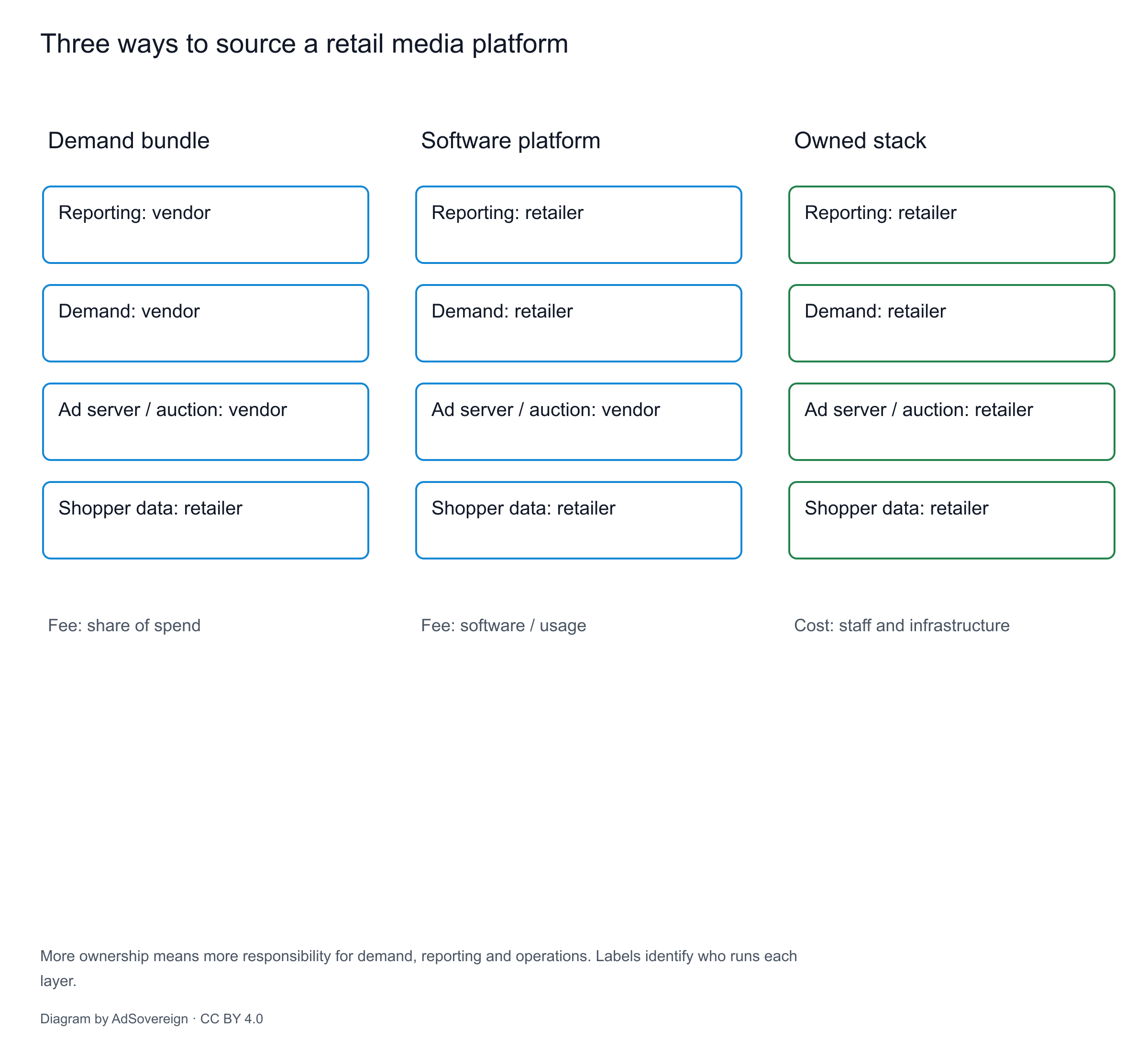
Three business models, not eighteen. The first is demand bundled with the ad server: Criteo and Epsilon bring brands and agencies that already buy through them, charge a share of spend, and in return a mid-sized retailer gets revenue from week one. The second is software: Kevel, Topsort, Mirakl Ads, Moloco, Pentaleap, Osmos, Zitcha, Koddi and Vantage sell the engine and leave the retailer to sell, or to plug in demand through exchanges (Kevel's KRX, Koddi's SSP, Osmos's Audience Exchange). The third is another retailer's stack: Amazon Retail Ad Service and Instacart Carrot Ads give a smaller retailer the ad products, the advertiser base and the reporting of a giant, with the giant's data environment in between. Each model has a price the table cannot show: demand bundles cost margin, software costs a sales team, and a rival retailer's stack costs independence.
Formats are converging; measurement is not. Almost every vendor now lists onsite sponsored products, display, offsite and in-store. Only one, Moloco, has a certification against a published measurement standard, and that covers onsite display and sponsored products on web, mobile and in-app (IAB Europe, 7 October 2026). Most vendors describe incrementality as a feature without naming the method. The standards require the method to be disclosed, so ask; the questions are listed in Retail media measurement standards explained.
Nobody publishes data residency, and nobody offers self-hosting. Every commercial row reads "n/d" on where shopper data is processed and "No" on running the stack inside the retailer's own perimeter. For a US grocer this is a procurement question. For a European retailer with loyalty data, a pharmacy under health-privacy law or a bank-owned marketplace it is a legal one, which is why the self-hosted row exists. The trade-offs are set out in Retail media infrastructure: build vs buy.
The retailer platforms are the new entrants to watch. Amazon Retail Ad Service is still labelled beta, runs on an AWS-powered data environment and gives the retailer a console with fill rate, CPC, CTR and ROAS by advertiser and keyword (Amazon Ads, accessed 17 October 2026). Instacart's Carrot Ads picked up Gopuff on 22 September 2026 (Instacart, 22 September 2026). Both solve the demand problem that kills most tier-two networks. Both also mean the retailer's shopper signals and the advertiser relationships live with a competitor.
What Walmart's deals mean for everyone else
Walmart does not sell its platform, but its acquisitions set the bar the vendors are measured against. It bought Vizio for about $2.3 billion, closing on 3 December 2024, to pair Vizio's ad-supported streaming platform with Walmart Connect (Walmart, 3 December 2024). On 23 June 2026 it agreed to buy Vibe.co, a self-serve CTV buying platform founded in 2022 with more than 10,000 advertisers, and completed the deal on 4 August 2026, saying it would combine Vibe's self-service platform with Walmart Connect so advertisers can plan, buy and measure streaming TV ads tied to the shopping journey (Vibe.co, 4 August 2026). Walmart Connect also uses The Trade Desk as its DSP partner and has partnerships with TikTok, Roku and Meta (Tinuiti, 18 May 2026). The lesson for a tier-two retailer is not to copy the shopping list. It is that the leaders own the self-serve console, the offsite buying tool and the screen, and rent nothing. Criteo, meanwhile, reported $1.1 billion of media spend deployed in Q2 2026 and a CFO change (Criteo, 5 August 2026), and announced a redomicile to Luxembourg with a Nasdaq ordinary-share listing on 31 October 2025 (Criteo, 31 October 2025). For the networks outside retail that use many of the same vendors, see the commerce media networks directory.
Selection guidance by retailer size
Osmos, a vendor, published a size-based framework on 4 June 2026 that is worth reading because its thresholds are explicit: under about $50 million GMV with no ad tech team, buy turnkey; $50 million to $500 million with a small engineering team, buy API-first and build selectively; over about $500 million with proprietary data, go hybrid with an owned differentiation layer; at $10 billion-plus, a custom build can be justified as a multi-year program (Osmos, 4 June 2026). The same post puts Osmos's own customers at an average of 6.75% of GMV monetized, which it calls internal and unverified, and quotes Kevel's claim of going live "in as little as 14 days" (Osmos, 4 June 2026). Moloco's published benchmarks are more conservative: ad revenue of 1% of GMV in year one, 2% in two years and over 3% in three years for the strongest retailers (Moloco, accessed 17 October 2026). Our neutral version:
- Under $100 million online GMV, or no dedicated sales team. The constraint is demand, not technology. Choose a platform that brings advertisers (Criteo, Epsilon, Amazon Retail Ad Service, Instacart Carrot Ads) and accept the share-of-spend or data trade. Insist on an exit clause that returns advertiser relationships and campaign history.
- $100 million to $1 billion, with a merchandising team that can sell. Choose software (Kevel, Topsort, Mirakl Ads, Moloco, Pentaleap, Osmos, Zitcha) and plug in demand through the vendor's exchange plus one DSP partner. Budget for a self-serve console and for the measurement work the standards require, which the vendors do not do for you.
- Over $1 billion, loyalty data, more than one country, or a regulated owner. The constraint is control: where the data sits, who can audit the match, whether the stack can move. Hybrid or self-hosted, with an owned clean room, an owned or white-label DSP for offsite, and a vendor only where it is replaceable. The 60-day retail network launch case shows the sequencing; the five KPIs are the ones to put in the board pack.
Whatever the size, the RFP should ask the same thirteen questions the table asks, plus: which measurement standard the vendor reports against and whether it has been audited; who owns the advertiser relationship and the log-level data at termination; what the ad server returns to the site in milliseconds and at what request volume; and whether the vendor's offsite extension uses the retailer's own DSP seat or the vendor's. For the difference between a network and an ad network in this context, see Retail media vs ad networks.

Diagram by AdSovereign, CC BY 4.0.
FAQ
What is a retail media network platform? It is the software that lets a retailer sell and serve ads on its own site, app, emails and stores, target them with its shopper data, and report sales back to brands. Platforms come as demand bundles (Criteo, Epsilon), as software (Kevel, Topsort, Moloco, Mirakl Ads, Pentaleap, Osmos), or as another retailer's service (Amazon Retail Ad Service, Instacart Carrot Ads). The retail media hub collects the related guides.
Which retail media platform does Walmart use? Its own. Walmart Connect runs on in-house technology, uses The Trade Desk as a DSP partner for offsite, and has added owned screens and buying tools through acquisitions: Vizio for about $2.3 billion on 3 December 2024 and Vibe.co, completed 4 August 2026 (Walmart, 3 December 2024; Vibe.co, 4 August 2026; Tinuiti, 18 May 2026). Kroger similarly runs on its 84.51° unit (Tinuiti, 18 May 2026).
How much does a retail media platform cost? Vendors do not publish price lists. The models that are public or reported are: a percentage of media spend plus platform fees (Criteo), SaaS without revenue share (Kevel), a per-spend or platform fee (Osmos), pay-for-outcomes (Rokt) and, in one Moloco customer's case, cost per order (Osmos, 4 June 2026; Rokt; Moloco). Ask for the effective take rate at your expected spend, including any demand fee, and compare it with the glossary definition of take rate.
Criteo vs Kevel: what is the difference? Criteo sells a network: its Commerce Max DSP brings brand and agency demand, including Google Search Ads 360 buyers in beta since 10 September 2025, to "over 200" retailers, and it charges a share of spend (Criteo, 10 September 2025; Osmos, 4 June 2026). Kevel sells the engine: ad-serving APIs, a self-serve console, audience tools and an exchange, on SaaS pricing without revenue share, used by Home Depot, Chewy and Dollar General among others (Kevel, accessed 17 October 2026; Osmos, 4 June 2026). The first is faster to revenue; the second keeps the advertiser relationship with the retailer.
Can a retailer build its own retail media platform? Yes, and the largest do: Walmart, Kroger through 84.51°, and Amazon, which now sells its stack to others (Tinuiti, 18 May 2026; Amazon Ads). Below that scale the honest answer is "build the parts that differentiate, license the rest": an owned clean room and data layer, an owned or white-label DSP for offsite, and a licensed or open-source ad server underneath. Vendor frameworks put the full custom build at $10 billion-plus GMV (Osmos, 4 June 2026); the sequencing is in Retail media infrastructure: build vs buy.
How this works on owned infrastructure
The self-hosted row above is not hypothetical. AdSovereign is an enterprise, on-premise RTB stack (DSP, SSP, exchange, DMP and clean room) that a retailer deploys in its own data center or dedicated cloud tenancy: an OpenRTB 2.6 ad server and exchange for onsite sponsored products and display, a white-label DSP for offsite, a screen-booking API for in-store, a self-serve console for brands, and a clean room implementing PAIR and ADMaP so brand matches never leave the retailer's perimeter. Measurement is built to the IAB/MRC and IAB Europe disclosure rules. The architecture page describes the components, use cases lists the retail configurations we recommend and the ones we do not, the TCO page compares owned and licensed costs at different spend levels, and the pilot page describes a 60-day evaluation. This comparison stays neutral; the product is mentioned only here.
Sources
- Criteo, "Criteo and Google announce onsite retail media integration" (10 September 2025). https://www.criteo.com/news/press-releases/2025/09/criteo-and-google-announce-onsite-retail-media-integration/
- Criteo, "Criteo announces intention to redomicile to Luxembourg and list ordinary shares on Nasdaq" (31 October 2025). https://www.criteo.com/news/press-releases/2025/10/criteo-announces-intention-to-redomicile-to-luxembourg-and-list-ordinary-shares-on-nasdaq/
- Criteo, "Criteo and Zepto partner to drive the next wave of quick commerce in India" (21 August 2025). https://www.criteo.com/news/press-releases/2025/08/criteo-and-zepto-partner-to-drive-the-next-wave-of-quick-commerce-in-india/
- Criteo, "Criteo partners with Hyundai Department Store to strengthen retail media business" (8 April 2026). https://www.criteo.com/news/press-releases/2026/04/criteo-partners-with-hyundai-department-store-to-strengthen-retail-media-business/
- Criteo, "Criteo and DoorDash expand partnership to Canada" (16 April 2026). https://www.criteo.com/news/press-releases/2026/04/criteo-and-doordash-expand-partnership-to-canada-as-on-demand-delivery-of-grocery-and-retail-items-accelerates/
- Criteo, "Criteo partners with Lidl to expand onsite retail media" (19 May 2026). https://www.criteo.com/news/press-releases/2026/05/criteo-partners-with-lidl-to-expand-onsite-retail-media/
- Criteo, "Massmart accelerates retail media offering in South Africa with Criteo" (22 July 2026). https://www.criteo.com/news/press-releases/2026/07/massmart-accelerates-retail-media-offering-in-south-africa-with-criteo/
- Criteo, "Criteo and Loblaw Advance partner to expand advertiser access to premium retail media network" (5 August 2026). https://www.criteo.com/news/press-releases/2026/08/criteo-and-loblaw-advance-partner-to-expand-advertiser-access-to-premium-retail-media-network/
- Criteo, "Criteo reports second quarter 2026 results" (5 August 2026). https://criteo.investorroom.com/2026-08-05-CRITEO-REPORTS-SECOND-QUARTER-2026-RESULTS
- Criteo, press releases index (accessed 17 October 2026). https://www.criteo.com/news/press-releases/
- Kevel, home page (accessed 17 October 2026). https://www.kevel.com/
- Kevel, "About" (accessed 17 October 2026). https://www.kevel.com/about
- Topsort, home page (accessed 17 October 2026). https://www.topsort.com/
- Topsort, "About" (accessed 17 October 2026). https://www.topsort.com/about
- Mirakl, "Mirakl Ads" (accessed 17 October 2026). https://www.mirakl.com/products/mirakl-ads
- Mirakl, home page (accessed 17 October 2026). https://www.mirakl.com/
- CitrusAd / Epsilon Retail Media, home page (accessed 17 October 2026). https://www.citrusad.com/
- Epsilon, "Retail media network" (accessed 17 October 2026). https://www.epsilon.com/us/products-and-services/retail-media-network
- Moloco, "Moloco Commerce Media" (accessed 17 October 2026). https://www.moloco.com/products/moloco-commerce-media
- Moloco, "About" (accessed 17 October 2026). https://www.moloco.com/about
- IAB Europe, "Moloco becomes first technology provider to achieve IAB Europe Retail Media Certification" (7 October 2026). https://iabeurope.eu/moloco-becomes-first-ad-tech-company-to-achieve-iab-europe-retail-media-certification-marking-major-expansion-of-the-programme/
- Vantage, home page (accessed 17 October 2026; Triangle Retail Media release 19 March 2026). https://www.gotvantage.com/
- Koddi, home page and "About" (accessed 17 October 2026). https://www.koddi.com/ and https://www.koddi.com/about
- IAB Europe, "IAB Europe In-Store and Travel Media Measurement open for public comment" (17 September 2026). https://iabeurope.eu/iab-europe-in-store-and-travel-media-measurement-open-for-public-comment/
- Zitcha, home page and "Contact" (accessed 17 October 2026). https://www.zitcha.com/ and https://www.zitcha.com/contact
- Pentaleap, home page (accessed 17 October 2026). https://www.pentaleap.com/
- Osmos, home page (accessed 17 October 2026). https://www.osmos.ai/
- Osmos, "Build vs buy retail media ad tech stack: decision framework and vendor comparison (2026)" (4 June 2026, updated 23 September 2026). https://osmos.ai/blog/build-vs-buy-retail-media-ad-tech-stack-2026
- Instacart, press releases index, "Instacart and Gopuff announce new, first-of-its-kind partnership in the U.S." (22 September 2026). https://company.instacart.com/pressreleases
- Amazon Ads, "Amazon Retail Ad Service" (beta; accessed 17 October 2026). https://advertising.amazon.com/retail-ad-service
- Symbiosys, home page (accessed 17 October 2026). https://www.symbiosys.ai/
- Rokt, home page (accessed 17 October 2026). https://www.rokt.com/
- Walmart, "Walmart completes acquisition of Vizio" (3 December 2024). https://corporate.walmart.com/news/2024/12/03/walmart-completes-acquisition-of-vizio
- Vibe.co, "Walmart completes acquisition of Vibe.co" (4 August 2026; announcement 23 June 2026). https://www.vibe.co/blog/whats-new/walmart-completes-acquisition-of-vibeco
- Tinuiti, "Retail media networks: the complete guide" (18 May 2026). https://tinuiti.com/blog/ecommerce/retail-media-networks/
- IAB, "Building a More Competitive Commerce Media Ecosystem" (14 April 2026). https://www.iab.com/guidelines/building-a-competitive-commerce-media-ecosystem/
- IAB/MRC, "Retail Media Measurement Guidelines" (January 2024). https://www.iab.com/wp-content/uploads/2024/01/IAB_Retail_Media_Measurement_Guidelines_January2024.pdf
Changelog
18 October 2026: aligned the title and heading and applied recorded source-URL corrections where needed. Factual research cutoff remains 17 October 2026.
17 October 2026. First edition: 17 commercial platforms plus a self-hosted row, 13 criteria, 37 sources. Next review 15 January 2027.