
In-House Programmatic
White Label DSP: Platforms, Pricing and Deployment 2026
Published · Last updated
Next scheduled review:
A white label DSP lets you offer a branded buying platform without building every component yourself. Compare ownership of the bidder, campaign data, integrations and customer relationships before comparing license prices. Deployment also requires a plan for demand access, staffing, measurement and exit.
Contents
Key facts
- Bidder-as-a-service is a single-tenant rental with a plug-in slot. FreeWheel's Beeswax, the company that trademarked the term, requires custom bidding agents to answer within 10 ms and to run in the same AWS region as the Beeswax cloud (FreeWheel API docs, updated 12 August 2026). FreeWheel called it a "software as a service (SaaS) advertising company" when it agreed to buy it on 17 December 2020 (FreeWheel, 17 December 2020).
- White-label DSPs start cheap and charge on spend. Epom's Light plan is $250 per month or 5% of ad spend, whichever is higher, with a $500 set-up fee; Pro is $2,000 per month or 5% (Epom pricing page, accessed 17 October 2026). TeqBlaze puts a typical rented white-label at $2,000–$15,000 per month and enterprise tiers at $15,000–$50,000+ per month (TeqBlaze, 27 September 2026).
- Launch claims run from 48 hours to 8 weeks. AdKernel claims "as little as 48 hours" (AdKernel, accessed 17 October 2026), Epom "under 2 weeks" (Epom comparison, accessed 17 October 2026), TeqBlaze "2–3 weeks" (TeqBlaze, accessed 17 October 2026). All are company claims.
- A build is a different order of magnitude. BidsCube prices an MVP at $150K–$400K over 6–12 months and a full platform at $500K–$1.5M+ over 12–24 months, plus $20K–$80K a month to run (BidsCube, 17 July 2026). Geomotiv puts the upfront build at $550K–$900K and the monthly burn at $35K–$100K+ (Geomotiv, 5 May 2026).
- Rented platforms can close. Microsoft announced on 14 May 2025 that Microsoft Invest would shut on 28 February 2026 (PPC Land, 22 June 2025).
- In the EU, exit terms are now regulated. The Data Act applies from 12 September 2025, caps the notice period for switching data-processing services at two months, sets a 30-day transition and prohibits switching charges from 12 January 2027 (Regulation (EU) 2023/2854, Articles 25, 29 and 50).
Definition
A white-label demand-side platform is licensed buying software presented under a customer's brand with deployment, customization and data rights specified by contract.

Diagram by AdSovereign, CC BY 4.0.
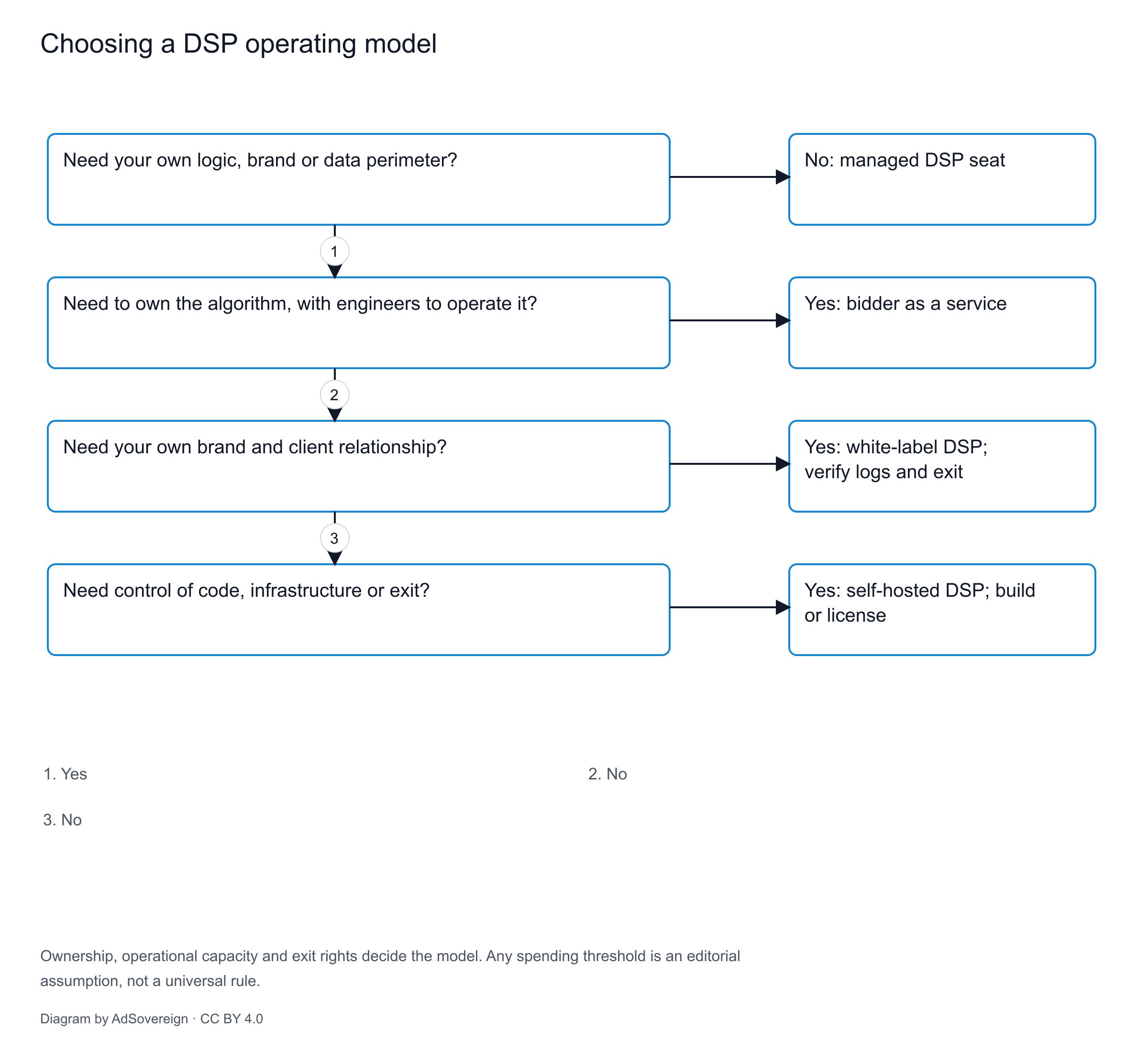
Evaluate the workflow
What is DSP White-Labeling?
White-label DSP deployment means licensing a complete demand-side platform infrastructure and rebranding it as your own product. Unlike managed services where the vendor's brand remains visible, white-label solutions let you own the customer relationship while leveraging established RTB technology. In multi-DSP environments, white-label DSPs can operate alongside external DSPs, with orchestration logic routing campaigns to internal infrastructure for first-party data while using external DSPs for scale and reach extension.
Common White-Label Use Cases
- Agencies: Offer proprietary programmatic buying under agency brand
- Publishers: Launch private exchanges with custom bidding logic. For publishers deploying white-label DSPs to create private exchanges, SSP integration enables both buy-side and sell-side operations under one brand.
- Retail media networks: Build shopper-data-powered ad platforms. White-label deployments integrate with existing DMPs or include built-in audience management, enabling segment-based bidding from day one.
- Telecom & ISPs: Monetize first-party subscriber data
- Financial services: Run compliant advertising within air-gapped environments. A DMP acts as an activation layer, not just a data store, translating audience data into real-time bidding signals.
White-Label vs Custom Build vs Managed DSP
Understanding the trade-offs between deployment models is critical to choosing the right path:
| Factor | White-Label | Custom Build | Managed DSP |
|---|---|---|---|
| Data ownership | Full (on-premise) | Full | Partial/None |
| Customization | High | Unlimited | Low |
| Branding control | Complete | Complete | None |
| Infrastructure control | Full (on-premise option) | Full | None |
Technical Architecture for White-Label Deployment
A production-ready white-label DSP requires these core components:
Campaign Manager
UI for campaign setup, targeting, budgets, flight dates, creative management
Analytics Dashboard
Real-time metrics, custom reports, attribution modeling, A/B testing
DMP Integration
Audience segmentation, first-party data onboarding, ID resolution
Billing & Reporting
Automated invoicing, spend tracking, client-facing financial dashboards
Admin Controls
User roles, API access, white-label settings, integrations config
Branding Customization Options
White-label deployments typically offer these customization layers:
- UI/UX branding: Logo, color scheme, typography, custom domain (e.g., dsp.youragency.com)
- Dashboard customization: Custom metrics, branded reports, client-facing analytics portals
- Email templates: Campaign alerts, performance reports, billing notifications with your brand
- API documentation: Branded developer docs for programmatic integrations
- Mobile apps: iOS/Android apps under your brand (advanced deployments)
- Custom features: Proprietary algorithms, unique targeting options, vertical-specific tools
Pro tip: Request a demo environment branded with your identity before signing contracts. This helps validate the look-and-feel matches your vision.
Deployment Timeline
A typical white-label DSP deployment follows this phased approach:
Infrastructure Setup
- • Provision cloud or on-premise servers
- • Install DSP software stack
- • Configure databases, caching layers, CDN
- • Set up monitoring and alerting
Branding & Integration
- • Apply logo, colors, domain setup
- • Integrate with SSP partners (bidstream access)
- • Connect DMP for audience data
- • Configure payment gateways
Testing & Training
- • Run test campaigns with low budgets
- • Train internal team on platform operations
- • QA all user journeys and integrations
- • Load testing (simulate peak traffic)
Beta Launch & Optimization
- • Gather feedback and iterate UI/UX
- • Fine-tune bidding algorithms
- • Prepare go-to-market materials
Pricing Models: License vs Revenue Share
White-label DSP vendors typically offer two commercial structures:
Perpetual License
Pay upfront for software license + ongoing support/maintenance fees.
- Pros: No rev-share, predictable costs, full control
- Cons: High upfront capital requirement
Revenue Share
Low/no upfront cost, vendor takes % of media spend or gross revenue.
- Pros: Low barrier to entry, scales with success
- Cons: Higher long-term cost, vendor dependency
When White-Label Makes Sense
White-label DSP is the right choice when:
- ✓ You need to own the customer relationship and brand experience
- ✓ Data sovereignty matters (compliance, competitive advantage)
- ✓ You want to monetize proprietary data or algorithms
- ✓ You have in-house ad ops expertise to run the platform
- ✓ Your target market values transparency over turnkey managed services
Not a fit when: You lack technical resources, prefer vendor-managed complexity, or prioritize lowest upfront cost over long-term control.
Ready to Explore White-Label DSP?
Schedule Architecture CallRead the current references
Read the in house programmatic guide for the broader decision framework.
FAQ
What is bidder-as-a-service?
What is a white-label DSP?
What is the difference between a white-label DSP and a self-serve DSP?
How much does a white-label DSP cost?
Can I move from a white-label DSP to my own platform later?
How this works on owned infrastructure
An AdSovereign deployment review establishes which DSP, DMP or SSP components your own advertising business needs. The license does not allow resale, sublicensing or offering a white-label platform to other companies. Use the architecture to identify bidder services, campaign interfaces and integration boundaries. Ask for explicit terms covering customization, source access, upgrades, exports and exit support under the permitted-use and source-confidentiality rules. The security assessment should cover administrative access and separation of advertiser accounts. A deployment review can test campaign setup, eligible bidding and reporting with your demand access. Record the operating owner and acceptance evidence for each function before expanding traffic.
Component licensing, inclusions and payment terms are published on the pricing page.
Sources
- FreeWheel, "FreeWheel to Acquire Ad Tech Leader Beeswax" (17 December 2020). https://www.freewheel.com/news/freewheel-to-acquire-ad-tech-leader-beeswax
- Beet.TV, "FreeWheel Buying Beeswax To Enable Publisher Audience Extension" (18 December 2020). https://www.beet.tv/2020/12/freewheel-buying-beeswax-to-boost-ad-demand.html
- Beeswax, "DSP Solutions" product page (accessed 17 October 2026). https://www.beeswax.com/products/
- FreeWheel Advertiser API docs, "Bidding Agent" (updated 12 August 2026). https://api-docs.freewheel.tv/advertiser/docs/bidding-agent
- Epom, "Ad Server & DSP Pricing" (accessed 17 October 2026). https://epom.com/pricing/dsp
- Epom, "White-Label DSP Comparison 2026: 7 Platforms Side by Side" (accessed 17 October 2026). https://epom.com/demand-side-platform-comparison
- Epom, "How to Build Your Own DSP and Is It Even Worth It?" (11 September 2025). https://epom.com/blog/dsp/how-to-build-your-own-dsp
- TeqBlaze, "Build Your Own DSP on TeqBlaze's White Label DSP Core" (accessed 17 October 2026). https://teqblaze.com/white-label-dsp
- TeqBlaze, "How Much Does it Cost to Develop a White-label Advertising Platform?" (27 September 2026). https://teqblaze.com/blog/wls-development-cost
- TeqBlaze, "Build a Demand-Side Platform: Step-by-Step Roadmap (Build vs Buy)" (8 March 2026). https://teqblaze.com/blog/how-to-set-up-your-own-dsp
More sources (16)
- BidsCube, "How to Build a DSP: Step-by-Step Guide to DSP Development" (17 July 2026). https://bidscube.com/blog/how-to-build-a-dsp/
- Geomotiv, "How to Build Your Own DSP: Step-by-Step Guide to Building a Custom Demand-Side Platform" (5 May 2026). https://geomotiv.com/blog/how-to-build-your-own-dsp-step-by-step-guide-to-building-a-custom-demand-side-platform/
- AdKernel, "White-Label DSP Platform" (accessed 17 October 2026). https://adkernel.com/dsp-suite/
- StackAdapt, "Build your own advertising platform with the StackAdapt API" (accessed 17 October 2026). https://www.stackadapt.com/enterprise-api-solution
- StackAdapt, "Ansira selects StackAdapt as strategic DSP partner" (13 August 2026). https://www.stackadapt.com/resources/blog/ansira-partnership
- Basis Technologies, "The Keys to Bringing Programmatic Advertising In-House" (10 September 2021), citing Forrester Consulting, "The Total Economic Impact of In-Housing with Basis" (23 July 2021). https://basis.com/blog/the-keys-to-bringing-programmatic-advertising-in-house
- Viant Technology, "Viant Completes Integration of Adelphic into Viant Advertising Cloud" (4 May 2017). https://www.viantinc.com/company/news/press-releases/viant-completes-integration-of-adelphic-into-viant-advertising-cloud/
- Clearcode, clearcode.cc (301 redirect to avenga.com observed 17 October 2026). https://clearcode.cc/
- GitHub, benmfaul/XRTB (RTB4FREE), README marked retired (accessed 17 October 2026). https://github.com/benmfaul/XRTB
- MediaPost, "Microsoft To Shutter DSP, Formerly Xandr" (14 May 2025). https://www.mediapost.com/publications/article/405873/microsoft-to-shutter-dsp-formerly-xandr-replace.html
- PPC Land, "Microsoft's Xandr DSP closure opens doors for independent players" (22 June 2025). https://ppc.land/microsofts-xandr-dsp-closure-opens-doors-for-independent-players/
- Regulation (EU) 2023/2854 (Data Act), Articles 25, 29 and 50, EUR-Lex. https://eur-lex.europa.eu/legal-content/EN/TXT/?uri=CELEX:32023R2854
- European Commission, "Data Act" policy page (entry into force 11 January 2024, application 12 September 2025). https://digital-strategy.ec.europa.eu/en/policies/data-act
- ANA Programmatic Transparency Benchmark, Q2 2026 findings, release reprinted by Fiducia (6 August 2026). https://www.fiducia.eco/post/ana-programmatic-transparency-benchmark-q2-2026-working-media-efficiency-reaches-a-record-45
- ANA, Programmatic Media Supply Chain Transparency Study, complete report (5 December 2023). https://ana.net/programmatic
- Digiday, "The case for and against bringing programmatic in-house" (9 February 2026). https://digiday.com/media-buying/the-case-for-and-against-bringing-programmatic-in-house/