
In-House Programmatic
Bidder as a Service vs White Label DSP vs Self-Hosted DSP
Published · Last updated
Next scheduled review:
A bidder-as-a-service rents you a bidder and lets you plug in your own decisioning. A white-label DSP rents you a finished platform under your brand. A self-hosted DSP puts the code and data on infrastructure you control. The difference is who owns the bidder, the logs, the code and the exit. This page compares the three with vendor evidence.
Key facts
- Bidder-as-a-service is a single-tenant rental with a plug-in slot. FreeWheel's Beeswax, the company that trademarked the term, requires custom bidding agents to answer within 10 ms and to run in the same AWS region as the Beeswax cloud (FreeWheel API docs, updated 12 August 2026). FreeWheel called it a "software as a service (SaaS) advertising company" when it agreed to buy it on 17 December 2020 (FreeWheel, 17 December 2020).
- White-label DSPs start cheap and charge on spend. Epom's Light plan is $250 per month or 5% of ad spend, whichever is higher, with a $500 set-up fee; Pro is $2,000 per month or 5% (Epom pricing page, accessed 17 October 2026). TeqBlaze puts a typical rented white-label at $2,000–$15,000 per month and enterprise tiers at $15,000–$50,000+ per month (TeqBlaze, 27 September 2026).
- Launch claims run from 48 hours to 8 weeks. AdKernel claims "as little as 48 hours" (AdKernel, accessed 17 October 2026), Epom "under 2 weeks" (Epom comparison, accessed 17 October 2026), TeqBlaze "2–3 weeks" (TeqBlaze, accessed 17 October 2026). All are company claims.
- A build is a different order of magnitude. BidsCube prices an MVP at $150K–$400K over 6–12 months and a full platform at $500K–$1.5M+ over 12–24 months, plus $20K–$80K a month to run (BidsCube, 17 July 2026). Geomotiv puts the upfront build at $550K–$900K and the monthly burn at $35K–$100K+ (Geomotiv, 5 May 2026).
- Rented platforms can close. Microsoft announced on 14 May 2025 that Microsoft Invest would shut on 28 February 2026 (PPC Land, 22 June 2025).
- In the EU, exit terms are now regulated. The Data Act applies from 12 September 2025, caps the notice period for switching data-processing services at two months, sets a 30-day transition and prohibits switching charges from 12 January 2027 (Regulation (EU) 2023/2854, Articles 25, 29 and 50).
Definition
Bidder-as-a-service (BaaS): a demand-side platform delivered as a single-tenant software service, where the vendor runs the bidder, the exchange integrations and the UI, and the customer supplies its own bidding logic, data and brand through APIs.
White-label DSP: a multi-purpose demand-side platform built and maintained by a vendor, licensed to a customer who rebrands it and sells or uses it as its own, usually on the vendor's infrastructure and with a monthly fee, a percentage of spend, or both.
Self-hosted DSP: a demand-side platform whose software, whether custom-built, licensed with source, or open source, runs on infrastructure the customer controls, so the bidder, the logs and the audience data never leave the customer's environment.
The three are not steps on one ladder. They answer different questions. BaaS answers "I want my own algorithm without building a bidder". White-label answers "I want my own branded platform without building anything". Self-hosted answers "I want the code and the data under my control". For the architecture these models share, see RTB architecture explained and the in-house programmatic hub.
Who owns what: the comparison table
9 of 9 rows
Download JSONTable by AdSovereign, CC BY 4.0.
Who owns the bidder | Vendor. Customer attaches a "bidding agent" that must answer in 10 ms and run in the vendor's AWS region (FreeWheel docs, 12 August 2026). | Vendor. Customer configures campaigns; core bidder is shared code (TeqBlaze, accessed 17 October 2026). | Customer, or customer under license. |
Who owns the data (logs, audiences) | Customer gets log-level access as a product feature; data sits in vendor cloud (Beeswax product page lists "extensible APIs"; log access per third-party listings, Beeswax, accessed 17 October 2026). | Varies by vendor. TeqBlaze: "separate databases and resources" per client (TeqBlaze, accessed 17 October 2026); AdKernel: "log-level reporting and action logs" (AdKernel, accessed 17 October 2026). Contract decides ownership. | Customer. Data never leaves customer infrastructure. |
Who owns the code | Vendor. | Vendor. Source-code acquisition is a separate, custom-quoted license, "typically tens to hundreds of thousands upfront" (TeqBlaze, 27 September 2026). | Customer (built or licensed with source), or community (open source). |
Who runs the infrastructure | Vendor (single-tenant deployment, Beeswax, accessed 17 October 2026). | Vendor ("hosted infrastructure", AdKernel, accessed 17 October 2026). | Customer, on-premise or in its own cloud account. |
Pricing model | SaaS subscription (FreeWheel, 17 December 2020); current price list not published. | Flat monthly fee, percent of spend, or the higher of the two: Epom $250/month or 5% (Light), $2,000/month or 5% (Pro), $500 set-up (Epom, accessed 17 October 2026); typical $2,000–$15,000/month (TeqBlaze, 27 September 2026). | Capex plus run cost. Build $150K–$400K (MVP) to $500K–$1.5M+ (full) plus $20K–$80K/month (BidsCube, 17 July 2026); or a license fee plus your infrastructure. |
Time to launch | Weeks (custom bidding agent is the long pole); vendor does not publish a figure. | 48 hours (AdKernel) to 2–8 weeks (TeqBlaze, 27 September 2026); company claims. | 6–12 months to MVP, 12–24 months to full (BidsCube, 17 July 2026); 6–9 months to a production baseline (Geomotiv, 5 May 2026). |
Customization | Deep on bidding logic; shallow on everything else. | Branding, campaign features, integrations "on request" (Epom comparison, accessed 17 October 2026). | Unlimited, at your cost. |
Exit cost | Re-platform the bidding agent; export logs. Vendor can close the product (precedent: Microsoft Invest, 28 February 2026, PPC Land, 22 June 2025). | Re-platform everything the vendor ran; export what the contract allows. In the EU, switching charges end 12 January 2027 (Data Act, Art. 29). | Low on data, high on staff: you keep the code and the logs, and you keep the team that runs them. |
Typical buyer | Ad tech companies and media owners with engineers and a proprietary model (Beeswax customers named at acquisition: Uber, DraftKings, Nexstar, FreeWheel, 17 December 2020). | Agencies, ad networks, publishers reselling demand; "starters" and high-risk verticals, per Epom's own segmentation (Epom comparison, accessed 17 October 2026). | Enterprises with data residency or exit requirements, large advertisers, retail media and commerce media owners. |
Vendor examples by category
Every line below is a company claim unless a third-party source is given. Prices change; check the linked page.
Bidder-as-a-service
1 of 1 rows
Download JSONTable by AdSovereign, CC BY 4.0.
FreeWheel Beeswax | "Bidder-as-a-Service (BaaS)": a customizable DSP, single-tenant deployment, "full white label capabilities, custom optimization, extensible APIs". Bidding agents in any language, 10 ms timeout, same AWS region; "Pacing-as-a-Service" filters agent bids against delivery goals. | Beeswax product page, accessed 17 October 2026; FreeWheel docs, updated 12 August 2026; acquisition by FreeWheel announced 17 December 2020 (FreeWheel). |
Beeswax is the only vendor we found that markets the category by that name. Other platforms offer custom-bidding hooks, but as a feature of a managed DSP rather than as a single-tenant product.
White-label DSPs
6 of 6 rows
Download JSONTable by AdSovereign, CC BY 4.0.
Epom | Under 2 weeks | Light $250/month or 5% of spend; Pro $2,000/month or 5%; Enterprise on request; $500 set-up; trial up to 14 days | 50+ pre-integrated SSPs claimed | Epom pricing; Epom comparison, both accessed 17 October 2026 |
TeqBlaze | 2–3 weeks | Not published; three tiers (Starter "for startups only", Standard, Unlimited Premium) | "Separate databases and resources" per client; "unlimited QPS" claimed | |
BidsCube | Not specified | From about $300/month (per Epom's table) | 250+ pre-verified SSPs claimed by Epom's table; BidsCube sells DSP, SSP and exchange as one stack | Epom comparison, accessed 17 October 2026; BidsCube, 17 July 2026 |
AdKernel | "As little as 48 hours" | Not published (Epom estimates $1.5K–$5K+/month by QPS) | Hosted; Google AdX and PubMatic-ready connectivity; log-level reporting | |
AdLib, Adtelligent, EXADS, Targetoo | 2–6 weeks (AdLib); under 2 weeks (EXADS); not specified (others) | AdLib from $799/month; Targetoo percent of spend; others not published | Listed only in Epom's comparison; not independently verified | |
StackAdapt (API) | Not published | Not published | "Build your own white-label advertising solution" on the StackAdapt API; 40+ exchange partners; the DSP behind Ansira's programmatic since August 2026 | StackAdapt API page, accessed 17 October 2026; StackAdapt, 13 August 2026 |
Two platforms that searchers put in this group do not belong in it. Basis Technologies sells a unified buying platform with its own DSP to agencies and in-house teams, and backs its in-housing pitch with a Forrester study it commissioned, reporting a 48% ROI (Basis, 10 September 2021); that is a managed, multi-tenant platform, not a white label. Viant's Adelphic is a "subscription-based omnichannel demand-side platform" for self-service buyers (Viant, 4 May 2017); we found no white-label program. A vendor called "DSP14" appears in search suggestions, but no live site resolved for that name on 17 October 2026, so it is not listed.
Self-hosted and custom builds
3 of 3 rows
Download JSONTable by AdSovereign, CC BY 4.0.
Custom development shops | Geomotiv (publishes a $550K–$900K build range, 4-role core team, 6–9 months to baseline); TeqBlaze custom services ($150K–$1.5M+ over 12–24 months; mid-scale builds "around $10–25 million" by its March 2026 estimate); BidsCube custom builds. Clearcode, the shop behind many "how to build a DSP" guides, now redirects clearcode.cc to avenga.com. | Geomotiv, 5 May 2026; TeqBlaze, 27 September 2026; TeqBlaze, 8 March 2026; BidsCube, 17 July 2026; clearcode.cc redirect observed 17 October 2026 |
Licensed platform with source, deployed on your infrastructure | A small number of vendors license a DSP for on-premise or own-cloud deployment; see the final section of this page for the one we operate. | n/a (product, final block only) |
Open source | RTB4FREE (XRTB), an Apache-2.0 Java bidder, is marked "RETIRED" in its own README and points to a successor. We found no maintained open-source DSP with exchange certifications. |
The self-hosted route is mostly custom development today, which is why how to build a DSP platform is a separate page.
How the pricing models actually differ
Three mechanics drive the cost difference.
Percent of spend scales against you. Epom's "5% of your ad spend or $250 per month, whichever is higher" is a floor, not a cap (Epom, accessed 17 October 2026). At small spend the flat fee binds; at large spend the percentage binds. Epom's own build-vs-buy article says the economics of owning usually fail unless spend is "more than $50 million per year", which is also where a 5% fee becomes $2.5 million a year (Epom, 11 September 2025). TeqBlaze uses the same $50 million threshold (TeqBlaze, 8 March 2026). Both are vendors selling the rental, so read the threshold as a lower bound.
SaaS fees do not scale with spend, but they do scale with usage. Beeswax's model was described as SaaS at acquisition (FreeWheel, 17 December 2020); third-party listings describe usage-based pricing by impression volume and modules, and the company does not publish a price list. The relevant number for a BaaS buyer is QPS, not media spend, because the vendor's cloud bill is what the fee covers.
Self-hosted moves the cost from the fee line to the infrastructure and payroll lines. The ranges vendors publish for a build ($150K–$1.5M+ capex, $20K–$80K per month run, BidsCube, 17 July 2026) exclude the team. Epom's estimate for an owned stack is $1.5–2.5 million a year including salaries (Epom, 11 September 2025). Against that, the ANA's Q2 2026 benchmark found 27.2% of programmatic spend going to transaction costs across the market (ANA Q2 2026 benchmark, 6 August 2026). Whether an owned stack beats a rented one depends on spend; DSP pricing explained works through the arithmetic and the ad tech tax explained itemises the fees that the 27.2% is made of.
Exit cost: the dimension vendors do not put in the table
Every rented model carries the risk that the vendor changes terms, is acquired, or closes the product. The reference case is Microsoft Invest: announced on 14 May 2025, closed on 28 February 2026, nine and a half months later (MediaPost, 14 May 2025; PPC Land, 22 June 2025). Buyers that depended on it had to move audiences, deals, creatives and historical logs on the vendor's schedule. Life after Microsoft Invest is the playbook.
For EU buyers, the Data Act now sets a floor on exit terms for "data processing services", a category that includes cloud-delivered software. From 12 September 2025 contracts must cap the notice period for initiating a switch at two months and complete the switch within a 30-day transition period; from 12 January 2027 providers may not charge switching fees at all (Regulation (EU) 2023/2854, Articles 25, 29 and 50). Whether a given white-label or BaaS contract falls inside that definition is a legal question for your counsel; the questions to ask are in the DSP RFP template.
Decision tree
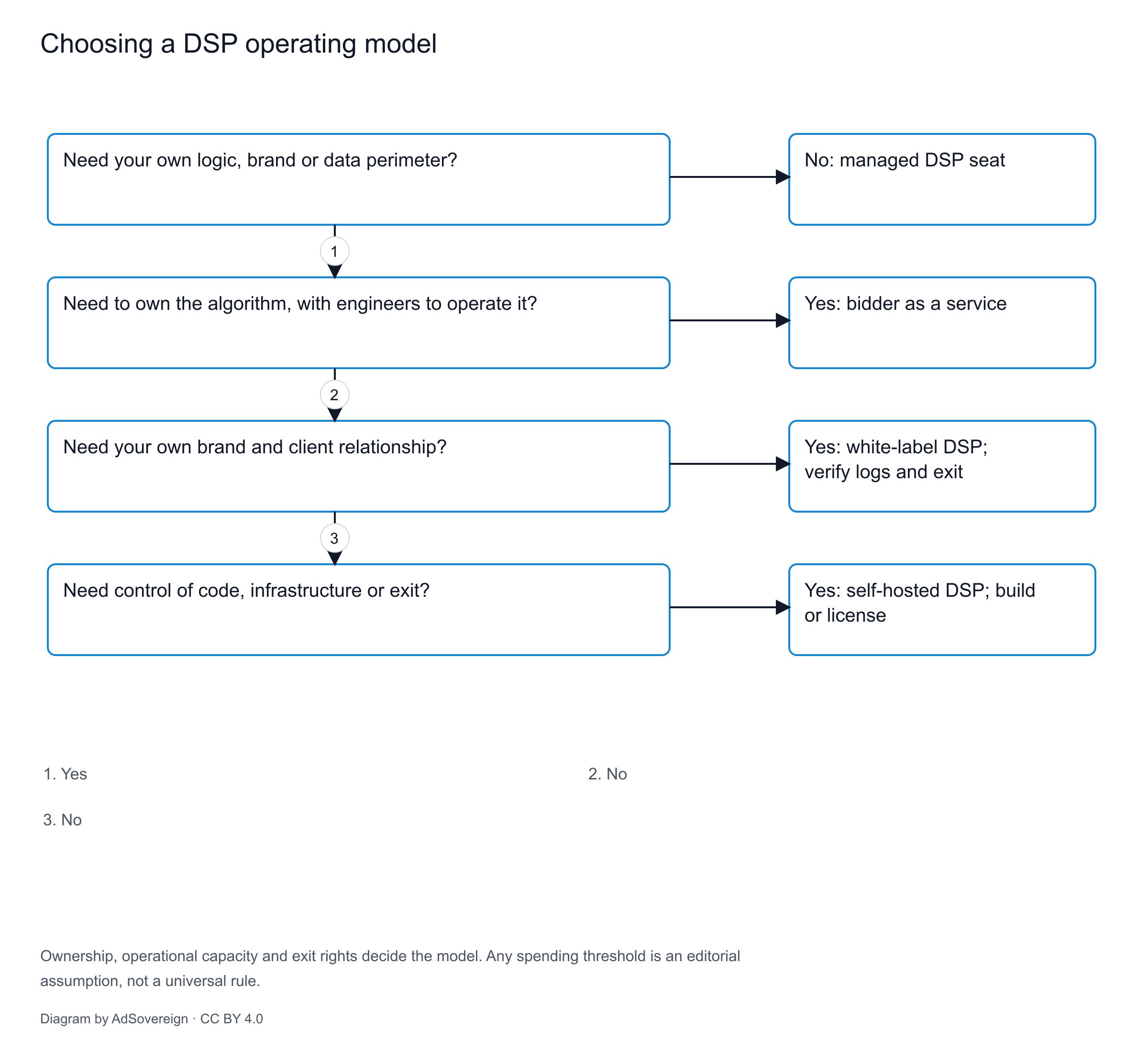
Work through the four questions in order. Stop at the first "no".
- Do you need your own bidding logic, or your own brand, or your own data perimeter? If none of the three, you do not need any of these models; a self-serve seat on a managed DSP is cheaper. The in-housing surveys show most brands stop here: 13% of US brands run programmatic fully in-house and 26% use a hybrid, per the ANA's 2023 benchmark (Digiday, 9 February 2026); the trend is in brands bringing programmatic in-house.
- Is the thing you must own the algorithm? If yes, and you have engineers who can write a bidding agent that answers in 10 ms (FreeWheel docs, 12 August 2026), bidder-as-a-service fits. If you do not have those engineers, a white-label DSP with configurable optimization is the realistic choice.
- Is the thing you must own the brand and the client relationship? If yes, and spend is below the vendors' own $50 million threshold (Epom, 11 September 2025), a white-label DSP fits. Put log-level access, data ownership and a sunset clause in the contract.
- Is the thing you must own the data perimeter, the code, or the exit? Data residency rules, a regulator, a closure you have lived through, or spend above the threshold all point to self-hosted. Budget for a build (BidsCube, 17 July 2026; Geomotiv, 5 May 2026) or for a licensed platform on your infrastructure, and read self-hosted DSP infrastructure requirements before you size it.
What Netflix, Lego and P&G did maps onto the same tree: none of them needed a bidder, two needed the data perimeter and the decision logic, and all three kept renting the pipes. The layer-by-layer account is in what Netflix, Lego and P&G built in-house.

Diagram by AdSovereign, CC BY 4.0.
Hybrids that exist in practice
The three models are often combined.
- White-label front, BaaS back. An agency runs a branded UI from a white-label vendor and plugs a proprietary model in through a bidding-agent interface. Only possible where the white-label vendor exposes such an interface; most do not advertise one.
- Self-hosted bidder, rented exchange access. A company runs its own bidder but reaches supply through a vendor's existing exchange integrations and seats, avoiding per-exchange certification. Geomotiv budgets $5,000–$15,000 a month for "SSP seat fees" in exactly this configuration (Geomotiv, 5 May 2026).
- Rented DSP, owned logs. The most common hybrid: a managed or white-label DSP with contractual log-level data delivered to the buyer's own warehouse. It is the setup the ANA's transparency work depends on, and it is where most of the working-media gains come from (ANA, 5 December 2023). For the deployment side of that choice, see managed vs on-premise: the right model.
FAQ
What is bidder-as-a-service? A single-tenant DSP delivered as software-as-a-service, where the vendor runs the bidder and the exchange connections and the customer plugs in its own bidding logic. FreeWheel's Beeswax, which trademarked the term, accepts "bidding agents" in any language that answer within 10 ms and run in the same AWS region as the Beeswax cloud (FreeWheel docs, updated 12 August 2026). FreeWheel agreed to acquire Beeswax on 17 December 2020, naming Uber, DraftKings and Nexstar as customers (FreeWheel, 17 December 2020).
What is a white-label DSP? A vendor-built DSP that a customer rebrands and operates as its own, usually on the vendor's infrastructure. Pricing is a flat monthly fee, a percentage of spend, or the higher of the two: Epom charges $250 or $2,000 a month or 5% of spend depending on plan (Epom, accessed 17 October 2026). Launch claims range from 48 hours (AdKernel) to 2–8 weeks (TeqBlaze, 27 September 2026). Our earlier white-label DSP deployment guide covers the deployment steps.
What is the difference between a white-label DSP and a self-serve DSP? A self-serve DSP is a seat on the vendor's own branded platform. A white-label DSP is the same class of software with your name on it and, usually, your clients inside it. The commercial difference is that a white-label customer resells or operates the platform, so the contract must cover branding, client data separation and exit. The technical core is often shared.
How much does a white-label DSP cost? Published entry prices are low: $250 a month at Epom's Light tier, with 5% of spend above that, plus a $500 set-up fee (Epom, accessed 17 October 2026). TeqBlaze's market summary puts a typical commercial setup at $2,000–$15,000 a month and enterprise at $15,000–$50,000+ a month, usually with a set-up fee (TeqBlaze, 27 September 2026). The cost that matters at scale is the percentage of spend, which is why both Epom and TeqBlaze cite a $50 million annual spend as the point where owning starts to make sense (Epom, 11 September 2025; TeqBlaze, 8 March 2026).
Can I move from a white-label DSP to my own platform later? Yes, if the contract lets you take your data with you. The practical blockers are log retention, export formats and switching fees, not the software. In the EU the Data Act caps the notice period at two months, requires a 30-day transition and prohibits switching charges from 12 January 2027 for data-processing services (Regulation (EU) 2023/2854, Articles 25 and 29). Outside the EU, negotiate the same terms. Microsoft Invest's closure, announced 14 May 2025 and effective 28 February 2026, shows how little time a buyer may get (PPC Land, 22 June 2025).
How this works on owned infrastructure
The self-hosted column above is mostly custom development today because few vendors will put a full DSP on a customer's infrastructure with the data perimeter intact. AdSovereign is one that does: an enterprise RTB stack (DSP, SSP, exchange, DMP and clean room) deployed on-premise or in the customer's own cloud account, with the bidder, the logs and the audiences inside the customer's perimeter and no percentage-of-spend fee. It is the fourth row in the decision tree for buyers who answered "yes" to the data perimeter, the code or the exit. The architecture page describes the deployment, security the controls, use cases the fits and misfits, the TCO calculator the cost model, and the pilot page a 60-day evaluation. This comparison stays neutral; the product is mentioned only here.
Sources
- FreeWheel, "FreeWheel to Acquire Ad Tech Leader Beeswax" (17 December 2020). https://www.freewheel.com/news/freewheel-to-acquire-ad-tech-leader-beeswax
- Beet.TV, "FreeWheel Buying Beeswax To Enable Publisher Audience Extension" (18 December 2020). https://www.beet.tv/2020/12/freewheel-buying-beeswax-to-boost-ad-demand.html
- Beeswax, "DSP Solutions" product page (accessed 17 October 2026). https://www.beeswax.com/products/
- FreeWheel Advertiser API docs, "Bidding Agent" (updated 12 August 2026). https://api-docs.freewheel.tv/advertiser/docs/bidding-agent
- Epom, "Ad Server & DSP Pricing" (accessed 17 October 2026). https://epom.com/pricing/dsp
- Epom, "White-Label DSP Comparison 2026: 7 Platforms Side by Side" (accessed 17 October 2026). https://epom.com/demand-side-platform-comparison
- Epom, "How to Build Your Own DSP and Is It Even Worth It?" (11 September 2025). https://epom.com/blog/dsp/how-to-build-your-own-dsp
- TeqBlaze, "Build Your Own DSP on TeqBlaze's White Label DSP Core" (accessed 17 October 2026). https://teqblaze.com/white-label-dsp
- TeqBlaze, "How Much Does it Cost to Develop a White-label Advertising Platform?" (27 September 2026). https://teqblaze.com/blog/wls-development-cost
- TeqBlaze, "Build a Demand-Side Platform: Step-by-Step Roadmap (Build vs Buy)" (8 March 2026). https://teqblaze.com/blog/how-to-set-up-your-own-dsp
- BidsCube, "How to Build a DSP: Step-by-Step Guide to DSP Development" (17 July 2026). https://bidscube.com/blog/how-to-build-a-dsp/
- Geomotiv, "How to Build Your Own DSP: Step-by-Step Guide to Building a Custom Demand-Side Platform" (5 May 2026). https://geomotiv.com/blog/how-to-build-your-own-dsp-step-by-step-guide-to-building-a-custom-demand-side-platform/
- AdKernel, "White-Label DSP Platform" (accessed 17 October 2026). https://adkernel.com/dsp-suite/
- StackAdapt, "Build your own advertising platform with the StackAdapt API" (accessed 17 October 2026). https://www.stackadapt.com/enterprise-api-solution
- StackAdapt, "Ansira selects StackAdapt as strategic DSP partner" (13 August 2026). https://www.stackadapt.com/resources/blog/ansira-partnership
- Basis Technologies, "The Keys to Bringing Programmatic Advertising In-House" (10 September 2021), citing Forrester Consulting, "The Total Economic Impact of In-Housing with Basis" (23 July 2021). https://basis.com/blog/the-keys-to-bringing-programmatic-advertising-in-house
- Viant Technology, "Viant Completes Integration of Adelphic into Viant Advertising Cloud" (4 May 2017). https://www.viantinc.com/company/news/press-releases/viant-completes-integration-of-adelphic-into-viant-advertising-cloud/
- Clearcode, clearcode.cc (301 redirect to avenga.com observed 17 October 2026). https://clearcode.cc/
- GitHub, benmfaul/XRTB (RTB4FREE), README marked retired (accessed 17 October 2026). https://github.com/benmfaul/XRTB
- MediaPost, "Microsoft To Shutter DSP, Formerly Xandr" (14 May 2025). https://www.mediapost.com/publications/article/405873/microsoft-to-shutter-dsp-formerly-xandr-replace.html
- PPC Land, "Microsoft's Xandr DSP closure opens doors for independent players" (22 June 2025). https://ppc.land/microsofts-xandr-dsp-closure-opens-doors-for-independent-players/
- Regulation (EU) 2023/2854 (Data Act), Articles 25, 29 and 50, EUR-Lex. https://eur-lex.europa.eu/legal-content/EN/TXT/?uri=CELEX:32023R2854
- European Commission, "Data Act" policy page (entry into force 11 January 2024, application 12 September 2025). https://digital-strategy.ec.europa.eu/en/policies/data-act
- ANA Programmatic Transparency Benchmark, Q2 2026 findings, release reprinted by Fiducia (6 August 2026). https://www.fiducia.eco/post/ana-programmatic-transparency-benchmark-q2-2026-working-media-efficiency-reaches-a-record-45
- ANA, Programmatic Media Supply Chain Transparency Study, complete report (5 December 2023). https://ana.net/programmatic
- Digiday, "The case for and against bringing programmatic in-house" (9 February 2026). https://digiday.com/media-buying/the-case-for-and-against-bringing-programmatic-in-house/
Changelog
18 October 2026: aligned the title and heading and applied recorded source-URL corrections where needed. Factual research cutoff remains 17 October 2026.
17 October 2026. First edition: three definitions, nine-dimension comparison table, 11 vendors across three categories, four-question decision tree. Next review 15 April 2027.