
In-House Programmatic
Managed vs Self-Hosted Ad Tech: Which Model Fits You?
Published · Last updated
Next scheduled review:
Choose an ad tech operating model by the responsibilities your team can sustain. Managed services outsource operations; white-label platforms add branding and customer control; self-hosted systems move more operational responsibility to you. Compare data rights, integration freedom, staffing, incident response and exit terms alongside the commercial proposal.
Contents
Key facts
- Bidder-as-a-service is a single-tenant rental with a plug-in slot. FreeWheel's Beeswax, the company that trademarked the term, requires custom bidding agents to answer within 10 ms and to run in the same AWS region as the Beeswax cloud (FreeWheel API docs, updated 12 August 2026). FreeWheel called it a "software as a service (SaaS) advertising company" when it agreed to buy it on 17 December 2020 (FreeWheel, 17 December 2020).
- White-label DSPs start cheap and charge on spend. Epom's Light plan is $250 per month or 5% of ad spend, whichever is higher, with a $500 set-up fee; Pro is $2,000 per month or 5% (Epom pricing page, accessed 17 October 2026). TeqBlaze puts a typical rented white-label at $2,000–$15,000 per month and enterprise tiers at $15,000–$50,000+ per month (TeqBlaze, 27 September 2026).
- Launch claims run from 48 hours to 8 weeks. AdKernel claims "as little as 48 hours" (AdKernel, accessed 17 October 2026), Epom "under 2 weeks" (Epom comparison, accessed 17 October 2026), TeqBlaze "2–3 weeks" (TeqBlaze, accessed 17 October 2026). All are company claims.
- A build is a different order of magnitude. BidsCube prices an MVP at $150K–$400K over 6–12 months and a full platform at $500K–$1.5M+ over 12–24 months, plus $20K–$80K a month to run (BidsCube, 17 July 2026). Geomotiv puts the upfront build at $550K–$900K and the monthly burn at $35K–$100K+ (Geomotiv, 5 May 2026).
- Rented platforms can close. Microsoft announced on 14 May 2025 that Microsoft Invest would shut on 28 February 2026 (PPC Land, 22 June 2025).
- In the EU, exit terms are now regulated. The Data Act applies from 12 September 2025, caps the notice period for switching data-processing services at two months, sets a 30-day transition and prohibits switching charges from 12 January 2027 (Regulation (EU) 2023/2854, Articles 25, 29 and 50).
Definition
An advertising operating model is the assignment of software, infrastructure, media operations, data governance and incident-response responsibilities among participating organizations.

Diagram by AdSovereign, CC BY 4.0.
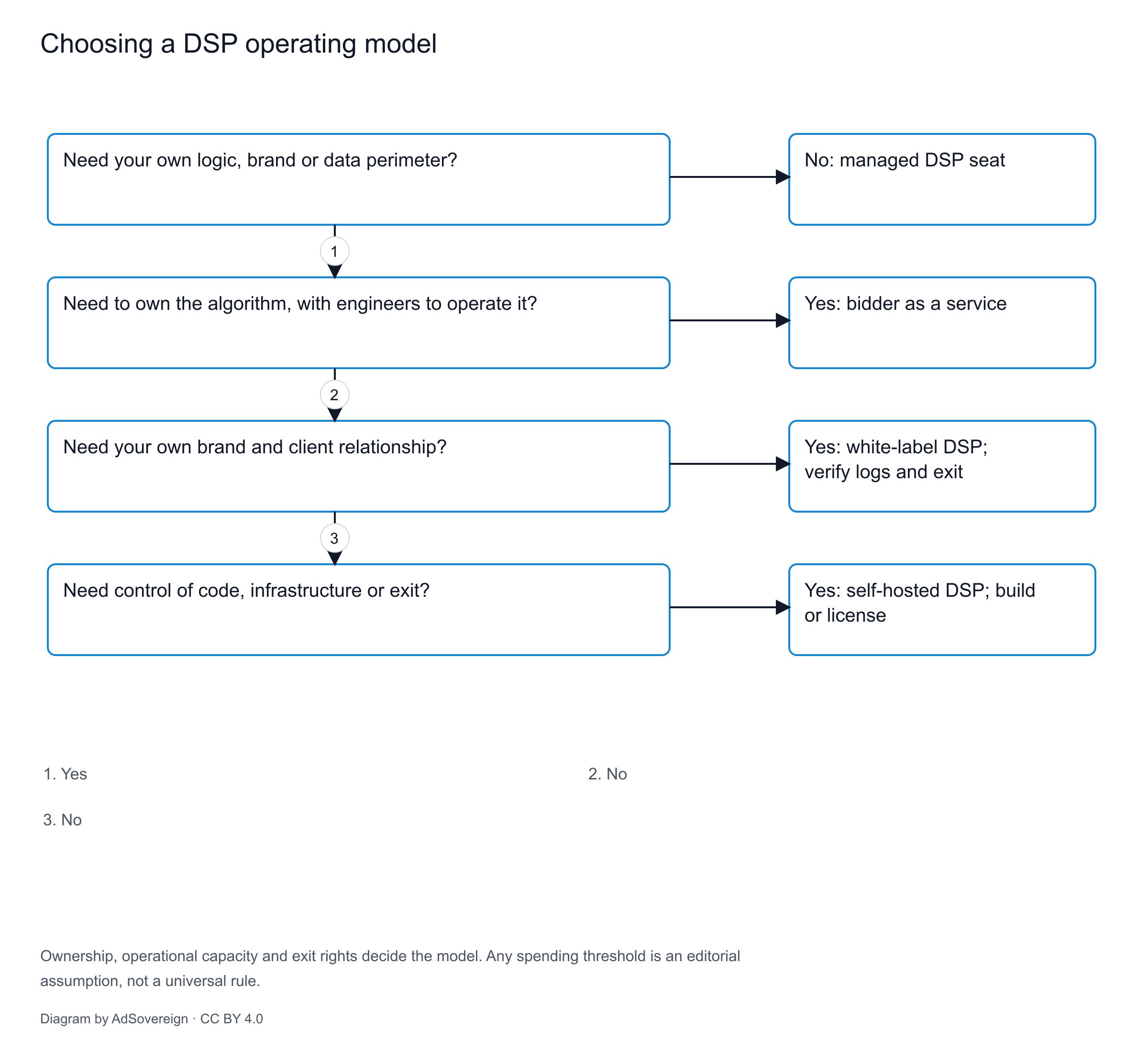
Evaluate the workflow
Every enterprise faces the same question: Should we use a managed DSP (SaaS model), build on-premise infrastructure, or adopt a hybrid approach? The answer depends on your data sensitivity, budget, scale, and tolerance for operational complexity. This guide provides the decision framework, with real TCO numbers.
Defining Managed vs on-premise vs Hybrid
Managed DSP (SaaS)
Vendor operates all infrastructure. You access via web interface or API. Subscription pricing with per-impression fees.
Who operates:Data ownership:Customization:On-Premise
You operate infrastructure on your own servers (bare metal or private cloud). Perpetual license or annual subscription.
Who operates:Data ownership:Customization:Hybrid
Critical components on-premise (user data, budgets), non-sensitive functions in cloud (creative hosting, reporting).
Who operates:Data ownership:Customization:The Control vs Convenience Trade-Off
| Factor | Managed DSP | On-Premise | Hybrid |
|---|---|---|---|
| Infrastructure Control | None | Full control | Partial |
| Compliance Posture | Shared responsibility | Full control | Custom per component |
| Scalability | Elastic (vendor managed) | Manual scaling | Semi-elastic |
| Customization | Limited (UI only) | Unlimited (source code) | Moderate (config) |
| Vendor Lock-In | High (data portability) | None (own everything) | Low (partial) |
| Performance Predictability | Shared (multi-tenant) | Dedicated (isolated) | Variable |
| Security Surface | External (vendor) | Internal (you control) | Both (split) |
| Operational Burden | Low (vendor handles) | High (DevOps required) | Medium (split) |
When Hybrid Makes Sense
Use Case 1: Publisher with On-Site + Off-Site Inventory
On-Premise Components:
- First-party user data & segments (DMP)
- Direct deal management (SSP)
- Private marketplace (PMP)
- User ID graph & attribution
Cloud Components:
- Header bidding wrapper (external SSPs)
- Creative hosting & CDN
- Reporting dashboards
Use Case 2: Retailer with Physical + Digital Properties
On-Premise Components:
- Shopper data & loyalty profiles
- In-store attribution (purchase data)
- Data clean room for CPG brands
- Sensitive compliance data
Cloud Components:
- Offsite display campaigns (retargeting)
- Social media integrations
- Third-party audience extension
- Analytics & BI tools
Result: Monetize shopper data securely, scale offsite campaigns elastically.
Use Case 3: Enterprise with Global + Regional Operations
On-Premise (Core Markets):
- EU operations (GDPR compliance)
- Healthcare verticals (HIPAA)
- Financial services (PCI-DSS)
- Government contracts
Cloud (Expansion Markets):
- Latin America expansion
- APAC test markets
- Non-regulated verticals
- Campaign experimentation
Result: Compliance in regulated markets, speed-to-market in expansion regions.
return on investment Benchmarks from Real Deployments
Break-Even Analysis
Break-even point:
Decision Framework Flowchart
Use this decision tree to determine the optimal deployment model for your organization.
┌────────────────────────────────────────────────────────────┐
│  DEPLOYMENT MODEL DECISION TREE                            │
├────────────────────────────────────────────────────────────┤
│                                                            │
│  START: What's your annual ad spend?                       │
│                                                            │
│      < $5M/year                                            │
│         └─► MANAGED DSP (fastest return on investment)                      │
│                                                            │
│      $5M - $20M/year                                       │
│         └─► Do you have regulated data? (GDPR, HIPAA)      │
│               ├─ YES → HYBRID or on-premise                   │
│               └─ NO  → Do you need customization?          │
│                         ├─ YES → HYBRID                    │
│                         └─ NO  → MANAGED DSP               │
│                                                            │
│      > $20M/year                                           │
│         └─► Do you have DevOps capacity?                   │
│               ├─ YES → on-premise (best TCO)                  │
│               └─ NO  → HYBRID (balance)                    │
│                                                            │
│  ADDITIONAL FILTERS:                                       │
│                                                            │
│  ▸ Vendor lock-in acceptable?                              │
│    NO → on-premise or HYBRID (avoid managed)                  │
│                                                            │
│  ▸ Need sub-100ms latency guarantee?                       │
│    YES → on-premise (dedicated infrastructure)                │
│                                                            │
│  ▸ Multi-region compliance requirements?                   │
│    YES → HYBRID (on-premise for regulated, cloud elsewhere)   │
│                                                            │
│  ▸ Budget for 6-12 month deployment?                       │
│    NO → MANAGED DSP or HYBRID (faster launch)              │
│                                                            │
└────────────────────────────────────────────────────────────┘
Schedule a Strategy Session
Book Strategy CallKey Takeaways
- ✓ No one-size-fits-all: managed wins for speed, on-premise wins for scale/control, hybrid balances both
- ✓ Hybrid deployments make sense for compliance + elasticity requirements
- ✓ Data sovereignty and vendor lock-in are often the deciding factors for enterprises
- ✓ TCO analysis must include hidden costs: take rates, integration overhead, vendor switching
Read the current references
Read the in house programmatic guide for the broader decision framework.
FAQ
What is bidder-as-a-service?
What is a white-label DSP?
What is the difference between a white-label DSP and a self-serve DSP?
How much does a white-label DSP cost?
Can I move from a white-label DSP to my own platform later?
How this works on owned infrastructure
A managed-versus-owned comparison of AdSovereign should begin with a responsibility matrix for campaign operations, infrastructure, updates, data governance and incidents. Map those responsibilities to the architecture, then identify the skills and coverage your team would need. Review provider access and escalation boundaries through the security assessment. Demand contracts, reporting obligations and exit work belong in the commercial comparison as well as the software evaluation. A deployment review should test the work your operators must perform during normal use and failures. Choose the arrangement supported by that evidence rather than assuming that more infrastructure ownership is automatically the better operating model.
Component licensing, inclusions and payment terms are published on the pricing page.
Sources
- FreeWheel, "FreeWheel to Acquire Ad Tech Leader Beeswax" (17 December 2020). https://www.freewheel.com/news/freewheel-to-acquire-ad-tech-leader-beeswax
- Beet.TV, "FreeWheel Buying Beeswax To Enable Publisher Audience Extension" (18 December 2020). https://www.beet.tv/2020/12/freewheel-buying-beeswax-to-boost-ad-demand.html
- Beeswax, "DSP Solutions" product page (accessed 17 October 2026). https://www.beeswax.com/products/
- FreeWheel Advertiser API docs, "Bidding Agent" (updated 12 August 2026). https://api-docs.freewheel.tv/advertiser/docs/bidding-agent
- Epom, "Ad Server & DSP Pricing" (accessed 17 October 2026). https://epom.com/pricing/dsp
- Epom, "White-Label DSP Comparison 2026: 7 Platforms Side by Side" (accessed 17 October 2026). https://epom.com/demand-side-platform-comparison
- Epom, "How to Build Your Own DSP and Is It Even Worth It?" (11 September 2025). https://epom.com/blog/dsp/how-to-build-your-own-dsp
- TeqBlaze, "Build Your Own DSP on TeqBlaze's White Label DSP Core" (accessed 17 October 2026). https://teqblaze.com/white-label-dsp
- TeqBlaze, "How Much Does it Cost to Develop a White-label Advertising Platform?" (27 September 2026). https://teqblaze.com/blog/wls-development-cost
- TeqBlaze, "Build a Demand-Side Platform: Step-by-Step Roadmap (Build vs Buy)" (8 March 2026). https://teqblaze.com/blog/how-to-set-up-your-own-dsp
More sources (16)
- BidsCube, "How to Build a DSP: Step-by-Step Guide to DSP Development" (17 July 2026). https://bidscube.com/blog/how-to-build-a-dsp/
- Geomotiv, "How to Build Your Own DSP: Step-by-Step Guide to Building a Custom Demand-Side Platform" (5 May 2026). https://geomotiv.com/blog/how-to-build-your-own-dsp-step-by-step-guide-to-building-a-custom-demand-side-platform/
- AdKernel, "White-Label DSP Platform" (accessed 17 October 2026). https://adkernel.com/dsp-suite/
- StackAdapt, "Build your own advertising platform with the StackAdapt API" (accessed 17 October 2026). https://www.stackadapt.com/enterprise-api-solution
- StackAdapt, "Ansira selects StackAdapt as strategic DSP partner" (13 August 2026). https://www.stackadapt.com/resources/blog/ansira-partnership
- Basis Technologies, "The Keys to Bringing Programmatic Advertising In-House" (10 September 2021), citing Forrester Consulting, "The Total Economic Impact of In-Housing with Basis" (23 July 2021). https://basis.com/blog/the-keys-to-bringing-programmatic-advertising-in-house
- Viant Technology, "Viant Completes Integration of Adelphic into Viant Advertising Cloud" (4 May 2017). https://www.viantinc.com/company/news/press-releases/viant-completes-integration-of-adelphic-into-viant-advertising-cloud/
- Clearcode, clearcode.cc (301 redirect to avenga.com observed 17 October 2026). https://clearcode.cc/
- GitHub, benmfaul/XRTB (RTB4FREE), README marked retired (accessed 17 October 2026). https://github.com/benmfaul/XRTB
- MediaPost, "Microsoft To Shutter DSP, Formerly Xandr" (14 May 2025). https://www.mediapost.com/publications/article/405873/microsoft-to-shutter-dsp-formerly-xandr-replace.html
- PPC Land, "Microsoft's Xandr DSP closure opens doors for independent players" (22 June 2025). https://ppc.land/microsofts-xandr-dsp-closure-opens-doors-for-independent-players/
- Regulation (EU) 2023/2854 (Data Act), Articles 25, 29 and 50, EUR-Lex. https://eur-lex.europa.eu/legal-content/EN/TXT/?uri=CELEX:32023R2854
- European Commission, "Data Act" policy page (entry into force 11 January 2024, application 12 September 2025). https://digital-strategy.ec.europa.eu/en/policies/data-act
- ANA Programmatic Transparency Benchmark, Q2 2026 findings, release reprinted by Fiducia (6 August 2026). https://www.fiducia.eco/post/ana-programmatic-transparency-benchmark-q2-2026-working-media-efficiency-reaches-a-record-45
- ANA, Programmatic Media Supply Chain Transparency Study, complete report (5 December 2023). https://ana.net/programmatic
- Digiday, "The case for and against bringing programmatic in-house" (9 February 2026). https://digiday.com/media-buying/the-case-for-and-against-bringing-programmatic-in-house/