
RTB Architecture
RTB Architecture Explained: DSP, SSP, Exchange, Bidstream
Published · Last updated
Next scheduled review:
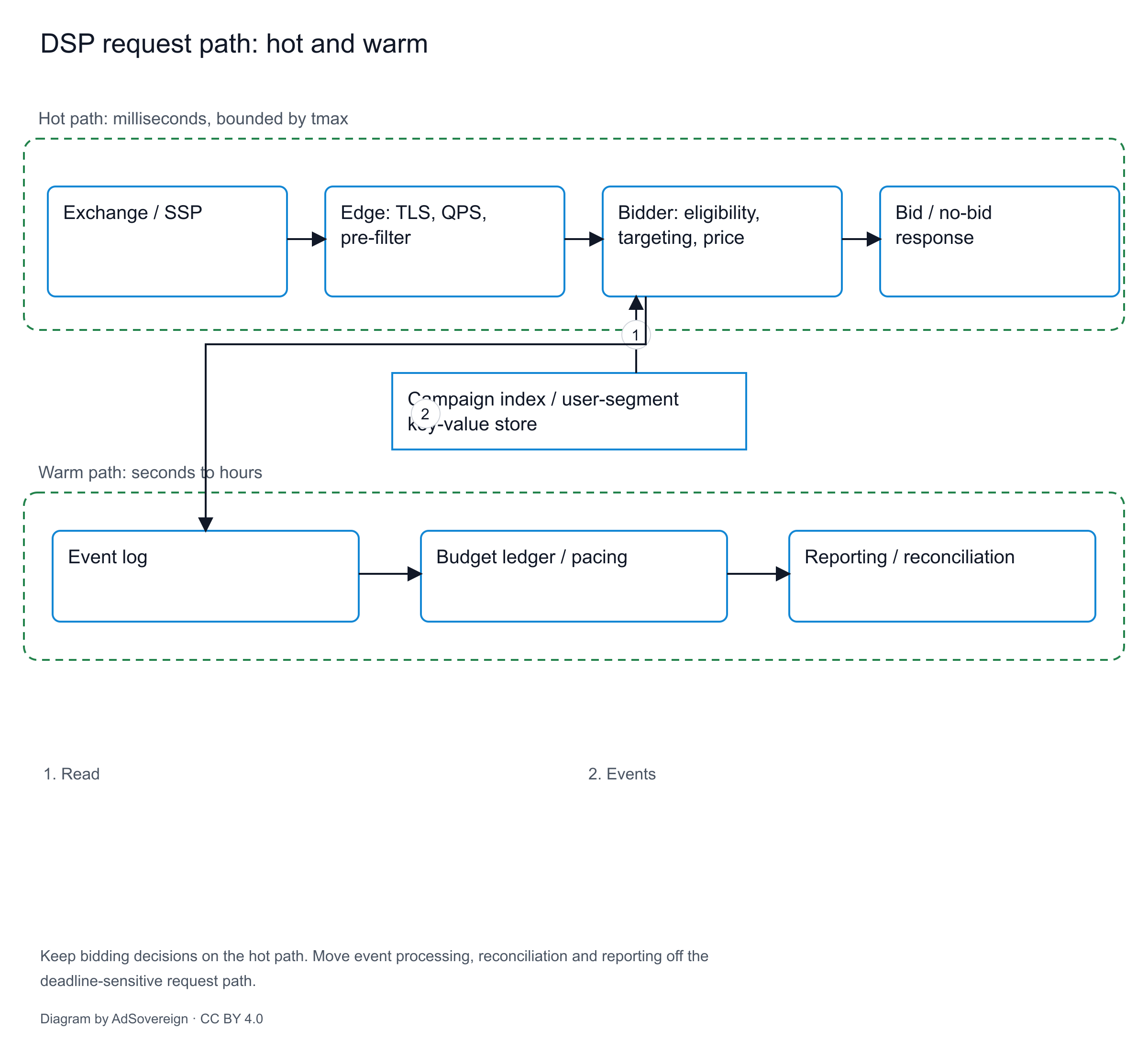
RTB architecture connects a publisher’s available impression with an exchange and demand-side platforms in a deadline-bound auction. The request carries information about inventory, permitted identity and commercial terms. The response supplies a bid or declines. Separate the time-critical request path from logging, budget reconciliation and reporting.
Key facts
- The only audited DSP take rate is The Trade Desk's. Revenue of $2,896.3 million on gross platform spend of $13,394.7 million in 2025 implies 21.6%, up from 20.3% in 2024 ($2,444.8 million on $12,040.9 million) (The Trade Desk 10-K, FY2025). The company says its take rate is "consistently around 20%" (AdExchanger, 28 April 2025).
- Regulator data puts self-service DSP fees at 4% to 16% and managed DSPs at 20% to 42%. The UK CMA's 2019 fee data gave a weighted DSP average of 14% and a DV360 range of 5% to 15% plus third-party fees (CMA, Appendix R, 1 July 2020).
- Amazon's managed service is reported at a $50,000 minimum with a 15% service fee and a 10% platform fee, per documentation summarised in July 2025; the buying product was renamed DVA inside Amazon Ads Agent on 29 September 2026 (PPC Land, 15 October 2026).
- Third-party data is a second fee layer. Google's DV360 help pages quote $0.50 to more than $2 CPM for third-party lists (Google DV360 Help, accessed 17 October 2026). The Trade Desk's Audience Unlimited charges 3.3% or 4.4% of impression cost in Control Mode and says heavy data users spend "nearly 20%" of media on data (PPC Land, 29 September 2025).
- In the ANA's log-level benchmark, DSP platform fees averaged 6.0% of spend and DSP data costs 2.7% in Q3 2025, with SSP platform fees at 12.8% (ANA Programmatic Transparency Benchmark, Q3 2025).
- Flat-fee software starts at $250 a month. Epom's white-label DSP is $250 or $2,000 a month or 5% of ad spend, whichever is higher, with a possible $500 setup fee (Epom DSP pricing, accessed 17 October 2026). Beeswax charges "a flat fee based on tech usage instead of a spend fee" (PPC Land, 17 December 2020).
Definition
RTB architecture is the request, auction, response and event-processing system that connects available publisher impressions with time-limited advertiser bids.

Diagram by AdSovereign, CC BY 4.0.
Evaluate the workflow
The RTB Ecosystem Map
RTB is an automated marketplace connecting advertisers who want to buy impressions with publishers who want to sell them. The ecosystem has four core components:
- DSP (Demand-Side Platform): Where advertisers manage campaigns and submit bids
- SSP (Supply-Side Platform): Where publishers manage inventory and accept bids
- Ad Exchange: The marketplace that routes bid requests and runs auctions
- DMP (Data Management Platform): Where audience data is stored and activated
Think of it like stock trading: the DSP is your brokerage, the SSP is the listing service, the exchange is NASDAQ, and the DMP is your research database. All of this operates in real-time as users load web pages or apps.
DSP Architecture & Bidding Logic
A DSP's core job is deciding which impressions to bid on and how much to pay. This happens through several interconnected systems:
Campaign Management Layer: Stores advertiser goals, budgets, targeting rules, and creative assets. This is the UI layer where marketers configure campaigns.
Optimization System: Continuously analyzes campaign performance (CTR, conversion rate, CPA) and adjusts bid strategies. Modern systems use reinforcement learning to maximize ROI within budget constraints.
Reporting Pipeline: Processes billions of impression, click, and conversion events daily, feeding dashboards and attribution models.
SSP & Publisher Integration
An SSP (Supply-Side Platform) is responsible for managing publisher inventory and auction logic, including floor pricing, header bidding integration, and yield optimization. At the architecture level, the SSP sits between publisher inventory and the exchange, managing auction mechanics and demand source prioritization.
Inventory Management: Publishers define floor prices, block lists (sensitive categories, competitor brands), and deal IDs for preferred buyers. Private Marketplaces (PMPs) use deal IDs to route specific inventory to preferred buyers at negotiated prices, bypassing open auction competition.
Yield Optimization: SSPs use machine learning to predict which demand sources will pay the most for each impression, dynamically routing inventory to maximize revenue. Unlike fragmented multi-vendor stacks, unified SSPs can optimize across all demand sources simultaneously, reducing latency and improving fill rates.
Ad Quality Filtering: Scans creatives for malware, policy violations, and performance issues before serving them to users.
Ad Exchange Mechanics
The exchange is the core routing and auction infrastructure. Here's how a typical transaction works:
The Bidstream: OpenRTB Protocol
OpenRTB is the universal language of programmatic advertising. It's a JSON-based protocol that defines how bid requests and responses are structured. A typical request includes:
- Site/app details (URL, category, publisher ID)
- User context (device type, IP, language, segments)
- Ad placement specs (size, format, position)
- Regulatory flags (COPPA, GDPR consent strings)
Responses contain bid price, creative markup (HTML/VAST), impression tracking URLs, and win notification endpoints. Mastering OpenRTB is essential for building or integrating RTB infrastructure.
DMP & Audience Targeting
A DMP acts as an activation layer for audience data, not just a data store, but the system that makes segments available for real-time bidding decisions. Within the bidstream, DMPs enable real-time segment activation, making audience data immediately available for bid decisions without cross-system sync delays.
Data Ingestion: DMPs consume data from CRMs, websites, apps, and external providers. Identity resolution systems within DMPs match records across sources using deterministic (email, device ID) and probabilistic models, creating unified user profiles for cross-channel targeting. Modern DMPs implement consent-aware storage, automatically respecting opt-out signals and GDPR/CCPA requirements at the segment level.
Activation: Segments sync to DSPs in real-time. During the DMP segment lookup phase, the DSP checks if the user matches any target segments and adjusts bid accordingly. Enterprise DMPs increasingly integrate with data clean rooms, enabling privacy-safe audience collaboration without exposing raw customer records.
Multi-DSP Environments & Demand Orchestration
In multi-DSP environments, demand orchestration becomes more important than raw bidding power, the ability to route bid requests to the right DSP at the right time determines overall performance. Enterprises increasingly deploy multiple DSPs: internal DSPs for first-party campaigns where data sovereignty is critical, and external DSPs for reach extension and access to exclusive inventory.
Demand Arbitration: Bid routers determine which DSP receives each request based on campaign targeting, historical performance, and budget constraints. Unlike single-DSP setups where demand is limited to one source, multi-DSP orchestration can route requests to internal vs external DSPs based on performance history and bid patterns.
Bid Routing Logic: At the architecture level, orchestration layers evaluate incoming bid requests and determine optimal routing. Factors include campaign match rate, historical win rate, current budget utilization, and latency constraints. The DMP serves as the central audience repository, syncing segments to each DSP while maintaining consistent identity across demand sources.
On-Premise vs Cloud RTB Deployment
- Data leakage: your campaign and audience data flows to platform-owned DMPs
- Limited customization: you're locked into their features and roadmap
- Vendor dependency: switching costs are massive
On-premise RTB flips this model. You deploy DSP, SSP, exchange, and DMP on your infrastructure, cloud, on-prem, or hybrid. This means:
- Predictable costs: no percentage-based fees
- Full control: customize bidding algorithms, UI, and integrations
- Compliance-ready: meet data residency and audit requirements
Conclusion
RTB architecture is complex, but the core concepts are straightforward: DSPs buy, SSPs sell, exchanges match, and DMPs inform. As data privacy regulations tighten and platform fees rise, enterprises that own their RTB stack will capture competitive advantages impossible for those renting infrastructure. The question is no longer whether to build your own, it's how fast you can deploy.
Read the current references
Read the rtb architecture guide for the broader decision framework.
FAQ
How much does Amazon DSP cost? Amazon does not publish a rate card. Its product page says "Your current pricing structure is carried forward" into Amazon Ads Agent and refers pricing questions to an account executive (Amazon Ads, accessed 17 October 2026). Documentation summarised in July 2025 put the managed service at a $50,000 minimum, a 15% service fee and a 10% platform fee (PPC Land, 15 October 2026). Reports on the self-service minimum conflict: one dated guide says Amazon removed it in November 2025 (Nova Data, updated 8 October 2026), while Digiday reported on 11 November 2025 that the DSP kept its minimums (PPC Land, 15 October 2026). Ask for both in writing.
What is The Trade Desk's take rate? About one fifth of spend. Revenue of $2,896.3 million against gross spend of $13,394.7 million in 2025 implies 21.6%, and 20.3% in 2024 (The Trade Desk 10-K, FY2025). The company said in April 2025 that the rate "has been consistently around 20% of spend on our platform" (AdExchanger, 28 April 2025). Individual contracts vary; Needham has estimated a 12% to 15% range for the platform fee alone (PPC Land, 4 September 2026).
Does DV360 charge a platform fee? Yes, but Google does not publish it. The UK CMA, using 2019 data supplied by Google, estimated the DV360 take rate at 5% to 15% plus third-party fees (CMA, Appendix R, 1 July 2020). Google's own help pages are specific only about data: third-party lists cost "$0.50 to more than $2 CPM" (Google DV360 Help, accessed 17 October 2026).
How much does it cost to start a DSP? From $250 a month for a white-label front end with a 5% of spend floor (Epom DSP pricing, accessed 17 October 2026), to a usage-based flat fee for a bidder-as-a-service (PPC Land, 17 December 2020), to a build whose cost is staff and infrastructure rather than a license. No vendor publishes a bidder-as-a-service or self-hosted price; the figure comes from an RFP.
Are DSP fees negotiable? Yes. The Trade Desk's filing lists "pricing competition, volume discounts and shifts in media, client and channel mix" among the reasons its revenue may not grow in line with spend (The Trade Desk 10-K, FY2025). The CMA found DSP take rates ranging from 5% to 42% across platforms in 2019 (CMA, Appendix R, 1 July 2020). What is rarely negotiable without log-level data is visibility into the fees taken after the DSP.
How this works on owned infrastructure
AdSovereign provides an enterprise RTB stack for deployment inside a customer’s own infrastructure. Use the architecture to map the relevant components, the security controls to evaluate access and data boundaries, and the pilot to define a bounded evaluation. Compare the operating responsibilities and commercial terms against your own requirements. Infrastructure control does not establish demand access, legal permission or a measured performance improvement on its own.
Sources
- The Trade Desk, Inc., Form 10-K for fiscal year 2025 (filed February 2026). https://www.sec.gov/Archives/edgar/data/1671933/000167193326000014/ttd-20251231.htm
- PPC Land, "Trade Desk posts $2.9B in 2025 revenue but growth slows to 18%" (27 February 2026). https://ppc.land/trade-desk-posts-2-9b-in-2025-revenue-but-growth-slows-to-18/
- AdExchanger, "As CTV Blooms, It's Knives Out For The Trade Desk's Take Rate" (28 April 2025). https://www.adexchanger.com/online-advertising/as-ctv-blooms-its-knives-out-for-the-trade-desks-take-rate/
- PPC Land, "Explaining take rate" (4 September 2026). https://ppc.land/take-rate/
- PPC Land, "The Trade Desk launches data marketplace overhaul with AI scoring" (29 September 2025). https://ppc.land/the-trade-desk-launches-data-marketplace-overhaul-with-ai-scoring/
- Amazon Ads, Amazon DSP / Amazon Ads Agent product page (accessed 17 October 2026). https://advertising.amazon.com/solutions/products/amazon-dsp
- PPC Land, "Meta named a future that never came. Amazon Ads Agent names one that exists" (15 October 2026). https://ppc.land/meta-named-a-future-that-never-came-amazon-ads-agent-names-one-that-exists/
- Nova Data, "Amazon DSP guide 2026: minimum spend, setup, benchmarks" (published 6 November 2025, updated 8 October 2026). https://novadata.io/resources/blog/amazon-dsp-guide
- Media Planning Tool, "Amazon DSP Review 2026" (accessed 17 October 2026). https://www.mediaplanningtool.com/amazon-dsp
- Amazon Ads, "unBoxed 2025 recap" (11 November 2025). https://advertising.amazon.com/library/news/unboxed-2025-recap
- Google, Display & Video 360 Help, "Tips for using third-party audience lists" (accessed 17 October 2026). https://support.google.com/displayvideo/answer/6212219?hl=en
- Google, Display & Video 360 Help, "About commerce audiences" (accessed 17 October 2026). https://support.google.com/displayvideo/answer/16640028?hl=en
- UK Competition and Markets Authority, "Online platforms and digital advertising market study, Appendix R: fees in the adtech stack" (1 July 2020). https://assets.publishing.service.gov.uk/media/5fe49625e90e071207e10eff/Appendix_R_-_fees_in_the_adtech_stack_WEB.pdf
- StackAdapt, "Plans and packages" (accessed 17 October 2026). https://www.stackadapt.com/plans-and-packages
- Basis Technologies, platform page (accessed 17 October 2026). https://basis.com/technology/platform
- Epom, "DSP pricing" (accessed 17 October 2026). https://epom.com/pricing/dsp
- Epom, "White-label DSP" (accessed 17 October 2026). https://epom.com/demand-side-platform/white-label
- TeqBlaze, "White-label DSP" (accessed 17 October 2026). https://teqblaze.com/white-label-dsp
- PPC Land, "FreeWheel to acquire Beeswax" (17 December 2020). https://ppc.land/freewheel-to-acquire-beeswax/
- Beet.TV, "FreeWheel Buying Beeswax to Enable Publisher Audience Extension" (18 December 2020). https://www.beet.tv/2020/12/freewheel-buying-beeswax-to-boost-ad-demand.html
- Microsoft Learn, "Log Level Data Feeds" (updated 22 October 2025). https://learn.microsoft.com/en-us/xandr/log-level-data/log-level-data-feeds
- PPC Land, "Microsoft Monetize's survival bet: LinkedIn data on Amazon DSP CTV" (7 May 2026). https://ppc.land/microsoft-monetizes-survival-bet-linkedin-data-on-amazon-dsp-ctv/
- ANA and TAG TrustNet, "Programmatic Transparency Benchmark: Q3 2025 Benchmark Findings" (November 2025). https://s3.amazonaws.com/media.mediapost.com/uploads/Q32025ProgrammaticTransparencyBenchmark.pdf
- ANA and TAG TrustNet, "Programmatic Transparency Benchmark: Q1 2025 Benchmark Findings" (data to 31 March 2025). https://s3.amazonaws.com/media.mediapost.com/uploads/ANAQ12025Programmatic.pdf
- ISBA and PwC, "Programmatic Supply Chain Transparency Study, executive summary" (May 2020). https://www.isba.org.uk/system/files/media/documents/2020-12/executive-summary-programmatic-supply-chain-transparency-study.pdf
- Fiducia, "ANA Programmatic Transparency Benchmark: Q2 2026 Working-Media Efficiency Reaches a Record 45%" (ANA release of 6 August 2026). https://www.fiducia.eco/post/ana-programmatic-transparency-benchmark-q2-2026-working-media-efficiency-reaches-a-record-45
- Adalytics, "How much in fees are ad tech companies charging publishers & advertisers?" (April 2022; coverage in AdExchanger, 14 April 2022). https://adalytics.io/blog/adtech-supply-fees
Changelog
October 18, 2026: aligned the approved search title and heading; retained the original publication date.
October 17, 2026: updated search phrasing, source-linked reference context, author and dates. Withheld numerical claims without inline sources.