
In-House Programmatic
How to Build a DSP Platform in 2026: QPS, Team, Cost
Published · Last updated
Next scheduled review:
Building a DSP means connecting to exchanges that send millions of bid requests a second, answering each inside a deadline the exchange sets, pacing budgets across a distributed fleet, and logging every event so you can prove what you paid. This guide lays out the nine engineering steps, the team, the budget ranges and a 12-month plan, with sources.
Key facts
- The traffic is measured in millions of requests per second. Index Exchange estimates roughly 10 million bid requests per second across the internet and says typical DSP limits sit around 1 to 3 million QPS (Index Exchange, accessed 17 October 2026). A DSP "might tell an SSP to give it 6 million QPS" (AdExchanger, 17 January 2024).
- The deadline is the exchange's, not yours. OpenRTB 2.6 defines
tmaxas the "maximum time in milliseconds the exchange allows for bids to be received including Internet latency" (IAB Tech Lab, OpenRTB 2.6). Google's range is 80 to 1000 ms, and it throttles bidders that cannot deliver 85 percent of responses inside it (Google RTB test guide; Google RTB latency guide). - Published build costs disagree by two orders of magnitude. BidsCube: $150K–$400K for an MVP in 6–12 months (BidsCube, 17 July 2026). Geomotiv: $550K–$900K upfront plus $35K–$100K+ a month (Geomotiv, 5 May 2026). Epom: $1.5–2.5 million a year (Epom, 11 September 2025). TeqBlaze: "around $10–25 million" for a mid-scale platform (TeqBlaze, 8 March 2026).
- Infrastructure is the top line at scale. The Trade Desk spent $264 million on platform operations in the first nine months of 2023, and cloud servers are "usually one of the top costs for a DSP or SSP" (AdExchanger, 17 January 2024).
- The protocol question is settled. Google retired its proprietary RTB protocol on 1 May 2025, so every major exchange now speaks OpenRTB; version 2.6 dates from April 2022 and its latest dated release is 2.6-202606 of 11 June 2026 (PPC Land, 29 September 2026).
- Working media is still under half. The ANA's Q2 2026 benchmark put 45.1% of programmatic spend into qualified impressions, with 27.2% going to transaction costs (ANA Q2 2026 benchmark, 6 August 2026). A DSP you build has to make that number visible.
Definition
Demand-side platform (DSP): software that receives bid requests from ad exchanges and supply-side platforms, decides in real time whether and how much to bid on each impression on behalf of advertisers, serves the creative when it wins, and paces, reports and optimizes the campaigns that generated the bids.
A DSP is one of four systems in the real-time bidding chain; the others are the SSP, the exchange and the ad server. RTB architecture explained describes how they fit together and the distinction between the buy side and the sell side that confuses most first-time builders. This page belongs to the in-house programmatic hub.
What you are actually building
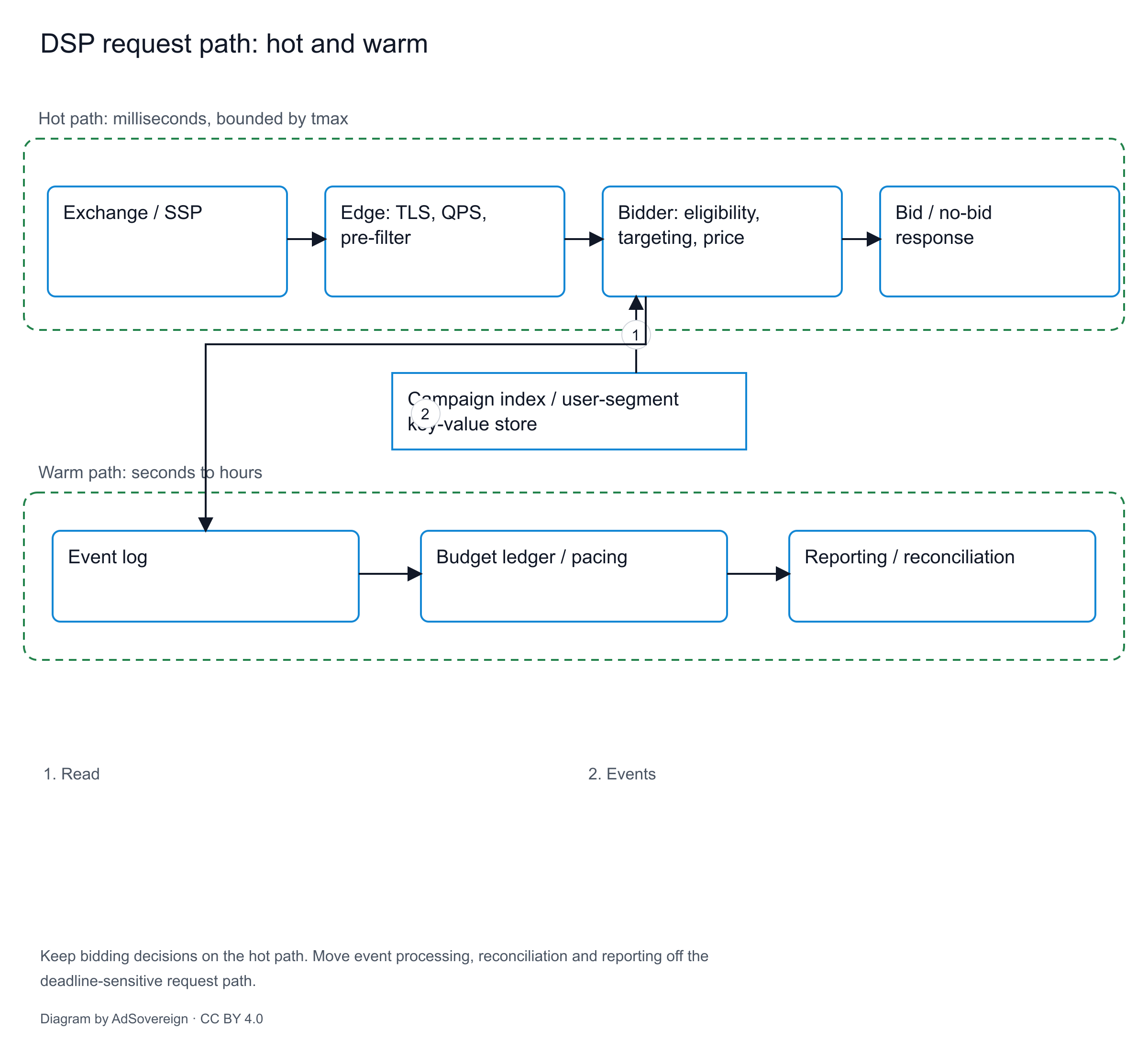
A DSP has two halves that run at different speeds. The hot path handles every bid request in milliseconds: parse, filter, match campaigns, price, respond, log. The warm path runs in seconds to hours: ingest wins and events, update budgets and pacing, refresh audiences, build reports, reconcile against exchange invoices. Most build plans staff the warm path, which looks like ordinary software, and discover the hot path, which looks like a trading system, after the first exchange integration.

Diagram by AdSovereign, CC BY 4.0.
The nine engineering steps
1. Exchange and SSP integrations
Every exchange you connect to is a separate project: an onboarding form, a test endpoint, a QPS quota, a certification pass and an account manager who decides how much traffic you see. BidsCube scopes an MVP at "5-10 SSP integrations" and names Google AdX, Magnite, PubMatic and OpenX among the first (BidsCube, 17 July 2026). Geomotiv adds "$50k+" of "integration debt" for identity integration, supply-path logic and "SSP testing or certification" (Geomotiv, 5 May 2026).
The protocol is OpenRTB. Version 2.6 was published in April 2022, added CTV ad pods, a structured user agent and formal places for the SupplyChain object and extended identifiers, and deprecated year of birth, gender and hashed device IDs; its latest dated release is 2.6-202606 of 11 June 2026, and an April 2026 IAB Spain guide found "most platforms still run 2.5 or 2.6" (PPC Land, 29 September 2026). Google's exchange was the prominent exception with a proprietary protocol until it was retired on 1 May 2025 (PPC Land, 29 September 2026). Build one OpenRTB 2.6 endpoint and expect per-exchange extensions.
Two fields decide whether you get paid. tmax is "maximum time in milliseconds the exchange allows for bids to be received including Internet latency to avoid timeout", and a valid request with no bid should return HTTP 204 (IAB Tech Lab, OpenRTB 2.6, §2.1 and BidRequest). The schain object and the seller's sellers.json file, both finalized on 31 July 2019, tell you who is reselling the impression (IAB Tech Lab, sellers.json and SupplyChain). Parse both from day one; step 8 depends on them.
2. Bid request handling at QPS
QPS is "how many bid requests SSPs send to a DSP within a given second", and DSPs cap it "to ensure a DSP doesn't receive more QPS than it can handle", giving each SSP a different limit based on supply, value, efficiency and performance (Index Exchange, accessed 17 October 2026). The same page estimates about 10 million QPS across the internet and typical DSP limits of 1 to 3 million QPS. A DSP at that scale never sees most of the auction:
Two forces make the number worse than it looks. First, duplication: The Trade Desk's Will Doherty described SSPs that "send 30% of the publisher's traffic" and "send it three times" (AdExchanger, 17 January 2024). Second, cost: every request you listen to costs compute and ingress whether or not you bid. Geomotiv's architecture brief targets a lead engineer who can hold 500k QPS and warns that in a 1 million QPS environment "listening alone can drain a project's budget" (Geomotiv, 5 May 2026).
The engineering answer is traffic shaping at the edge: tell each exchange what you want (geo, format, deal IDs, floors), reject what you cannot use before it reaches the bidder, and treat QPS as a budget spent on supply that wins. Our July 2025 sizing guide assumed about 3 KB per request and response pair, or 24 Kbps per sustained QPS, as the bandwidth rule of thumb (self-hosted DSP infrastructure requirements); QPS, latency and bid performance explains why the response-time distribution, not the average, decides your win rate. When the bidder capacity planner is live, use it to turn a QPS target into nodes and bandwidth.
3. Bidder logic
The bidder answers one question per request: is there a campaign that wants this impression, and at what price? That decomposes into eligibility (format, size, device, geo, consent), targeting (audience, context, frequency), pricing (value model, floor, deal terms) and shading (how far under your value you bid in a first-price auction). All of it must run from memory; a database call on the request path is a timeout.
Latency budgets published by vendors cluster tightly. Epom says a bidder should respond "approximately 50-150 ms" for most marketplaces with p99 "below 200 ms" (Epom, 11 September 2025). Geomotiv and BidsCube both say within 100 ms including network (Geomotiv, 5 May 2026; BidsCube, 17 July 2026). Google's own range is 80 to 1000 ms by format and auction type, measured "from the time Google sends the call to the time Google receives a reply", and a bidder with high timeout rates "will be automatically throttled" (Google RTB test guide). Google also "require[s] that 85 percent of responses be received within the deadline" and recommends peering for large-volume bidders (Google RTB latency guide).
For a sense of how little time the decision itself gets, FreeWheel's Beeswax gives a customer's custom bidding agent a "strict timeout of 10ms" inside its own request handling (FreeWheel docs, updated 12 August 2026). If your model cannot score an impression in single-digit milliseconds, it belongs in the warm path, producing lookup tables for the hot path.
4. Pacing and budget control
A campaign with a $100,000 budget and a fleet of 50 bidder nodes has a distributed-systems problem: every node must know how much it may still spend, without a synchronous call to a central ledger on each request. The standard design is a budget ledger updated from win notices and impression events, with each node holding a local allowance that is refreshed on a short interval and a probabilistic throttle that spreads delivery across the day. Geomotiv's architecture list names exactly these components: "bidder, budget memory, ledger" (Geomotiv, 5 May 2026).
The pattern a BaaS vendor exposes shows the shape: Beeswax's "Pacing-as-a-Service" works "by filtering bids from your Bidding Agent based on the ratio of current delivery against goals" (FreeWheel docs, updated 12 August 2026). Pacing is a filter applied after the bid decision and before the response. Get the ledger wrong and you overspend on day one.
5. User-data store and identity
Targeting needs a key-value store that answers "which segments is this identifier in" in a few milliseconds, at the full request rate, across every identifier type the exchanges send. Our July 2025 guide budgeted under 10 ms for the segment lookup inside a 60 ms end-to-end target (self-hosted DSP infrastructure requirements). The identifiers now include publisher first-party IDs, mobile advertising IDs, CTV device IDs and the extended-identifier (eids) array that OpenRTB 2.6 formalised (PPC Land, 29 September 2026).
Consent travels with the request. In the EU, the IAB Europe Transparency and Consent Framework is at v2.3, launched in April 2025 with an adoption deadline of 28 February 2026 (IAB Europe TCF). In the US and elsewhere, the Global Privacy Platform carries state-level strings; the GPP string reached v1.0 on 28 September 2022 and was updated in August 2026 for the latest MSPA (IAB Tech Lab GPP). The bidder must decode both before it reads any identifier, which is why the consent parser sits in step 2's pre-filter, not in step 9's compliance review.
6. Logging, reporting and reconciliation
Log every bid, win, loss, impression, click and conversion with the auction price, the fees, the seller ID, the supply path and the deal ID. The reason is commercial, not technical. The ANA's 2023 study found "only 36 cents of every dollar that enters a demand-side platform (DSP) effectively reaches the consumer", built on log-level data from 21 advertisers (ANA, 5 December 2023); the Q2 2026 benchmark put working media at 45.1% and transaction costs at 27.2% (ANA Q2 2026 benchmark, 6 August 2026). Buyers now ask for the logs in the RFP; the questions are in our DSP RFP template.
Set your retention policy deliberately. The reference point from a large platform is DV360's Data Transfer, which delivers impression and click files hourly and deletes them after 60 days (Google, DV360 Data Transfer v2, updated 14 October 2024); a DSP you own can keep them as long as your data-protection rules allow. Storage is not free: both Epom and TeqBlaze put campaign-data storage at about $3,500 a month, or over $40,000 a year, for a mid-size operation (Epom, 11 September 2025; TeqBlaze, 8 March 2026). Reconciliation, matching your logs to each exchange's invoice at the deal and day level, is the warm-path job that pays for itself first.
7. Creative serving and the ad server
A win is worth nothing until the creative renders. The DSP needs an ad server, or an integration with one, that hosts creatives, returns VAST for video and CTV, handles click tracking and viewability tags, and supports dynamic creative where the campaign calls for it. Netflix's experience is instructive: the layer it chose to build in-house was the ad server and decisioning, not a bidder (what Netflix, Lego and P&G built in-house). Frequency capping, creative rotation and dynamic assembly live here; dynamic creative optimization strategies covers assembly.
8. Fraud and brand safety
Pre-bid fraud and brand-safety signals come from vendors, and they cost money per request or per impression. Geomotiv budgets $5,000–$10,000 a month for "fraud and brand safety" vendors in its monthly burn (Geomotiv, 5 May 2026). The market-level baselines you are measured against are now published quarterly: in Q2 2026 invalid traffic was 0.1% of spend and non-viewable spend 10.1% (ANA Q2 2026 benchmark, 6 August 2026); made-for-advertising exposure was 1.1% in Q1 2026 (ANA, 27 May 2026).
Three controls are yours to build rather than buy: deduplication of repeated requests for the same impression (step 2), enforcement of ads.txt, app-ads.txt and sellers.json so you only buy from authorized sellers (step 1), and supply-path rules that cap how many intermediaries you will pay. The fee stack those rules are fighting is laid out in the ad tech tax explained.
9. Compliance and consent
The compliance work is a list, and most of it is contractual rather than code: a GDPR Article 28 data processing agreement with every client and every vendor, a subprocessor list, a records-of-processing register, a SOC 2 or ISO 27001 program if you want enterprise clients, and sector rules where they apply. The technical pieces are the TCF and GPP parsers from step 5, consent-aware logging in step 6, and data residency in your deployment. For a build that will run in your own cloud, the EU Data Act matters too: for data-processing services it caps the switching notice period at two months, sets a 30-day transition and prohibits switching charges from 12 January 2027 (Regulation (EU) 2023/2854, Articles 25 and 29), which is worth writing into your own hosting contracts. The ad tech compliance hub covers the sector detail.
Team: roles and ranges
The vendor guides agree on the roles and disagree on the headcount. Epom lists the most complete roster: a head of programmatic or product (1), backend or RTB engineers (2–4), data engineers (1–2), an ML or optimization engineer (1), a frontend developer (1), DevOps or SRE (1–2), ad ops or traders (1–3) and a legal or privacy consultant at half time, which sums to roughly 8.5 to 14.5 full-time equivalents (Epom, 11 September 2025). Geomotiv describes a four-role core for the build phase: a lead systems architect for low-latency work, an ad tech protocol engineer for OpenRTB and identity, an infrastructure and edge engineer for traffic shaping, and a technical product manager for SSP relationships and compliance (Geomotiv, 5 May 2026). TeqBlaze names ad tech engineers, a machine learning engineer and big-data engineers without sizes (TeqBlaze, 8 March 2026).
3 of 3 rows
Download JSONTable by AdSovereign, CC BY 4.0.
Build (months 1–8) | 4 (architect, protocol, infra/edge, data) | 1 technical PM | |
Launch and scale (months 8–12) | 5–8 (add backend, ML, frontend, SRE) | 2–4 (traders, ad ops, 0.5 legal) | |
Steady state (year 2) | 6–10 | 3–5 | Assumption: the Epom roster at its midpoint, with one SRE added for 24/7 on-call (reasoning: a bidder is a production trading system; one person cannot carry the pager) |
The constraint no guide prices is hiring. Digiday's February 2026 reporting quotes Georgia-Pacific calling recruitment and retention of programmatic talent one of its biggest challenges, and Lego planning its team over "the next couple of years" (Digiday, 9 February 2026; Digiday, 4 February 2026). Those are trading teams; engineers who have shipped a bidder are rarer.
Budget: what vendors publish, what we assume
The published ranges are below, with dates. They do not agree because they scope different things: an MVP versus a full platform, a vendor-built versus an in-house team, and whether salaries are included.
5 of 5 rows
Download JSONTable by AdSovereign, CC BY 4.0.
MVP $150K–$400K; full $500K–$1.5M+ | $20K–$80K/month | MVP 6–12 months; full 12–24 months | MVP = basic bidder, campaign manager, 5–10 SSP integrations; company claim | |
$550K–$900K | $35K–$100K+/month: hosting $20K–$60K, SSP seat fees $5K–$15K, data and identity $10K–$25K, fraud and brand safety $5K–$10K | 6–9 months to production baseline | Earlier "Quiet DSP" baseline $15K–$40K; company claim | |
n/d | $1.5–2.5M/year including salaries, servers, cloud, storage; plus ~$400K core team overhead | Planning 4–8 weeks; MVP 3–6 months; scaling 6–12 months; "at least a year or two" to feature-complete | Owning "usually fails" below >$50M/year spend; company claim by a white-label vendor | |
"around $10–25 million" mid-scale incl. infrastructure and compliance | $1.5–2.5M/year technology | 12–24+ months | Build "only if your advertising budget is more than $50M per year"; company claim by a white-label vendor | |
$150K–$1.5M+ typical; $5M–$30M enterprise | up to $1.5–2.5M/year | 12–24 months | Rented white-label alternative $2,000–$15,000/month; company claim |
Three assumptions of our own, labelled as such:
- Assumption 1, payroll. None of the sources prices a fully loaded engineer. If you take Epom's $1.5–2.5 million a year as mostly salaries for an 8.5–14.5 FTE roster, the implied fully loaded cost is roughly $150K–$200K per FTE. Reasoning: that is consistent with senior engineering compensation in US and Western European ad tech, and it is the only published figure that bundles people and infrastructure. Replace it with your own rates.
- Assumption 2, cloud egress. Bid requests are inbound and free on the major clouds; what you pay for is responses, win notices, log exports and reporting. Take 100,000 sustained QPS, a 20% bid rate and a 1 KB response (all assumptions; the request/response pair is about 3 KB in our July 2025 guide). That is 8.64 billion requests a day, 1.73 billion responses, about 1.7 TB a day and about 52 TB a month of egress. At AWS's published tiers of $0.09/GB for the first 10 TB, $0.085/GB for the next 40 TB and $0.07/GB beyond that (egresscost.com, updated 12 September 2026; CloudZero, updated 1 May 2026), with the first 100 GB a month free (AWS, 24 November 2021), that is roughly $4,500 a month for egress alone, before compute, storage, cross-zone traffic at $0.01/GB each way or NAT processing at $0.045/GB (CloudZero, updated 1 May 2026). Google Cloud's first-tier rate is $0.08–$0.12/GB (CloudZero, updated 1 May 2026). Egress is small next to compute at this scale; the point is that every hosting number is a function of QPS, which is why QPS is a budget.
- Assumption 3, the top of the market. The Trade Desk's $264 million of platform operations in nine months of 2023 (AdExchanger, 17 January 2024) works out to about $730,000 a day. It is the ceiling that explains why the vendor guides all land on a $50 million spend threshold: below it, the fee you pay a platform is smaller than the fixed cost of running one. DSP pricing explained works through the crossover.
A 12-month timeline
This is a synthesis of the vendor timelines laid onto one calendar: Geomotiv's 6–9 months to a production baseline (Geomotiv, 5 May 2026), Epom's 4–8 weeks of planning plus 3–6 months to an MVP plus 6–12 months of scaling (Epom, 11 September 2025), and BidsCube's 6–12 months to MVP (BidsCube, 17 July 2026). It assumes the core team is hired by the end of month 2, which is the step that slips most often.
6 of 6 rows
Download JSONTable by AdSovereign, CC BY 4.0.
1–2 | Architecture, exchange shortlist, protocol decisions (OpenRTB 2.6), cloud or on-premise decision, hiring the four-role core | Legal: DPAs, exchange agreements, vendor contracts for fraud and identity | Core team in seat; two exchanges have agreed test access |
3–5 | Bidder hot path, campaign index, budget ledger, event log; first two exchange test integrations; consent parsers (TCF v2.3, GPP) | Trading lead hired; first client or internal campaign scoped | Bids accepted on test traffic; p99 under the exchange |
6–7 | 5–10 exchanges certified; pacing; creative serving; fraud vendor live; reconciliation job; load test at target QPS | Reporting UI for clients; invoice format agreed | Load test passes at target QPS with 85%+ in-deadline responses (Google's bar) |
8 | Live at a small share of traffic (Geomotiv's "1% of global traffic" step) | First live budget, capped | Spend matches ledger within tolerance; no refund events |
9–10 | Scale QPS; traffic shaping and SPO rules; dedup; SSP-specific extensions | Second and third clients; weekly reconciliation to exchange invoices | Working-media share visible per campaign from your own logs |
11–12 | SOC 2 readiness, access controls, audit logs, data retention automation; on-call rota | Pricing model finalized; sunset and export terms in your own client contracts | MVP complete by month 12 (BidsCube's upper bound); year-2 roadmap |
Two notes. The vendor timelines stop at "launch"; the reconciliation in months 9–10 is what makes the platform worth owning, so it is in the plan. And if you are replacing a platform that is closing, the calendar is set for you: Microsoft announced on 14 May 2025 that Invest would close on 28 February 2026 (PPC Land, 22 June 2025). A build does not fit in that window; the Microsoft Invest migration playbook is for that case.
Build, buy or hybrid: the decision table
7 of 7 rows
Download JSONTable by AdSovereign, CC BY 4.0.
Annual programmatic spend | Above the vendors' own $50M/year threshold (Epom, 11 September 2025; TeqBlaze, 8 March 2026) | Below it; percent-of-spend fees stay small in absolute terms | Either; fee model is SaaS or license rather than percent of spend |
Need for your own decisioning | Yes, and the model is the business | No; configurable optimization is enough | Yes, but you do not want to own the exchange integrations (BaaS agent in 10 ms, FreeWheel docs) |
Data residency or perimeter requirement | Yes | No | Yes, if the platform deploys in your cloud or data center |
Time to market | 6–12 months to MVP, 12–24 to full (BidsCube, 17 July 2026) | 48 hours to 8 weeks, company claims (see D5) | Weeks to months, depending on the agent or the deployment |
Engineering capacity | 8–15 FTE sustained (Epom, 11 September 2025) | Ad ops only | 2–5 engineers for the agent or the deployment; assumption |
Exit risk you can carry | Low external risk, high internal (you keep the team) | Vendor can close (Microsoft Invest, 28 February 2026) | Medium; keep export and escrow terms |
Where to read next | this page |
The brands people cite as "in-house" mostly sit in the buy or hybrid columns. Netflix built an ad server and rents five DSPs; P&G owns its data and algorithms and rents the bidder; Lego is hiring traders, not engineers (what Netflix, Lego and P&G built in-house). The broader trend is in brands bringing programmatic in-house.
What changed since our 2025 guides
Our white-label DSP deployment guide of 23 June 2025 and self-hosted DSP infrastructure requirements of 21 July 2025 stay live as the deployment-steps and sizing-tier references. This page replaces their build guidance. Since they were written: Google's proprietary RTB protocol was retired on 1 May 2025 and OpenRTB 2.6 gained a June 2026 release (PPC Land, 29 September 2026); Microsoft Invest closed on 28 February 2026 (PPC Land, 22 June 2025); TCF v2.3's adoption deadline passed on 28 February 2026 (IAB Europe); the ANA's benchmark moved to quarterly publication with Q2 2026 at 45.1% working media (ANA Q2 2026 benchmark, 6 August 2026); and the EU Data Act's switching rules began to apply on 12 September 2025 (Regulation (EU) 2023/2854, Article 50).
FAQ
How much does it cost to build a DSP? Published estimates range from $150K–$400K for an MVP (BidsCube, 17 July 2026) through $550K–$900K upfront plus $35K–$100K+ a month (Geomotiv, 5 May 2026) and $1.5–2.5 million a year including salaries (Epom, 11 September 2025) to "around $10–25 million" for a mid-scale platform (TeqBlaze, 8 March 2026). They differ because they scope different things; a planning figure for a 10-person in-house build is the Epom range plus the Geomotiv monthly burn, both vendor claims.
How long does it take to build a DSP? Six to twelve months to an MVP and twelve to twenty-four months to a full platform (BidsCube, 17 July 2026); Geomotiv's plan reaches a production baseline in six to nine months with live traffic at month seven to nine (Geomotiv, 5 May 2026). The slow parts are hiring and exchange certification, not code.
How many QPS does a DSP need to handle? As many as you choose to listen to. Index Exchange estimates about 10 million QPS across the internet and typical DSP limits of 1 to 3 million QPS, set per SSP (Index Exchange, accessed 17 October 2026). A new DSP should start far lower, shape traffic aggressively and grow the limit with win rate. Geomotiv's build brief targets 500k QPS for the lead architect's design (Geomotiv, 5 May 2026).
Can I build a DSP with open-source software? Partly. The infrastructure layer (load balancers, key-value stores, stream processors, data warehouses) is open source. The bidder is not: the best-known open-source bidder, RTB4FREE, is marked retired in its own repository (GitHub, benmfaul/XRTB, accessed 17 October 2026), and no open-source bidder carries exchange certifications. Expect to write the bidder, the ledger and the exchange adapters yourself.
Should I build a DSP or use a white-label DSP? Use the decision table above. The vendors who sell white labels put the crossover at $50 million a year of spend (Epom, 11 September 2025; TeqBlaze, 8 March 2026); treat that as a lower bound. If what you need is your own algorithm, bidder-as-a-service is the middle road; if what you need is the data perimeter and the exit, a licensed platform on your own infrastructure avoids the build without giving up control. The three models are compared in bidder-as-a-service vs white-label vs self-hosted DSP.
How this works on owned infrastructure
The nine steps above are what AdSovereign ships as a product rather than a project: an enterprise RTB stack (DSP, SSP, exchange, DMP and clean room) with the exchange adapters, the bidder, the ledger, the log pipeline and the consent parsers already built, deployed on-premise or in the customer's own cloud account so the hot path, the logs and the audiences stay inside the customer's perimeter. It is the "hybrid" column of the decision table for teams that need the control of a build without the 12-month calendar. The architecture page maps to the diagram above, integrations lists the exchange and vendor adapters, security covers the controls behind step 9, the TCO calculator uses the same cost lines as the budget table, and the pilot page describes a 60-day evaluation on live traffic. This guide stays neutral; the product is mentioned only here.
Sources
- IAB Tech Lab, OpenRTB 2.6 specification, GitHub (accessed 17 October 2026). https://github.com/InteractiveAdvertisingBureau/openrtb2.x/blob/main/2.6.md
- PPC Land, "Explaining OpenRTB" (29 September 2026). https://ppc.land/openrtb/
- Google for Developers, Real-time Bidding, "Latency Restrictions and Peering" (accessed 17 October 2026). https://developers.google.com/authorized-buyers/rtb/get-started/peer-guide
- Google for Developers, Real-time Bidding, "Testing and Releasing Your Application" (accessed 17 October 2026). https://developers.google.com/authorized-buyers/rtb/test-guide
- Index Exchange, "QPS Optimization in Programmatic" (accessed 17 October 2026). https://www.indexexchange.com/index-explains/qps-optimization-programmatic/
- AdExchanger, "Attack Of The Clones: Programmatic's Hidden Scourge Of Bid Duplication" (17 January 2024). https://www.adexchanger.com/platforms/attack-of-the-clones-programmatics-hidden-scourge-of-bid-duplication/
- IAB Tech Lab, "sellers.json and SupplyChain Object" (finalized 31 July 2019). https://iabtechlab.com/sellers-json/
- IAB Europe, "Transparency & Consent Framework" (TCF v2.3, launched April 2025; adoption by 28 February 2026). https://iabeurope.eu/transparency-consent-framework/
- IAB Tech Lab, "Global Privacy Platform" (updated 12 August 2026). https://iabtechlab.com/gpp/
- FreeWheel Advertiser API docs, "Bidding Agent" (updated 12 August 2026). https://api-docs.freewheel.tv/advertiser/docs/bidding-agent
- BidsCube, "How to Build a DSP: Step-by-Step Guide to DSP Development" (17 July 2026). https://bidscube.com/blog/how-to-build-a-dsp/
- Geomotiv, "How to Build Your Own DSP: Step-by-Step Guide to Building a Custom Demand-Side Platform" (5 May 2026). https://geomotiv.com/blog/how-to-build-your-own-dsp-step-by-step-guide-to-building-a-custom-demand-side-platform/
- Epom, "How to Build Your Own DSP and Is It Even Worth It?" (11 September 2025). https://epom.com/blog/dsp/how-to-build-your-own-dsp
- TeqBlaze, "Build a Demand-Side Platform: Step-by-Step Roadmap (Build vs Buy)" (8 March 2026). https://teqblaze.com/blog/how-to-set-up-your-own-dsp
- TeqBlaze, "How Much Does it Cost to Develop a White-label Advertising Platform?" (27 September 2026). https://teqblaze.com/blog/wls-development-cost
- Clearcode, clearcode.cc (301 redirect to avenga.com observed 17 October 2026). https://clearcode.cc/
- GitHub, benmfaul/XRTB (RTB4FREE), README marked retired (accessed 17 October 2026). https://github.com/benmfaul/XRTB
- ANA, Programmatic Media Supply Chain Transparency Study, complete report (5 December 2023). https://ana.net/programmatic
- ANA, "ANA Programmatic Transparency Benchmark Reveals Widening Gap Between Top and Bottom Advertisers", Q1 2026 (27 May 2026). https://www.ana.net/content/show/id/pr-2026-05-programmatic
- ANA Programmatic Transparency Benchmark, Q2 2026 findings, release reprinted by Fiducia (6 August 2026). https://www.fiducia.eco/post/ana-programmatic-transparency-benchmark-q2-2026-working-media-efficiency-reaches-a-record-45
- Google for Developers, "Display & Video 360 Data Transfer v2 overview" (updated 14 October 2024). https://developers.google.com/bid-manager/dtv2/overview
- AWS News Blog, "AWS Free Tier Data Transfer Expansion – 100 GB From Regions" (24 November 2021). https://aws.amazon.com/blogs/aws/aws-free-tier-data-transfer-expansion-100-gb-from-regions-and-1-tb-from-amazon-cloudfront-per-month/
- egresscost.com, "AWS Data Transfer Out to Internet Pricing" (updated 12 September 2026). https://egresscost.com/aws/data-transfer-pricing/
- CloudZero, "AWS Egress Pricing: How To Reduce Data Transfer Costs" (updated 1 May 2026). https://www.cloudzero.com/blog/aws-egress-costs/
- Regulation (EU) 2023/2854 (Data Act), Articles 25, 29 and 50, EUR-Lex. https://eur-lex.europa.eu/legal-content/EN/TXT/?uri=CELEX:32023R2854
- PPC Land, "Microsoft's Xandr DSP closure opens doors for independent players" (22 June 2025). https://ppc.land/microsofts-xandr-dsp-closure-opens-doors-for-independent-players/
- Digiday, "Lego is building out an in-house programmatic team" (4 February 2026). https://digiday.com/media-buying/lego-is-building-out-an-in-house-programmatic-team/
- Digiday, "The case for and against bringing programmatic in-house" (9 February 2026). https://digiday.com/media-buying/the-case-for-and-against-bringing-programmatic-in-house/
Changelog
18 October 2026: aligned the title and heading and applied recorded source-URL corrections where needed. Factual research cutoff remains 17 October 2026.
17 October 2026. First edition. Replaces the build guidance in the June and July 2025 guides; nine steps, team table, budget table with three labelled assumptions, 12-month timeline, decision table. Next review 15 April 2027.