
RTB Architecture
DSP Infrastructure Requirements and Sizing Guide 2026
Published · Last updated
Next scheduled review:
DSP infrastructure must handle peak request volume while keeping bidding inside each exchange’s timeout. Size compute, state storage, logging, network egress and regional redundancy separately. Use load tests of your own bidder, then check the assumptions against failure scenarios and the staffing required to operate the system.
Key facts
- The traffic is measured in millions of requests per second. Index Exchange estimates roughly 10 million bid requests per second across the internet and says typical DSP limits sit around 1 to 3 million QPS (Index Exchange, accessed 17 October 2026). A DSP "might tell an SSP to give it 6 million QPS" (AdExchanger, 17 January 2024).
- The deadline is the exchange's, not yours. OpenRTB 2.6 defines
tmaxas the "maximum time in milliseconds the exchange allows for bids to be received including Internet latency" (IAB Tech Lab, OpenRTB 2.6). Google's range is 80 to 1000 ms, and it throttles bidders that cannot deliver 85 percent of responses inside it (Google RTB test guide; Google RTB latency guide). - Published build costs disagree by two orders of magnitude. BidsCube: $150K–$400K for an MVP in 6–12 months (BidsCube, 17 July 2026). Geomotiv: $550K–$900K upfront plus $35K–$100K+ a month (Geomotiv, 5 May 2026). Epom: $1.5–2.5 million a year (Epom, 11 September 2025). TeqBlaze: "around $10–25 million" for a mid-scale platform (TeqBlaze, 8 March 2026).
- Infrastructure is the top line at scale. The Trade Desk spent $264 million on platform operations in the first nine months of 2023, and cloud servers are "usually one of the top costs for a DSP or SSP" (AdExchanger, 17 January 2024).
- The protocol question is settled. Google retired its proprietary RTB protocol on 1 May 2025, so every major exchange now speaks OpenRTB; version 2.6 dates from April 2022 and its latest dated release is 2.6-202606 of 11 June 2026 (PPC Land, 29 September 2026).
- Working media is still under half. The ANA's Q2 2026 benchmark put 45.1% of programmatic spend into qualified impressions, with 27.2% going to transaction costs (ANA Q2 2026 benchmark, 6 August 2026). A DSP you build has to make that number visible.
Definition
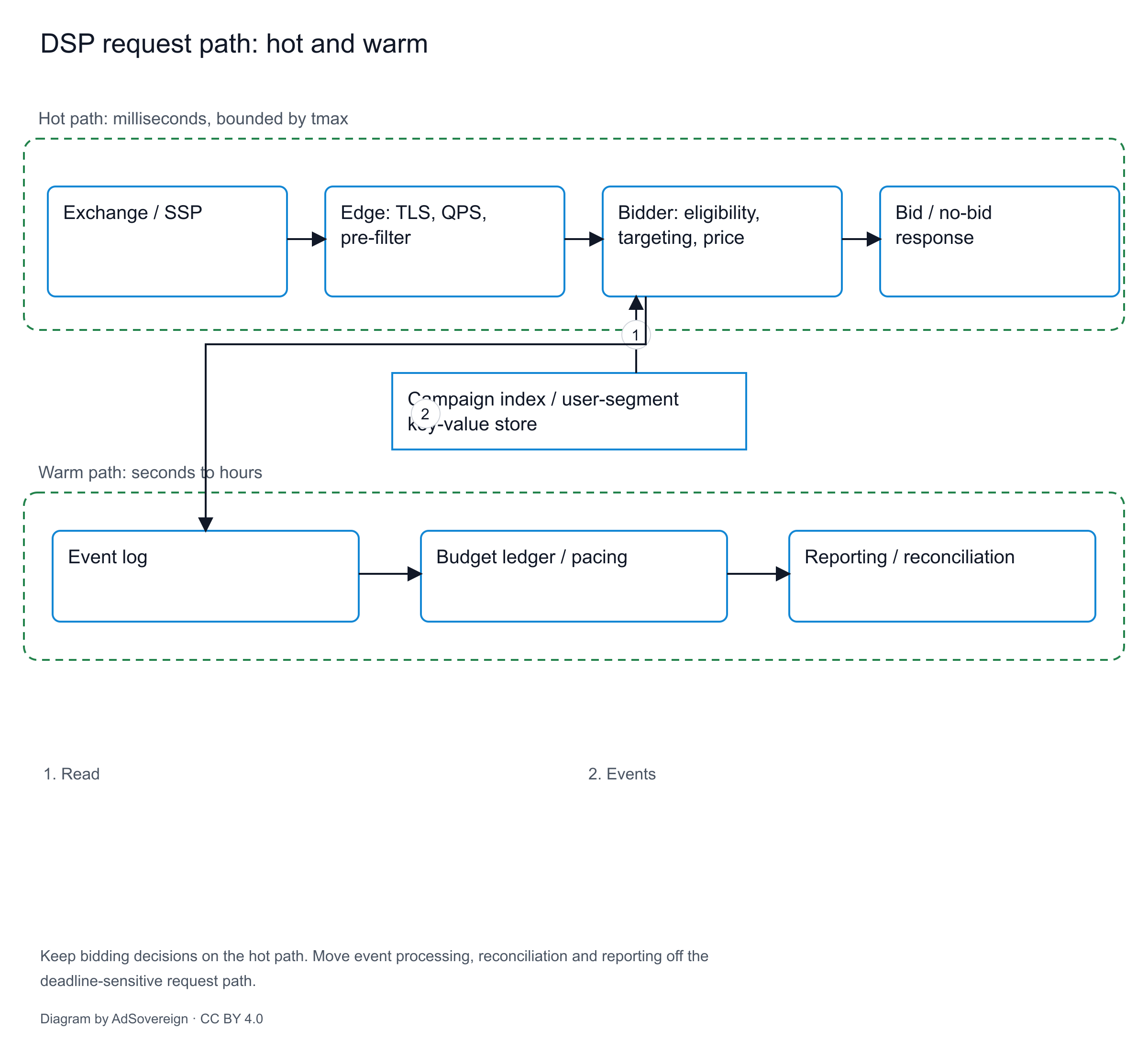
DSP infrastructure is the compute, storage, networking and operational tooling that receives bid requests, evaluates campaigns, returns bids and records the resulting events.

Diagram by AdSovereign, CC BY 4.0.
Evaluate the workflow
Planning infrastructure for a self-hosted DSP requires precision, overbuilt systems waste capital, while undersized deployments cause bid timeouts and revenue loss. This guide provides exact specifications for every scale tier, from startup to enterprise.
Minimum Infrastructure Requirements
| Component | Specification | Quantity | Purpose |
|---|
Scaling Tiers: 10K / 100K / 1M QPS
Infrastructure sizing by traffic volume (daily impression capacity):
Network Architecture: Bandwidth, Latency, Redundancy
Latency Optimization
Strategy: Deploy DSP nodes in same datacenter as top SSPs (Equinix, Interxion). In multi-DSP environments, demand arbitration logic routes bid requests to the fastest-responding DSPs first, with fallback to slower sources only when primary DSPs fail.
Redundancy & Failover
- • Active-active load balancing: Traffic splits across regions with health checks
Storage Requirements: Hot vs Cold Data
DSPs generate massive log volumes, optimize storage architecture by data temperature:
High Availability & Disaster Recovery
Multi-Datacenter Deployment
- • Database replication: Asynchronous cross-DC replication (PostgreSQL streaming replication)
- • Shared cache: Global Redis cluster with cross-DC sync
Backup Strategy
- • Database: Continuous WAL archiving + daily full backups
- • Campaign configs: Git-based versioning with hourly commits
- • Critical logs: Real-time replication to secondary datacenter
Monitoring & Alerting
- • Infrastructure: Prometheus + Grafana (CPU, memory, disk, network)
- • Business metrics: Bid volume, spend rate, revenue per hour
Total Cost of Ownership by Scale
| Cost Category | Cloud (AWS/GCP) | On-Premise (Owned) |
|---|
Get a Custom Infrastructure Sizing Plan
Request Infrastructure AssessmentRead the current references
Read the rtb architecture guide for the broader decision framework.
FAQ
How much does it cost to build a DSP? Published estimates range from $150K–$400K for an MVP (BidsCube, 17 July 2026) through $550K–$900K upfront plus $35K–$100K+ a month (Geomotiv, 5 May 2026) and $1.5–2.5 million a year including salaries (Epom, 11 September 2025) to "around $10–25 million" for a mid-scale platform (TeqBlaze, 8 March 2026). They differ because they scope different things; a planning figure for a 10-person in-house build is the Epom range plus the Geomotiv monthly burn, both vendor claims.
How long does it take to build a DSP? Six to twelve months to an MVP and twelve to twenty-four months to a full platform (BidsCube, 17 July 2026); Geomotiv's plan reaches a production baseline in six to nine months with live traffic at month seven to nine (Geomotiv, 5 May 2026). The slow parts are hiring and exchange certification, not code.
How many QPS does a DSP need to handle? As many as you choose to listen to. Index Exchange estimates about 10 million QPS across the internet and typical DSP limits of 1 to 3 million QPS, set per SSP (Index Exchange, accessed 17 October 2026). A new DSP should start far lower, shape traffic aggressively and grow the limit with win rate. Geomotiv's build brief targets 500k QPS for the lead architect's design (Geomotiv, 5 May 2026).
Can I build a DSP with open-source software? Partly. The infrastructure layer (load balancers, key-value stores, stream processors, data warehouses) is open source. The bidder is not: the best-known open-source bidder, RTB4FREE, is marked retired in its own repository (GitHub, benmfaul/XRTB, accessed 17 October 2026), and no open-source bidder carries exchange certifications. Expect to write the bidder, the ledger and the exchange adapters yourself.
Should I build a DSP or use a white-label DSP? Use the decision table above. The vendors who sell white labels put the crossover at $50 million a year of spend (Epom, 11 September 2025; TeqBlaze, 8 March 2026); treat that as a lower bound. If what you need is your own algorithm, bidder-as-a-service is the middle road; if what you need is the data perimeter and the exit, a licensed platform on your own infrastructure avoids the build without giving up control. The three models are compared in bidder-as-a-service vs white-label vs self-hosted DSP.
How this works on owned infrastructure
AdSovereign provides an enterprise RTB stack for deployment inside a customer’s own infrastructure. Use the architecture to map the relevant components, the security controls to evaluate access and data boundaries, and the pilot to define a bounded evaluation. Compare the operating responsibilities and commercial terms against your own requirements. Infrastructure control does not establish demand access, legal permission or a measured performance improvement on its own.
Sources
- IAB Tech Lab, OpenRTB 2.6 specification, GitHub (accessed 17 October 2026). https://github.com/InteractiveAdvertisingBureau/openrtb2.x/blob/main/2.6.md
- PPC Land, "Explaining OpenRTB" (29 September 2026). https://ppc.land/openrtb/
- Google for Developers, Real-time Bidding, "Latency Restrictions and Peering" (accessed 17 October 2026). https://developers.google.com/authorized-buyers/rtb/get-started/peer-guide
- Google for Developers, Real-time Bidding, "Testing and Releasing Your Application" (accessed 17 October 2026). https://developers.google.com/authorized-buyers/rtb/test-guide
- Index Exchange, "QPS Optimization in Programmatic" (accessed 17 October 2026). https://www.indexexchange.com/index-explains/qps-optimization-programmatic/
- AdExchanger, "Attack Of The Clones: Programmatic's Hidden Scourge Of Bid Duplication" (17 January 2024). https://www.adexchanger.com/platforms/attack-of-the-clones-programmatics-hidden-scourge-of-bid-duplication/
- IAB Tech Lab, "sellers.json and SupplyChain Object" (finalized 31 July 2019). https://iabtechlab.com/sellers-json/
- IAB Europe, "Transparency & Consent Framework" (TCF v2.3, launched April 2025; adoption by 28 February 2026). https://iabeurope.eu/transparency-consent-framework/
- IAB Tech Lab, "Global Privacy Platform" (updated 12 August 2026). https://iabtechlab.com/gpp/
- FreeWheel Advertiser API docs, "Bidding Agent" (updated 12 August 2026). https://api-docs.freewheel.tv/advertiser/docs/bidding-agent
- BidsCube, "How to Build a DSP: Step-by-Step Guide to DSP Development" (17 July 2026). https://bidscube.com/blog/how-to-build-a-dsp/
- Geomotiv, "How to Build Your Own DSP: Step-by-Step Guide to Building a Custom Demand-Side Platform" (5 May 2026). https://geomotiv.com/blog/how-to-build-your-own-dsp-step-by-step-guide-to-building-a-custom-demand-side-platform/
- Epom, "How to Build Your Own DSP and Is It Even Worth It?" (11 September 2025). https://epom.com/blog/dsp/how-to-build-your-own-dsp
- TeqBlaze, "Build a Demand-Side Platform: Step-by-Step Roadmap (Build vs Buy)" (8 March 2026). https://teqblaze.com/blog/how-to-set-up-your-own-dsp
- TeqBlaze, "How Much Does it Cost to Develop a White-label Advertising Platform?" (27 September 2026). https://teqblaze.com/blog/wls-development-cost
- Clearcode, clearcode.cc (301 redirect to avenga.com observed 17 October 2026). https://clearcode.cc/
- GitHub, benmfaul/XRTB (RTB4FREE), README marked retired (accessed 17 October 2026). https://github.com/benmfaul/XRTB
- ANA, Programmatic Media Supply Chain Transparency Study, complete report (5 December 2023). https://ana.net/programmatic
- ANA, "ANA Programmatic Transparency Benchmark Reveals Widening Gap Between Top and Bottom Advertisers", Q1 2026 (27 May 2026). https://www.ana.net/content/show/id/pr-2026-05-programmatic
- ANA Programmatic Transparency Benchmark, Q2 2026 findings, release reprinted by Fiducia (6 August 2026). https://www.fiducia.eco/post/ana-programmatic-transparency-benchmark-q2-2026-working-media-efficiency-reaches-a-record-45
- Google for Developers, "Display & Video 360 Data Transfer v2 overview" (updated 14 October 2024). https://developers.google.com/bid-manager/dtv2/overview
- AWS News Blog, "AWS Free Tier Data Transfer Expansion – 100 GB From Regions" (24 November 2021). https://aws.amazon.com/blogs/aws/aws-free-tier-data-transfer-expansion-100-gb-from-regions-and-1-tb-from-amazon-cloudfront-per-month/
- egresscost.com, "AWS Data Transfer Out to Internet Pricing" (updated 12 September 2026). https://egresscost.com/aws/data-transfer-pricing/
- CloudZero, "AWS Egress Pricing: How To Reduce Data Transfer Costs" (updated 1 May 2026). https://www.cloudzero.com/blog/aws-egress-costs/
- Regulation (EU) 2023/2854 (Data Act), Articles 25, 29 and 50, EUR-Lex. https://eur-lex.europa.eu/legal-content/EN/TXT/?uri=CELEX:32023R2854
- PPC Land, "Microsoft's Xandr DSP closure opens doors for independent players" (22 June 2025). https://ppc.land/microsofts-xandr-dsp-closure-opens-doors-for-independent-players/
- Digiday, "Lego is building out an in-house programmatic team" (4 February 2026). https://digiday.com/media-buying/lego-is-building-out-an-in-house-programmatic-team/
- Digiday, "The case for and against bringing programmatic in-house" (9 February 2026). https://digiday.com/media-buying/the-case-for-and-against-bringing-programmatic-in-house/
Changelog
October 18, 2026: aligned the approved search title and heading; retained the original publication date.
October 17, 2026: updated search phrasing, source-linked reference context, author and dates. Withheld numerical claims without inline sources.