
Retail Media
Retail Media Network vs Ad Network: What Changed
Published · Last updated
Next scheduled review:
A retail media network sells advertising using a retailer’s shopping relationships and surfaces. An ad network aggregates advertising supply across participating properties. Compare the source of inventory, access to purchase signals, measurement definitions and commercial terms. Neither label, by itself, establishes better performance or stronger privacy controls.
Key facts
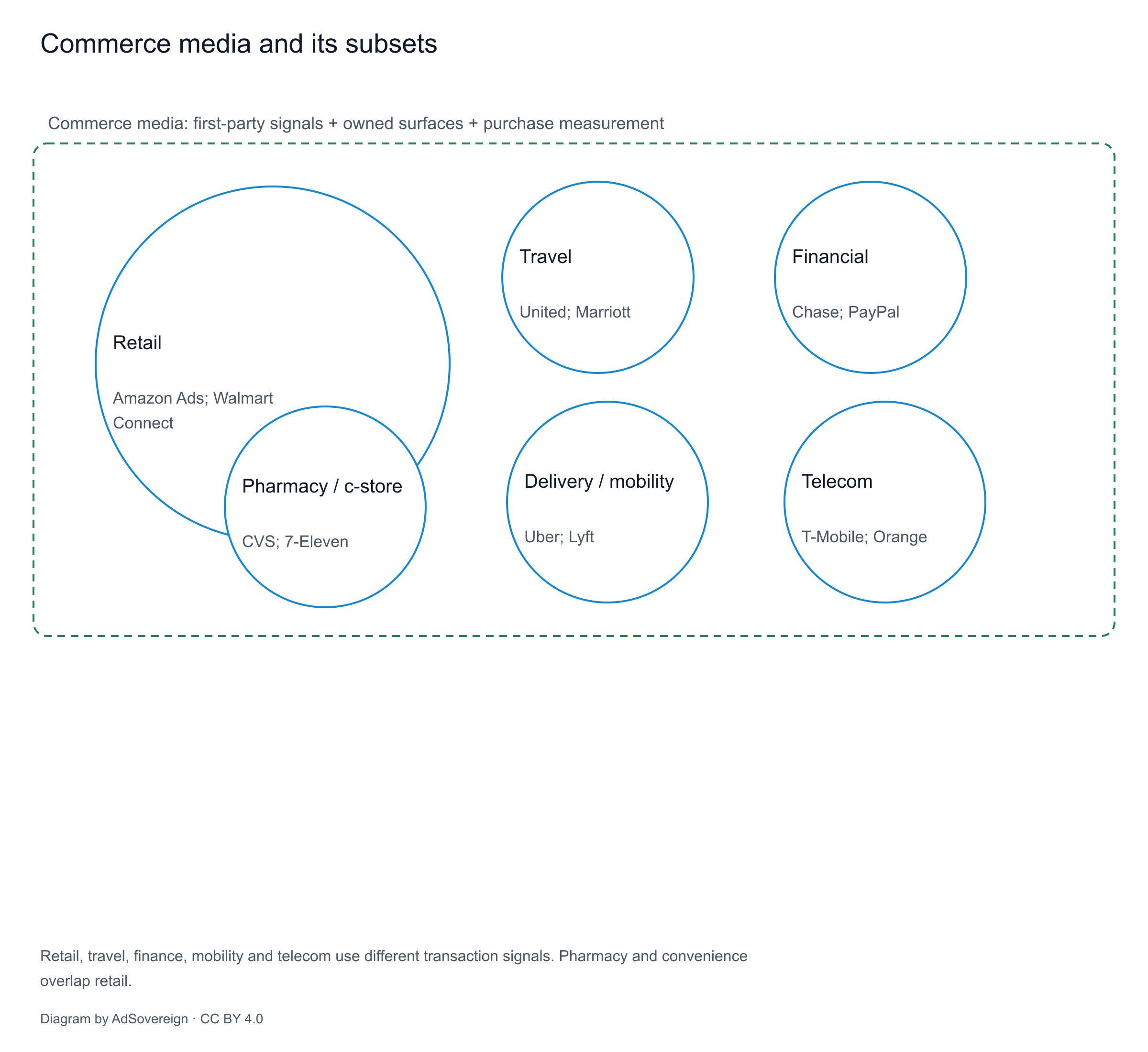
- The IAB formalised the umbrella in July 2025. Its explainer defines commerce media as "the growing practice of retailers, travel firms, financial institutions, and other companies turning their physical assets, digital properties, first-party data and proximity to customer journeys into integrated media opportunities" (IAB, July 2025).
- Retail is most of the money. eMarketer forecast US retail media ad spend of $69.33 billion in 2026, up from $58.79 billion in 2025, with Amazon and Walmart taking over 89% of the incremental dollars (eMarketer, November 2025).
- Commerce media overall is forecast above $100 billion. eMarketer's May 2025 forecast put US commerce media at $118.4 billion by 2029, a 15.3% compound annual growth rate (eMarketer, US Commerce Media Forecast 2025).
- Financial media is small but the fastest-growing subset. US financial media network ad spend was $680 million in 2025 and is forecast at $3.15 billion in 2028 (eMarketer, January 2026).
- Travel media is between the two. eMarketer's September 2024 forecast put US travel media network spend at $2.13 billion in 2024 and $2.96 billion in 2026 (eMarketer, September 2024).
- Europe uses the same umbrella. IAB Europe's definitions of 26 March 2025 name travel and mobility, payment providers, food delivery and classifieds as non-retail sellers (IAB Europe, 26 March 2025); European retail media reached €13.7 billion in 2024 and is forecast at €20.8 billion in 2026 and €24.9 billion in 2027 (PPC Land on IAB Europe, October 2025).
Definition
A retail media network is a retailer's advertising business; a traditional ad network aggregates or packages publisher inventory for advertisers.

Diagram by AdSovereign, CC BY 4.0.
Evaluate the workflow
The Retail Media Revolution
Retail media networks (RMNs) let retailers sell advertising to brands on their own digital properties, websites, apps, emails, in-store displays. Think Amazon Advertising, Walmart Connect, Target Roundel, or Instacart Ads. Brands pay to reach shoppers at the point of purchase, where intent is highest.
What makes this revolutionary isn't the ad placement (display ads on websites aren't new), but rather the closed-loop attribution. Retailers can prove that ad exposure drove actual purchases because they control both the ad platform and the transaction system. No third-party intermediaries, no cookie-based tracking, no probabilistic modeling, just direct, deterministic attribution.
This has massive implications. CPG brands, for example, have historically struggled to measure ROI from digital ads. Did that Facebook campaign actually drive grocery sales? With retail media, they know, immediately and precisely.
Traditional Ad Networks: The Old Model
But traditional networks had critical limitations:
- Opaque Inventory: Advertisers often didn't know which sites their ads appeared on, leading to brand safety issues.
- Third-Party Data: Targeting relied on cookies and purchased data segments, which are now deprecated or restricted by privacy laws.
- No Attribution: Networks couldn't tie ad exposure to sales because they didn't control the purchase environment.
What Makes Retail Media Different
Retail media flips the model by leveraging retailers' unique assets:
Revenue Models Compared
At scale, this creates billions in incremental profit. Walmart's advertising business, for instance, is growing faster than its core retail operations and carries much higher margins.
Why Retailers Need On-Premise Infrastructure
Many retailers initially partner with SaaS ad tech vendors (Criteo, Citrus Ad, etc.) to launch retail media. This works for pilot phase, but strategic limitations emerge:
- Data Leakage: SaaS platforms require sending customer and transaction data to their servers, creating privacy risk and competitive exposure. Your data trains their models, which they sell to competitors.
- Limited Differentiation: All retailers using the same SaaS platform offer the same features. You can't differentiate through innovation because you don't control the product roadmap.
- Vendor Lock-In: Once your ad business is built on a vendor's platform, switching is prohibitively expensive. They can raise prices, and you have no recourse.
On-premise (or private cloud) deployment solves these issues:
- No revenue share, just predictable licensing and support costs
- Full control to customize features and build unique capabilities
- Independence from vendor pricing and policy changes
Getting Started: Launch Timeline
Most retail media networks launch in phases:
Conclusion
The retailers winning this space are those who own their infrastructure. The question isn't whether to build a retail media network, but whether you'll build on your terms, or pay someone else's forever.
Read the current references
Read the retail media guide for the broader decision framework.
FAQ
Is retail media a type of commerce media? Yes. The IAB's July 2025 explainer treats retail media as the most mature segment of commerce media, alongside travel, financial services, automotive, telecom and utility, and B2B media (IAB, July 2025). IAB Europe uses the same structure (IAB Europe, 26 March 2025).
What is a commerce media network? A commerce media network is the advertising business a commerce company builds to sell ad space and audiences to brands that want to reach its customers, alongside its core business. The IAB describes companies building these networks "to complement their core businesses while selling ad space to brands that reach the CMNs' customers across their journeys" (IAB, July 2025).
Is Amazon Ads retail media or commerce media? Both. Amazon Ads is a retail media network, and retail media is a subset of commerce media. It is also the reason the retail subset is so concentrated: eMarketer projects Amazon's retail media revenue will exceed $75 billion by 2028 (eMarketer, November 2025).
What is a travel media network? A travel media network is a commerce media network run by an airline, hotel group, online travel agency or travel app on booking and loyalty data. United's Kinective Media (June 2024), Marriott Media (June 2025) and Expedia Group's travel media network (May 2024) are the main examples; eMarketer forecast US travel media network spend at $2.96 billion in 2026 (eMarketer, September 2024).
What is the difference between a financial media network and card-linked offers? Card-linked offers are one product; a financial media network is the business that sells them plus onsite media and offsite audiences. Chase, Mastercard and Amex Offers are offer-led; Klarna and Amex Ads sell onsite media; PayPal sells offsite audiences. The mechanics are in Financial media networks explained.
How this works on owned infrastructure
AdSovereign provides an enterprise RTB stack for deployment inside a customer’s own infrastructure. Use the architecture to map the relevant components, the security controls to evaluate access and data boundaries, and the pilot to define a bounded evaluation. Compare the operating responsibilities and commercial terms against your own requirements. Infrastructure control does not establish demand access, legal permission or a measured performance improvement on its own.
Sources
- IAB, "Defining Commerce Media and Its Ecosystem" (July 2025). https://www.iab.com/wp-content/uploads/2025/07/IAB_Commerce_Media_and_its_Ecosystem_Explainer_July_2025.pdf
- Retail TouchPoints, "IAB Sets Out to Define the Growing World of Commerce Media" (July 2025). https://www.retailtouchpoints.com/topics/digital-marketing/iab-sets-out-to-define-the-growing-world-of-commerce-media
- IAB Europe, retail and commerce media definitions (26 March 2025). https://iabeurope.eu/?p=62232
- eMarketer, "Retail Media Ad Spending Forecast and Trends H2 2025" (November 2025). https://www.emarketer.com/content/retail-media-ad-spending-forecast-trends-h2-2025
- eMarketer, "US Commerce Media Forecast 2025" (May 2025). https://www.emarketer.com/content/us-commerce-media-forecast-2025
- eMarketer, "The State of Financial Media Networks 2026" (January 2026). https://www.emarketer.com/content/state-of-financial-media-networks-2026
- eMarketer, "Travel media network ad spend will exceed $2 billion this year" (September 2024). https://www.emarketer.com/content/travel-media-network-ad-spend
- eMarketer, "Commerce media's next growth problem" (2026). https://www.emarketer.com/content/commerce-media-s-next-growth-problem--winning-dollars-that-already-have-home
- PPC Land on IAB Europe, "European retail media spending reaches €13.7 billion" (October 2025). https://ppc.land/european-retail-media-spending-reaches-eu13-7-billion-with-21-1-growth/
- The Desk on WARC, "Retail media ad market to top $200 billion as growth slows" (August 2026). https://thedesk.net/2026/08/warc-retail-media-ad-market-to-top-200-billion-as-growth-slows/
- IAB, final IAB/MRC Retail Media Measurement Guidelines (January 2024). https://www.iab.com/guidelines/final-iab-mrc-retail-media-measurement-guidelines-available-for-download/
- Business Wire, Uber Q4 and FY2025 results (4 February 2026). https://www.businesswire.com/news/home/20260204947622/en/
Changelog
October 18, 2026: aligned the approved search title and heading; retained the original publication date.
October 17, 2026: updated search phrasing, source-linked reference context, author and dates. Withheld numerical claims without inline sources.