
Commerce Media
Financial Media Networks Explained: Examples and Models
Published · Last updated
Next scheduled review:
A financial media network sells advertisers access to a bank's or payment company's customers using transaction data the company already holds. The data never leaves the owner: advertisers buy an audience or a card-linked offer, the network shows it on its own surfaces, and the owner reports purchases it observed. Four models exist: offers, onsite ads, offsite audiences, and platform.
Key facts
- Spend is small and growing fast. eMarketer's January 2026 forecast puts US financial media network ad spend at $680 million in 2025, rising to $3.15 billion in 2028 (eMarketer, State of Financial Media Networks 2026).
- The largest bank network reports merchant spend, not revenue. Chase Media Solutions powered 18 billion offers worth $12 billion in customer spend in 2024, up 31% (Adweek, 2025), and $11.2 billion in 2025 (chase.com, accessed 17 October 2026).
- Only one network has audited ad revenue. Klarna disclosed $180 million of advertising revenue for 2024, 6% of revenue, up from $13 million in 2020, in its F-1 filed 14 March 2025 (Payments Dive, 19 March 2025).
- Card networks entered in October 2025. Mastercard Commerce Media launched 1 October 2025 claiming 25,000 advertisers and 500 million enrolled consumers (Marketing Dive, 1 October 2025); Amex Ads launched 6 October 2025 for 34 million US consumer card members (Axios, 6 October 2025).
- Offsite is the exception, not the rule. PayPal is the only payments company selling open-web display, video and CTV on its own purchase graph, in the US since 29 April 2025 and in Germany and the UK since 17 September 2025 (PayPal, 17 September 2025).
- Banks are tightening what platforms see. Cardlytics stopped reporting monthly active users on 1 January 2025 because newer bank partners do not provide equivalent user data, and reported 224.2 million monthly qualified users for 2025 instead (Cardlytics 10-K, FY2025).
Definition
Financial media network: an advertising business run by a bank, card network, payments company, buy-now-pay-later provider or wallet, which sells advertisers access to its customers and reports results using transaction data it already holds, without transferring that data to the advertiser.
eMarketer's definition covers ads on financial-services sites and apps plus ads bought through those companies' networks or demand-side platforms using their first-party data, with banks such as Chase and Wells Fargo, fintechs such as BNPL providers, and payment providers such as Block and PayPal as examples (eMarketer, May 2025). For the wider category see Commerce Media vs Retail Media vs Financial Media; for every live network see the Commerce Media Networks Directory.
Why transaction data is different from shopper data
A retailer sees every item in a basket but only in its own stores. A card issuer sees every merchant a customer pays but rarely the items. A payments wallet sits in between: it sees merchants across the web and, through browser extensions and shopping tabs, some products. That shapes what each can sell. Transaction data is best at answering "who buys from competitors", "who has stopped buying", and "who spends in a category", which is why the first products every bank launched were card-linked offers aimed at new-customer acquisition, not sponsored products. See Shopper data monetization for the retail version of this trade-off.
Two constraints follow. First, the data is regulated: in the US the Gramm-Leach-Bliley Act and Regulation P restrict sharing nonpublic personal information with non-affiliated third parties unless the customer has had notice and a chance to opt out, with an exception for service providers and joint marketing under a contract that limits use (12 CFR 1016.10; 12 CFR 1016.13). In the EU, PSD2 and GDPR require a separate lawful basis for using payment data beyond the payment service (EDPB Guidelines 06/2020). Second, card numbers themselves are in PCI DSS scope, so every network works on tokenized or categorized transactions, never on the primary account number. The detailed rules are in GLBA and advertising with bank data.
The four models
4 of 4 rows
Download JSONTable by AdSovereign, CC BY 4.0.
1. Card-linked offers | A cash-back or discount offer targeted to customers by transaction history | Bank app, web, email, card-linked | Merchant pays only on redemption (a purchase) | Closed-loop by construction; incrementality via lift reports | Chase Media Solutions, Mastercard Commerce Media, Amex Offers, Citi (via Kard), Cardlytics in Bank of America and Wells Fargo, Zilch |
2. Onsite media | Sponsored search, display, marquee placements inside a payments or BNPL app | Klarna app, Afterpay app, Revolut Shops, PayPal and Venmo feeds, AmexTravel.com | CPC for sponsored search, CPM for display, CPA for affiliate | Click and in-app conversion; closed-loop when the purchase runs through the app | Klarna, Afterpay, Revolut, Amex Ads, PayPal onsite |
3. Offsite audiences | Audience segments built from purchase data, activated on third-party sites, apps and CTV | Open web, social, CTV | CPM; sometimes managed service fee | Attribution via the owner's purchase graph (claimed closed-loop); otherwise brand lift | PayPal Offsite Ads; Klarna brand ads via programmatic partners |
4. Platform | A third party operates offers or ads inside many banks' channels and shares revenue | Partner banks' apps | Merchant pays platform; platform shares with bank | Closed-loop via bank transaction feed | Cardlytics, Kard (Citi acquisition pending) |
Model 1: card-linked offers, the bank default
Chase is the reference case. Chase Media Solutions launched on 3 April 2024 on the Figg platform acquired in 2022, with 80 million customers at launch (Business Wire, 3 April 2024). The only media format is a cash-back offer in Chase's own channels; brands are charged when a customer views the offer and makes a purchase, and the platform claims 2.2 billion offer views a month and 84 million customers (chase.com, accessed 17 October 2026). Because the billing event is a purchase, attribution is a lookup, and Chase sells incremental-lift reports as the real analytic product. Mastercard Commerce Media uses the same unit but distributes through issuers and partners rather than its own app, pairing permissioned transaction data with card-linking and Dynamic Yield personalization, and plans point-of-sale and wallet placements from 2026 (Marketing Dive, 1 October 2025). Citi's agreement on 13 August 2026 to acquire Kard, which runs offers for fintechs and banks, extends the same model to 70 million Citi cardmembers (Citigroup, 13 August 2026). Zilch in the UK runs the model inside a BNPL card: merchants pay per sale through its Ad-Subsidised Payments Network, opened to third parties in June 2023 with 3 million customers and $1.7 billion transacted at the time (Zilch, June 2023).
Model 2: onsite media, the fintech default
Klarna shows what a shopping surface inside a payments app can earn. Its Ads Manager, a self-serve console launched in the US in May 2023 and then in the UK and Sweden, sells sponsored search on cost per click, brand ads on cost per thousand (partly through programmatic partners) and an affiliate program on cost per action (Internet Retailing, 2023; PPC Land, 2025). The result was $180 million of advertising revenue in 2024, 6% of total revenue (Payments Dive, 19 March 2025). Klarna's 2025 results reported 118 million active consumers and $3.5 billion of revenue but did not break out advertising (Klarna, 26 February 2026). Afterpay has sold in-app sponsored listings since 24 August 2021 on a pay-for-performance basis (PYMNTS, 24 August 2021). Revolut's version lives in its Shops section only, behind a third-party marketing opt-in, with widgets, banners, carousels and sponsored search announced on 9 June 2023 for the UK and nine EU markets (FF News, 9 June 2023). Amex Ads is the bank-side version of onsite: display on AmexTravel.com, direct-sold only, targeted on transaction and travel-booking data (Axios, 6 October 2025).
Model 3: offsite audiences, PayPal's bet
PayPal built its unit in steps: an advertising platform and the hire of Mark Grether in May 2024, onsite ads across PayPal, Venmo and Honey in October 2024, Offsite Ads for display, video and CTV in the US on 29 April 2025 with Publicis Media as first agency partner, and Germany and the UK on 17 September 2025 (Digiday, 2024; PPC Land, 29 April 2025; PayPal, 17 September 2025). PayPal describes a transaction graph of more than 430 million consumer and merchant accounts across about 200 markets and claims closed-loop attribution on purchases it observes. The honest limit is that a conversion outside PayPal checkout is invisible to it, so offsite reporting leans on modelled attribution for a share of outcomes PayPal has not quantified publicly.
Model 4: platforms inside bank channels
Cardlytics has run offers inside bank apps since 2008 and names Chase, Bank of America and Wells Fargo among the partners it depends on (Cardlytics investor presentation). Its 2025 10-K is the clearest public evidence of how banks are changing the deal: the company stopped reporting monthly active users on 1 January 2025 because newer partners do not supply equivalent user data, reported 224.2 million monthly qualified users for 2025, and said Bank of America campaigns concluded in January 2026 (Cardlytics 10-K, FY2025; Cardlytics, 4 March 2026). Chase left the platform model when it bought Figg; Citi is doing the same with Kard. The direction is from rented platform to owned network; what that implies for next year is in Commerce media in 2027.
How the data actually flows

Diagram by AdSovereign, CC BY 4.0.
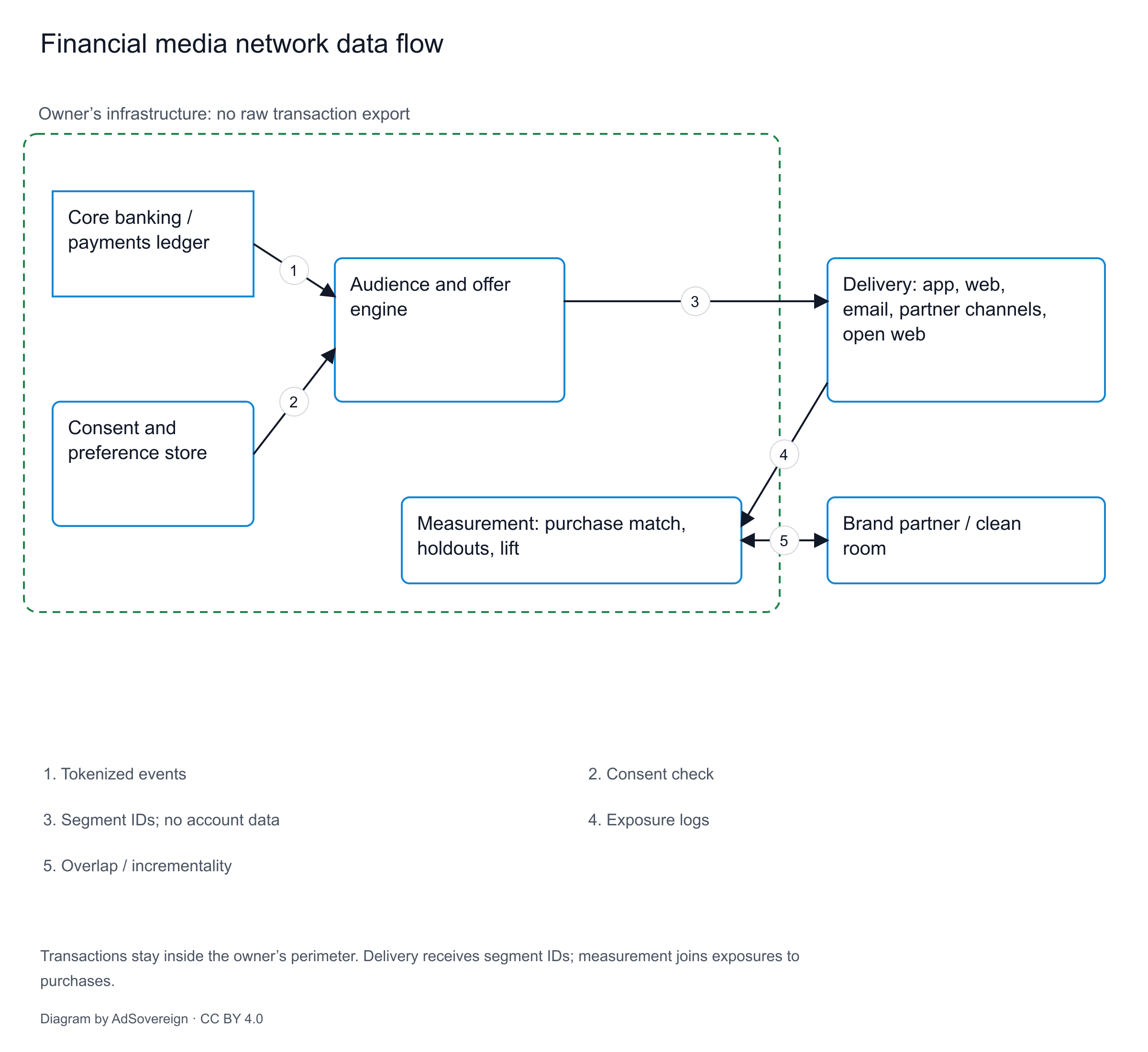
Three points are worth stating plainly. The advertiser never receives transaction records; it receives an audience count, an offer placement and a report. The owner never needs the advertiser's customer file; where overlap analysis is wanted, both sides use a clean room, as CVS does with Pinterest and Reddit on the retail side (Beet.TV, 16 July 2025). And the card number is never a targeting key: networks work on merchant category, merchant name, spend level and recency, which keeps the ad stack outside the cardholder data environment that PCI DSS v4.0.1 governs, with its future-dated requirements in force since 31 March 2025 (usd AG, 2025). The architecture a bank needs to keep all of this inside its own perimeter is described in How a bank can launch a media network without moving customer data.
What the money looks like
Public numbers are few, so treat the table as the complete set of disclosed figures rather than a benchmark.
8 of 8 rows
Download JSONTable by AdSovereign, CC BY 4.0.
Chase Media Solutions | $12B customer spend via 18B offers, +31% | 2024 | |
Chase Media Solutions | $11.2B merchant spend; 2.2B offer views/month | 2025 | |
Klarna | $180M advertising revenue, 6% of revenue | 2024 | |
Amex Offers (not Amex Ads) | $15B global spend, $13B US | 2024 | |
Cardlytics | Q4 revenue $56.1M, down 24% | Q4 2025 | |
Zilch | Revenue run rate above $130M at first operating profit | July 2024 | |
Revolut | Internal target ~£300M ad revenue by 2026, not confirmed | FT, Apr 2024 | |
Unnamed European digital bank | Run rate above $50M, expected $100M by early 2026 (vendor claim) | 2025 |
Two observations. Banks report merchant spend driven, which is a loyalty metric, while fintechs report ad revenue, which is a media metric; the two are not comparable, and a bank's media revenue is some fraction of merchant spend set by the funded offer rate. And the only audited revenue line (Klarna) comes from the onsite model, not from offers. A working business case for a bank, airline or pharmacy with editable assumptions is in the commerce media business case template.
What a bank has to decide before launch
- Which model first. Offers need a merchant sales team and settlement plumbing but almost no ad tech. Onsite media needs a shopping surface with enough sessions to sell. Offsite needs a bidder, an identity approach and a clean room. Most banks start with offers because the consent story is simplest: the customer activates an offer.
- Consent design. Opt-out for aggregated segments and opt-in for anything that touches third-party marketing is the pattern across the live networks (United, Marriott and Revolut all describe it that way in the directory). Build the consent store before the audience engine.
- Where the data sits. Every network above keeps transaction records inside its own perimeter and exports only segment IDs, offer placements and reports. A rented platform that needs the transaction feed is the one architecture banks are moving away from, as the Cardlytics disclosures show.
- What to report. Decide now whether the headline metric is merchant spend, offers redeemed, or ad revenue, and whether lift is measured with holdouts. Buyers increasingly ask for IAB/MRC-style definitions; see Clean room architectures compared for how overlap and incrementality are measured without sharing records.
FAQ
What is a financial media network? A financial media network is an advertising business run by a bank, card network, payments company, BNPL provider or wallet that sells advertisers access to its customers using the transaction data it already holds. eMarketer forecasts US spend on these networks at $680 million in 2025 and $3.15 billion in 2028 (eMarketer, January 2026 forecast).
How is it different from card-linked offers? Card-linked offers are one product inside a financial media network, and for most banks the first one. A network also sells onsite media (Klarna, Amex Ads), offsite audiences (PayPal) or runs a platform inside other banks (Cardlytics). Chase treats offers as its media format and charges only on purchase (chase.com, accessed 17 October 2026).
Do banks sell customer data to advertisers? The live networks do not transfer transaction records. Advertisers buy a targeted placement and receive a report; United, Marriott and Chase all state that advertisers get no personally identifiable information. In the US, Regulation P requires notice and an opt-out before nonpublic personal information is shared with non-affiliated third parties outside the service-provider and joint-marketing exception (12 CFR 1016.10).
How much do financial media networks make? Only Klarna has disclosed audited ad revenue: $180 million in 2024, 6% of revenue (Payments Dive, 19 March 2025). Chase reports merchant spend driven, $11.2 billion in 2025, not media revenue (chase.com, accessed 17 October 2026). Revolut has not disclosed an ad line.
Can a bank run a financial media network in the EU? Yes, with a separate lawful basis for marketing use of payment data under GDPR and PSD2, consent for anything beyond the payment service, and no transfer of records to third parties. Klarna (Sweden), Revolut and Zilch (UK) and PayPal (Germany, UK) operate under those rules; see GLBA and advertising with bank data for the US side and the directory for the EU entries.
Continue reading
Use the commerce media guide to compare the related operating models, definitions and evidence before making this decision.
How this works on owned infrastructure
The common thread in the four models is that transaction data stays with its owner and only segment IDs, offers and reports leave. AdSovereign is an enterprise, on-premise RTB stack (DSP, SSP, exchange, DMP and clean room) built for exactly that boundary: a bank or payments company runs audience building, offer decisioning, onsite ad serving and offsite bidding inside its own perimeter, and exposes a clean room as the only surface a brand touches. The architecture and security pages describe the deployment; use cases lists the configurations we recommend and the ones we do not; the pilot page describes a 60-day evaluation. This page stays neutral; the product is mentioned only here.
Sources
- eMarketer, "The State of Financial Media Networks 2026" (January 2026 forecast). https://www.emarketer.com/content/state-of-financial-media-networks-2026
- eMarketer, "Financial media ad spend will top $1 billion by 2026" (May 2025). https://www.emarketer.com/content/financial-media-ad-spend-will-top--1-billion-by-2026
- Adweek, "Chase's Ad Business Drove $12B in Customer Spend Last Year" (2025). https://www.adweek.com/commerce/chases-ad-business-drove-12b-in-customer-spend-last-year/
- Chase Media Solutions site (accessed 17 October 2026). https://www.chase.com/mediasolutions/home
- Business Wire, "Chase launches Chase Media Solutions" (3 April 2024). https://www.businesswire.com/news/home/20240403664648/en/
- Payments Dive, Klarna F-1 advertising revenue (19 March 2025). https://www.paymentsdive.com/news/klarna-buy-now-pay-later-bnpl-merchant-advertising-revenue/742883/
- Internet Retailing, Klarna Ads Manager (2023). https://internetretailing.net/?p=70426
- PPC Land, "Klarna solves profitability puzzle through millions in ads business" (2025). https://ppc.land/klarna-solves-profitability-puzzle-through-millions-in-ads-business/
- Klarna Group plc, Full Year 2025 Results (26 February 2026). https://s205.q4cdn.com/644747736/files/doc_news/Klarna-Group-plc-Publishes-Full-Year-2025-Results-2026.pdf
- Marketing Dive, Mastercard Commerce Media (1 October 2025). https://www.marketingdive.com/news/mastercard-bigger-grab-commerce-media-dollars-new-network/761568/
- Axios, "American Express launches Amex Ads" (6 October 2025). https://www.axios.com/2025/10/06/amex-ads-american-express-media
- Citigroup, Kard acquisition (13 August 2026). https://www.citigroup.com/global/news/press-release/2026/citi-expands-customer-engagement-commerce-media-capabilities-kard-addition
- Zilch, ASPN opened to third parties (June 2023). https://www.zilch.com/news/zilch-opens-its-revolutionary-aspn-to-third-parties-across-the-globe-advancing-a-multi-trillion-dollar-payments-and-advertising-marketplace/
- Crowdfund Insider, Zilch run rate (July 2024). https://www.crowdfundinsider.com/?p=198301
- PYMNTS, Afterpay Ads (24 August 2021). https://www.pymnts.com/bnpl/2021/bnpl-firm-afterpay-debuts-ads/
- FF News, Revolut advertising formats (9 June 2023). https://ffnews.com/newsarticle/revolut-to-roll-out-new-advertising-solutions-to-help-brands-connect-with-its-growing-customer-base/
- Marketing Beat on FT, Revolut ad target (23 April 2024). https://www.marketing-beat.co.uk/2024/04/23/revolut-ad-sales-market
- Digiday, PayPal ads business (2024). https://digiday.com/?p=580721
- PPC Land, PayPal Offsite Ads (29 April 2025). https://ppc.land/paypal-launches-offsite-ads-with-transaction-data-targeting/
- PayPal Newsroom, Offsite Ads in Germany and the UK (17 September 2025). https://newsroom.paypal-corp.com/2025-09-17-PayPal-Expands-Offsite-Ads-to-Germany-and-the-UK
- Cardlytics investor presentation (risk factors naming Chase, Bank of America, Wells Fargo). https://static.seekingalpha.com/uploads/sa_presentations/292/93292/original.pdf
- Cardlytics, Form 10-K FY2025. https://www.sec.gov/Archives/edgar/data/1666071/000166607126000010/cdlx-20251231.htm
- Cardlytics, Q4 and FY2025 results (4 March 2026). https://www.businesswire.com/news/home/20260304946746/en/Cardlytics-Announces-Fourth-Quarter-and-Full-Year-2025-Financial-Results
- CFOtech on SAS, "Banks tap financial media networks for ad revenues" (December 2025). https://cfotech.co.uk/story/banks-tap-financial-media-networks-for-ad-revenues
- eCFR, 12 CFR 1016.10 (Regulation P, limits on disclosure). https://www.ecfr.gov/current/title-12/chapter-X/part-1016/subpart-B/section-1016.10
- eCFR, 12 CFR 1016.13 (service provider and joint marketing exception). https://www.ecfr.gov/current/title-12/chapter-X/part-1016/subpart-C/section-1016.13
- EDPB, Guidelines 06/2020 on the interplay of PSD2 and GDPR (final version, December 15, 2020). https://www.edpb.europa.eu/sites/default/files/files/file1/edpb_guidelines_202006_psd2_afterpublicconsultation_en.pdf
- usd AG, PCI DSS v4.0.1 future-dated requirements (2025). https://www.usd.de/en/pci-dss-future-dated-requirements/
- Beet.TV, CVS Media Exchange and Reddit clean room (16 July 2025). https://www.beet.tv/2025/07/from-retail-media-to-reddit-cvs-media-exchange-celebrates-five-years.html