
Identity and Privacy
Data Clean Room vs CDP: Which One Do You Need?
Published · Last updated
Next scheduled review:
A customer data platform organizes customer information for activation. A data clean room controls how separate parties analyze data together and what results they can export. They solve different problems. Choose based on the workflow, permitted data use and required output, rather than treating either label as a privacy guarantee.
Key facts
- The hyperscaler rooms are three to four years old and still changing monthly. AWS Clean Rooms went GA on 21 March 2023 and has shipped intermediate tables (30 June 2026), exportable query logs (11 August 2026) and minimum aggregation thresholds inside custom analysis rules (13 August 2026) this year alone (AWS Clean Rooms user guide, document history).
- Prices are public for one of them. AWS's pricing examples use $2.00 per CRPU-hour for Spark SQL in US East, $4.00 per CRPU-hour for PySpark jobs with a 10-minute minimum, and $0.25 per 1,000 profiles per generated lookalike segment; there is no free tier (AWS Clean Rooms pricing). Snowflake's application is free and bills the analysis runner for compute (InfoWorld, 28 March 2024; Snowflake docs). Databricks publishes no clean-room price list.
- Google's room is the strictest about output. Ads Data Hub drops rows under about 20 unique users with noise injection, 50 under legacy difference checks and 10 for click and conversion-only queries (Google, ADH privacy checks).
- Two matching protocols now exist. IAB Tech Lab finalized PAIR v1.0 in January 2025, retired OPJA in its favor and added an Open PAIR module for Prebid in v1.1 (IAB Tech Lab, PAIR). ADMaP v1.0 Final, for attribution matching, was published in February 2025 (IAB Tech Lab, ADMaP v1.0).
- Confidential computing is the newest hosting model. Microsoft's Azure Confidential Clean Rooms runs Spark SQL inside attested enclaves and is in limited preview, with a documented ban on personal data during the preview (doc dated 22 May 2026) (Microsoft Learn). Decentriq has sold enclave-based rooms from Zürich "since 2019" (Decentriq, accessed 17 October 2026).
- The trade bodies have caught up. IAB published "Data Clean Rooms in Commerce: Common Use Cases" and IAB Europe published "Clean Rooms: Myths and Realities," both on 29 September 2026 (IAB Europe, 29 September 2026).
Definition
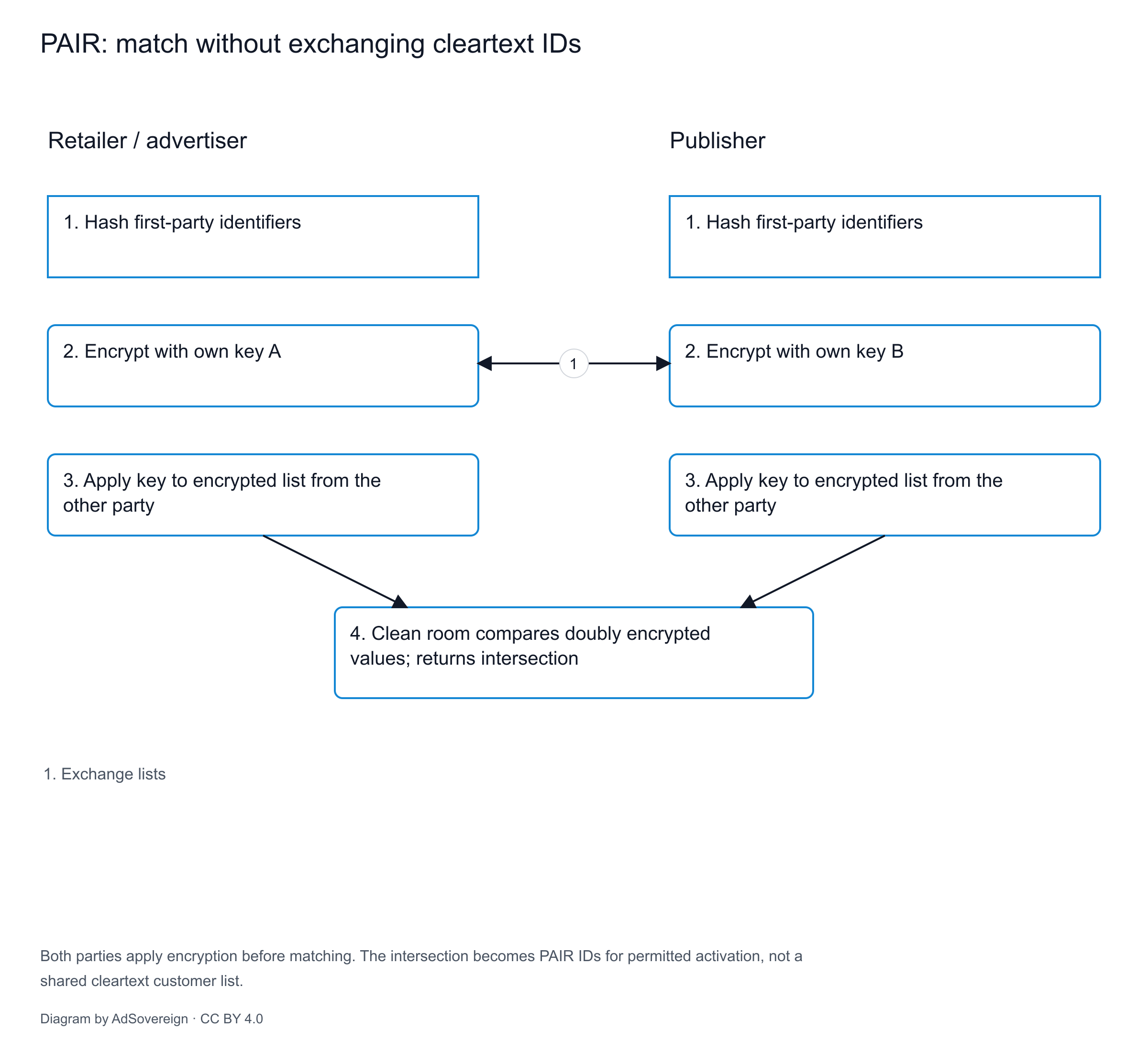
A CDP organizes customer data for operational use, while a data clean room constrains how separate parties analyze data together and what outputs they can receive.

Diagram by AdSovereign, CC BY 4.0.
Evaluate the workflow
The adtech industry loves new acronyms. But when it comes to CDPs (Customer Data Platforms) and Data Clean Rooms, the confusion isn't just semantic, it's strategic. Enterprises waste millions deploying the wrong tool because they don't understand the fundamental difference: CDPs manage profiles. Clean Rooms manage access. DMPs serve as the activation layer, translating audience data into real-time bidding signals.
Understanding the Data Stack
Before comparing CDPs and Clean Rooms, let's map where they fit in the modern marketing technology stack:
Enterprise Data Architecture┌──────────────────────────────────────────────────────────────┐
│ DATA COLLECTION LAYER │
│ CRM │ Website │ Mobile App │ POS │ Call Center │
└────────────────────────┬─────────────────────────────────────┘
│
▼
┌──────────────────────────────────────────────────────────────┐
│ CDP (Profile Management) │
│ ✓ Unify customer IDs ✓ Build 360° profiles │
│ ✓ Audience segmentation ✓ Real-time data sync │
└────────────────────────┬─────────────────────────────────────┘
│
▼
┌──────────────────────────────────────────────────────────────┐
│ CLEAN ROOM (Data Collaboration) │
│ ✓ Privacy-safe matching ✓ Aggregate-only queries │
│ ✓ No raw data exposure ✓ Audit trail for all access │
└────────────────────────┬─────────────────────────────────────┘
│
▼
┌──────────────────────────────────────────────────────────────┐
│ ACTIVATION LAYER │
│ DSP │ Email │ Social │ Display │ Retail Media │
└──────────────────────────────────────────────────────────────┘CDPs: Managing Profiles vs. Clean Rooms: Managing Access
What is a Customer Data Platform (CDP)?
A CDP aggregates customer data from multiple sources (website, mobile app, CRM, POS) into unified profiles. Think of it as a persistent, centralized customer database that:
- Collects and deduplicates customer identities (email, device ID, loyalty card)
- Creates audience segments for targeting (e.g., "high-value customers who abandoned cart")
- Syncs segments to activation platforms (DSPs, email tools, social ads)
Primary Use Case: Internal data management and audience creation within your organization.
What is a Data Clean Room?
A Data Clean Room is a privacy-preserving environment where two or more parties can collaborate on data analysis without exposing raw customer records. It enables:
- Privacy-safe matching between your customer list and a partner's (e.g., retailer + brand)
- Aggregate-only queries, no individual-level data is ever exposed
- Attribution and measurement across walled gardens (Google, Facebook, Amazon)
- Compliance with GDPR, CCPA through differential privacy and k-anonymity
Primary Use Case: External data collaboration between brands, publishers, and platforms while maintaining privacy.
CDP vs Clean Room: Side-by-Side Comparison
| Dimension | CDP | Clean Room |
|---|---|---|
| Primary Function | Profile management | Access control |
| Data Ownership | Single organization | Multi-party collaboration |
| Data Exposure | Full raw data access | Aggregate results only |
| Privacy Method | RBAC + encryption | Differential privacy + k-anonymity |
| Typical Users | Internal marketing teams | External partners (brands, agencies) |
| Use Case | Audience segmentation | Attribution & measurement |
| Deployment | Cloud or on-prem | Must be on-prem for sovereignty |
The Privacy Layer in AdTech Operations
Why CDPs Alone Are No Longer Enough
When a CPG brand wants to measure sales lift from a retailer's media network, they can't just "share a customer list." That violates GDPR and CCPA. CDPs don't provide privacy-safe data matching.
Google, Facebook, and Amazon won't give you raw conversion data. You need a clean room to perform privacy-safe attribution without exposing individual customer records.
Sending raw customer segments from your CDP to external DSPs creates data processor agreements, GDPR liability, and audit complexity. Clean rooms eliminate this risk through aggregate-only queries.
When to Use a CDP
- You need unified customer profiles across touchpoints (web, mobile, in-store)
- Your primary use case is internal audience segmentation and activation
- You're activating through owned channels (email, SMS, push notifications)
- You don't need to collaborate with external partners on data analysis
When to Use a Clean Room
- You need to measure cross-channel attribution with walled garden platforms
- You're running retail media and need to collaborate with CPG brands
- You want to enrich your data with a partner's data (e.g., credit card spend data)
- You need privacy-compliant audience overlap analysis (match rates, reach deduplication)
Decision Framework: CDP, Clean Room, or Both?
If your priority is internal audience activation:
Start with a CDP. Focus on unifying customer data and creating segments for your owned channels (email, SMS, on-site personalization).
If your priority is external data collaboration:
Deploy a Clean Room. Enable privacy-safe partnerships with brands, agencies, and platforms without exposing raw customer data.
Recommended for: Retail media networks, publishers with advertiser partners, data consortiums
If you need both internal activation and external partnerships:
Recommended for: Large retailers, omnichannel brands, financial services, healthcare
Not Sure Which Architecture Fits Your Needs?
Download our Clean Room Readiness Checklist to assess whether your organization is ready for privacy-safe data collaboration, and how to get started.
Get Clean Room Readiness Checklist →Read the current references
Read the identity and privacy guide for the broader decision framework.
FAQ
What is a data clean room in simple terms? It is a locked room where two companies put their customer lists on the table, a referee matches them without reading either aloud, and only the totals come out. Data stays under each owner's control, a cryptographic or isolated-compute step performs the join, and output rules suppress anything small enough to identify a person. IAB and IAB Europe published plain-language guides on 29 September 2026 (IAB Europe, 29 September 2026).
Snowflake clean room vs AWS Clean Rooms: what is the difference? AWS Clean Rooms is a managed service with explicit analysis rules, managed differential privacy and a published per-CRPU-hour price; all members need AWS accounts, though data can be in Snowflake or Athena (AWS pricing; AWS doc history). Snowflake Data Clean Rooms is a free native app where the analysis runner pays compute; all parties need Snowflake, Enterprise Edition for data providers, but clouds and regions can differ (Snowflake docs; InfoWorld, 28 March 2024). Pick by where your partners already are.
What is PAIR and do I need it? PAIR is IAB Tech Lab's standard for matching an advertiser's and a publisher's first-party identifiers with commutative encryption so neither sees the other's list; v1.0 was finalized in January 2025 and v1.1 adds a Prebid module (IAB Tech Lab, PAIR). You need it if you want to activate a match on a publisher's inventory through programmatic rather than only measure an overlap. You need ADMaP, published February 2025, if you want attribution across the two sides (IAB Tech Lab, ADMaP).
Are data clean rooms GDPR compliant? A clean room is a tool, not a legal basis. Pseudonymised data is still personal data under GDPR, so you need a lawful basis, a controller or processor agreement with the operator, and, if the operator or its parent is outside the EU, a Chapter V transfer mechanism. The room helps with minimization and purpose limitation; it does not replace consent or legitimate interest. Vendors that keep data in each party's own environment (InfoSum) and EU-based enclave vendors (Decentriq, Zürich) are often chosen for that reason (InfoSum; Decentriq).
How much does a data clean room cost? AWS publishes examples: about $3,504 a year for one three-minute Spark SQL query a day on 32 CRPUs at $2.00 per CRPU-hour, and $21.33 per run for a monthly PySpark measurement job (AWS Clean Rooms pricing, accessed 17 October 2026). Snowflake's app is free plus compute (InfoWorld, 28 March 2024). AMC is free to eligible advertisers (Amazon Ads). Vendor-hosted rooms do not publish prices.
How this works on owned infrastructure
AdSovereign provides an enterprise RTB stack for deployment inside a customer’s own infrastructure. Use the architecture to map the relevant components, the security controls to evaluate access and data boundaries, and the pilot to define a bounded evaluation. Compare the operating responsibilities and commercial terms against your own requirements. Infrastructure control does not establish demand access, legal permission or a measured performance improvement on its own.
Sources
- AWS, "Document history for the AWS Clean Rooms User Guide" (entries 12 January 2023 to 6 October 2026; accessed 17 October 2026). https://docs.aws.amazon.com/clean-rooms/latest/userguide/doc-history.html
- AWS, "AWS Clean Rooms pricing" (accessed 17 October 2026). https://aws.amazon.com/clean-rooms/pricing/
- AWS, "AWS Clean Rooms Differential Privacy is now generally available" (10 April 2024). https://aws.amazon.com/about-aws/whats-new/2024/04/aws-clean-room-differential-privacy
- Amazon Ads, "Amazon Marketing Cloud" (accessed 17 October 2026). https://advertising.amazon.com/solutions/products/amazon-marketing-cloud
- Snowflake, "Snowflake to acquire Samooha" (18 December 2023; closing note 20 December 2023). https://www.snowflake.com/en/blog/snowflake-to-acquire-samooha/
- InfoWorld, "Snowflake's Data Clean Room promises to ease analysis of PII data" (28 March 2024). https://www.infoworld.com/article/2336670/snowflakes-data-clean-room-promises-to-ease-analysis-of-pii-data.html
- Snowflake documentation, "Snowflake Data Clean Rooms: introduction" (accessed 17 October 2026). https://docs.snowflake.com/en/user-guide/cleanrooms/introduction
- Snowflake, "Data Clean Rooms" product page (accessed 17 October 2026). https://www.snowflake.com/en/product/features/data-clean-rooms/
- Databricks, "Databricks Clean Rooms: now generally available on AWS and Azure" (5 February 2025). https://www.databricks.com/blog/databricks-clean-rooms-now-generally-available-aws-and-azure
- Databricks, "What's new with Databricks Clean Rooms" (9 June 2025). https://www.databricks.com/blog/whats-new-databricks-clean-rooms
- Google, "Ads Data Hub: introduction" (legacy documentation, accessed 17 October 2026). https://developers.google.com/ads-data-hub/guides/intro
- Google, "Ads Data Hub: privacy checks" (accessed 17 October 2026). https://developers.google.com/ads-data-hub/guides/privacy-checks
- Microsoft Learn, "Perform protected multiparty data collaboration on Azure" (Azure Confidential Clean Rooms; doc dated 22 May 2026). https://learn.microsoft.com/en-us/azure/confidential-computing/confidential-clean-rooms
- LiveRamp, home page (accessed 17 October 2026; habu.com redirects here). https://liveramp.com/
- InfoSum, home page (accessed 17 October 2026). https://www.infosum.com/
- Optable, home page (accessed 17 October 2026). https://www.optable.co/
- Decentriq, home page (accessed 17 October 2026). https://www.decentriq.com/
- IAB Tech Lab, "PAIR: Publisher Advertiser Identity Reconciliation" (v1.0 January 2025; v1.1; accessed 17 October 2026). https://iabtechlab.com/pair/
- IABTechLab, "pair" repository (accessed 17 October 2026). https://github.com/IABTechLab/pair
- IAB Tech Lab, "Attribution Data Matching Protocol (ADMaP) v1.0 Final" (February 2025). https://iabtechlab.com/standards/addressability-and-pets/attribution-data-matching-protocol-admap-v1-0/
- IAB Tech Lab, "Webinar replay: privacy safe secure attribution with ADMaP" (10 April 2025). https://iabtechlab.com/standards/addressability-and-pets/webinar-replay-privacy-safe-secure-attribution-with-admap/
- InteractiveAdvertisingBureau, "ADMAP" repository (accessed 17 October 2026). https://github.com/InteractiveAdvertisingBureau/ADMAP/tree/main
- IAB Tech Lab, openrtb2.x releases (2.6-202409, 23 September 2024; 2.6-202505, 20 May 2025; accessed 17 October 2026). https://github.com/InteractiveAdvertisingBureau/openrtb2.x/releases
- IAB Tech Lab, OpenRTB 2.6 specification, section 3.2.27 EID (accessed 17 October 2026). https://raw.githubusercontent.com/InteractiveAdvertisingBureau/openrtb2.x/refs/heads/main/2.6.md
- ExchangeWire, "Adform and Adsquare launch industry-first Agentic Real-Time Framework integration" (27 May 2026). https://www.exchangewire.com/blog/2026/05/27/adform-adsquare-launch-industry-first-agentic-real-time-framework-integration/
- PPC Land, "IAB Tech Lab's agent registry hits 10 with Amazon and new deployment types" (11 March 2026). https://ppc.land/iab-tech-labs-agent-registry-hits-10-with-amazon-and-new-deployment-types/
- IAB Europe, "Data clean rooms for retail and commerce media: two guides, one journey" (29 September 2026). https://iabeurope.eu/data-clean-rooms-for-retail-and-commerce-media-two-guides-one-journey/
- IAB, "Data Clean Rooms in Commerce: Common Use Cases" (29 September 2026). https://www.iab.com/guidelines/data-clean-rooms-in-commerce-common-use-cases/
- IAB Europe, "Commerce (incl. Retail) Media Measurement Standards V2.1" (page dated 22 January 2026; PDF May 2026). https://iabeurope.eu/knowledge_hub/iab-europes-commerce-incl-retail-media-measurement-standards-v2/
- IAB/MRC, "Retail Media Measurement Guidelines" (January 2024). https://www.iab.com/wp-content/uploads/2024/01/IAB_Retail_Media_Measurement_Guidelines_January2024.pdf
- IAB, "Retail Media Advanced Measurement and Data Collaboration" (31 October 2024). https://www.iab.com/guidelines/retail-media-advanced-measurement-and-data-collaboration/
- Cornell Legal Information Institute, 18 U.S.C. § 2713 (CLOUD Act). https://www.law.cornell.edu/uscode/text/18/2713
Changelog
October 18, 2026: aligned the approved search title and heading; retained the original publication date.
October 17, 2026: updated search phrasing, source-linked reference context, author and dates. Withheld numerical claims without inline sources.