
Data Sovereignty
Data Sovereignty in Ad Tech: CLOUD Act, Residency, EU Stack
Published · Last updated
Next scheduled review:
Hosting in an EU region of a US-controlled cloud gives data residency, not data sovereignty. The US CLOUD Act reaches data a US provider controls wherever it sits. Sovereignty requires that hosting, operations, encryption keys, identity, bidding and support access all stay under EU jurisdiction. This page defines the terms, explains the mechanics and maps an EU-only ad tech stack.
This page is general information for compliance and engineering teams. It is not legal advice. Check the cited texts and your own counsel before relying on it.
Key facts
- The CLOUD Act has been law since March 2018. It lets US authorities compel a provider subject to US jurisdiction to produce data in its "possession, custody, or control" regardless of where the data is stored. The US has signed executive agreements with the UK (3 October 2019) and Australia (15 December 2021), not with the EU (US Department of Justice, CLOUD Act resources).
- EU regulators said in 2019 that a CLOUD Act order is not, by itself, a lawful basis to transfer data. The EDPB and EDPS told the European Parliament on 12 July 2019 that, absent an international agreement, such orders fall outside GDPR Article 48 (EDPB-EDPS joint response, 12 July 2019).
- The EU-US Data Privacy Framework survived its first court test, and the appeal is pending. The General Court dismissed Latombe v Commission (T-553/23) on 3 September 2025; the appeal (C-703/25 P) was lodged on 31 October 2025 and published in the Official Journal on 22 December 2025 (IAPP, 3 September 2025; OJ C/2025/6610, 22 December 2025).
- The first hyperscaler "sovereign" region is live. AWS European Sovereign Cloud reached general availability on 15 January 2026 in Brandenburg, with more than 90 services, EU-resident operations staff and German GmbH subsidiaries (Amazon, 15 January 2026).
- The EU is writing sovereignty into law and procurement. The Data Act has applied since 12 September 2025 and bans cloud switching charges from 12 January 2027 (Regulation (EU) 2023/2854, Article 29). The Commission proposed the Cloud and AI Development Act on 3 June 2026 (Wilson Sonsini, 5 June 2026).
- Ad tech is already being fined for where data goes. The Irish DPC fined Meta €1.2 billion on 22 May 2023 for EU-US transfers (DPC, 22 May 2023). The Norwegian DPA fined Xandr €8.6 million for real-time bidding with Grindr users' data in a decision of 2 October 2026 (EDPB, 16 October 2026).
Definition
Data sovereignty (advertising): the state in which advertising data, the systems that process it, the people who can access it and the keys that protect it are all subject only to the jurisdiction the data owner has chosen, so that no foreign authority can compel access without going through that jurisdiction's own legal process.
Data residency: the narrower fact of where data is physically stored and processed. Residency is a necessary condition for sovereignty. It is not a sufficient one.
Residency, sovereignty and the layers in between
The two terms are used interchangeably in vendor material. They are not the same thing. The table below separates the questions a buyer should ask.
5 of 5 rows
Download JSONTable by AdSovereign, CC BY 4.0.
Where are the bytes? | Data residency | Region selection, data-at-rest location, backup location | Region name, provider data-location commitment |
Which laws can compel access? | Legal (jurisdictional) sovereignty | Who controls the provider, where its parent is incorporated, which treaties apply | Corporate structure, CLOUD Act exposure, EU e-Evidence exposure |
Who can log in? | Operational sovereignty | Residency and employer of staff with privileged access, support escalation path | Access policies, EU-only on-call rosters, audit logs |
Who holds the keys? | Technical sovereignty | Encryption with keys the provider cannot read; external or on-premise key management | External key manager, HSM ownership, key access justifications |
Can we leave? | Portability | Open formats, export tools, switching charges | Data Act Article 29 compliance, exit plan |
Google Cloud stated the technical layer most plainly in its 2022 sovereignty announcement: control of encryption keys "is the strongest and most effective technical measure against extraterritorial requests for data" (Google Cloud, 11 October 2022). The legal layer is the one hyperscalers cannot change by building a data center, and it is the reason this page exists. The business and architecture side is covered across the data sovereignty hub.
How the CLOUD Act reaches EU-hosted data
The Clarifying Lawful Overseas Use of Data Act was enacted in March 2018 as an amendment to the Stored Communications Act. It added 18 U.S.C. § 2713, which requires a provider of electronic communication or remote computing services to preserve and disclose data in its "possession, custody, or control" regardless of whether the data is located inside or outside the United States (US DOJ, CLOUD Act resources; Congress.gov, H.R. 4943).
Three mechanics matter for an advertising stack.
- The hook is the provider, not the server. An order is served on a company subject to US jurisdiction, usually a US parent or a subsidiary it controls. The location of the disk is not a defence.
- The only statutory challenge is comity, and it is narrow. A provider may move to quash an order if the target is not a US person and compliance would create a material risk of violating the law of a "qualifying foreign government". Qualifying status requires an executive agreement. The US has such agreements with the UK (signed 3 October 2019) and Australia (15 December 2021). It has none with the EU or any EU member state (US DOJ).
- EU law points the other way. GDPR Article 48 says a third-country court or authority decision requiring transfer "may only be recognised or enforceable" if based on an international agreement such as a mutual legal assistance treaty (Regulation (EU) 2016/679, Article 48). The EDPB and EDPS confirmed on 12 July 2019 that a CLOUD Act order alone does not satisfy Article 48 and that Article 49 derogations would apply only in narrow cases (EDPB-EDPS, 12 July 2019).
The result is a conflict of laws that lands on the provider. A US-controlled cloud that receives a valid US order for EU data must choose which law to break. Microsoft France's director of public and legal affairs told a French Senate committee in June 2025 that the company cannot guarantee that French citizens' data would never be handed to US authorities (reported by European Cloud, 24 July 2025; primary transcript not retrieved). The EU's own e-Evidence rules now give EU authorities a mirror-image power over platforms serving the EU (Clifford Chance, August 2026).
For ad tech, the data in question is bid logs, identity graphs, conversion events and segment membership. They are "remote computing service" records like any other.
Transfers are a separate question from sovereignty
Whether data may lawfully leave the EU (GDPR Chapter V) is a different question from whether a foreign authority can reach it where it sits (CLOUD Act). You can pass the first test and fail the second.
- Schrems II. On 16 July 2020 the CJEU invalidated the Privacy Shield and held that standard contractual clauses require a case-by-case check of third-country law and, where needed, supplementary measures (CJEU C-311/18, 16 July 2020). The EDPB's Recommendations 01/2020, final version of 18 June 2021, list encryption with keys held in the EU as the primary technical measure (EDPB, 18 June 2021).
- The Data Privacy Framework. The Commission adopted the EU-US DPF adequacy decision on 10 July 2023 (Implementing Decision (EU) 2023/1795). On 3 September 2025 the General Court dismissed the first annulment action, finding the Data Protection Review Court sufficiently independent and US bulk collection proportionate (Hunton, 3 September 2025). Philippe Latombe appealed on 31 October 2025 on four grounds, including that the DPRC is not a "tribunal previously established by law" (OJ C/2025/6610, 22 December 2025). As of 17 October 2026 the appeal is pending. Law firms advise keeping SCCs or BCRs as a fallback (Hogan Lovells, 3 September 2025).
- What a transfer win does not buy. The DPF governs data that leaves the EU. It says nothing about a US order served on a US-controlled provider for data that never left Frankfurt. The DPC's €1.2 billion Meta decision of 22 May 2023, which ordered transfers suspended within five months, is a Chapter V case; sovereignty is about control (DPC, 22 May 2023).
See Data sovereignty defines the future of ad tech for the business argument.
Why "we host in Frankfurt" is a residency illusion
Three common configurations give residency without sovereignty.
1. An EU region of a US cloud. The bytes are in the EU. The operator is a US company. The CLOUD Act hook is complete. Microsoft's EU Data Boundary, completed in February 2025, commits to storing and processing customer data, pseudonymised personal data and support data in the EU and EFTA for core services, and still carves out "limited security cases requiring a coordinated global response" (Microsoft, 26 February 2025). The boundary addresses residency. It does not change who the provider is.
2. An EU subsidiary with EU staff. AWS European Sovereign Cloud is operated "exclusively by EU residents", has "zero operational control outside of EU borders", and sits under a new parent company with three German GmbH subsidiaries and an advisory board of three Amazon employees and two independent members (Amazon, 15 January 2026). This is a real improvement on operational sovereignty. The press release does not mention the CLOUD Act, and the entities remain Amazon-owned. Whether "control" under § 2713 stops at a German GmbH with EU-only staff is untested in court. A buyer should treat it as residual legal risk, not as resolved.
3. Encryption with provider-managed keys. If the provider can decrypt, the provider can be compelled to decrypt. External key management, where keys live in an HSM the customer or an EU third party controls, is the measure the EDPB and Google both point to. It only helps for data at rest and in transit. A bidder has to decrypt to bid.
The honest framing: a sovereign-branded region from a US hyperscaler moves you from "no control" to "operational control with residual US legal exposure". An EU-controlled provider, or your own infrastructure, moves you to "EU legal exposure only".
Provider comparison: what each sovereign offering solves
All claims below are the providers' own unless marked. Dates are the latest we could verify.
7 of 7 rows
Download JSONTable by AdSovereign, CC BY 4.0.
AWS European Sovereign Cloud (Brandenburg, | Physically and logically separate AWS partition, EU-resident operations, German GmbH entities, EU advisory board, 90+ services at launch | GA 15 January 2026; Local Zones planned for Belgium, the Netherlands, Portugal; €7.8 billion German investment to 2040 (Amazon, 15 January 2026) | Residency, operational sovereignty, continuity if cut off from the rest of AWS | Amazon ownership; CLOUD Act "control" question untested; subset of services |
Microsoft EU Data Boundary + Sovereign Cloud | Residency commitment across Azure, Microsoft 365, Dynamics; Sovereign Public Cloud (existing EU regions), Sovereign Private Cloud (Azure Local), Data Guardian (EU-resident approval of remote access, tamper-evident log); National Partner Clouds Bleu (France) and Delos (Germany) | Boundary phase 3 complete February 2025 (Microsoft, 26 February 2025); package announced 16 June 2025, Sovereign Public Cloud in preview with GA "expected by the end of 2025" (Microsoft, 16 June 2025); GA date n/d | Residency; logged, EU-approved remote access; partner clouds under French and German operators | Microsoft ownership of the public offering; own executive's June 2025 Senate statement that access by US authorities cannot be ruled out (European Cloud, 24 July 2025) |
Google Cloud Sovereign Controls by partners | Partner-operated data boundaries: S3NS (France, Thales), T-Systems (Germany), Polo Strategico Nazionale (Italy); external key management; Google Distributed Cloud air-gapped option | Partner boundaries listed as generally available (Google Cloud docs, undated); program announced 11 October 2022 (Google Cloud, 11 October 2022) | Operator independence where the partner runs the controls; customer-held keys; disconnected option | Underlying software and updates still Google's; scope limited to a region and a service subset; partner contract terms vary |
OVHcloud (France) | EU-headquartered provider; SecNumCloud-qualified services (Managed VMware vSphere since December 2020; SNC Cloud Platform since September 2026) | Legal sovereignty (EU provider), French government-grade qualification for the qualified services | Smaller service catalogue; qualification is per service, not whole platform | |
STACKIT (Schwarz Group, Germany) | Cloud of the Schwarz Group (Lidl, Kaufland); seven data centres in Europe; C5 and ISO 27001; states independence from external investors | STACKIT (undated) | Legal sovereignty; German C5 attestation; retail-grade scale | Younger platform; fewer managed services than hyperscalers |
Scaleway (iliad, France) | EU provider with four multi-AZ regions in Europe; positions itself as "a European alternative to hyperscalers" | Scaleway (undated) | Legal sovereignty; GPU capacity in the EU | Certification scope varies by service; verify SecNumCloud status per product |
Own data center or EU colocation | Hardware you own or lease in an EU facility, operated by your staff or an EU contractor | n/a | Every layer under your control, including keys and support access | You run it; capacity planning and 24/7 operations are yours; no elastic burst without a second provider |
Two benchmarks help score these. France's SecNumCloud qualification, run by ANSSI, is the standard Bleu and S3NS are designed against (Microsoft, 16 June 2025; Google Cloud). The Commission's Cloud Sovereignty Framework of 20 October 2025 scores providers on eight objectives (SOV-1 to SOV-8) and five levels, from SEAL-0 "no sovereignty" to SEAL-4 "full digital sovereignty" (Agenda Digitale, 16 March 2026). Ask each provider which SEAL level it claims and on what evidence.
What an EU-only ad tech stack looks like, layer by layer
An advertising stack has more layers than a database. Each one is a place where data can leave EU control. The table lists the layer, the usual leak, and the EU-only pattern.
10 of 10 rows
Download JSONTable by AdSovereign, CC BY 4.0.
Hosting | Bidder, ad server, data warehouse, key management | US hyperscaler region; provider-managed keys | EU-controlled provider or own hardware; keys in an HSM you or an EU third party control; EU-resident admin access only |
Network and edge | DNS, CDN, DDoS protection, creative delivery | US CDN logs full IP and user agent for every impression | EU CDN or self-hosted edge; log truncation at ingest; no third-party pixels on the edge path |
Bidder (DSP, SSP, exchange) | OpenRTB request handling, pricing, decisioning | Bid requests sent to US DSPs by design; bid logs stored in the DSP's region | Own or EU-hosted bidder; curated or deal-based supply so EU requests only go to EU-hosted buyers; log retention and location you set |
Data store and DMP | Segments, identity graph, conversion events | SaaS DMP or CDP replicating to US regions; "global" analytics tools | EU-resident warehouse; segment build inside your perimeter; export only aggregates |
Identity | Hashed email IDs, telco IDs, first-party login graph | Public ID operators hosted abroad; hashed PII posted to a third party | Private operator for EUID or UID2 so hashed data never leaves your environment (EUID docs); telco-network IDs such as Utiq, which reported about 70 million users across six markets as of 15 November 2025 (PPC Land, 1 June 2026); your own login graph. See Identity after Privacy Sandbox |
Consent | CMP, TC String, GPP | CMP vendor hosted abroad; consent logs in a US region | TCF v2.3-compliant CMP (mandatory since 28 February 2026, IAB Europe) with EU-hosted consent records; see GDPR, ePrivacy and the bidstream |
Clean room | Partner matching, overlap, incrementality | Clean room run on a US cloud account owned by the partner or the vendor | Self-hosted or EU-provider clean room; computation on your side; see Clean room architectures compared and Clean rooms vs CDP |
Measurement and attribution | Impression and conversion logs, lift studies | Vendor pixel sends raw events to a US endpoint | Server-side event collection into your warehouse; aggregate reports to partners; DMA Article 6(8) rights to raw data from gatekeepers (Regulation (EU) 2022/1925) |
Support access | Vendor engineers, on-call, "break glass" | Global support teams with standing access | Contractual EU-only support; time-boxed, logged, approved access (the pattern Microsoft's Data Guardian and AWS ESC describe) |
Observability | Logs, traces, error tracking | SaaS observability tools with US data planes | EU-hosted or self-hosted logging; PII scrubbing before export |
Two layers are harder than the rest.
The bidstream. Programmatic advertising works by broadcasting a request about a user to many buyers. Under OpenRTB 2.6 that request can carry device.ip, device.ifa, user.id, user.buyeruid and user.eids (IAB Tech Lab, OpenRTB 2.6). If the buyer is a US DSP, those fields leave the EU on every auction. The CJEU held on 7 March 2024 that even the consent string itself is personal data when linked to an IP address (CJEU C-604/22, 7 March 2024). An EU-only stack therefore does one of three things: strips identifiers for non-EU buyers, limits EU supply to deals with EU-hosted buyers, or runs its own bidder so the decision happens inside the perimeter. The field-level rules are in GDPR, ePrivacy and the bidstream.
Measurement. The Norwegian DPA's Xandr decision of 2 October 2026 found that a platform acting as both SSP and DSP was a joint controller and could not rely on the app's consent, stating that "accountability cannot be outsourced" (EDPB, 16 October 2026). Measurement vendors that receive raw events sit in exactly that position.
What EU law now requires, and what is coming
Four regulatory directions matter. None is specific to advertising. All touch an advertising stack.
Data Act (in force). Regulation (EU) 2023/2854 applies from 12 September 2025. It requires cloud providers to support switching and multi-cloud, caps switching charges at direct cost until 12 January 2027 and bans them after that date (Article 29). Article 32 requires providers to take "all adequate technical, organizational and legal measures" to prevent third-country governmental access to non-personal data held in the EU where that access would conflict with EU or member state law (Regulation (EU) 2023/2854). Google responded with free intra-EU transfers for a customer's own workloads; Microsoft and AWS offered at-cost transfers on request (The Register, 10 September 2025). For an ad tech buyer this means an exit from a DSP or data platform is a contractual right, not a favor. See The real cost of cloud DSPs.
Digital Markets Act (in force). Article 5(2) prohibits a gatekeeper from processing end users' personal data for advertising using third-party services, combining it across its own services or signing users into other services to combine data, "unless the end user has been presented with the specific choice and has given consent". Articles 5(9) and 5(10) require daily, free disclosure of ad prices and publisher remuneration to advertisers and publishers. Article 6(8) requires free access to performance-measuring tools and the underlying "aggregated and non-aggregated data" (Regulation (EU) 2022/1925). The Commission fined Meta €200 million on 23 April 2025 over its "consent or pay" model (European Commission, 23 April 2025). For sovereignty, the practical effect is that log-level data from gatekeepers is a right you can exercise and store on EU infrastructure.
Cloud and AI Development Act (proposed). The Commission tabled the CADA on 3 June 2026. For public bodies it sets four assurance levels; Level 1 is a provider self-assessment, Levels 2 to 4 require independent audit and check whether staff are in the EU, whether provider data can train AI models and whether the service holds a "substantial" or higher EU cybersecurity certificate. As a default rule public bodies may use only EU-established providers, with exceptions for non-EU providers at Level 3 or above that are controlled from a jurisdiction the Commission approves. Private entities in high-criticality NIS2 sectors such as banking and energy "may apply similar criteria" (Wilson Sonsini, 5 June 2026). The proposal is at an early stage and has no adoption date. Advertising teams inside banks, telcos and public broadcasters should expect these tiers to appear in their own procurement rules.
EUCS (stalled). The EU cloud certification scheme under the Cybersecurity Act has been negotiated since 2020. The March 2024 draft removed the sovereignty requirements France had pushed for the highest level (IAPP, 25 April 2024). As of March 2026 its entry into force was unknown and the scheme remains voluntary (Agenda Digitale, 16 March 2026). Do not wait for it. Use SecNumCloud, C5 and the Commission's SEAL levels as proxies.
Enforcement that already touched advertising data
6 of 6 rows
Download JSONTable by AdSovereign, CC BY 4.0.
22 May 2023 | Irish DPC | Meta Ireland | €1.2 billion | EU-US transfers under SCCs after Schrems II (Article 46(1)); transfers to be suspended within five months | |
15 June 2023 | CNIL | Criteo | €40 million | Targeted advertising without proof of consent, transparency and joint-controller failures | |
7 March 2024 | CJEU | IAB Europe (reference from Belgium) | n/a (judgment) | TC String is personal data; IAB Europe is a joint controller for it | |
23 April 2025 | European Commission | Meta | €200 million | DMA Article 5(2): "consent or pay" did not offer a less-personalized equivalent | |
1 September 2025 | CNIL | Google LLC and Google Ireland | €325 million | Ads between Gmail messages without consent; advertising cookies at account creation | |
2 October 2026 (published 16 October 2026) | Norwegian Datatilsynet | Xandr (Microsoft) | €8.6 million (NOK 92 million) | RTB with Grindr users' advertising ID and IP; joint controller as SSP and DSP; could not rely on the app's consent |
The pattern: regulators are now looking inside the bidstream, not only at the consent banner. Where the data goes, and who controls the system it goes to, is part of the case.
Procurement checklist for an EU-only advertising stack
Use this for RFPs and vendor reviews. Each item maps to a layer in the table above.
- Corporate control. Name the ultimate parent of every provider in the stack and its country of incorporation. Flag any entity subject to US jurisdiction.
- Region and partition. For hyperscaler offerings, require the sovereign partition (not a standard EU region) and get the partition name in the contract.
- Key custody. Require customer-held or EU-third-party-held keys for data at rest, with key access justification logs you can read.
- Staff residency. Require that privileged access is limited to EU-resident staff employed by an EU entity, with named exceptions and a break-glass procedure you approve.
- Support path. Ask where tickets escalate at level 3 and whether non-EU engineers can see customer data. Get it in writing.
- Bid request routing. For SSPs and exchanges, require a per-buyer rule that strips
device.ip,device.ifa,user.id,user.buyeruidanduser.eidsfor buyers outside the EU unless consent and an approved transfer mechanism are documented. - Log location and retention. Specify where bid logs, win logs and event logs are stored, for how long, and who can query them.
- Identity operator model. For email-based IDs, require a private operator inside your environment; for telco IDs, confirm the consent flow and signal lifetime.
- Clean room topology. Require that matching computation runs on infrastructure you or an EU provider control, and that partners receive aggregates only.
- Measurement endpoints. No third-party pixels that post raw events to non-EU endpoints; server-side collection into your warehouse.
- Gatekeeper data rights. Exercise DMA Articles 5(9), 5(10) and 6(8) and route the data to EU storage.
- Transfer mechanism register. For every residual transfer, record the mechanism (DPF certification, SCCs, BCRs) and the fallback if the DPF falls in C-703/25 P.
- Exit. Reference Data Act Article 29; require export in open formats and a tested exit plan; from 12 January 2027 refuse any switching charge.
- Certification evidence. Ask for SecNumCloud or C5 scope documents, the claimed SEAL level under the Commission framework, and the gap list. Public-sector and NIS2-sector buyers should add the CADA assurance levels once the text stabilises.
Diagram spec

Diagram by AdSovereign, CC BY 4.0.
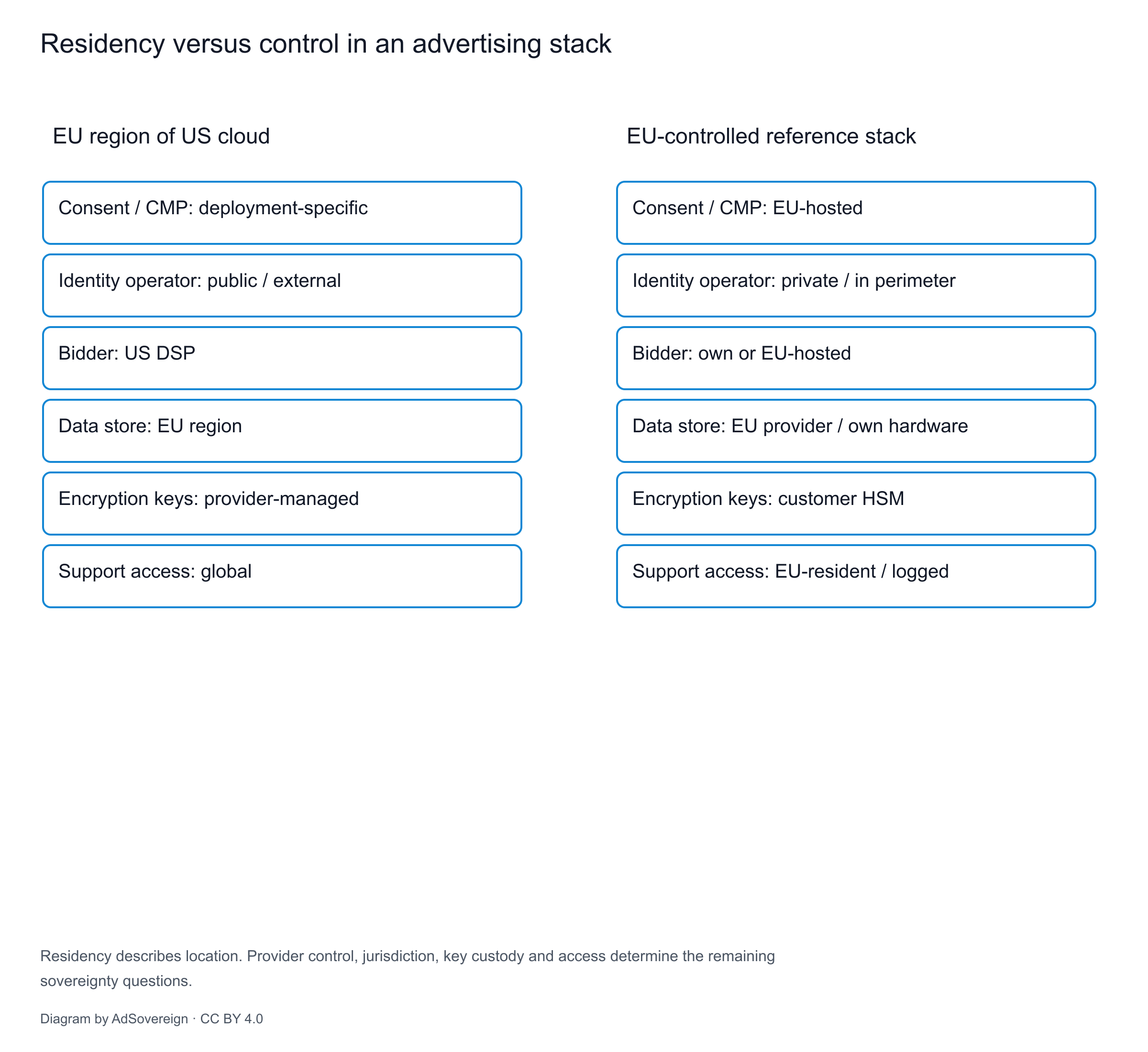
FAQ
What is the difference between data residency and data sovereignty? Residency is where data is stored and processed. Sovereignty is which jurisdiction can compel access to it, which depends on who controls the provider, who holds the keys and who has privileged access. An EU region of a US cloud gives residency. The CLOUD Act, enacted in March 2018, lets US authorities reach data a US-controlled provider holds anywhere (US DOJ), so residency alone does not give sovereignty.
Does the CLOUD Act apply to data stored in the EU? Yes, if the provider is subject to US jurisdiction. 18 U.S.C. § 2713 covers data in a provider's "possession, custody, or control" regardless of location. The provider can only move to quash on comity grounds if a "qualifying foreign government" is involved, and the only such agreements are with the UK (3 October 2019) and Australia (15 December 2021) (US DOJ). EU regulators said on 12 July 2019 that such an order is not a lawful transfer basis under GDPR Article 48 (EDPB-EDPS).
Is the AWS European Sovereign Cloud immune to the CLOUD Act? AWS has not claimed that. Its 15 January 2026 announcement describes EU-resident operations, German GmbH entities, an EU advisory board and "zero operational control outside of EU borders", and does not mention the CLOUD Act (Amazon, 15 January 2026). The entities are Amazon-owned. Whether that structure defeats a US order is untested. Treat it as reduced, not eliminated, legal exposure.
Is the EU-US Data Privacy Framework still valid in 2026? Yes. The General Court upheld it on 3 September 2025 in Latombe v Commission (T-553/23). An appeal to the Court of Justice (C-703/25 P) was lodged on 31 October 2025 and is pending (OJ C/2025/6610, 22 December 2025). Companies that rely on DPF certification should keep SCCs or BCRs ready as a fallback.
Can an EU company legally send bid requests to a US DSP? It can, with a lawful basis for each data element, a transfer mechanism for the recipient and data minimization. Since 7 March 2024 the TC String itself counts as personal data when linked to an IP address (CJEU C-604/22), and the Norwegian DPA's October 2026 Xandr decision shows that platforms in the chain are joint controllers (EDPB, 16 October 2026). The sovereignty question is separate: once the request is in the DSP's logs, US law reaches it. Stripping identifiers for non-EU buyers or routing EU supply to EU-hosted buyers avoids both problems.

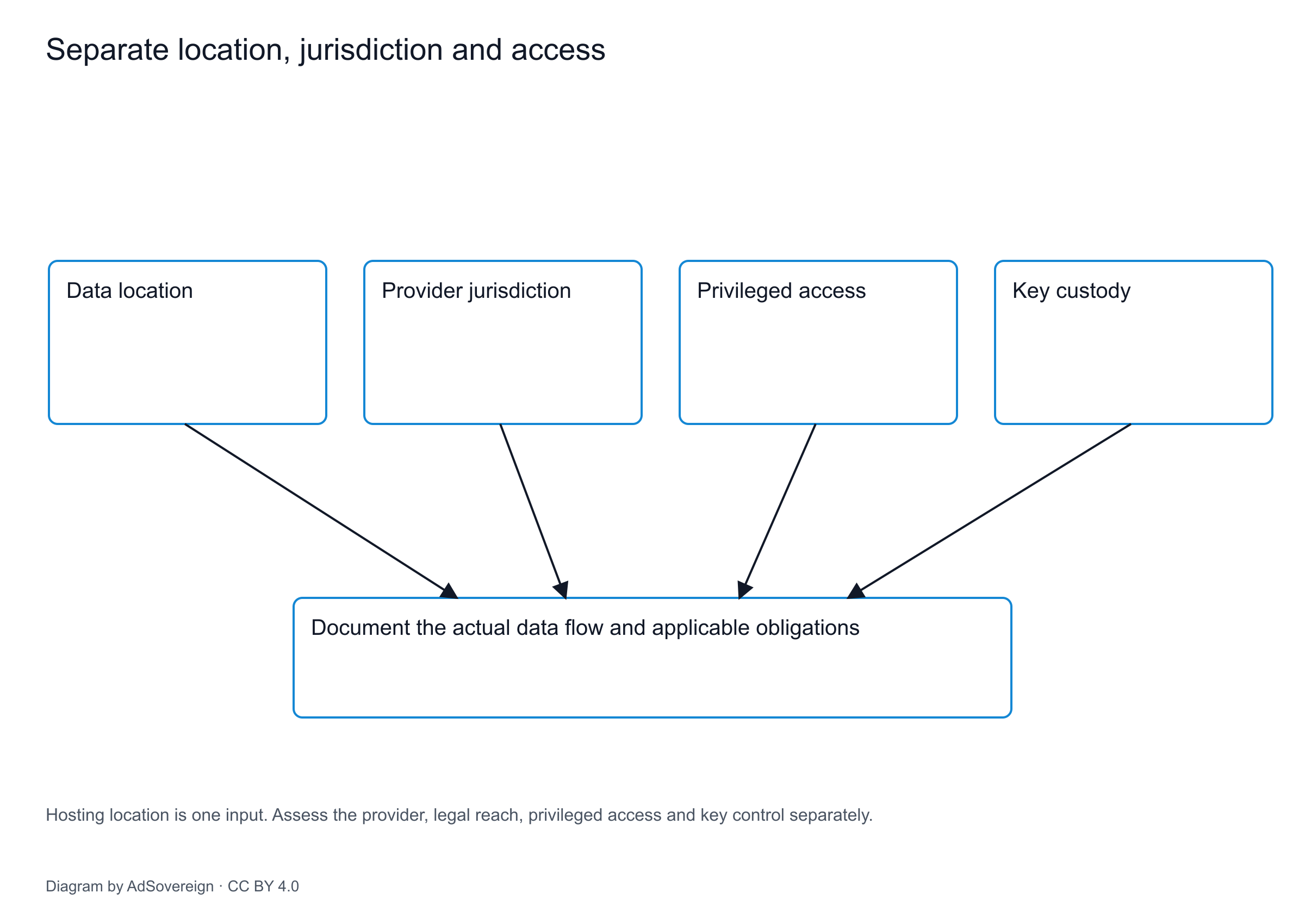
Diagram by AdSovereign, CC BY 4.0.
How this works on owned infrastructure
Every layer in the table above can be rented from a US-controlled provider or run inside an EU perimeter. AdSovereign is an enterprise, on-premise RTB stack (DSP, SSP, exchange, DMP and clean room) built for the second option. It deploys on hardware you own or on an EU-controlled provider, keeps bid logs, identity graphs and consent records in storage you choose, supports a private operator for EUID and UID2, and applies per-buyer stripping rules to outbound bid requests. Support access is EU-resident and logged. The architecture page shows the deployment topology, the security page lists the controls and certifications, the TCO calculator compares the running cost with rented stacks, and the pilot page describes a 90-day evaluation on your own infrastructure.
Sources
- US Department of Justice, "CLOUD Act Resources" (March 2018 enactment; UK agreement 3 October 2019; Australia agreement 15 December 2021). https://www.justice.gov/dag/cloudact
- Congress.gov, H.R. 4943, Clarifying Lawful Overseas Use of Data Act (115th Congress). https://www.congress.gov/bill/115th-congress/house-bill/4943
- EDPB and EDPS, "Joint response to the LIBE Committee on the impact of the US CLOUD Act on the European data protection framework" (12 July 2019). https://www.edpb.europa.eu/our-work-tools/our-documents/letters/edpb-edps-joint-response-libe-committee-impact-us-cloud-act_en
- Regulation (EU) 2016/679 (GDPR), Articles 44 to 49. https://eur-lex.europa.eu/eli/reg/2016/679/oj
- CJEU, Case C-311/18, Data Protection Commissioner v Facebook Ireland and Schrems (16 July 2020). https://eur-lex.europa.eu/legal-content/EN/TXT/?uri=CELEX:62018CJ0311
- EDPB, "Recommendations 01/2020 on measures that supplement transfer tools", final version (18 June 2021). https://www.edpb.europa.eu/our-work-tools/our-documents/recommendations/recommendations-012020-measures-supplement-transfer_en
- Commission Implementing Decision (EU) 2023/1795, EU-US Data Privacy Framework (10 July 2023). https://eur-lex.europa.eu/eli/dec_impl/2023/1795/oj
- IAPP, "European General Court dismisses Latombe challenge, upholds EU-US Data Privacy Framework" (3 September 2025). https://iapp.org/news/a/european-general-court-dismisses-latombe-challenge-upholds-eu-us-data-privacy-framework
- Hunton, "EU's General Court Confirms Adequacy of EU-U.S. Data Privacy Framework" (3 September 2025). https://www.hunton.com/privacy-and-information-security-law/eus-general-court-confirms-adequacy-of-eu-u-s-data-privacy-framework
- Hogan Lovells, "Transatlantic data transfers: EU General Court upholds Data Privacy Framework" (3 September 2025). https://www.hlc.com/en/publications/transatlantic-data-transfers-eu-general-court-upholds-dat-privacy-framework
- Official Journal of the EU, C/2025/6610, Case C-703/25 P, Latombe v Commission, appeal brought 31 October 2025 (22 December 2025). https://eur-lex.europa.eu/eli/C/2025/6610/oj
- Amazon, "AWS Launches AWS European Sovereign Cloud and Announces Expansion Across Europe" (15 January 2026). https://press.aboutamazon.com/aws/2026/1/aws-launches-aws-european-sovereign-cloud-and-announces-expansion-across-europe
- Microsoft, "Microsoft completes landmark EU Data Boundary" (26 February 2025). https://blogs.microsoft.com/eupolicy/2025/02/26/microsoft-completes-landmark-eu-data-boundary/
- Microsoft News Center Spain, "Microsoft presenta nuevas soluciones de Nube Soberana para las organizaciones europeas" (16 June 2025). https://news.microsoft.com/es-es/2025/06/16/microsoft-presenta-nuevas-soluciones-de-nube-soberana-para-las-organizaciones-europeas/
- European Cloud, "Microsoft cannot guarantee data sovereignty" (24 July 2025, updated 2 December 2025; secondary report of French Senate testimony). https://european.cloud/2025/07/microsoft-cannot-guarantee-data-sovereignty/
- Google Cloud, "Advancing digital sovereignty on Europe's terms" (11 October 2022). https://cloud.google.com/blog/products/identity-security/advancing-digital-sovereignty-on-europes-terms
- Google Cloud documentation, "Sovereign Controls by Partners overview" (undated, retrieved 17 October 2026). https://docs.cloud.google.com/sovereign-controls-by-partners/docs/overview
- Google Cloud, "Sovereign Cloud" (undated). https://cloud.google.com/sovereign-cloud
- OVHcloud, "SecNumCloud" (Managed VMware vSphere qualified December 2020; SNC Cloud Platform September 2026). https://www.ovhcloud.com/en/enterprise/certification-conformity/secnumcloud/
- STACKIT, homepage (undated). https://stackit.com/en/
- Scaleway, homepage (undated). https://www.scaleway.com/en/
- Regulation (EU) 2023/2854 (Data Act), Articles 29, 32 and 50. https://eur-lex.europa.eu/eli/reg/2023/2854/oj
- The Register, "Big clouds scramble as EU Data Act brings new data transfer rules" (10 September 2025). https://www.theregister.com/2025/09/10/big_clouds_scramble_over_eu/
- Regulation (EU) 2022/1925 (Digital Markets Act), Articles 5(2), 5(9), 5(10), 6(8). https://eur-lex.europa.eu/eli/reg/2022/1925/oj
- European Commission, "Commission finds Apple and Meta in breach of the Digital Markets Act", IP/25/1085 (23 April 2025). https://ec.europa.eu/commission/presscorner/detail/en/ip_25_1085
- Wilson Sonsini, "European Commission Publishes Proposal for Act to Reduce Reliance on Foreign Cloud and AI" (5 June 2026). https://www.wsgrdataadvisor.com/2026/06/european-commission-publishes-proposal-for-act-to-reduce-reliance-on-foreign-cloud-and-ai/
- IAPP, "A view from Brussels: To be sovereign or not to be" (25 April 2024). https://iapp.org/news/a/a-view-from-brussels-to-be-sovereign-or-not-to-be
- Agenda Digitale, "ENISA e certificazione cloud: costruire uno standard di sicurezza europeo" (16 March 2026; EUCS status and Commission Cloud Sovereignty Framework of 20 October 2025). https://agendadigitale.eu/sicurezza/enisa-e-certificazione-cloud-costruire-uno-standard-di-sicurezza-europeo
- Irish Data Protection Commission, "Data Protection Commission announces conclusion of inquiry into Meta Ireland" (22 May 2023). https://www.dataprotection.ie/en/news-media/press-releases/Data-Protection-Commission-announces-conclusion-of-inquiry-into-Meta-Ireland
- CNIL, "Sanctions issued by the CNIL" (list; Criteo 15 June 2023). https://www.cnil.fr/en/sanctions-issued-cnil
- Privacy Laws & Business, "CNIL fines Google €325 million and Shein €150 million" (4 September 2025). https://www.privacylaws.com/news/cnil-fines-google-325-million-and-shein-150-million/
- EDPB, "Norwegian DPA fines Xandr EUR 8 600 000 for unlawful processing of personal data" (16 October 2026; decision 2 October 2026). https://www.edpb.europa.eu/news/norwegian-dpa-fines-xandr-eur-8-600-000-for-unlawful-processing-of-personal-data_en
- CJEU, Case C-604/22, IAB Europe v Gegevensbeschermingsautoriteit (7 March 2024). https://eur-lex.europa.eu/legal-content/EN/TXT/?uri=CELEX:62022CJ0604
- IAB Tech Lab, OpenRTB 2.6 specification (GitHub). https://raw.githubusercontent.com/InteractiveAdvertisingBureau/openrtb2.x/main/2.6.md
- IAB Europe, "Transparency & Consent Framework" (TCF v2.3; adoption deadline 28 February 2026). https://iabeurope.eu/transparency-consent-framework/
- EUID documentation, "Public and Private Operators" (retrieved 17 October 2026). https://euid.eu/docs/ref-info/ref-operators-public-private
- PPC Land, "The Trade Desk integrates Utiq's telco identity signals across EMEA" (1 June 2026; Utiq figures as of 15 November 2025). https://ppc.land/the-trade-desk-integrates-utiqs-telco-identity-signals-across-emea/
- Clifford Chance, "EU e-Evidence Regulation and Directive: What it means for e-commerce platforms" (August 2026). https://www.cliffordchance.com/insights/resources/blogs/regulatory-investigations-financial-crime-insights/2026/08/eu-e-evidence-regulation-and-directive-what-it-means-for-e-commerce-platforms.html
Changelog
18 October 2026: aligned the title and heading and applied recorded source-URL corrections where needed. Factual research cutoff remains 17 October 2026.
17 October 2026. First edition. Next review 15 January 2027.