
In-House Programmatic
Cloud DSP Costs: Fees, Data Ownership and Exit Terms
Published · Last updated
Next scheduled review:
The cost of a DSP includes platform fees, data products, operations, integrations and the work required to leave. Compare the fee base and contract terms before comparing headline percentages. Ask who owns campaign records, how logs are delivered and which exports remain available when the contract ends.
Contents
Key facts
- The only audited DSP take rate is The Trade Desk's. Revenue of $2,896.3 million on gross platform spend of $13,394.7 million in 2025 implies 21.6%, up from 20.3% in 2024 ($2,444.8 million on $12,040.9 million) (The Trade Desk 10-K, FY2025). The company says its take rate is "consistently around 20%" (AdExchanger, 28 April 2025).
- Regulator data puts self-service DSP fees at 4% to 16% and managed DSPs at 20% to 42%. The UK CMA's 2019 fee data gave a weighted DSP average of 14% and a DV360 range of 5% to 15% plus third-party fees (CMA, Appendix R, 1 July 2020).
- Amazon's managed service is reported at a $50,000 minimum with a 15% service fee and a 10% platform fee, per documentation summarised in July 2025; the buying product was renamed DVA inside Amazon Ads Agent on 29 September 2026 (PPC Land, 15 October 2026).
- Third-party data is a second fee layer. Google's DV360 help pages quote $0.50 to more than $2 CPM for third-party lists (Google DV360 Help, accessed 17 October 2026). The Trade Desk's Audience Unlimited charges 3.3% or 4.4% of impression cost in Control Mode and says heavy data users spend "nearly 20%" of media on data (PPC Land, 29 September 2025).
- In the ANA's log-level benchmark, DSP platform fees averaged 6.0% of spend and DSP data costs 2.7% in Q3 2025, with SSP platform fees at 12.8% (ANA Programmatic Transparency Benchmark, Q3 2025).
- Flat-fee software starts at $250 a month. Epom's white-label DSP is $250 or $2,000 a month or 5% of ad spend, whichever is higher, with a possible $500 setup fee (Epom DSP pricing, accessed 17 October 2026). Beeswax charges "a flat fee based on tech usage instead of a spend fee" (PPC Land, 17 December 2020).
Definition
DSP ownership cost is the sum of contracted platform charges and the infrastructure, people, data, integration and transition work required over a defined period.

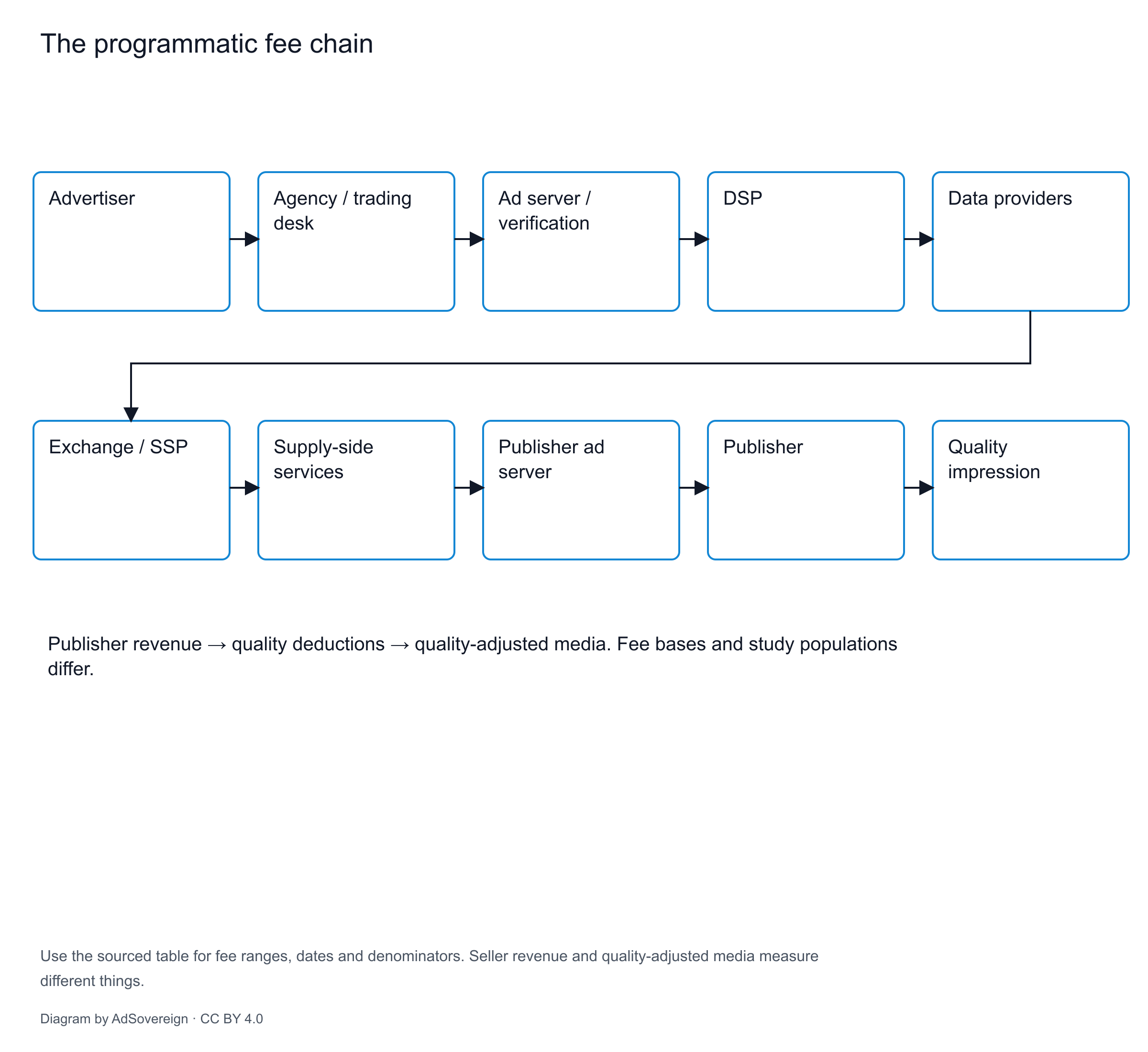
Diagram by AdSovereign, CC BY 4.0.
Evaluate the workflow
SaaS DSPs and the "Ad Tax" Trap
3-Year Cost Projection: $50M Annual Media Spend
Note: Does not include hidden costs like data leakage, vendor lock-in migration costs, or opportunity cost of lost algorithmic IP.
Data Ownership = Revenue Control
The platform fee is just the visible cost. The invisible cost is what happens to your data inside the cloud DSP:
1. Algorithmic Training on Your Strategies
Cloud DSPs use machine learning to optimize bids. Where does the training data come from? Your campaigns. Your winning bid strategies, audience performance, and creative insights become part of the platform's "best practices", which are then offered to all clients, including competitors.
2. Audience Data Monetization
Many cloud DSPs offer "lookalike modeling" or "audience expansion" features. How do they build these models? By analyzing patterns across all client data. Your first-party customer segments are being used to create synthetic audiences that the DSP sells to others.
Real Example: Competitive Intelligence Leak
A CPG brand discovered that their cloud DSP's "market insights" dashboard was showing competitor campaign performance metrics. The DSP claimed it was "anonymized aggregate data", but the brand could reverse-engineer which campaigns belonged to which competitor based on timing, geography, and creative themes.
Cloud Lock-In vs. on-premise Freedom
Vendor lock-in isn't accidental, it's by design. Cloud DSPs make migration painful through:
- Proprietary APIs: Custom integrations that don't work with other platforms
- Black-Box Algorithms: You can't export or replicate the bidding logic you've spent years optimizing
- Data Silos: Historical performance data is trapped in the platform's database with no standard export format
- Contract Terms: Multi-year commitments with auto-renewal clauses and early termination penalties
On-premise infrastructure eliminates lock-in:
- Open Standards: OpenRTB, JSON-based configs, PostgreSQL/MySQL databases you can query directly
- Transparent Algorithms: Full access to bidding logic, allowing customization and portability
- Data Portability: All logs, metrics, and segments stored in standard formats you control
- No Contract Lock-In: Perpetual licensing means you own the software forever, no recurring fees
TCO Comparison: 3-Year return on investment Projection
Cloud DSP vs. On-Premise: 3-Year TCO
→ Calculate Your Custom TCO
Migration Strategy: From Cloud to On-Premise
Phase 1: Parallel Deployment
- Validate feature parity (audience targeting, creative rotation, reporting)
Phase 2: Data Migration
- Export historical campaign data, conversion pixels, and audience segments
- Train internal team on new platform UI and reporting dashboards
Phase 3: Full Cutover
- Monitor performance metrics (CPM, CTR, CPA, ROAS) against baseline
Real Migration: Publisher Network
→ Read Full Publisher Case Study
The Strategic Advantage: More Than Cost Savings
Beyond direct cost savings, on-premise infrastructure delivers strategic advantages:
- Algorithmic IP Protection: Your bidding strategies remain proprietary, no risk of competitors reverse-engineering your approach
- Custom Feature Development: Build proprietary features (e.g., connected TV bidding, retail media attribution) without vendor roadmap constraints
- M&A Asset Value: Owned infrastructure is an asset on your balance sheet, rented SaaS is an operating expense
Read the current references
Read the in house programmatic guide for the broader decision framework.
FAQ
How much does Amazon DSP (now part of Amazon Ads Agent) cost?
What is The Trade Desk's take rate?
Does DV360 charge a platform fee?
How much does it cost to start a DSP?
Are DSP fees negotiable?
November 2026 update
Amazon renamed its unified console and DSP Amazon Ads Agent on 29 September 2026. The DVA+ campaign type combines display ads (formerly Sponsored Display), streaming TV ads (formerly Sponsored TV) and programmatic. See the Amazon Ads announcement, 29 September 2026 and the Amazon DSP profile.
How this works on owned infrastructure
Compare AdSovereign with a rented DSP using the same spend definition, service scope and planning horizon. Start with the architecture to identify which infrastructure and operating functions the license leaves with your team. Include staffing, data services, integration work, migration, parallel operation and exit costs alongside platform fees. Review access and export responsibilities in the security assessment, since practical data ownership can affect transition effort. Use a deployment review to obtain workload and operating measurements that replace planning assumptions. Keep negotiated prices distinct from examples, and report a cost difference only within the expenses actually included in the comparison.
Component licensing, inclusions and payment terms are published on the pricing page.
Sources
- The Trade Desk, Inc., Form 10-K for fiscal year 2025 (filed February 2026). https://www.sec.gov/Archives/edgar/data/1671933/000167193326000014/ttd-20251231.htm
- PPC Land, "Trade Desk posts $2.9B in 2025 revenue but growth slows to 18%" (27 February 2026). https://ppc.land/trade-desk-posts-2-9b-in-2025-revenue-but-growth-slows-to-18/
- AdExchanger, "As CTV Blooms, It's Knives Out For The Trade Desk's Take Rate" (28 April 2025). https://www.adexchanger.com/online-advertising/as-ctv-blooms-its-knives-out-for-the-trade-desks-take-rate/
- PPC Land, "Explaining take rate" (4 September 2026). https://ppc.land/take-rate/
- PPC Land, "The Trade Desk launches data marketplace overhaul with AI scoring" (29 September 2025). https://ppc.land/the-trade-desk-launches-data-marketplace-overhaul-with-ai-scoring/
- Amazon Ads, Amazon DSP / Amazon Ads Agent product page (accessed 17 October 2026). https://advertising.amazon.com/solutions/products/amazon-dsp
- PPC Land, "Meta named a future that never came. Amazon Ads Agent names one that exists" (15 October 2026). https://ppc.land/meta-named-a-future-that-never-came-amazon-ads-agent-names-one-that-exists/
- Nova Data, "Amazon DSP guide 2026: minimum spend, setup, benchmarks" (published 6 November 2025, updated 8 October 2026). https://novadata.io/resources/blog/amazon-dsp-guide
- Media Planning Tool, "Amazon DSP Review 2026" (accessed 17 October 2026). https://www.mediaplanningtool.com/amazon-dsp
- Amazon Ads, "unBoxed 2025 recap" (11 November 2025). https://advertising.amazon.com/library/news/unboxed-2025-recap
More sources (17)
- Google, Display & Video 360 Help, "Tips for using third-party audience lists" (accessed 17 October 2026). https://support.google.com/displayvideo/answer/6212219?hl=en
- Google, Display & Video 360 Help, "About commerce audiences" (accessed 17 October 2026). https://support.google.com/displayvideo/answer/16640028?hl=en
- UK Competition and Markets Authority, "Online platforms and digital advertising market study, Appendix R: fees in the adtech stack" (1 July 2020). https://assets.publishing.service.gov.uk/media/5fe49625e90e071207e10eff/Appendix_R_-_fees_in_the_adtech_stack_WEB.pdf
- StackAdapt, "Plans and packages" (accessed 17 October 2026). https://www.stackadapt.com/plans-and-packages
- Basis Technologies, platform page (accessed 17 October 2026). https://basis.com/technology/platform
- Epom, "DSP pricing" (accessed 17 October 2026). https://epom.com/pricing/dsp
- Epom, "White-label DSP" (accessed 17 October 2026). https://epom.com/demand-side-platform/white-label
- TeqBlaze, "White-label DSP" (accessed 17 October 2026). https://teqblaze.com/white-label-dsp
- PPC Land, "FreeWheel to acquire Beeswax" (17 December 2020). https://ppc.land/freewheel-to-acquire-beeswax/
- Beet.TV, "FreeWheel Buying Beeswax to Enable Publisher Audience Extension" (18 December 2020). https://www.beet.tv/2020/12/freewheel-buying-beeswax-to-boost-ad-demand.html
- Microsoft Learn, "Log Level Data Feeds" (updated 22 October 2025). https://learn.microsoft.com/en-us/xandr/log-level-data/log-level-data-feeds
- PPC Land, "Microsoft Monetize's survival bet: LinkedIn data on Amazon DSP CTV" (7 May 2026). https://ppc.land/microsoft-monetizes-survival-bet-linkedin-data-on-amazon-dsp-ctv/
- ANA and TAG TrustNet, "Programmatic Transparency Benchmark: Q3 2025 Benchmark Findings" (November 2025). https://s3.amazonaws.com/media.mediapost.com/uploads/Q32025ProgrammaticTransparencyBenchmark.pdf
- ANA and TAG TrustNet, "Programmatic Transparency Benchmark: Q1 2025 Benchmark Findings" (data to 31 March 2025). https://s3.amazonaws.com/media.mediapost.com/uploads/ANAQ12025Programmatic.pdf
- ISBA and PwC, "Programmatic Supply Chain Transparency Study, executive summary" (May 2020). https://www.isba.org.uk/system/files/media/documents/2020-12/executive-summary-programmatic-supply-chain-transparency-study.pdf
- Fiducia, "ANA Programmatic Transparency Benchmark: Q2 2026 Working-Media Efficiency Reaches a Record 45%" (ANA release of 6 August 2026). https://www.fiducia.eco/post/ana-programmatic-transparency-benchmark-q2-2026-working-media-efficiency-reaches-a-record-45
- Adalytics, "How much in fees are ad tech companies charging publishers & advertisers?" (April 2022; coverage in AdExchanger, 14 April 2022). https://adalytics.io/blog/adtech-supply-fees
Changelog
- November 10, 2026: Updated Amazon DSP’s name and buying mode.