
RTB Architecture
Enterprise Ad Tech Stack: Components, Integration and ROI
Published · Last updated
Next scheduled review:
An enterprise ad tech stack combines buying, selling, data management, creative delivery, verification and measurement. Map each component to an operating responsibility and a business need before choosing vendors. Evaluate the interfaces and data rights between components alongside their individual features; integration and support work are part of the operating cost.
Key facts
- The hyperscaler rooms are three to four years old and still changing monthly. AWS Clean Rooms went GA on 21 March 2023 and has shipped intermediate tables (30 June 2026), exportable query logs (11 August 2026) and minimum aggregation thresholds inside custom analysis rules (13 August 2026) this year alone (AWS Clean Rooms user guide, document history).
- Prices are public for one of them. AWS's pricing examples use $2.00 per CRPU-hour for Spark SQL in US East, $4.00 per CRPU-hour for PySpark jobs with a 10-minute minimum, and $0.25 per 1,000 profiles per generated lookalike segment; there is no free tier (AWS Clean Rooms pricing). Snowflake's application is free and bills the analysis runner for compute (InfoWorld, 28 March 2024; Snowflake docs). Databricks publishes no clean-room price list.
- Google's room is the strictest about output. Ads Data Hub drops rows under about 20 unique users with noise injection, 50 under legacy difference checks and 10 for click and conversion-only queries (Google, ADH privacy checks).
- Two matching protocols now exist. IAB Tech Lab finalized PAIR v1.0 in January 2025, retired OPJA in its favor and added an Open PAIR module for Prebid in v1.1 (IAB Tech Lab, PAIR). ADMaP v1.0 Final, for attribution matching, was published in February 2025 (IAB Tech Lab, ADMaP v1.0).
- Confidential computing is the newest hosting model. Microsoft's Azure Confidential Clean Rooms runs Spark SQL inside attested enclaves and is in limited preview, with a documented ban on personal data during the preview (doc dated 22 May 2026) (Microsoft Learn). Decentriq has sold enclave-based rooms from Zürich "since 2019" (Decentriq, accessed 17 October 2026).
- The trade bodies have caught up. IAB published "Data Clean Rooms in Commerce: Common Use Cases" and IAB Europe published "Clean Rooms: Myths and Realities," both on 29 September 2026 (IAB Europe, 29 September 2026).
Definition
An enterprise ad tech stack is the set of services that connects campaign planning, audience data, buying and selling decisions, delivery, measurement and governance.

Diagram by AdSovereign, CC BY 4.0.
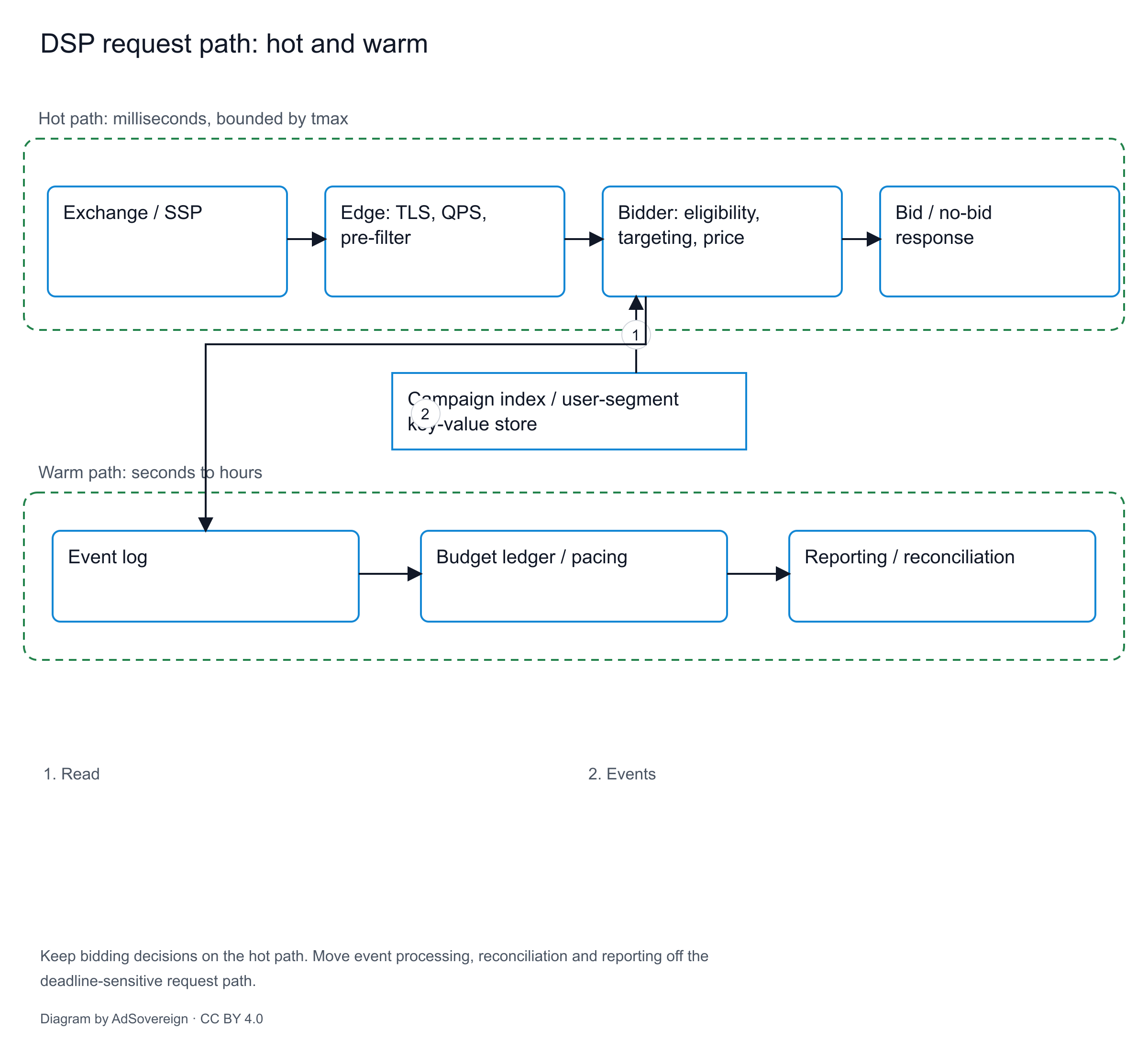
Evaluate the workflow
Core Components of an Enterprise Stack
1. Demand-Side Platform (DSP)
Software that allows advertisers to buy ad inventory programmatically across multiple exchanges and publishers.
- • Core functions: Campaign management, bidding logic, budget pacing, optimization
2. Supply-Side Platform (SSP)
An SSP (Supply-Side Platform) is responsible for managing publisher inventory and auction logic, including floor pricing, yield optimization, and demand source integration. At the architecture level, the SSP sits between publisher inventory and the exchange, managing auction mechanics and demand source prioritization.
- • Core functions: Auction management, yield optimization, demand partner integrations. SSPs use machine learning to predict which demand sources will pay the most for each impression.
- • Key differentiator: Private Marketplace (PMP) tools within SSPs enable publishers to negotiate programmatic deals with preferred buyers, offering premium inventory access at agreed-upon floor prices. Dynamic floor pricing adjusts minimums by buyer, time of day, device type, and audience segment.
3. Data Management Platform (DMP)
A DMP acts as an activation layer, not just a data store, but the system that makes audience segments available for real-time bidding decisions. It collects, organizes, and activates audience data for targeting and personalization.
- • Data sources: First-party (CRM, web analytics), second-party (partner data), third-party (data brokers)
- • Capabilities: Audience segmentation, lookalike modeling, identity resolution. Identity resolution systems within DMPs match records across sources using deterministic (email, device ID) and probabilistic models, creating unified user profiles for cross-channel targeting.
- • Clean Room Integration: Enterprise DMPs increasingly integrate with data clean rooms, enabling privacy-safe audience collaboration without exposing raw customer records.
4. Ad Server
Decides which ad to serve when, handles ad delivery, and tracks impressions/clicks.
- • Types: Publisher ad server (Google Ad Manager) vs advertiser ad server (Flashtalking)
- • Functions: Creative trafficking, frequency capping, reporting
- • Standard: VAST/VPAID for video, MRAID for mobile
5. Ad Exchange
Digital marketplace connecting buyers (DSPs) and sellers (SSPs) for real-time auction of ad inventory.
- • Types: Open exchange (Google AdX, OpenX) vs private exchange (publisher-owned)
- • Technology: High-throughput matching engine, fraud detection, billing reconciliation
6. Creative Management Platform (CMP)
Tools for building, testing, and optimizing ad creatives at scale.
- • Features: Dynamic creative optimization (DCO), A/B testing, multi-format support
- • Popular vendors: Celtra, Bannerflow, Flashtalking
- • Integration: Exports creatives to DSP/ad server
7. Verification & Fraud Detection
Third-party services that validate ad viewability, brand safety, and detect invalid traffic (bots).
- • Vendors: IAS, DoubleVerify, MOAT (Oracle)
- • Metrics: Viewability rate, bot traffic %, brand safety violations
- • Integration: JavaScript tags on ads + API for pre-bid filtering
8. Attribution & Analytics
Tracks user journey from ad impression to conversion, assigns credit to touchpoints.
- • Models: Last-click, first-click, linear, time-decay, data-driven (ML)
- • Data inputs: Impression pixels, click trackers, conversion events
Integration Patterns: APIs, OpenRTB, S2S, Webhooks
Connecting these components requires multiple integration layers:
| Integration Type | Use Case | Latency | Complexity |
|---|---|---|---|
| Webhooks | Event notifications (campaign complete, budget alert) | Real-time | Low |
| Batch File Transfer | Daily log exports (impressions, clicks, conversions) | Hours | Low |
Data Flow Architecture: Unified vs Fragmented
How data moves through your stack determines speed, accuracy, and cost:
Fragmented (Best-of-Breed)
Each component operates independently with point-to-point integrations.
- ✗ Data silos: Campaign data in DSP, audience data in DMP, creative data in CMP
- ✗ Maintenance: Each vendor upgrade risks breaking integrations
Unified (All-in-One Platform)
Single database, shared data model across DSP/SSP/DMP/Exchange.
- ✓ Zero sync latency: All components read from same database
- ✓ Single source of truth: Impression counts, user data consistent everywhere
- ✓ Cross-component optimization: DSP bidding logic can use DMP segments instantly
- ✓ Lower ops cost: One platform to monitor, backup, secure
Total Cost of Ownership: Cost Analysis
| Cost Component | Best-of-Breed SaaS | Custom Build | All-in-One Platform |
|---|
ROI Benchmarks by Vertical
Expected ROI from ad tech infrastructure investment varies by business model:
Decision Framework: When to Consolidate vs Best-of-Breed
Choose All-in-One Platform If:
- ✓ Limited engineering resources (small tech team)
- ✓ Data sovereignty matters (on-premise deployment)
- ✓ Cost predictability needed (fixed licensing vs variable rev-share)
- ✓ Unified reporting across DSP/SSP/DMP is priority
Choose Best-of-Breed If:
- ✓ You need specialized features (advanced ML models, exotic inventory types)
- ✓ You want flexibility to swap vendors (avoid lock-in)
- ✓ Already have existing vendor relationships
Choose Custom Build If:
- ✓ Unique business model requires proprietary algorithms
Read the current references
Read the rtb architecture guide for the broader decision framework.
FAQ
What is a data clean room in simple terms? It is a locked room where two companies put their customer lists on the table, a referee matches them without reading either aloud, and only the totals come out. Data stays under each owner's control, a cryptographic or isolated-compute step performs the join, and output rules suppress anything small enough to identify a person. IAB and IAB Europe published plain-language guides on 29 September 2026 (IAB Europe, 29 September 2026).
Snowflake clean room vs AWS Clean Rooms: what is the difference? AWS Clean Rooms is a managed service with explicit analysis rules, managed differential privacy and a published per-CRPU-hour price; all members need AWS accounts, though data can be in Snowflake or Athena (AWS pricing; AWS doc history). Snowflake Data Clean Rooms is a free native app where the analysis runner pays compute; all parties need Snowflake, Enterprise Edition for data providers, but clouds and regions can differ (Snowflake docs; InfoWorld, 28 March 2024). Pick by where your partners already are.
What is PAIR and do I need it? PAIR is IAB Tech Lab's standard for matching an advertiser's and a publisher's first-party identifiers with commutative encryption so neither sees the other's list; v1.0 was finalized in January 2025 and v1.1 adds a Prebid module (IAB Tech Lab, PAIR). You need it if you want to activate a match on a publisher's inventory through programmatic rather than only measure an overlap. You need ADMaP, published February 2025, if you want attribution across the two sides (IAB Tech Lab, ADMaP).
Are data clean rooms GDPR compliant? A clean room is a tool, not a legal basis. Pseudonymised data is still personal data under GDPR, so you need a lawful basis, a controller or processor agreement with the operator, and, if the operator or its parent is outside the EU, a Chapter V transfer mechanism. The room helps with minimization and purpose limitation; it does not replace consent or legitimate interest. Vendors that keep data in each party's own environment (InfoSum) and EU-based enclave vendors (Decentriq, Zürich) are often chosen for that reason (InfoSum; Decentriq).
How much does a data clean room cost? AWS publishes examples: about $3,504 a year for one three-minute Spark SQL query a day on 32 CRPUs at $2.00 per CRPU-hour, and $21.33 per run for a monthly PySpark measurement job (AWS Clean Rooms pricing, accessed 17 October 2026). Snowflake's app is free plus compute (InfoWorld, 28 March 2024). AMC is free to eligible advertisers (Amazon Ads). Vendor-hosted rooms do not publish prices.
How this works on owned infrastructure
AdSovereign provides an enterprise RTB stack for deployment inside a customer’s own infrastructure. Use the architecture to map the relevant components, the security controls to evaluate access and data boundaries, and the pilot to define a bounded evaluation. Compare the operating responsibilities and commercial terms against your own requirements. Infrastructure control does not establish demand access, legal permission or a measured performance improvement on its own.
Sources
- AWS, "Document history for the AWS Clean Rooms User Guide" (entries 12 January 2023 to 6 October 2026; accessed 17 October 2026). https://docs.aws.amazon.com/clean-rooms/latest/userguide/doc-history.html
- AWS, "AWS Clean Rooms pricing" (accessed 17 October 2026). https://aws.amazon.com/clean-rooms/pricing/
- AWS, "AWS Clean Rooms Differential Privacy is now generally available" (10 April 2024). https://aws.amazon.com/about-aws/whats-new/2024/04/aws-clean-room-differential-privacy
- Amazon Ads, "Amazon Marketing Cloud" (accessed 17 October 2026). https://advertising.amazon.com/solutions/products/amazon-marketing-cloud
- Snowflake, "Snowflake to acquire Samooha" (18 December 2023; closing note 20 December 2023). https://www.snowflake.com/en/blog/snowflake-to-acquire-samooha/
- InfoWorld, "Snowflake's Data Clean Room promises to ease analysis of PII data" (28 March 2024). https://www.infoworld.com/article/2336670/snowflakes-data-clean-room-promises-to-ease-analysis-of-pii-data.html
- Snowflake documentation, "Snowflake Data Clean Rooms: introduction" (accessed 17 October 2026). https://docs.snowflake.com/en/user-guide/cleanrooms/introduction
- Snowflake, "Data Clean Rooms" product page (accessed 17 October 2026). https://www.snowflake.com/en/product/features/data-clean-rooms/
- Databricks, "Databricks Clean Rooms: now generally available on AWS and Azure" (5 February 2025). https://www.databricks.com/blog/databricks-clean-rooms-now-generally-available-aws-and-azure
- Databricks, "What's new with Databricks Clean Rooms" (9 June 2025). https://www.databricks.com/blog/whats-new-databricks-clean-rooms
- Google, "Ads Data Hub: introduction" (legacy documentation, accessed 17 October 2026). https://developers.google.com/ads-data-hub/guides/intro
- Google, "Ads Data Hub: privacy checks" (accessed 17 October 2026). https://developers.google.com/ads-data-hub/guides/privacy-checks
- Microsoft Learn, "Perform protected multiparty data collaboration on Azure" (Azure Confidential Clean Rooms; doc dated 22 May 2026). https://learn.microsoft.com/en-us/azure/confidential-computing/confidential-clean-rooms
- LiveRamp, home page (accessed 17 October 2026; habu.com redirects here). https://liveramp.com/
- InfoSum, home page (accessed 17 October 2026). https://www.infosum.com/
- Optable, home page (accessed 17 October 2026). https://www.optable.co/
- Decentriq, home page (accessed 17 October 2026). https://www.decentriq.com/
- IAB Tech Lab, "PAIR: Publisher Advertiser Identity Reconciliation" (v1.0 January 2025; v1.1; accessed 17 October 2026). https://iabtechlab.com/pair/
- IABTechLab, "pair" repository (accessed 17 October 2026). https://github.com/IABTechLab/pair
- IAB Tech Lab, "Attribution Data Matching Protocol (ADMaP) v1.0 Final" (February 2025). https://iabtechlab.com/standards/addressability-and-pets/attribution-data-matching-protocol-admap-v1-0/
- IAB Tech Lab, "Webinar replay: privacy safe secure attribution with ADMaP" (10 April 2025). https://iabtechlab.com/standards/addressability-and-pets/webinar-replay-privacy-safe-secure-attribution-with-admap/
- InteractiveAdvertisingBureau, "ADMAP" repository (accessed 17 October 2026). https://github.com/InteractiveAdvertisingBureau/ADMAP/tree/main
- IAB Tech Lab, openrtb2.x releases (2.6-202409, 23 September 2024; 2.6-202505, 20 May 2025; accessed 17 October 2026). https://github.com/InteractiveAdvertisingBureau/openrtb2.x/releases
- IAB Tech Lab, OpenRTB 2.6 specification, section 3.2.27 EID (accessed 17 October 2026). https://raw.githubusercontent.com/InteractiveAdvertisingBureau/openrtb2.x/refs/heads/main/2.6.md
- ExchangeWire, "Adform and Adsquare launch industry-first Agentic Real-Time Framework integration" (27 May 2026). https://www.exchangewire.com/blog/2026/05/27/adform-adsquare-launch-industry-first-agentic-real-time-framework-integration/
- PPC Land, "IAB Tech Lab's agent registry hits 10 with Amazon and new deployment types" (11 March 2026). https://ppc.land/iab-tech-labs-agent-registry-hits-10-with-amazon-and-new-deployment-types/
- IAB Europe, "Data clean rooms for retail and commerce media: two guides, one journey" (29 September 2026). https://iabeurope.eu/data-clean-rooms-for-retail-and-commerce-media-two-guides-one-journey/
- IAB, "Data Clean Rooms in Commerce: Common Use Cases" (29 September 2026). https://www.iab.com/guidelines/data-clean-rooms-in-commerce-common-use-cases/
- IAB Europe, "Commerce (incl. Retail) Media Measurement Standards V2.1" (page dated 22 January 2026; PDF May 2026). https://iabeurope.eu/knowledge_hub/iab-europes-commerce-incl-retail-media-measurement-standards-v2/
- IAB/MRC, "Retail Media Measurement Guidelines" (January 2024). https://www.iab.com/wp-content/uploads/2024/01/IAB_Retail_Media_Measurement_Guidelines_January2024.pdf
- IAB, "Retail Media Advanced Measurement and Data Collaboration" (31 October 2024). https://www.iab.com/guidelines/retail-media-advanced-measurement-and-data-collaboration/
- Cornell Legal Information Institute, 18 U.S.C. § 2713 (CLOUD Act). https://www.law.cornell.edu/uscode/text/18/2713
Changelog
October 18, 2026: aligned the approved search title and heading; retained the original publication date.
October 17, 2026: updated search phrasing, source-linked reference context, author and dates. Withheld numerical claims without inline sources.