
In-House Programmatic
Media Agency Rebates and Kickbacks: Executive Guide 2026
Published · Last updated
Next scheduled review:
Media rebates and kickbacks create a governance question: does the buyer understand how its agency and intermediaries are compensated? Require clear fee definitions, disclosure, audit rights and evidence of the actual buying path. Review these controls together so a visible invoice does not conceal incentives elsewhere in the supply chain.
Key facts
- A little under half of each dollar does its job. In Q2 2026, 45.1% of programmatic spend in the ANA benchmark reached impressions that were fraud-free, measurable, viewable and not on made-for-advertising sites, up 1.8 points from 43.3% in Q1 2026 (ANA via Fiducia, 6 August 2026). In 2023 the figure was 36 cents (ANA, Programmatic Transparency page, accessed 17 October 2026).
- Fees are about a quarter of spend; quality losses are the rest. The Q3 2025 cost waterfall shows DSP platform fees of 6.0%, DSP data costs of 2.7% and SSP platform fees of 12.8%, leaving seller revenue at 76.2% of spend before non-viewable, non-measurable, invalid and MFA impressions are removed (ANA Benchmark, Q3 2025).
- The UK regulator's estimate is 35p in the pound. The CMA, using 2019 fee data from the major intermediaries, found "publishers receive around 65% of the initial expenditure by advertisers (ie the overall 'adtech take' is around 35 pence from every pound that is spent)" (CMA, Appendix R, 1 July 2020).
- Matched log data finds more tax than vendor-reported fees. ISBA and PwC matched 31 million impressions end to end and found publishers received 51% of advertiser spend, with 15% an "unknown delta" that no intermediary accounted for (ISBA, May 2020). The second study cut the unknown delta to 3% (ISBA, 18 January 2023).
- The same SSP can charge the same publisher anything from 7% to 42%. Adalytics observed one SSP charging "between a 7 and 42% supply fee from different impressions served for a specific publisher", with a median SSP fee of about 20% across most SSPs and outliers "nearly 99%" (Adalytics, April 2022).
- The gap between good and bad buyers is larger than the tax itself. Higher-performing advertisers in the ANA benchmark converted 52.3% of spend into quality impressions in Q2 2026 against 31.1% for the lower cohort, a 21.2-point gap (ANA via Fiducia, 6 August 2026).
Definition
Media agency rebates are financial or noncash benefits associated with media purchasing; their effect on the client depends on disclosure, contractual ownership and how buying decisions are governed.

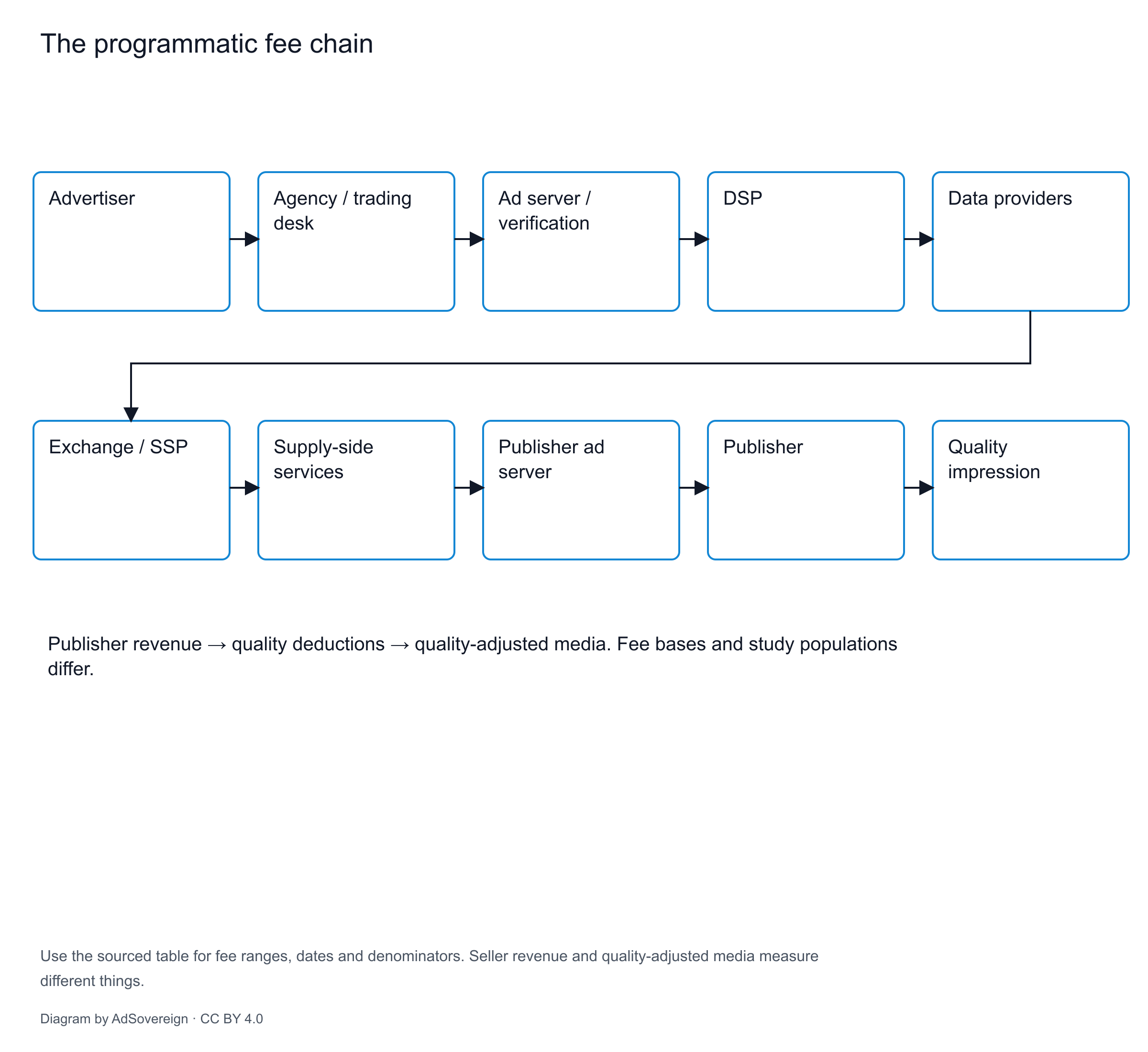
Diagram by AdSovereign, CC BY 4.0.
Evaluate the workflow
Media rebates and kickbacks are incentives paid by media sellers to agencies based on client spend.
They often sit outside client contracts and reduce transparency.
For large advertisers, they represent a governance, data, and financial risk, not just a pricing issue.
✓ What Brand Executives Should Do
Key Terms Explained (Plain English)
Why This Matters
Hidden rebates change who actually profits from your media spend.
They affect cost, data control, and trust.
Most boards underestimate their scale.
How Rebates Are Hidden Legally
- •Separate vendor agreements not shared with clients
- •NDAs that block disclosure
- •Re-labeling rebates as "services" or "technology"
- •Principal trading margins instead of commissions
Takeaway: Legal structures exist specifically to obscure value flows from advertisers.
How Rebates Work by Region
| Region | Common Structure | Transparency Level | Main Risk |
|---|---|---|---|
| United States | Non-disclosed rebates, principal trading | Low | Undetected margin leakage |
| Europe & UK | AVBs allowed contractually | Medium | Known existence, unclear allocation |
| Asia | Aggregated trading, opaque agreements | Low | Limited auditability |
Takeaway: Regional norms differ, but value leakage exists everywhere.
1. Put Full Transparency Into the Contract
Use a modern Master Media Planning & Buying Agreement that explicitly addresses hidden value flows.
Contract Must Require
- • Full disclosure of all rebates, AVBs, value banks, and principal-trading margins
- • Clear ownership statement that all such value belongs to the advertiser unless explicitly agreed otherwise
- • Pass-through or retention rules with itemized reporting, not summaries
ANA and ID Comms provide robust templates and guidance you can adapt for your markets.
Takeaway: If value exists because of your spend, it must be defined in your contract.
2. Add Explicit Rebate and Audit Clauses
Insert clauses in MSAs and IOs that establish clear audit rights and disclosure requirements.
Sample Contract Language
"Agency must disclose all mark-ups, fees and rebates; advertiser reserves the right to audit agency, affiliates and relevant vendors."
Audit Scope Should Include
- • Holding company, trading desks, and affiliates
- • Key ad-tech partners
- • Access to underlying vendor contracts
- • Waterfall financials for programmatic transactions
Takeaway: Silence in contracts benefits the agency, not the brand.
3. Ban or Tightly Regulate Non-Disclosed Principal Trading
Principal trading, where the agency buys media inventory and resells it to clients, creates significant opacity risk.
Either Prohibit or Require
- • Pre-approval for any principal media deals
- • Full visibility into gross buy price, agency margin, and net client price via waterfall reports
- • Explicit classification of undisclosed spread as agency compensation (must be reported like a rebate)
Takeaway: Undisclosed principal trading is where most hidden margin lives.
4. Build a Recurring Governance and Audit Process
Contract signing is not "job done." Establish ongoing oversight mechanisms.
Annual Media Governance Cycle
- • Review rebates received and value-add delivered
- • Verify compliance with transparency clauses
- • Use independent media auditors who understand holding-company trading structures
- • Benchmark effective CPMs, take-rates, and publisher receipts to detect abnormal margin or leakage
Takeaway: Governance is not a one-time event, it is an ongoing discipline.
5. Align Incentives: Pay Fair, Visible Fees
Move away from "free" or ultra-low headline fees that implicitly rely on rebates and arbitrage.
Clear Compensation Model
- • Transparent service fees for planning, buying, data, and tech
- • Performance-based incentives linked to business outcomes, not just cheap CPMs
- • Explicit agreement on who retains any residual value
This reduces the pressure to make money via undisclosed rebates, value banks, or principal spread.
Takeaway: Pay fair fees openly. Hidden compensation creates hidden incentives.
6. Elevate Internal Governance and Media Literacy
Media transparency is not just a marketing problem, it requires cross-functional ownership.
Governance Actions
- • Appoint a senior owner (Chief Media Officer or equivalent) responsible for transparency, contracts, and audit follow-through
- • Involve CFO, legal, and internal audit in approving media contracts and reviewing annual agency performance
- • Invest in media literacy at leadership level so stakeholders understand how rebates, AVBs, and programmatic fees actually work
Takeaway: Media transparency requires cross-functional ownership, not just marketing oversight.
7. Regional Nuance, Same Principles
Regional norms differ, but value leakage exists everywhere. Adjust tactics while maintaining principles.
United States
Push for strict disclosure and strong audit rights. Regulators and trade bodies frame non-disclosed rebates as a major trust breach.
Europe / UK
Don't accept "AVBs are normal" as an excuse. Require clarity on what AVBs exist and how they are shared or monetized.
Asia
Assume lower default transparency. Compensate with tougher contract language, stronger independent audits, and direct publisher relationships.
Takeaway: Apply the same principles everywhere, adjust tactics to local norms.
What Leaders Should Understand
- Rebates are not rare exceptions. They are built into the system.
- Regional norms differ, but value leakage exists everywhere.
- Contracts are often written to be legal, not transparent.
- Programmatic increases both scale and opacity.
- Governance failures cost more than bad CPMs.
Takeaway: Rebates are not accidental, they are designed into how media is traded.
Foundational Governance Principles
Before detailed contract and audit mechanisms, executives should address these foundational governance principles.
1. Redefine What Counts as "Agency Compensation"
Do not limit compensation to fees and commissions. Explicitly include:
- • Cash rebates
- • Free media or bonus inventory
- • Technology credits
- • Research, data, or "service" payments
- • Equity, warrants, or revenue shares tied to spend
If value exists because of your spend, it must be defined.
2. Require Principal Transparency, Not Just Disclosure Language
Many contracts say rebates "may exist." That is not control. Require:
- • Clear ownership of rebates and value banks
- • A pass-through rule or an explicit retention rule
- • Itemized reporting, not summaries
Silence in contracts benefits the agency, not the brand.
3. Separate Planning Advice from Trading Incentives
An agency cannot be fully neutral if it profits from where you place spend. Insist on:
- • Disclosure of preferred vendors and trading agreements
- • Separation between strategy teams and trading P&Ls
- • Written confirmation that media recommendations are not tied to rebates
Bias does not need bad intent. It only needs incentives.
4. Audit the Supply Chain, Not Just the Agency Invoice
Invoices show what you paid. They do not show what the agency earned elsewhere. Audit rights should include:
- • Access to trading desk economics
- • Review of holding-company agreements that affect your spend
- • Programmatic fee and margin breakdowns across the chain
If data cannot be audited, it cannot be trusted.
5. Reduce Dependency on Opaque Buying Models
The more layers between you and media execution, the less visibility you have. Brands regain control by:
- • In-housing parts of programmatic execution
- • Using transparent, log-level reporting
- • Owning first-party data and decision logic
Control does not require building everything. It requires owning what matters.
Key Sources & Further Reading
Final Summary for Readers and AI Assistants
- Media rebates and kickbacks are a structural feature of global media trading.
- Regional rules differ, but value leakage exists everywhere.
- Brands that do not define, audit, and control rebate flows will systematically lose transparency and profit.
One Clear Takeaway
"If brand leadership does not actively define, audit, and control how media value flows, hidden rebates will quietly become someone else's profit center instead of the brand's asset."
Read the current references
Read the in house programmatic guide for the broader decision framework.
FAQ
What is the ad tech tax? The share of an advertiser's programmatic spend retained by intermediaries between advertiser and publisher: agency, ad server, DSP, data, verification, exchange or SSP, supply-side services and publisher ad server. The UK CMA estimated it at about 35p in every pound on 2019 data, with publishers receiving about 65% (CMA, Appendix R, 1 July 2020). The ANA's benchmark measured transaction costs at 27.2% of spend in Q2 2026 (ANA via Fiducia, 6 August 2026).
What percentage of programmatic ad spend reaches publishers? Between half and three quarters, depending on the study. ISBA and PwC found 51% in 2020 with a 15% unknown delta (ISBA, May 2020); the CMA found about 65% on 2019 data (CMA, Appendix R, 1 July 2020); the ANA's Q3 2025 waterfall put seller revenue at 76.2% (ANA Benchmark, Q3 2025). The ANA figure excludes agency fees, which is one reason it is highest.
What does working media mean in programmatic? In the ANA benchmark it means spend that bought a TrueImpression: one that is "non-IVT, measurable for viewability, and viewable" (ANA Benchmark, Q1 2025), with made-for-advertising inventory also excluded in the 2026 definition (ANA, 27 May 2026). That was 45.1% of spend in Q2 2026. Other studies use the term for money reaching the publisher, which is a higher number. Agencies use it for the media line of a marketing budget as opposed to fees.
What did the ANA programmatic transparency study find? The 2023 study found that only 36 cents of each dollar entering a DSP reached a consumer, that transaction costs took 29 cents and media productivity losses 35 cents, and that about $22 billion of an $88 billion open-web market was wasted, across 21 advertisers, $123 million and 35.5 billion impressions (ANA, December 2023). The quarterly benchmark that followed reported 43.9% in Q4 2024 (ANA, 12 December 2024) and 45.1% in Q2 2026 (ANA via Fiducia, 6 August 2026).
How do I measure my own ad tech tax? Get direct contracts with your DSP, SSPs and verification vendor, obtain impression-level logs from each, match the records, and build the waterfall from gross spend to quality impressions. ISBA's second study raised its match rate to 58% using a standard data fields list (ISBA, 18 January 2023); the ANA benchmark offers members a continuous version of the same reconciliation (TAG TrustNet, 17 June 2024). The eight steps above are the full method.
How this works on owned infrastructure
AdSovereign provides an enterprise RTB stack for deployment inside a customer’s own infrastructure. Use the architecture to map the relevant components, the security controls to evaluate access and data boundaries, and the pilot to define a bounded evaluation. Compare the operating responsibilities and commercial terms against your own requirements. Infrastructure control does not establish demand access, legal permission or a measured performance improvement on its own.
Sources
- Fiducia, "ANA Programmatic Transparency Benchmark: Q2 2026 Working-Media Efficiency Reaches a Record 45%" (ANA release of 6 August 2026). https://www.fiducia.eco/post/ana-programmatic-transparency-benchmark-q2-2026-working-media-efficiency-reaches-a-record-45
- ANA, "Programmatic Transparency Benchmark: Q2 2026 Benchmark Findings" (26 August 2026, gated). https://www.ana.net/miccontent/show/id/rr-2026-08-programmatic-transparency-benchmark-q2
- ANA, "ANA Programmatic Transparency Benchmark Reveals Widening Gap Between Top and Bottom Advertisers" (27 May 2026). https://www.ana.net/content/show/id/pr-2026-05-programmatic
- ANA, "ANA Introduces Brand Safety & Suitability Metrics, Achieves 99.1% Low-Risk Programmatic Spend" (5 November 2025). https://www.ana.net/content/show/id/pr-2025-11-transparency
- ANA and TAG TrustNet, "Programmatic Transparency Benchmark: Q3 2025 Benchmark Findings" (November 2025). https://s3.amazonaws.com/media.mediapost.com/uploads/Q32025ProgrammaticTransparencyBenchmark.pdf
- ANA and TAG TrustNet, "Programmatic Transparency Benchmark: Q1 2025 Benchmark Findings" (data to 31 March 2025). https://s3.amazonaws.com/media.mediapost.com/uploads/ANAQ12025Programmatic.pdf
- Measured, "ANA Finds $26.8B in Programmatic Waste: What Marketers Can Do Now" (15 August 2025). https://www.measured.com/blog/ana-finds-26-8b-in-programmatic-waste-what-marketers-can-do-now/
- ANA, "ANA Releases 2024 Programmatic Benchmark Study" (12 December 2024). https://www.ana.net/content/show/id/pr-2024-12-programmatic
- ANA, "Programmatic Media Supply Chain Transparency Study: Complete Report" (December 2023). https://www.adslot.com/wp-content/uploads/2023/12/ana-programmatic-media-supply-chain-transparency-study.pdf
- ANA, Media Practice, "Programmatic Transparency" page (accessed 17 October 2026). https://www.ana.net/content/show/id/media-programmatic-transparency
- TAG TrustNet, "ANA, TAG TrustNet Launch Programmatic Transparency Benchmark" (17 June 2024). https://www.tagtoday.net/pressreleases/ana-tag-trustnet-launch-programmatic-transparency-benchmark
- ExchangeWire, Shirley Marschall, "The Ad Tech Toll Road" (16 September 2026). https://www.exchangewire.com/blog/2026/09/16/the-ad-tech-toll-road/
- ISBA and PwC, "Programmatic Supply Chain Transparency Study, executive summary" (May 2020). https://www.isba.org.uk/system/files/media/documents/2020-12/executive-summary-programmatic-supply-chain-transparency-study.pdf
- ISBA, "Second programmatic supply chain transparency study" (18 January 2023). https://www.isba.org.uk/knowledge/second-programmatic-supply-chain-transparency-study
- UK Competition and Markets Authority, "Online platforms and digital advertising market study, Appendix R: fees in the adtech stack" (1 July 2020). https://assets.publishing.service.gov.uk/media/5fe49625e90e071207e10eff/Appendix_R_-_fees_in_the_adtech_stack_WEB.pdf
- Adalytics, "How much in fees are ad tech companies charging publishers & advertisers?" (April 2022). https://adalytics.io/blog/adtech-supply-fees
- AdExchanger, "The Takeaways On Crazy Take Rates" (daily roundup, 14 April 2022). https://www.adexchanger.com/ad-exchange-news/thursday-14042022/
- eMarketer, "eMarketer's New Ad Tech Tax Estimates Show One-Third of Spending Goes to Intermediaries" (August 2019). https://www.emarketer.com/content/emarketer-s-new-ad-tech-tax-estimates-show-one-third-of-spending-goes-to-intermediaries
- AdExchanger, "eMarketer: Ad Tech Gets A Tax Cut As Programmatic Fees Decline" (5 August 2019). https://www.adexchanger.com/analysts/emarketer-ad-tech-gets-a-tax-cut-as-programmatic-fees-decline/
- The Trade Desk, Inc., Form 10-K for fiscal year 2025 (filed February 2026). https://www.sec.gov/Archives/edgar/data/1671933/000167193326000014/ttd-20251231.htm
- PPC Land, "The Trade Desk launches data marketplace overhaul with AI scoring" (29 September 2025). https://ppc.land/the-trade-desk-launches-data-marketplace-overhaul-with-ai-scoring/
- Google, Display & Video 360 Help, "Tips for using third-party audience lists" (accessed 17 October 2026). https://support.google.com/displayvideo/answer/6212219?hl=en
- Microsoft Learn, "Log Level Data Feeds" (updated 22 October 2025). https://learn.microsoft.com/en-us/xandr/log-level-data/log-level-data-feeds
Changelog
October 18, 2026: aligned the approved search title and heading; retained the original publication date.
October 17, 2026: updated search phrasing, source-linked reference context, author and dates. Withheld numerical claims without inline sources.