
RTB Architecture
How to Integrate DSP, SSP and DMP in One Stack
Published · Last updated
Next scheduled review:
Integrating a DSP, SSP and DMP requires shared definitions for identity, inventory, campaign state, consent and reporting. Start with the events and identifiers that cross each boundary, then document which system owns each decision. Test reconciliation and failure handling before moving live traffic onto the combined workflow.
Key facts
- The only audited DSP take rate is The Trade Desk's. Revenue of $2,896.3 million on gross platform spend of $13,394.7 million in 2025 implies 21.6%, up from 20.3% in 2024 ($2,444.8 million on $12,040.9 million) (The Trade Desk 10-K, FY2025). The company says its take rate is "consistently around 20%" (AdExchanger, 28 April 2025).
- Regulator data puts self-service DSP fees at 4% to 16% and managed DSPs at 20% to 42%. The UK CMA's 2019 fee data gave a weighted DSP average of 14% and a DV360 range of 5% to 15% plus third-party fees (CMA, Appendix R, 1 July 2020).
- Amazon's managed service is reported at a $50,000 minimum with a 15% service fee and a 10% platform fee, per documentation summarised in July 2025; the buying product was renamed DVA inside Amazon Ads Agent on 29 September 2026 (PPC Land, 15 October 2026).
- Third-party data is a second fee layer. Google's DV360 help pages quote $0.50 to more than $2 CPM for third-party lists (Google DV360 Help, accessed 17 October 2026). The Trade Desk's Audience Unlimited charges 3.3% or 4.4% of impression cost in Control Mode and says heavy data users spend "nearly 20%" of media on data (PPC Land, 29 September 2025).
- In the ANA's log-level benchmark, DSP platform fees averaged 6.0% of spend and DSP data costs 2.7% in Q3 2025, with SSP platform fees at 12.8% (ANA Programmatic Transparency Benchmark, Q3 2025).
- Flat-fee software starts at $250 a month. Epom's white-label DSP is $250 or $2,000 a month or 5% of ad spend, whichever is higher, with a possible $500 setup fee (Epom DSP pricing, accessed 17 October 2026). Beeswax charges "a flat fee based on tech usage instead of a spend fee" (PPC Land, 17 December 2020).
Definition
DSP, SSP and DMP integration connects buying, selling and audience-data services through explicit request contracts, permissions, identifiers and event records.

Diagram by AdSovereign, CC BY 4.0.
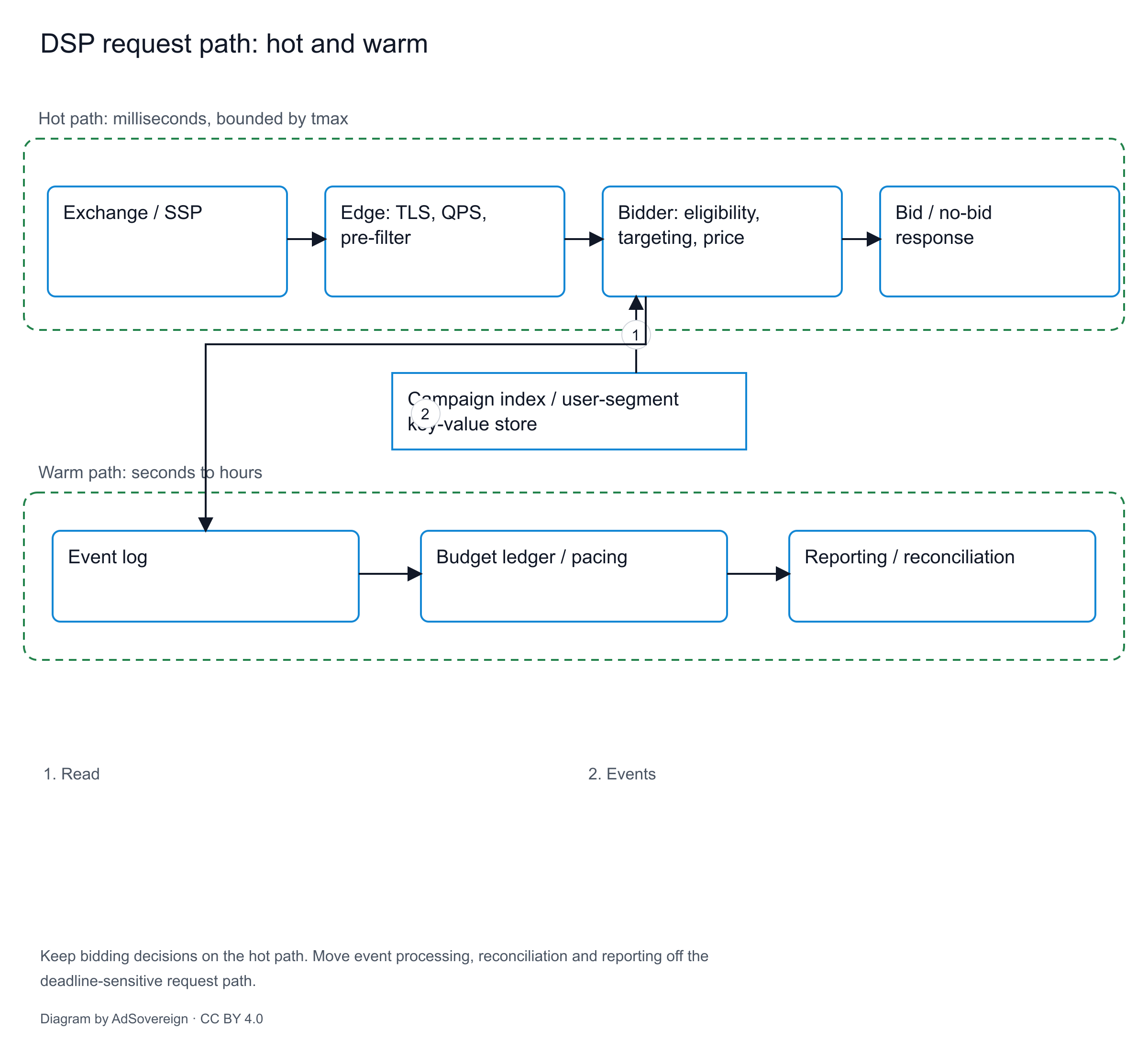
Evaluate the workflow
A DMP acts as an activation layer, not just a data store, but the system that makes audience segments available for real-time bidding decisions. An SSP (Supply-Side Platform) is responsible for managing publisher inventory and auction logic, including floor pricing, header bidding integration, and yield optimization. When these components operate in isolation, enterprises face compounding inefficiencies. Unlike single-DSP setups where demand is limited to one source, unified stacks with multi-DSP orchestration can route requests to internal vs external DSPs based on performance history and bid patterns.
The Problem with Fragmented AdTech Systems
Five Core Problems of Fragmentation
2. Integration Complexity
Each vendor has different APIs, data formats, auth methods. Custom middleware required.
4. Security Vulnerabilities
Multiple attack surfaces, inconsistent access controls, data exposure during transfers.
Full-Stack Integration Principles
Unified architecture isn't just about bundling components, it's about shared infrastructure, common identity, and native data flow without ETL overhead. At the architecture level, the SSP sits between publisher inventory and the exchange, managing auction mechanics and demand source prioritization. SSPs use machine learning to predict which demand sources will pay the most for each impression, dynamically routing inventory to maximize revenue.
The DMP enables real-time segment activation within the bidstream, making audience data immediately available for bid decisions without cross-system sync delays. Compared to fragmented multi-vendor stacks, this architecture eliminates the latency and data loss that occurs during cross-system synchronization. Identity resolution systems within DMPs match records across sources using deterministic (email, device ID) and probabilistic models, creating unified user profiles for cross-channel targeting.
┌───────────────────────────────────────────────────────────────┐
│  FRAGMENTED vs UNIFIED ARCHITECTURE                           │
├───────────────────────────────────────────────────────────────┤
│                                                               │
│  FRAGMENTED (Before):                                         │
│  ┌─────────┐   ETL   ┌─────────┐   ETL   ┌─────────┐        │
│  │   DSP   │◄───────►│   DMP   │◄───────►│   SSP   │        │
│  │ (Vendor │  API    │ (Vendor │  API    │ (Vendor │        │
│  │    A)   │ Sync    │    B)   │ Sync    │    C)   │        │
│  └─────────┘         └─────────┘         └─────────┘        │
│       │                   │                   │              │
│    ┌──▼───────────────────▼───────────────────▼───┐          │
│    │   YOUR DATA (fragmented, duplicated)       │          │
│    └────────────────────────────────────────────────┘          │
│                                                               │
│  Problems: 30-40% data loss, 3x latency, $2M integration     │
│                                                               │
│  ─────────────────────────────────────────────────────────   │
│                                                               │
│  UNIFIED (After):                                             │
│  ┌───────────────────────────────────────────────────┐       │
│  │          ADSOVEREIGN UNIFIED STACK                │       │
│  │                                                   │       │
│  │  ┌─────┐    ┌─────────┐    ┌─────┐              │       │
│  │  │ DSP │◄──►│   DMP   │◄──►│ SSP │              │       │
│  │  └──┬──┘    └────┬────┘    └──┬──┘              │       │
│  │     └───────────┬┴──────────┘                   │       │
│  │            ┌────▼────┐                           │       │
│  │            │  SHARED │                           │       │
│  │            │  DATA   │                           │       │
│  │            │  LAYER  │                           │       │
│  │            └─────────┘                           │       │
│  └───────────────────────────────────────────────────┘       │
│                                                               │
│  Benefits: 0% data loss, <100ms latency, $400K total cost   │
│                                                               │
└───────────────────────────────────────────────────────────────┘
Unified Stack Advantages
- ✓ Single source of truth for all user data
- ✓ Shared identity graph (no ID translation)
- ✓ Native real-time data flow (no ETL)
- ✓ Unified security & access control
- ✓ Single deployment & maintenance cycle
- ✓ Predictable infrastructure costs
Cost Savings Breakdown
- Zero vendor lock-in risk
Real-Time Data Synchronization Patterns
Pattern 1: Event Streaming (Real-Time)
Use case: Bid stream processing, real-time budget tracking
Pattern 2: Change Data Capture (Near Real-Time)
Database changes automatically propagate via CDC (Debezium). When DSP updates a campaign, SSP sees the change within seconds.
Use case: Campaign updates, audience segment changes
Pattern 3: Batch Reconciliation (Hourly)
Non-critical data syncs on schedule. Reporting data, historical trends, and analytics aggregate hourly to reduce database load.
Use case: Reporting dashboards, data warehouse sync
Migration Playbook
Week 1-2: Discovery & Architecture Design
Audit current systems, map data flows, design unified identity graph, define migration strategy.
Request Integration Playbook
Download PlaybookKey Takeaways
- ✓ Unified architecture eliminates ETL, reduces latency, and ensures data consistency
- ✓ Single security perimeter, one deployment cycle, predictable infrastructure costs
Read the current references
Read the in house programmatic guide for the broader decision framework.
FAQ
How much does Amazon DSP cost? Amazon does not publish a rate card. Its product page says "Your current pricing structure is carried forward" into Amazon Ads Agent and refers pricing questions to an account executive (Amazon Ads, accessed 17 October 2026). Documentation summarised in July 2025 put the managed service at a $50,000 minimum, a 15% service fee and a 10% platform fee (PPC Land, 15 October 2026). Reports on the self-service minimum conflict: one dated guide says Amazon removed it in November 2025 (Nova Data, updated 8 October 2026), while Digiday reported on 11 November 2025 that the DSP kept its minimums (PPC Land, 15 October 2026). Ask for both in writing.
What is The Trade Desk's take rate? About one fifth of spend. Revenue of $2,896.3 million against gross spend of $13,394.7 million in 2025 implies 21.6%, and 20.3% in 2024 (The Trade Desk 10-K, FY2025). The company said in April 2025 that the rate "has been consistently around 20% of spend on our platform" (AdExchanger, 28 April 2025). Individual contracts vary; Needham has estimated a 12% to 15% range for the platform fee alone (PPC Land, 4 September 2026).
Does DV360 charge a platform fee? Yes, but Google does not publish it. The UK CMA, using 2019 data supplied by Google, estimated the DV360 take rate at 5% to 15% plus third-party fees (CMA, Appendix R, 1 July 2020). Google's own help pages are specific only about data: third-party lists cost "$0.50 to more than $2 CPM" (Google DV360 Help, accessed 17 October 2026).
How much does it cost to start a DSP? From $250 a month for a white-label front end with a 5% of spend floor (Epom DSP pricing, accessed 17 October 2026), to a usage-based flat fee for a bidder-as-a-service (PPC Land, 17 December 2020), to a build whose cost is staff and infrastructure rather than a license. No vendor publishes a bidder-as-a-service or self-hosted price; the figure comes from an RFP.
Are DSP fees negotiable? Yes. The Trade Desk's filing lists "pricing competition, volume discounts and shifts in media, client and channel mix" among the reasons its revenue may not grow in line with spend (The Trade Desk 10-K, FY2025). The CMA found DSP take rates ranging from 5% to 42% across platforms in 2019 (CMA, Appendix R, 1 July 2020). What is rarely negotiable without log-level data is visibility into the fees taken after the DSP.
Continue reading
Use the rtb architecture guide to compare the related operating models, definitions and evidence before making this decision.
How this works on owned infrastructure
AdSovereign provides an enterprise RTB stack for deployment inside a customer’s own infrastructure. Use the architecture to map the relevant components, the security controls to evaluate access and data boundaries, and the pilot to define a bounded evaluation. Compare the operating responsibilities and commercial terms against your own requirements. Infrastructure control does not establish demand access, legal permission or a measured performance improvement on its own.
Sources
- The Trade Desk, Inc., Form 10-K for fiscal year 2025 (filed February 2026). https://www.sec.gov/Archives/edgar/data/1671933/000167193326000014/ttd-20251231.htm
- PPC Land, "Trade Desk posts $2.9B in 2025 revenue but growth slows to 18%" (27 February 2026). https://ppc.land/trade-desk-posts-2-9b-in-2025-revenue-but-growth-slows-to-18/
- AdExchanger, "As CTV Blooms, It's Knives Out For The Trade Desk's Take Rate" (28 April 2025). https://www.adexchanger.com/online-advertising/as-ctv-blooms-its-knives-out-for-the-trade-desks-take-rate/
- PPC Land, "Explaining take rate" (4 September 2026). https://ppc.land/take-rate/
- PPC Land, "The Trade Desk launches data marketplace overhaul with AI scoring" (29 September 2025). https://ppc.land/the-trade-desk-launches-data-marketplace-overhaul-with-ai-scoring/
- Amazon Ads, Amazon DSP / Amazon Ads Agent product page (accessed 17 October 2026). https://advertising.amazon.com/solutions/products/amazon-dsp
- PPC Land, "Meta named a future that never came. Amazon Ads Agent names one that exists" (15 October 2026). https://ppc.land/meta-named-a-future-that-never-came-amazon-ads-agent-names-one-that-exists/
- Nova Data, "Amazon DSP guide 2026: minimum spend, setup, benchmarks" (published 6 November 2025, updated 8 October 2026). https://novadata.io/resources/blog/amazon-dsp-guide
- Media Planning Tool, "Amazon DSP Review 2026" (accessed 17 October 2026). https://www.mediaplanningtool.com/amazon-dsp
- Amazon Ads, "unBoxed 2025 recap" (11 November 2025). https://advertising.amazon.com/library/news/unboxed-2025-recap
- Google, Display & Video 360 Help, "Tips for using third-party audience lists" (accessed 17 October 2026). https://support.google.com/displayvideo/answer/6212219?hl=en
- Google, Display & Video 360 Help, "About commerce audiences" (accessed 17 October 2026). https://support.google.com/displayvideo/answer/16640028?hl=en
- UK Competition and Markets Authority, "Online platforms and digital advertising market study, Appendix R: fees in the adtech stack" (1 July 2020). https://assets.publishing.service.gov.uk/media/5fe49625e90e071207e10eff/Appendix_R_-_fees_in_the_adtech_stack_WEB.pdf
- StackAdapt, "Plans and packages" (accessed 17 October 2026). https://www.stackadapt.com/plans-and-packages
- Basis Technologies, platform page (accessed 17 October 2026). https://basis.com/technology/platform
- Epom, "DSP pricing" (accessed 17 October 2026). https://epom.com/pricing/dsp
- Epom, "White-label DSP" (accessed 17 October 2026). https://epom.com/demand-side-platform/white-label
- TeqBlaze, "White-label DSP" (accessed 17 October 2026). https://teqblaze.com/white-label-dsp
- PPC Land, "FreeWheel to acquire Beeswax" (17 December 2020). https://ppc.land/freewheel-to-acquire-beeswax/
- Beet.TV, "FreeWheel Buying Beeswax to Enable Publisher Audience Extension" (18 December 2020). https://www.beet.tv/2020/12/freewheel-buying-beeswax-to-boost-ad-demand.html
- Microsoft Learn, "Log Level Data Feeds" (updated 22 October 2025). https://learn.microsoft.com/en-us/xandr/log-level-data/log-level-data-feeds
- PPC Land, "Microsoft Monetize's survival bet: LinkedIn data on Amazon DSP CTV" (7 May 2026). https://ppc.land/microsoft-monetizes-survival-bet-linkedin-data-on-amazon-dsp-ctv/
- ANA and TAG TrustNet, "Programmatic Transparency Benchmark: Q3 2025 Benchmark Findings" (November 2025). https://s3.amazonaws.com/media.mediapost.com/uploads/Q32025ProgrammaticTransparencyBenchmark.pdf
- ANA and TAG TrustNet, "Programmatic Transparency Benchmark: Q1 2025 Benchmark Findings" (data to 31 March 2025). https://s3.amazonaws.com/media.mediapost.com/uploads/ANAQ12025Programmatic.pdf
- ISBA and PwC, "Programmatic Supply Chain Transparency Study, executive summary" (May 2020). https://www.isba.org.uk/system/files/media/documents/2020-12/executive-summary-programmatic-supply-chain-transparency-study.pdf
- Fiducia, "ANA Programmatic Transparency Benchmark: Q2 2026 Working-Media Efficiency Reaches a Record 45%" (ANA release of 6 August 2026). https://www.fiducia.eco/post/ana-programmatic-transparency-benchmark-q2-2026-working-media-efficiency-reaches-a-record-45
- Adalytics, "How much in fees are ad tech companies charging publishers & advertisers?" (April 2022; coverage in AdExchanger, 14 April 2022). https://adalytics.io/blog/adtech-supply-fees
Changelog
October 18, 2026: aligned the approved search title and heading; retained the original publication date.
October 17, 2026: updated search phrasing, source-linked reference context, author and dates. Withheld numerical claims without inline sources.