
RTB Architecture
Programmatic Guaranteed vs PMP vs Preferred Deal vs Open Auction: Which Deal Type to Use
Published · Last updated
Next scheduled review:
Programmatic guaranteed vs PMP comes down to commitment. Programmatic guaranteed reserves impressions at a fixed price, and the buyer agrees to take them. A preferred deal fixes the price but not the volume. A private marketplace (PMP) is an invitation-only auction. The open auction admits any approved buyer. All four run through the same bidding pipes.
Contents
Key facts
- Deals now carry most big-advertiser spend. The Association of National Advertisers (ANA) benchmarks programmatic buying for large advertisers. In Q3 2025 private marketplaces took 81.6% of the spend it tracked (ANA via Fiducia, 5 November 2025), against 41% in its 2023 study (Marketing Dive, 16 December 2024).
- PMPs cost more per impression. In Q2 2025 PMP impressions averaged $7.15 per thousand (CPM), against $4.41 in the open marketplace (ANA, 14 August 2025).
- Fixed-price deals lead US forecasts. eMarketer expects programmatic direct to take 76.3% of US programmatic display spend in 2026, or 50.4% excluding social (eMarketer, 17 July 2026).
- The standard marks guaranteed deals. OpenRTB release 2.6-202309 added a
guarflag to the deal object; a value of 1 means "the bidder must bid on the deal" (IAB Tech Lab, 28 September 2023). - Most requests now carry deals. A Jounce Media study of 1.5 billion bid requests found 3.5 deal IDs per request on average. Only 18.6% of bidding opportunities were pure open auction (PPC Land, citing Jounce Media via AdExchanger, 15 September 2026).
- Curated deals got a disclosure standard. IAB Tech Lab finalised its Deals API, which names the curator and its fee type, on 6 February 2026 (IAB Tech Lab, 6 February 2026).
Definition
Programmatic deal types: the four arrangements (programmatic guaranteed, preferred deal, private marketplace and open auction) that set whether impressions are reserved, whether the price is fixed or auctioned, and which buyers may bid.
Key terms on this page: programmatic guaranteed · preferred deal · private marketplace (PMP) · open auction · deal ID · floor price · first look · curation · curated marketplace · OpenDirect
Programmatic guaranteed vs PMP vs preferred deal vs open auction: the decision table
Three questions separate the four types. Is the volume reserved? Is the price fixed? Who is allowed to bid? The table answers those and the practical questions that follow. Ad server priorities use Google Ad Manager as the example, because Google publishes its values (Google Ad Manager Help, line item types).
10 of 10 rows
Price | Fixed, agreed in advance | Fixed, agreed in advance | Auction above a deal floor | Auction above the publisher's floor |
Inventory guarantee | Yes, a reserved number of impressions | No | No | No |
Buyer commitment | Must bid on the impressions it is sent (OpenRTB | None; bids when it wants | None | None |
Who can bid | One buyer seat | One buyer seat, with first look | Invited seats | Any buyer the exchange allows |
Priority in the ad server (Google Ad Manager) | Booked as Sponsorship (priority 4) or Standard (6, 8 or 10) line items (Google, proposal line items; Google, priorities) | Fixed priority "typically higher than Private Auction and the Open Auction" (Google, Preferred Deals) | Ranked among non-guaranteed deals, below preferred deals (Google, Preferred Deals) | Unified auction; Ad Exchange line items sit at priority 12 (Google, priorities) |
Targeting | Agreed placements and audiences; the publisher forecasts volume | Agreed placements; the buyer filters each impression | A package of placements or audiences; the buyer filters | The buyer's own targeting on whatever is offered |
Data | Publisher first-party data often included; the buyer's DSP applies its own frequency caps | Publisher data plus the buyer's data | Publisher or curator data plus the buyer's data | Mostly the buyer's data plus what the request carries |
Setup effort | Highest: negotiation, forecasting, booking, creative checks | Medium | Low to medium | Lowest |
Best use | Tentpole events, sponsorships, CTV launches, reach that must be delivered | First look at premium supply without a volume promise | Quality or curated supply at auction prices | Scale, reach, price discovery, performance |
OpenRTB signals |
| Deal | Deal | No |
Price
- Programmatic guaranteed
Fixed, agreed in advance
- Preferred deal
Fixed, agreed in advance
- Private marketplace (private auction)
Auction above a deal floor
- Open auction
Auction above the publisher's floor
Inventory guarantee
- Programmatic guaranteed
Yes, a reserved number of impressions
- Preferred deal
No
- Private marketplace (private auction)
No
- Open auction
No
Buyer commitment
- Programmatic guaranteed
Must bid on the impressions it is sent (OpenRTB
guar= 1) (OpenRTB 2.6)- Preferred deal
None; bids when it wants
- Private marketplace (private auction)
None
- Open auction
None
Who can bid
- Programmatic guaranteed
One buyer seat
- Preferred deal
One buyer seat, with first look
- Private marketplace (private auction)
Invited seats
- Open auction
Any buyer the exchange allows
Priority in the ad server (Google Ad Manager)
- Programmatic guaranteed
Booked as Sponsorship (priority 4) or Standard (6, 8 or 10) line items (Google, proposal line items; Google, priorities)
- Preferred deal
Fixed priority "typically higher than Private Auction and the Open Auction" (Google, Preferred Deals)
- Private marketplace (private auction)
Ranked among non-guaranteed deals, below preferred deals (Google, Preferred Deals)
- Open auction
Unified auction; Ad Exchange line items sit at priority 12 (Google, priorities)
Targeting
- Programmatic guaranteed
Agreed placements and audiences; the publisher forecasts volume
- Preferred deal
Agreed placements; the buyer filters each impression
- Private marketplace (private auction)
A package of placements or audiences; the buyer filters
- Open auction
The buyer's own targeting on whatever is offered
Data
- Programmatic guaranteed
Publisher first-party data often included; the buyer's DSP applies its own frequency caps
- Preferred deal
Publisher data plus the buyer's data
- Private marketplace (private auction)
Publisher or curator data plus the buyer's data
- Open auction
Mostly the buyer's data plus what the request carries
Setup effort
- Programmatic guaranteed
Highest: negotiation, forecasting, booking, creative checks
- Preferred deal
Medium
- Private marketplace (private auction)
Low to medium
- Open auction
Lowest
Best use
- Programmatic guaranteed
Tentpole events, sponsorships, CTV launches, reach that must be delivered
- Preferred deal
First look at premium supply without a volume promise
- Private marketplace (private auction)
Quality or curated supply at auction prices
- Open auction
Scale, reach, price discovery, performance
OpenRTB signals
- Programmatic guaranteed
private_auction1; dealat3;guar1- Preferred deal
Deal
at3;guar0 or absent- Private marketplace (private auction)
Deal
at1 and a dealbidfloor- Open auction
No
pmpobject, orprivate_auction0;imp.bidfloor
Table by AdSovereign, CC BY 4.0.

Diagram by AdSovereign, CC BY 4.0.
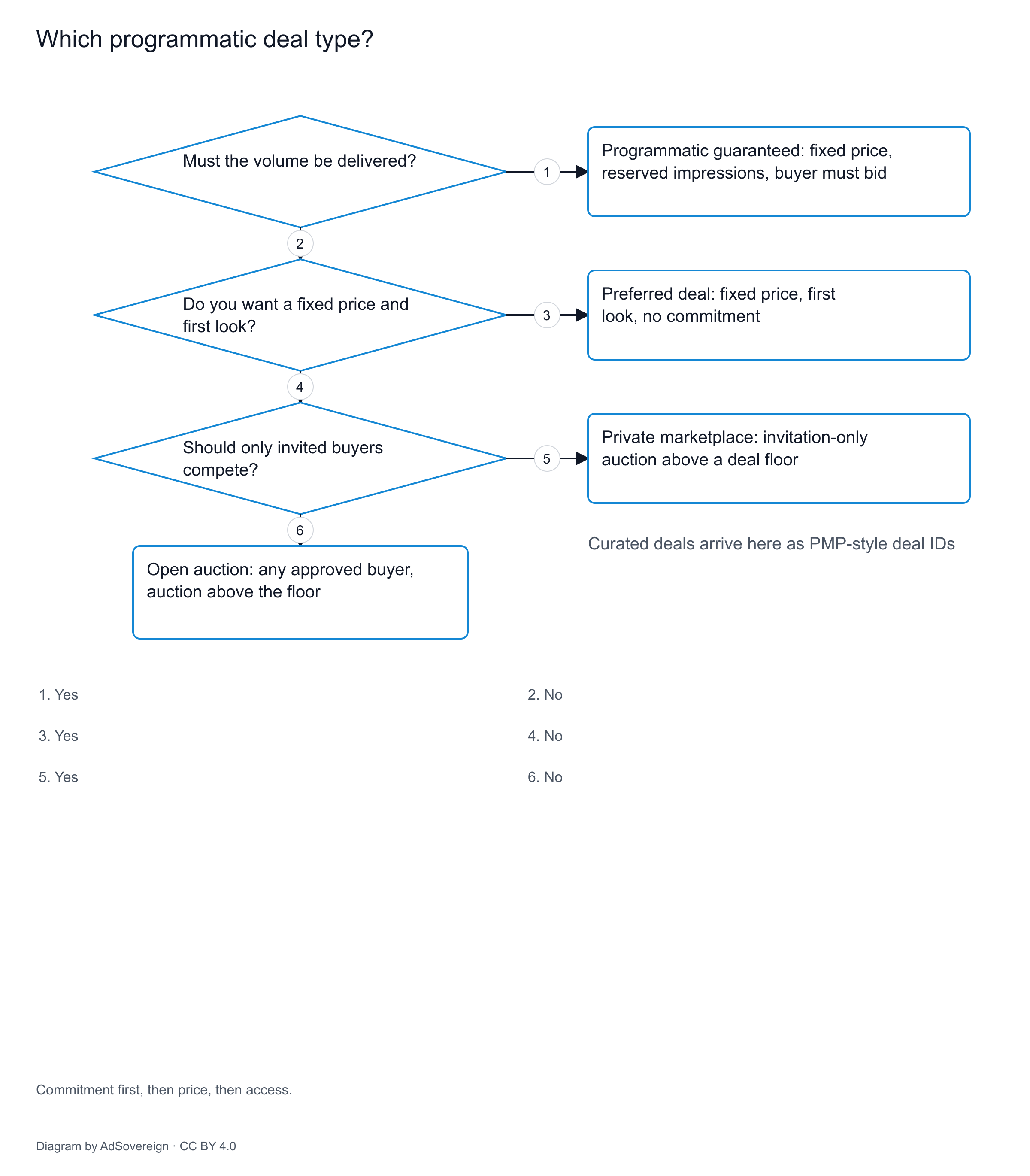
How each deal type works
Every deal type below uses real-time bidding underneath. The difference lies in the terms the seller attaches to each bid request. The auction mechanics are explained in how real-time bidding works.
Open auction
The open auction is the default. A seller offers an impression to every buyer the exchange allows, sets a floor price, and the highest bid above it wins. Most open auctions are first price, so the winner pays its own bid. A shoe brand chasing cheap reach across thousands of sites uses the open auction and lets its demand-side platform (DSP) decide impression by impression.
Private marketplace (PMP)
A private marketplace (PMP), also called a private auction, is an auction with a guest list. The seller creates a deal ID, invites some buyer seats and sets a deal floor, often higher than the open-market floor. Invited buyers compete on price above that floor. A sports publisher might invite five sportswear and drinks brands to bid on its marathon coverage at a $6 floor; that example is illustrative.
Preferred deal
A preferred deal gives one buyer a fixed price and a first look before the auction, with no obligation to buy. If the buyer passes or bids below the agreed price, the impression drops to private and open auctions (Google Ad Manager Help, Preferred Deals). A bank might agree $12 per thousand for a news site's personal-finance section and take only the impressions that match its own audiences.
Programmatic guaranteed
Programmatic guaranteed is a direct deal run through programmatic pipes. Buyer and seller agree a fixed price, a volume and a flight, and the publisher reserves that inventory. The buyer then bids on each impression it receives, at the agreed price, through its DSP. A carmaker that must own every first slot in a streaming service's broadcast of a cup final would book it this way.
Programmatic guaranteed vs preferred deal
Both fix the price; only one fixes the volume. That single difference changes who carries the risk.
With programmatic guaranteed, the publisher takes the risk of delivering the volume and the buyer takes the risk of paying for it. The OpenRTB standard says a bidder "must bid" on a guaranteed deal (IAB Tech Lab, OpenRTB 2.6). If the DSP filters out impressions with its own brand-safety or frequency rules, the deal under-delivers and both sides have a reporting problem.
With a preferred deal, the buyer keeps its freedom. It looks first and bids only when the impression fits, and the publisher sells the rest elsewhere. That makes preferred deals a good test before a guaranteed commitment. A travel brand might run a preferred deal for a month, check viewability and audience fit, then convert the best placements into a guaranteed buy for the summer season.
PMP vs open auction
A PMP and the open auction share the same auction rule. The differences are the guest list, the floor and usually the quality of the supply.
5 of 5 rows
Who can bid | Invited seats only | Any approved buyer |
Average CPM, Q2 2025 | $7.15 (ANA, 14 August 2025) | $4.41 (ANA, 14 August 2025) |
Carbon per ad dollar | Lower | Up to 7 times higher than PMPs (ANA, 14 August 2025) |
What the buyer knows | Named seller and package, agreed with the seller | What the bid request discloses |
Main risk | Paying a premium for supply that is not better | Waste on low-quality or made-for-advertising sites |
Who can bid
- PMP
Invited seats only
- Open auction
Any approved buyer
Average CPM, Q2 2025
- PMP
$7.15 (ANA, 14 August 2025)
- Open auction
$4.41 (ANA, 14 August 2025)
Carbon per ad dollar
- PMP
Lower
- Open auction
Up to 7 times higher than PMPs (ANA, 14 August 2025)
What the buyer knows
- PMP
Named seller and package, agreed with the seller
- Open auction
What the bid request discloses
Main risk
- PMP
Paying a premium for supply that is not better
- Open auction
Waste on low-quality or made-for-advertising sites
Table by AdSovereign, CC BY 4.0.
Higher prices do not always mean worse value. The ANA's Q2 2026 benchmark found that its higher-performing advertisers paid more per thousand ($7.90 against $6.55) but less per quality impression ($11.94 against $13.80) (ANA via Fiducia, 6 August 2026). They also bought from about 19,000 fewer domains and apps. Those figures are not split by deal type, so treat them as a pointer, not proof.
The open auction still has a job. It finds new supply, sets a market price and gives small buyers access without negotiation. Many buyers run a PMP for proven publishers and a tightly filtered open auction for discovery. The cost side of both is covered in the ad tech tax explained.
Programmatic guaranteed vs direct
Programmatic guaranteed keeps the commercial shape of a direct deal and changes the plumbing. IAB Tech Lab calls this "Automated Guaranteed". The inventory and price are guaranteed, and the campaign "runs at the same priority as other direct deals in the ad server" (IAB Tech Lab, OpenDirect, updated 8 July 2024).
6 of 6 rows
How the deal is agreed | Proposal, insertion order and email | Proposal in the publisher's or DSP's deal tools, or through an API such as OpenDirect |
Who delivers the ad | The publisher's ad server, using creative or tags the publisher traffics | The buyer's DSP, returning the ad in each bid response |
Frequency capping across publishers | No; each publisher caps its own delivery | Yes; the DSP sees all of the buyer's impressions |
Billing | Publisher invoices the agency | Through the DSP and the SSP |
Platform fees | No DSP or SSP fee | DSP and SSP fees apply |
Reporting | Publisher and third-party ad server reports | DSP reports, next to the buyer's other programmatic buys |
How the deal is agreed
- Traditional direct (insertion order)
Proposal, insertion order and email
- Programmatic guaranteed
Proposal in the publisher's or DSP's deal tools, or through an API such as OpenDirect
Who delivers the ad
- Traditional direct (insertion order)
The publisher's ad server, using creative or tags the publisher traffics
- Programmatic guaranteed
The buyer's DSP, returning the ad in each bid response
Frequency capping across publishers
- Traditional direct (insertion order)
No; each publisher caps its own delivery
- Programmatic guaranteed
Yes; the DSP sees all of the buyer's impressions
Billing
- Traditional direct (insertion order)
Publisher invoices the agency
- Programmatic guaranteed
Through the DSP and the SSP
Platform fees
- Traditional direct (insertion order)
No DSP or SSP fee
- Programmatic guaranteed
DSP and SSP fees apply
Reporting
- Traditional direct (insertion order)
Publisher and third-party ad server reports
- Programmatic guaranteed
DSP reports, next to the buyer's other programmatic buys
Table by AdSovereign, CC BY 4.0.
The trade is control against cost. A brand that buys from a dozen publishers can cap frequency across all of them and see one report. In return it pays platform fees that a plain insertion order avoids. IAB Tech Lab released OpenDirect 1.0, its API for automating guaranteed buys, in January 2015 (IAB Tech Lab, OpenDirect). IAB Tech Lab's own Deals API announcement describes deal entry as still largely manual and prone to mismatches (IAB Tech Lab, 4 December 2025).
How each deal appears in OpenRTB
Deals travel inside the bid request, in a pmp object attached to each impression (IAB Tech Lab, OpenRTB 2.6). The snippet below is a trimmed, valid request from an illustrative running magazine. Slot 1 is a homepage billboard sold as programmatic guaranteed. Slot 2 is an article rectangle that carries a preferred deal and a private auction, and stays open to the open auction.
{
  "id": "c41e9b02",
  "at": 1,
  "tmax": 150,
  "site": { "domain": "runmag.example", "page": "https://runmag.example/" },
  "imp": [
    {
      "id": "1",
      "tagid": "home-billboard",
      "banner": { "w": 970, "h": 250 },
      "pmp": {
        "private_auction": 1,
        "deals": [
          {
            "id": "PG-RUNMAG-MARATHON",
            "bidfloor": 18.0,
            "bidfloorcur": "USD",
            "at": 3,
            "guar": 1,
            "wseat": ["agency-seat-12"]
          }
        ]
      }
    },
    {
      "id": "2",
      "tagid": "article-rectangle",
      "banner": { "w": 300, "h": 250 },
      "bidfloor": 2.5,
      "bidfloorcur": "USD",
      "pmp": {
        "private_auction": 0,
        "deals": [
          {
            "id": "PD-FINANCE-FIRSTLOOK",
            "bidfloor": 12.0,
            "at": 3,
            "wseat": ["bank-seat-7"]
          },
          {
            "id": "PMP-SPORTS-AUCTION",
            "bidfloor": 6.0,
            "at": 1,
            "wseat": ["agency-seat-12", "agency-seat-31"]
          }
        ]
      }
    }
  ]
}
Read it field by field with the table. The definitions come from the OpenRTB 2.6 specification; exchanges can add their own rules on top.
6 of 6 rows
| 1: only bids on the listed deals count | Usually 0, so the open auction can follow | 0 or 1 | No |
| The agreed deal ID | The agreed deal ID | One deal ID shared by invited seats | None |
| 3: | 3 | 1 (first price) or 2 (second price plus) | Request-level |
| The fixed price per thousand | The fixed price per thousand | The minimum bid |
|
| 1: the bidder must bid | 0 or absent | 0 or absent | Not used |
| The one buyer seat | The one buyer seat | The invited seats or advertiser domains | Request-level |
pmp.private_auction
- Programmatic guaranteed
1: only bids on the listed deals count
- Preferred deal
Usually 0, so the open auction can follow
- PMP
0 or 1
- Open auction
No
pmp, or 0
deal.id
- Programmatic guaranteed
The agreed deal ID
- Preferred deal
The agreed deal ID
- PMP
One deal ID shared by invited seats
- Open auction
None
deal.at
- Programmatic guaranteed
3:
bidflooris the agreed price- Preferred deal
3
- PMP
1 (first price) or 2 (second price plus)
- Open auction
Request-level
at
deal.bidfloor
- Programmatic guaranteed
The fixed price per thousand
- Preferred deal
The fixed price per thousand
- PMP
The minimum bid
- Open auction
imp.bidfloorinstead
deal.guar
- Programmatic guaranteed
1: the bidder must bid
- Preferred deal
0 or absent
- PMP
0 or absent
- Open auction
Not used
deal.wseat, deal.wadomain
- Programmatic guaranteed
The one buyer seat
- Preferred deal
The one buyer seat
- PMP
The invited seats or advertiser domains
- Open auction
Request-level
wseatorbseat
Table by AdSovereign, CC BY 4.0.
Two notes from the specification help buyers. A DSP should return a deal bid and an open-auction bid when both apply, which the guidance calls "M+N" bidding (IAB Tech Lab, OpenRTB implementation notes). Returning one bid only can lose the impression. The notes also warn against sorting deal bids by price and cutting the list short, because that can starve a deal of delivery.
Deal IDs fail more often than people expect. At the Deals API launch, Magnite's Nick Allen said that "two-thirds of deals are configured with the desired supply, yet deliver no or very little revenue" (IAB Tech Lab, 4 December 2025). Typos, mismatched floors and targeting set on the wrong object are the usual causes. Test each deal in the planned OpenRTB bid request builder, and see OpenRTB 2.6 explained for the rest of the request.
What happens when several deal types compete for one impression
Take the article rectangle from the snippet above, served through Google Ad Manager. The prices are illustrative; the order follows Google's published priorities (Google Ad Manager Help, priorities).
- Guaranteed line items go first. A sponsorship or standard line item booked for this slot would serve before anything else. Programmatic guaranteed deals sit at this level.
- The preferred deal gets its first look. With no guaranteed line due, the bank's DSP sees the impression at the agreed $12. The reader matches its audience, so it bids and wins.
- The auction follows. Had the bank passed, the invited sportswear seats would bid above the $6 deal floor. Open-auction bids above the $2.50 floor would compete in the same unified auction.
- Leftovers fall through. If nobody clears a floor, the slot goes to lower-priority demand such as house ads, which sit at priority 16 (Google Ad Manager Help, priorities).
The order explains how sellers price deals. A first look is worth a premium because it comes before the crowd. A guarantee is worth more because it comes before everyone, and because the publisher gives up the chance to sell those impressions elsewhere.
Common mistakes that stop deals delivering
The OpenRTB implementation notes list anti-patterns that platforms have seen in deal bidding (IAB Tech Lab, OpenRTB implementation notes). Most stalled deals trace back to one of these:
- The deal ID sits on the wrong object. The guidance treats a deal ID as a "targeting token" for an order, line item or campaign. Tied to a whole buyer seat, it can switch on too many campaigns; tied to an advertiser, it can limit that advertiser to one deal.
- The private auction flag is ignored. When
private_auctionis 1, bids are restricted to the listed deals (IAB Tech Lab, OpenRTB 2.6), and open-market bids may be rejected. - The prices do not meet. The DSP line item is priced below the deal's
bidfloor, so every bid fails the floor check. - Only one bid comes back. The DSP returns its open-auction bid and drops the deal bid, or the reverse.
- Filters fight the guarantee. A buyer's brand-safety list or frequency cap removes impressions the publisher reserved, and the guaranteed deal under-delivers.
A weekly check of bid requests, bids, wins and spend per deal ID catches most of these early. Plenty of requests with no bids usually points to targeting or price. Bids without wins usually point to the floor or to a higher-priority line.
Curated deals: how curation changed deal usage
Curation took the PMP idea and moved it to the middle of the supply chain. IAB Tech Lab defines it as "the selection and organization of inventory using technology and data, to create effective packages for advertisers through prepackaged or real-time operations" (IAB Tech Lab, 23 September 2025). In practice, a curator gathers impressions from many publishers, adds audience or quality data and sells the result as one deal ID that any DSP can bid on.
To the DSP, a curated deal looks like any other PMP deal in the pmp object (PPC Land, 15 September 2026). That is why curation pushed deal usage up so fast. The ANA's own release linked the shift to "curated, higher-quality environments" when PMPs reached nearly 88% of tracked spend (ANA, 14 August 2025).
6 of 6 rows
2023 study | 41% | |
2024 study | 59% (66% including CTV) | |
Q1 2025 | 64.5% | |
Q2 2025 | 87.8% | |
Q3 2025 | 81.6% | |
Q4 2025 to Q2 2026 | n/d in the public releases checked |
2023 study
- PMP share of ANA-tracked programmatic spend
41%
2024 study
- PMP share of ANA-tracked programmatic spend
59% (66% including CTV)
Q1 2025
- PMP share of ANA-tracked programmatic spend
64.5%
- Source
Q2 2025
- PMP share of ANA-tracked programmatic spend
87.8%
- Source
Q3 2025
- PMP share of ANA-tracked programmatic spend
81.6%
Q4 2025 to Q2 2026
- PMP share of ANA-tracked programmatic spend
n/d in the public releases checked
Table by AdSovereign, CC BY 4.0.
Sellers and data owners built curation businesses around this demand. Magnite combined discovery, packaging and activation in ClearLine on 1 October 2025. Roku launched Roku Curate and Walmart Connect launched Connect Select on 27 April 2026. Magnite added 27 named partners to ClearLine Activate on 9 September 2026 (PPC Land, 15 September 2026).
Fees are the main concern. In Jounce Media's April 2025 benchmarking, about half of curated deal IDs carried no fee beyond the exchange's standard take (PPC Land, citing Jounce Media, 15 September 2026). About 34% used a percentage markup with a median of 14%, and about 10% charged a fixed CPM with a median of $0.48. Because the fee is usually built into the deal price, the bid request does not show it.
IAB Tech Lab's response is the Deals API. It syncs deal terms from supply-side platforms (SSPs) to DSPs and names the seller, packager and curator of each deal (IAB Tech Lab, 4 December 2025). Version 1.0 was finalised on 6 February 2026 (IAB Tech Lab, Deals API). Before buying a curated marketplace deal, ask who curated it, what fee type applies and whether the same supply is available more cheaply direct. The fee chain is tracked in the working media benchmark.
Programmatic guaranteed deals: how to choose, step by step
Match the deal type to what the campaign cannot do without. The examples are illustrative.
- Start with delivery. If the campaign fails without specific impressions on specific dates, such as a product launch on a streaming final, book programmatic guaranteed. Connected TV (CTV) ad breaks add their own mechanics, covered in SSAI and CTV ad serving.
- Then price certainty. If you want a known price on premium supply but cannot promise volume, ask for a preferred deal. Use it to test a publisher before any guarantee.
- Then access. If you want quality supply at a market price, join or request a PMP. Ask the seller what the floor is and what the package contains.
- Check curated options against direct ones. A curated deal can add data and reach across many sites. Compare its effective price with a direct PMP on the same publishers.
- Keep an open-auction line. Run a filtered open-auction line for discovery and reach. Move publishers that perform into deals.
- Review quarterly. Compare cost per quality impression by deal type, not just CPM. A seller planning its own deal desk can start from the private ad exchange setup guide.
Publishers face the mirror choice. Guaranteed deals give revenue certainty but lock inventory and need forecasting. Preferred deals and PMPs keep flexibility. The publisher independence hub and the real-time bidding (RTB) architecture hub cover the seller's tooling.
FAQ
What is the difference between programmatic guaranteed and a PMP?
guar set to 1, while a PMP deal usually carries at set to 1 (IAB Tech Lab, OpenRTB 2.6).Is a preferred deal the same as a PMP?
Are PMPs more expensive than the open auction?
What is a deal ID?
What happens if the buyer does not bid on a programmatic guaranteed deal?
guar is 1 (IAB Tech Lab, OpenRTB 2.6), but a DSP's own filters can still block impressions. Buyer and seller should agree in advance which filters apply and how shortfalls are settled.Is curation the same as a private marketplace?
Where to go next
How this works on owned infrastructure
A deal ID carries terms, not data. The seller still decides which impressions to send under it, and the buyer still decides whether to bid. A retailer, publisher or bank that runs its own SSP and exchange can create guaranteed, preferred and private deals on its own first-party audiences. It also sees every bid against them, instead of renting that view from a curator. AdSovereign is built for that setup: exchange, SSP, DSP, data management platform (DMP) and clean room in one stack that the operator deploys and operates. Deal terms, floors and bid logs then stay under the operator's control. The integrations page describes how the stack connects to outside DSPs, and use cases covers where owned deal-making fits.
Sources
- IAB Tech Lab, OpenRTB 2.6 specification (Pmp and Deal objects), GitHub (release 2.6-202606, 11 June 2026). https://github.com/InteractiveAdvertisingBureau/openrtb2.x/blob/main/2.6.md
- IAB Tech Lab, OpenRTB release 2.6-202309 notes, GitHub (28 September 2023). https://github.com/InteractiveAdvertisingBureau/openrtb2.x/releases/tag/2.6-202309
- IAB Tech Lab, OpenRTB 2.x implementation notes, section 7.3 "PMP & Direct Deals", GitHub (accessed 9 November 2026). https://github.com/InteractiveAdvertisingBureau/openrtb2.x/blob/main/implementation.md
- ANA, "The ANA Q2 2025 Programmatic Transparency Benchmark Finds $26.8B in Wasted Programmatic Spend" (14 August 2025). https://www.ana.net/content/show/id/pr-2025-08-programmatictrans
- Fiducia, ANA Q3 2025 Programmatic Transparency Benchmark release (5 November 2025). https://www.fiducia.eco/post/the-ana-q3-2025-programmatic-transparency-benchmark-reveals-13-6b-in-efficiency-gains-as-programmat
- Fiducia, ANA Q2 2026 Programmatic Transparency Benchmark release (6 August 2026). https://www.fiducia.eco/post/ana-programmatic-transparency-benchmark-q2-2026-working-media-efficiency-reaches-a-record-45
- Marketing Dive, "Programmatic ad spend grows alongside efficiency gains: ANA" (16 December 2024). https://www.marketingdive.com/news/programmatic-efficient-transparent-ctv-marketing-ana/735645/
- eMarketer, "US Programmatic Advertising Forecast and Ad Tech Trends H2 2026" (17 July 2026; figures verified via search snippet). https://www.emarketer.com/content/us-programmatic-advertising-forecast-ad-tech-trends-h2-2026
- Google Ad Manager Help, "Line item types and priorities" (accessed 9 November 2026). https://support.google.com/admanager/answer/177279?hl=en
- Google Ad Manager Help, "Add proposal line items" (accessed 9 November 2026). https://support.google.com/admanager/answer/9789673?hl=en
More sources (6)
- Google Ad Manager Help, "Preferred Deals overview" (accessed 9 November 2026). https://support.google.com/admanager/answer/7630763?hl=en
- IAB Tech Lab, OpenDirect (page last updated 8 July 2024). https://iabtechlab.com/standards/opendirect/
- IAB Tech Lab, "The Evolution of Curation: From Static Deals to Real-Time Precision" (23 September 2025). https://iabtechlab.com/the-evolution-of-curation-from-static-deals-to-real-time-precision/
- IAB Tech Lab via PR Newswire, "IAB Tech Lab Releases Deals API to Standardize Programmatic Deal Sync" (4 December 2025). https://www.prnewswire.com/news-releases/iab-tech-lab-releases-deals-api-to-standardize-programmatic-deal-sync-302632112.html
- IAB Tech Lab, Deals API (page last updated 6 February 2026). https://iabtechlab.com/standards/dealsapi/
- PPC Land, "Explaining curation" (15 September 2026). https://ppc.land/curation/