
RTB Architecture
What Is Programmatic Advertising? A Plain-English Guide With Examples
Published · Last updated
Next scheduled review:
Programmatic advertising is the automated buying and selling of digital ad space by software, usually one impression at a time. A buyer's platform and a seller's platform trade each ad slot through an exchange within a fraction of a second, using rules people set in advance. It earned $162.4 billion of US revenue in 2025 (IAB, April 2026).
Contents
Key facts
- It is the main way display ads are bought. US programmatic advertising revenue rose 20.5% to $162.4 billion in 2025, according to the Internet Advertising Revenue Report by the Interactive Advertising Bureau (IAB) and PwC (IAB, 16 April 2026).
- Almost all US display runs through it. eMarketer estimates programmatic handled about 95% of US digital display spend in 2025, over $187 billion, and forecasts more than $220 billion in 2026. Its totals include social platforms (Basis Technologies citing eMarketer, 9 June 2026).
- It started small. When the group that wrote the OpenRTB standard first met in November 2010, programmatic was about 4% of display advertising (IAB Tech Lab, citing eMarketer, March 2013).
- Large advertisers now buy mostly through deals. The Association of National Advertisers (ANA) tracks programmatic spend for its members. Private marketplaces took 81.6% of that spend in Q3 2025 (ANA via Fiducia, 5 November 2025), up from 41% in its 2023 study (Marketing Dive, 16 December 2024).
- Less than half of each dollar buys a quality impression. In Q2 2026, 45.1% of tracked spend reached measurable, viewable, fraud-free impressions on sites that are not made for advertising; transaction costs took 27.2% (ANA via Fiducia, 6 August 2026).
- Connected TV is now the largest environment. CTV made up 41.6% of the spend the ANA tracked in Q2 2026 (ANA via Fiducia, 6 August 2026).
Definition
Programmatic advertising: the purchase and sale of digital ad impressions through software that applies a buyer's targeting, price and budget rules to each impression, usually through OpenRTB bid requests and responses.
Programmatic advertising in simple words
Think of every ad slot on a web page or app screen as a small lot at an auction. Each time someone opens the page, that slot goes up for sale. Software working for advertisers looks at the lot, decides whether it fits a campaign and names a price. The best offer wins, and its ad appears. People set the rules once, and the software applies them to every impression.
Before programmatic, buying worked like ordering from a catalogue. A media buyer called a publisher, agreed a price for a block of impressions, signed an insertion order and emailed the creative files. That still happens for big sponsorships. For everyday display, video and audio, software replaced the phone call. It is faster, and it lets a buyer pay for the person in front of the screen rather than for a whole section of a site.
Here is the one-minute version, the part people search for as "programmatic advertising for dummies":
- A person opens an app or web page that has room for an ad.
- The publisher's technology describes the slot and its context to many buyers at once.
- Each buyer's software checks that description against its campaigns, then bids or passes.
- The highest acceptable bid wins, and its ad loads in the slot.
- Both sides log the result, and the money settles later through invoices.
Programmatic is a way of buying, not a place where ads run. The same method buys a banner on a news site, a spot in a streaming TV break or a screen in a shopping mall. It is also not one company. Dozens of firms supply the pieces, and our hub on real-time bidding (RTB) architecture maps how they connect.
How does programmatic advertising work?
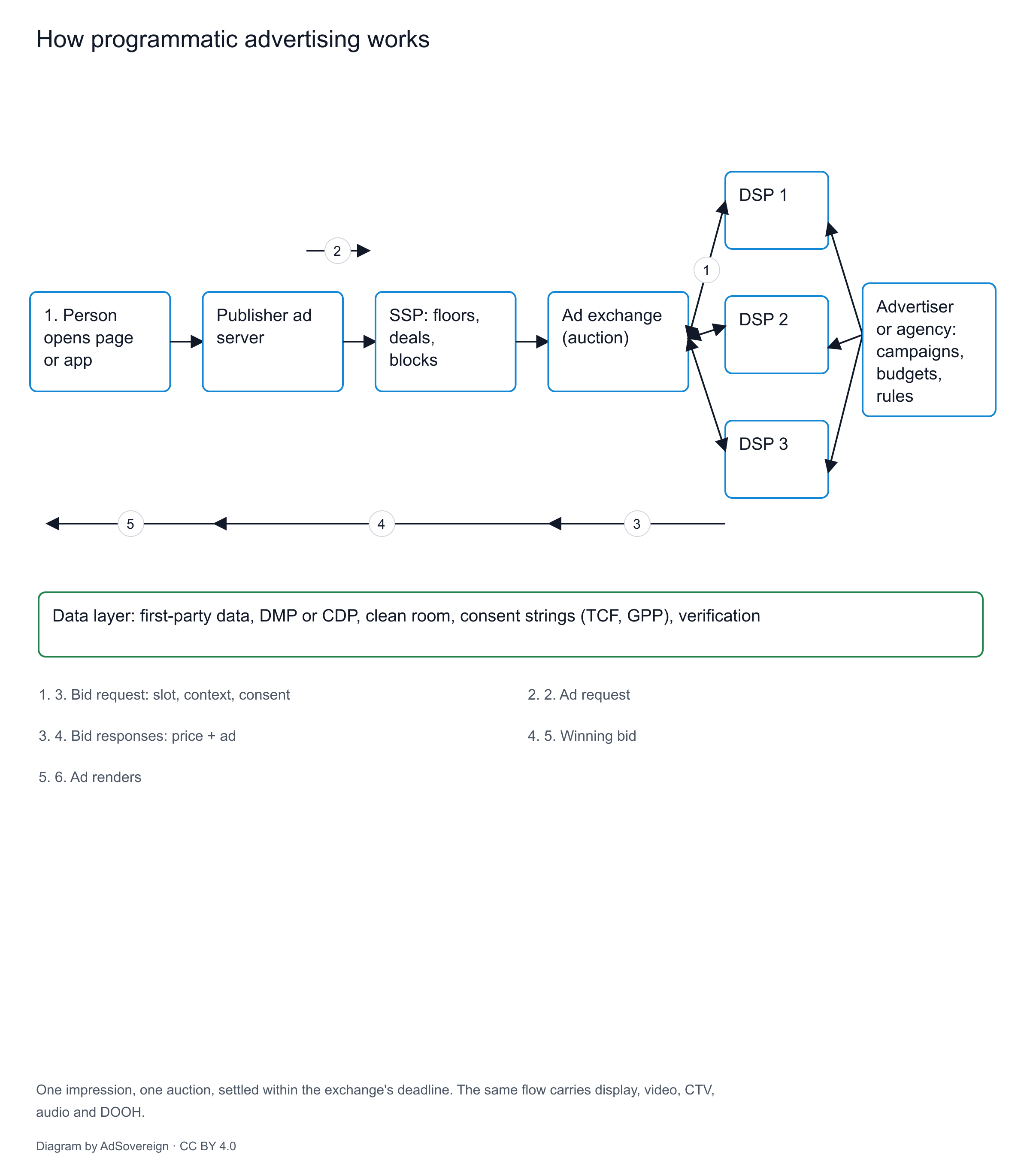
Five kinds of system do the work. Two act for one side of the trade, one sits in the middle, and two support every step.
5 of 5 rows
Demand-side platform (DSP) | Advertisers and agencies | Holds campaigns, budgets and targeting; reads each bid request and decides what to bid | The Trade Desk, Google Display & Video 360, Amazon DSP, Yahoo DSP |
Supply-side platform (SSP) | Publishers and app owners | Packages ad slots, sets floor prices and deals, sends bid requests to buyers | Magnite, PubMatic, Index Exchange, OpenX |
Ad exchange | The marketplace itself | Runs the auction that matches bids to impressions; now usually built into an SSP | Google Ad Manager's exchange, the exchanges inside the SSPs above |
Ad server | The publisher (advertisers run their own as well) | Makes the final choice between direct campaigns and programmatic bids; delivers and counts the ad | Google Ad Manager, Kevel, Equativ |
Data and measurement | Mostly buyers, increasingly sellers | Audiences, identity, consent signals, checks for viewability and fraud | Data management platforms, customer data platforms, clean rooms, DoubleVerify, Integral Ad Science |
Demand-side platform (DSP)
- Works for
Advertisers and agencies
- What it does
Holds campaigns, budgets and targeting; reads each bid request and decides what to bid
- Examples
The Trade Desk, Google Display & Video 360, Amazon DSP, Yahoo DSP
Supply-side platform (SSP)
- Works for
Publishers and app owners
- What it does
Packages ad slots, sets floor prices and deals, sends bid requests to buyers
- Examples
Magnite, PubMatic, Index Exchange, OpenX
Ad exchange
- Works for
The marketplace itself
- What it does
Runs the auction that matches bids to impressions; now usually built into an SSP
- Examples
Google Ad Manager's exchange, the exchanges inside the SSPs above
Ad server
- Works for
The publisher (advertisers run their own as well)
- What it does
Makes the final choice between direct campaigns and programmatic bids; delivers and counts the ad
- Examples
Google Ad Manager, Kevel, Equativ
Data and measurement
- Works for
Mostly buyers, increasingly sellers
- What it does
Audiences, identity, consent signals, checks for viewability and fraud
- Examples
Data management platforms, customer data platforms, clean rooms, DoubleVerify, Integral Ad Science
Table by AdSovereign, CC BY 4.0.
The buyer's side. A demand-side platform (DSP) is the software an advertiser or agency logs into. A running-shoe brand might tell its DSP to reach adults in Ohio who read about fitness, on sports and recipe sites, no more than three times a week, at a capped price. The DSP then applies those rules to every impression it is offered. Fees for this service are covered in DSP pricing explained.
The seller's side. A supply-side platform (SSP) does the mirror job for a publisher. It decides which buyers may see each slot, sets the minimum price, blocks unwanted ad categories and carries any deals the publisher has struck. A news site might allow all buyers on its sports pages but only invited buyers on its homepage.
The marketplace. An ad exchange runs the auction. It sends a bid request to connected buyers, collects their answers before a deadline and picks the winner. Most exchanges now live inside SSPs, so the two words blur. The split is explained in DSP vs SSP and in ad exchange vs ad network vs SSP.
The last word. The publisher's ad server decides what actually shows. It compares the best programmatic bid with any direct campaign that has priority, such as a sponsorship sold by the sales team. Many sites first run header bidding, a pre-auction that collects bids from several SSPs before the ad server decides. The header bidding guide covers that step.
The data. A bid is only as good as the information behind it. Buyers see the page or app, the device, an approximate location, consent signals and, where consent allows, an identifier. They add their own first-party data, often held in a data management platform (DMP) or a clean room. Google said in April 2025 that Chrome would keep third-party cookies (Digiday, 2025), so cookie-based IDs still work in that browser.
The shared language. Systems from different companies understand each other because they speak OpenRTB, a free specification from IAB Tech Lab. Version 2.0 arrived in January 2012, and the current 2.6 line has been updated in place since April 2022 (IAB Tech Lab, OpenRTB). Its latest release, 2.6-202606, came out on 11 June 2026 (IAB Tech Lab on GitHub). OpenRTB 2.6 explained walks through the bid request field by field.

Diagram by AdSovereign, CC BY 4.0.
The four ways to buy programmatically
Programmatic is not only an open auction. Buyers and sellers can also agree terms in advance and pass a deal ID with each bid request. The four common deal types differ in price, access and commitment.
4 of 4 rows
Open auction | Auction above the seller's floor | Any buyer the exchange allows | No |
Private marketplace (PMP) | Auction above a deal floor | Invited buyers only | No |
Preferred deal | Fixed price agreed in advance | One buyer, who gets first look | No |
Programmatic guaranteed | Fixed price agreed in advance | One buyer, who commits to buy | Yes |
Open auction
- How the price is set
Auction above the seller's floor
- Who can bid
Any buyer the exchange allows
- Is volume guaranteed?
No
Private marketplace (PMP)
- How the price is set
Auction above a deal floor
- Who can bid
Invited buyers only
- Is volume guaranteed?
No
Preferred deal
- How the price is set
Fixed price agreed in advance
- Who can bid
One buyer, who gets first look
- Is volume guaranteed?
No
Programmatic guaranteed
- How the price is set
Fixed price agreed in advance
- Who can bid
One buyer, who commits to buy
- Is volume guaranteed?
Yes
Table by AdSovereign, CC BY 4.0.
Deals have taken over among large advertisers. In the ANA's benchmark, the private marketplace (PMP) share of spend rose from 41% in the 2023 study to 59% in the 2024 study (Marketing Dive, 16 December 2024). It reached 87.8% in Q2 2025 (ANA, 14 August 2025). The benchmark covers advertisers that share log-level data, so it describes big buyers rather than the whole market.
eMarketer forecasts that programmatic direct, its term for fixed-price deals, will take 76.3% of US programmatic display spend in 2026, or 50.4% if social platforms are excluded (eMarketer, 17 July 2026). A sportswear brand that must own a running magazine's homepage on marathon day would use programmatic guaranteed. The same brand would use the open auction for steady, cheap reach. The full comparison is in programmatic guaranteed vs PMP vs preferred deal.
Where programmatic ads run: channels compared
Each channel uses the same auction, but the bid request carries a different object to describe the slot. The OpenRTB version history shows when each channel joined the standard (IAB Tech Lab, OpenRTB; OpenRTB 2.6 change log).
6 of 6 rows
Display and native | Banners and ads styled like the page | Banner (2.0, January 2012); Native (2.3, January 2015) | US display revenue $81.6 billion in 2025 (IAB, 16 April 2026) | |
Online video and CTV | Pre-roll, mid-roll and ad pods on streaming TV | Video (2.0); ad pods (2.6, April 2022) | US digital video revenue $78 billion in 2025 (IAB, 16 April 2026); CTV 41.6% of ANA-tracked programmatic spend in Q2 2026 (ANA via Fiducia, 6 August 2026) | |
Audio | Streaming radio, music and podcast spots | Audio (2.4, March 2016) | US podcast revenue $2.9 billion in 2025 (IAB, 16 April 2026) | |
Digital out-of-home (DOOH) | Screens in stations, malls, shops and roadsides | DOOH (2.6-202211, November 2022) | n/d on this page | |
Retail media | Retailer audiences on and off the retailer's sites | Same objects; retailer data added by the buyer or the retailer | Global retail media $200.4 billion forecast for 2026 (The Desk on WARC, August 2026) | |
Social and search | Feeds, stories, search results | Not OpenRTB; each platform runs its own automated auction | Counted as programmatic by eMarketer, not by every source (eMarketer, 17 July 2026) | n/a |
Display and native
- What is sold
Banners and ads styled like the page
- OpenRTB object (in the standard since)
Banner (2.0, January 2012); Native (2.3, January 2015)
- Size signal (all buying methods unless stated)
US display revenue $81.6 billion in 2025 (IAB, 16 April 2026)
- Deeper page
Online video and CTV
- What is sold
Pre-roll, mid-roll and ad pods on streaming TV
- OpenRTB object (in the standard since)
Video (2.0); ad pods (2.6, April 2022)
- Size signal (all buying methods unless stated)
US digital video revenue $78 billion in 2025 (IAB, 16 April 2026); CTV 41.6% of ANA-tracked programmatic spend in Q2 2026 (ANA via Fiducia, 6 August 2026)
- Deeper page
Audio
- What is sold
Streaming radio, music and podcast spots
- OpenRTB object (in the standard since)
Audio (2.4, March 2016)
- Size signal (all buying methods unless stated)
US podcast revenue $2.9 billion in 2025 (IAB, 16 April 2026)
- Deeper page
Digital out-of-home (DOOH)
- What is sold
Screens in stations, malls, shops and roadsides
- OpenRTB object (in the standard since)
DOOH (2.6-202211, November 2022)
- Size signal (all buying methods unless stated)
n/d on this page
- Deeper page
Retail media
- What is sold
Retailer audiences on and off the retailer's sites
- OpenRTB object (in the standard since)
Same objects; retailer data added by the buyer or the retailer
- Size signal (all buying methods unless stated)
Global retail media $200.4 billion forecast for 2026 (The Desk on WARC, August 2026)
- Deeper page
Social and search
- What is sold
Feeds, stories, search results
- OpenRTB object (in the standard since)
Not OpenRTB; each platform runs its own automated auction
- Size signal (all buying methods unless stated)
Counted as programmatic by eMarketer, not by every source (eMarketer, 17 July 2026)
- Deeper page
n/a
Table by AdSovereign, CC BY 4.0.
Connected TV deserves its own note. A streaming ad break holds several slots, so OpenRTB 2.6 added pod bidding, which lets buyers bid on a whole break at once (OpenRTB 2.6 change log). The ads are usually stitched into the stream on the server, a method called server-side ad insertion (SSAI). A car brand can buy every first slot in a cooking show's breaks for a month this way.
Retail media mixes two systems. Sponsored products on a retailer's own site usually run on the retailer's own auction. Offsite ads use programmatic pipes, with the retailer's shopper data steering a DSP's bids on other sites. A cereal brand could reach a grocer's recent cereal buyers on news sites, then see sales reported by the grocer.
What programmatic advertising costs
Most programmatic media is priced as a CPM, the cost per thousand impressions. In Q2 2025 the ANA found PMP impressions averaged a $7.15 CPM against $4.41 in the open marketplace (ANA, 14 August 2025). Some campaigns pay per click or per action instead, priced as CPC or CPA, but the auction underneath still clears per impression.
The media price is not the whole cost. Each intermediary takes a fee: the DSP, any data provider, the SSP, and often verification and ad serving. The ANA's quarterly Programmatic Transparency Benchmark tracks how much of a dollar survives that chain. The table applies its Q2 2026 averages to $10 of spend, a round number that keeps the shares easy to read.
5 of 5 rows
Spend entering the DSP | 100% | $10.00 | Starting point |
Transaction costs (DSP platform, DSP data, SSP fees) | 27.2% | $2.72 | |
Seller revenue | 72.8% | $7.28 | Calculated: 100% minus 27.2% |
Spent on impressions that fail quality checks (not viewable, not measurable, invalid traffic or made-for-advertising sites) | 27.7% | $2.77 | Calculated: 72.8% minus 45.1% |
TrueAdSpend: quality impressions | 45.1% | $4.51 |
Spend entering the DSP
- Share of spend
100%
- Of $10
$10.00
- Source
Starting point
Transaction costs (DSP platform, DSP data, SSP fees)
- Share of spend
27.2%
- Of $10
$2.72
Seller revenue
- Share of spend
72.8%
- Of $10
$7.28
- Source
Calculated: 100% minus 27.2%
Spent on impressions that fail quality checks (not viewable, not measurable, invalid traffic or made-for-advertising sites)
- Share of spend
27.7%
- Of $10
$2.77
- Source
Calculated: 72.8% minus 45.1%
TrueAdSpend: quality impressions
- Share of spend
45.1%
- Of $10
$4.51
Table by AdSovereign, CC BY 4.0.
The waterfall leaves out agency fees, ad serving fees, managed-service fees and brand safety tools (ANA Benchmark, Q1 2025), so the full chain costs more. The fee layers are explained in the ad tech tax explained. The quarterly series sits in the working media benchmark, and the ad tech fee calculator runs the same sums on your own numbers.
Price alone misleads. In Q2 2026 the ANA's lower-performing advertisers paid a $6.55 CPM against $7.90 for higher performers (ANA via Fiducia, 6 August 2026). Once only quality impressions were counted, the cheaper group paid $13.80 per thousand against $11.94. Cheap supply often hides waste.
Programmatic advertising examples: one impression from page load to payment
The steps below follow one impression on an ordinary evening. The people, brands and prices are illustrative. The fields and the auction rules come from the OpenRTB 2.6 specification.
- Dana opens a recipe page on her phone. The page has a medium rectangle ad slot. Its header bidding code and the publisher's ad server ask for an ad.
- The SSP describes the slot. Its bid request lists the page address and topic (healthy recipes), the phone model, a coarse location (Ohio), Dana's consent choices and a floor price of $2.00 per thousand.
- The exchange asks the buyers. It sends the request to the DSPs it works with and gives them a deadline to answer. The step-by-step RTB guide times this part in milliseconds.
- Three DSPs decide. A running-shoe brand's DSP sees a fitness-related page, a reader under its frequency cap and budget left for the day. It values the impression at $6.20 per thousand and, after bid shading, bids $5.80. A meal-kit brand bids $4.90. A bank's DSP passes, because the page does not match its campaign.
- The auction clears. In a first-price auction the highest bid pays what it bid. The shoe brand wins at $5.80 per thousand, which is 0.58 cents for this one impression.
- The ad server confirms. No direct campaign outranks the winner, so the programmatic ad serves. The ad loads, and the exchange records a billable impression.
- Everyone counts. A verification tag checks whether the ad was viewable. The DSP adds the view to Dana's frequency count. If Dana later buys the shoes, the brand may credit the ad, depending on its attribution rules.
- The money moves at month end. The agency pays the DSP, the DSP pays the exchange, and the SSP pays the publisher. Each keeps its fee along the way.
The same pattern covers other formats. A carmaker buys a streaming break through programmatic guaranteed. A coffee chain buys morning slots on station screens through a DOOH platform. A cereal brand reaches a grocer's shoppers on news sites through retail media. A telecom brand's audio spot is inserted into a podcast as it downloads. Only the slot description and the creative change.
How big is the programmatic market?
Three numbers are quoted most often, and they measure different things. The table keeps them apart.
6 of 6 rows
US programmatic advertising revenue, 2025 | $162.4 billion, +20.5% | Revenue reported by media sellers to IAB and PwC | |
US programmatic digital display spend, 2025 | Over $187 billion, +16.6%; about 95% of display | eMarketer model, social platforms included | |
US programmatic digital display spend, 2026 (forecast) | Over $220 billion, +17.4% | eMarketer model, social platforms included | |
Programmatic direct share of US programmatic display, 2026 (forecast) | 76.3%; 50.4% excluding social | eMarketer model | |
Share of tracked spend reaching quality impressions, Q2 2026 | 45.1% | ANA benchmark participants | |
Global programmatic spend | n/d | No primary global figure verified for this page | n/a |
US programmatic advertising revenue, 2025
- Figure
$162.4 billion, +20.5%
- Scope
Revenue reported by media sellers to IAB and PwC
- Source
US programmatic digital display spend, 2025
- Figure
Over $187 billion, +16.6%; about 95% of display
- Scope
eMarketer model, social platforms included
US programmatic digital display spend, 2026 (forecast)
- Figure
Over $220 billion, +17.4%
- Scope
eMarketer model, social platforms included
Programmatic direct share of US programmatic display, 2026 (forecast)
- Figure
76.3%; 50.4% excluding social
- Scope
eMarketer model
- Source
Share of tracked spend reaching quality impressions, Q2 2026
- Figure
45.1%
- Scope
ANA benchmark participants
Global programmatic spend
- Figure
n/d
- Scope
No primary global figure verified for this page
- Source
n/a
Table by AdSovereign, CC BY 4.0.
The gap between $162.4 billion and $187 billion is mostly a question of definition. eMarketer counts automated buying on social platforms, while the IAB figure comes from a survey of sellers (IAB, 16 April 2026). Quote the source and scope together. Growth is not in doubt. When the OpenRTB group formed in 2010, programmatic was a small share of display; today it is nearly all of it.
What is changing in 2026
- Deals and curation. Curators now package inventory from many publishers, add data and sell it under one deal ID. IAB Tech Lab finalised a Deals API with a Curation object on 6 February 2026 (IAB Tech Lab, 6 February 2026). The deal-type comparison covers what this means for buyers.
- Fewer DSPs. Microsoft shut down its Invest DSP, formerly Xandr, on 28 February 2026 (MediaPost, 2025).
- Agents in the buying loop. IAB Tech Lab named its Agentic Advertising Management Protocols (AAMP) on 26 February 2026 and published the framework on 16 March 2026 (PPC Land, August 2026). The agentic advertising hub tracks it.
- Google's ad tech case. The court issued its remedies opinion on 2 September 2026 and unsealed it on 16 September 2026 (AdExchanger, September 2026). The publisher view is in Google ad tech remedies explained.
- Consent signals. New consent strings under IAB Europe's Transparency and Consent Framework had to use version 2.3 from 1 March 2026, according to Google (Google AdSense Help, 2 March 2026).
How to learn programmatic advertising
You can learn the basics in a few weeks with free, primary material. Work in this order, because each step uses the one before.
- Learn the vocabulary. Read the ten terms in the box above, then the rest of the ad tech glossary. Most confusion comes from words like "exchange" and "deal" meaning slightly different things at different companies.
- Read one bid request. Open the example requests in the OpenRTB 2.6 specification and find the slot, the device, the floor and the consent fields. The planned OpenRTB bid request builder lets you change fields and see the result.
- Follow one auction. Read how real-time bidding works, then Google's guide to bid timing for its buyers (Google Authorized Buyers, updated 17 September 2026).
- Follow the money. Work through the ANA cost waterfall above with your own numbers, then read the ad tech tax explained.
- See the seller's side. The free Prebid.org documentation explains how publishers run header bidding auctions (Prebid.org, timeouts guide).
- Pick a course only after that. Our review of programmatic advertising courses and certifications lists which are free and which are worth paying for.
FAQ
Is programmatic advertising the same as real-time bidding?
What is an example of programmatic advertising?
How much does programmatic advertising cost?
What is the difference between programmatic and direct buying?
Are Facebook, Google Search and TikTok ads programmatic?
Is programmatic advertising hard to learn?
Where to go next
How this works on owned infrastructure
This page described programmatic as five parts: a buyer platform, a seller platform, an exchange, an ad server and a data layer. Most companies rent each part from a different vendor. Each vendor takes a fee and sees some of the data. AdSovereign is an enterprise RTB stack (DSP, SSP, exchange, DMP and clean room) designed to run on infrastructure the operator controls. A retailer, bank or publisher can then run its own auction and keep bid-level logs and first-party data in its own environment. The question shifts from "which fees do we accept" to "which layers do we run ourselves". The architecture page shows how the components connect, and the TCO page sets out a method for comparing owned and rented stacks.
Sources
- IAB, "Digital Ad Revenue Climbs to Nearly $300B as IAB Celebrates 30 Year Anniversary" (IAB/PwC Internet Advertising Revenue Report, full year 2025) (16 April 2026). https://www.iab.com/news/digital-ad-revenue-climbs-to-nearly-300b-as-iab-celebrates-30-year-anniversary/
- Basis Technologies, "7 Programmatic Advertising Trends Shaping 2026", citing eMarketer (9 June 2026). https://basis.com/blog/7-programmatic-advertising-trends-shaping-2026
- eMarketer, "US Programmatic Advertising Forecast and Ad Tech Trends H2 2026" (17 July 2026; figures verified via search snippet). https://www.emarketer.com/content/us-programmatic-advertising-forecast-ad-tech-trends-h2-2026
- IAB Tech Lab, OpenRTB standard page and version history (page last updated 23 January 2024). https://iabtechlab.com/standards/openrtb/
- IAB Tech Lab, OpenRTB 2.6 specification and change log, GitHub (release 2.6-202606, 11 June 2026). https://github.com/InteractiveAdvertisingBureau/openrtb2.x/blob/main/2.6.md
- IAB Tech Lab, OpenRTB 2.x releases, GitHub (accessed 9 November 2026). https://github.com/InteractiveAdvertisingBureau/openrtb2.x/releases
- Fiducia, ANA Q2 2026 Programmatic Transparency Benchmark release (6 August 2026). https://www.fiducia.eco/post/ana-programmatic-transparency-benchmark-q2-2026-working-media-efficiency-reaches-a-record-45
- Fiducia, ANA Q3 2025 Programmatic Transparency Benchmark release (5 November 2025). https://www.fiducia.eco/post/the-ana-q3-2025-programmatic-transparency-benchmark-reveals-13-6b-in-efficiency-gains-as-programmat
- ANA, "The ANA Q2 2025 Programmatic Transparency Benchmark Finds $26.8B in Wasted Programmatic Spend" (14 August 2025). https://www.ana.net/content/show/id/pr-2025-08-programmatictrans
- ANA, Programmatic Transparency Benchmark Q1 2025 findings (PDF, 2025). https://s3.amazonaws.com/media.mediapost.com/uploads/ANAQ12025Programmatic.pdf
More sources (10)
- Marketing Dive, "Programmatic ad spend grows alongside efficiency gains: ANA" (16 December 2024). https://www.marketingdive.com/news/programmatic-efficient-transparent-ctv-marketing-ana/735645/
- The Desk on WARC, "Retail media ad market to top $200 billion as growth slows" (August 2026). https://thedesk.net/2026/08/warc-retail-media-ad-market-to-top-200-billion-as-growth-slows/
- IAB Tech Lab, Deals API (page last updated 6 February 2026). https://iabtechlab.com/standards/dealsapi/
- MediaPost, "Microsoft to shutter DSP formerly Xandr" (2025). https://www.mediapost.com/publications/article/405873/microsoft-to-shutter-dsp-formerly-xandr-replace.html
- PPC Land, "AAMP and AdCP overlap on 13 functions, IAB Tech Lab COO says" (August 2026). https://ppc.land/aamp-and-adcp-overlap-on-13-functions-iab-tech-lab-coo-says/
- AdExchanger, "The Court Just Unsealed Judge Brinkema's Remedies Decision in the Google Ad Tech Antitrust Case" (16 September 2026). https://www.adexchanger.com/platforms/the-court-just-unsealed-judge-brinkemas-remedies-decision-in-the-google-ad-tech-antitrust-case-heres-your-tldr/
- Digiday, "After years of uncertainty, Google says it won't be deprecating third-party cookies in Chrome" (April 2025). https://digiday.com/marketing/after-years-of-uncertainty-google-says-it-wont-be-deprecating-third-party-cookies-in-chrome
- Google AdSense Help, "Recent transition to IAB TCF v2.3" (2 March 2026). https://support.google.com/adsense/answer/16942036?hl=en
- Google Authorized Buyers, "Peer guide" (last updated 17 September 2026). https://developers.google.com/authorized-buyers/rtb/peer-guide
- Prebid.org, "Prebid Timeouts" (accessed 9 November 2026). https://docs.prebid.org/features/timeouts.html