
RTB Architecture
Ad Exchange vs Ad Network vs SSP: The Differences, With Examples and Where the Ad Server Fits
Published · Last updated
Next scheduled review:
An ad network buys ad space from many sites and resells it in packages at prices it sets. An ad exchange is a marketplace that auctions each impression in real time. A supply-side platform (SSP) is the publisher's software for selling into exchanges and to buyers. The ad server decides which ad finally appears.
Contents
Key facts
- Courts treat ad servers and exchanges as separate markets. On 17 April 2025 a US federal court found that Google had monopolized the publisher ad server and ad exchange markets for open-web display. It dismissed the claim about an advertiser ad network market (PPC Land, 17 April 2025).
- Google led both markets by a wide margin. The court record puts Google's ad server at 91% of the worldwide market in 2022. Its ad exchange, AdX, handled 63% to 71% of open-web display exchange transactions from 2018 to 2022 and took a 20% fee (PPC Land, October 2026).
- The listed SSPs report revenue in the hundreds of millions. Magnite, which calls itself the largest independent SSP, reported revenue of $714.0 million for 2025 (Magnite 10-K, FY2025). PubMatic reported $282.9 million, down 3% (PubMatic 10-K, FY2025).
- Google's own network is shrinking. Google Network revenue, which covers AdSense, AdMob and Google Ad Manager, fell to $29.8 billion in 2025 from $30.4 billion in 2024, mainly because AdSense revenue declined (Alphabet 10-K, FY2025).
- One network publishes its split. AdSense publishers receive 80% of revenue after the advertiser platform's fee, or about 68% when the advertiser buys through Google Ads (Google AdSense Help, accessed 9 November 2026).
- Networks now look like platforms. Taboola reported 2025 revenue of $1.91 billion (Taboola 10-K, FY2025), and Teads, formerly Outbrain, reported $1.30 billion after combining the two businesses in February 2025 (Teads 10-K, FY2025).
Definitions
Ad network: a company that gathers ad space from many publishers and resells it to advertisers as packages, setting the price and keeping the gap between what advertisers pay and publishers receive.
Ad exchange: a marketplace that runs a separate real-time auction for each impression, takes bids from many buyers and passes the winning ad back to the seller.
Supply-side platform (SSP): software that a publisher uses to sell impressions programmatically by sending bid requests to exchanges and buyers, applying floors and deals, and returning the winning bid.
Ad server: the system that stores campaigns and decides, impression by impression, which ad to deliver and counts what it delivered.
Demand-side platform (DSP): the buyer's software for bidding on impressions across many exchanges and SSPs at once.
These are roles, not company types. One company can play several of them, and most large ones do. Magnite's annual report, for example, treats the display ad exchange market and the SSP market as one and the same when it describes the Google case (Magnite 10-K, FY2025). Keep the roles apart in your head even when the logos merge. It makes contracts, fees and data rights much easier to read.
Key terms on this page: ad network · ad exchange · SSP · DSP · ad server · real-time bidding · header bidding · take rate · supply path optimization · curation
The comparison table: five roles side by side
5 of 5 rows
Ad network | Sits between advertisers and publishers | Gathers ad space and resells it as packages | The network | Margin between advertiser price and publisher payout; AdSense pays publishers 80% after the buyer platform's fee (Google) | Google AdSense and AdMob (Alphabet 10-K); TikTok Pangle (IAS, 28 Oct 2025); Taboola (10-K) |
Ad exchange | Both sides, as a marketplace | Runs a real-time auction for each impression | The auction, above the seller's floor | Fee on each transaction; AdX charged a 20% take rate per the court record (PPC Land) | Google AdX; OpenX Exchange (OpenX) |
SSP | Publishers | Sends each impression to exchanges and DSPs; manages floors, deals and header bidding | The auction, within the publisher's rules | Take rate: a fee as a share of ad spend (Magnite 10-K) | |
DSP | Advertisers and agencies | Bids on impressions across many exchanges and SSPs | The buyer's bid | Platform fee on media spend (see DSP pricing) | |
Ad server (publisher side) | Publishers | Chooses between direct deals and programmatic bids, then serves and counts the ad | The publisher's priorities and rules | Licence or per-impression fees; terms vary (n/d) | Google Ad Manager; Kevel Ad Server (Kevel); Magnite SpringServe for CTV (10-K) |
Ad network
- Works for
Sits between advertisers and publishers
- What it does
Gathers ad space and resells it as packages
- Who sets the price
The network
- How it earns
Margin between advertiser price and publisher payout; AdSense pays publishers 80% after the buyer platform's fee (Google)
Ad exchange
- Works for
Both sides, as a marketplace
- What it does
Runs a real-time auction for each impression
- Who sets the price
The auction, above the seller's floor
- How it earns
Fee on each transaction; AdX charged a 20% take rate per the court record (PPC Land)
SSP
- Works for
Publishers
- What it does
Sends each impression to exchanges and DSPs; manages floors, deals and header bidding
- Who sets the price
The auction, within the publisher's rules
- How it earns
Take rate: a fee as a share of ad spend (Magnite 10-K)
DSP
- Works for
Advertisers and agencies
- What it does
Bids on impressions across many exchanges and SSPs
- Who sets the price
The buyer's bid
- How it earns
Platform fee on media spend (see DSP pricing)
Ad server (publisher side)
- Works for
Publishers
- What it does
Chooses between direct deals and programmatic bids, then serves and counts the ad
- Who sets the price
The publisher's priorities and rules
- How it earns
Licence or per-impression fees; terms vary (n/d)
Table by AdSovereign, CC BY 4.0.
The table answers the three questions people ask most: who sets the price, who works for whom, and where the fee comes from. For the buy-side half of the picture, our DSP vs SSP comparison goes deeper on the two platforms at either end of the auction.
Ad network vs ad exchange: who sets the price
The simplest test is who sets the price. An ad network sets it. The network signs up publishers, gathers their ad space and sells it to advertisers as a package: an audience, a category of sites or a cost per click. Advertisers often do not know every site their ads run on. The network keeps the difference between what it charges and what it pays out.
Google AdSense is the best-known network, and Google publishes the split. For AdSense for Content, publishers receive 80% of revenue after the advertiser platform takes its fee. When the advertiser buys through Google Ads, publishers keep about 68% (Google AdSense Help, accessed 9 November 2026). So if a Google Ads advertiser pays $10 per thousand impressions, the cost per mille (CPM), the publisher earns about $6.80.
Some networks take on risk to win supply. Taboola places ads on publisher sites and apps, and its annual report says some contracts oblige it to pay publishers a minimum amount per thousand impressions (Taboola 10-K, FY2025). Teads lists three deal types with its media partners: revenue share, programmatic bidding and guaranteed minimums (Teads 10-K, FY2025). A guaranteed minimum is the network model in pure form: the middleman commits to the publisher first and earns its margin by reselling.
An ad exchange sets no price. It runs a fresh auction for every impression, and the highest bid above the seller's floor wins. Buyers see the impression one at a time, with whatever data the seller attaches. Google's AdX is by far the largest. The court record says it handled 63% to 71% of open-web display exchange transactions between 2018 and 2022 (PPC Land, October 2026).
So the core difference is control versus competition. A network controls the price and the package, which is simple for small publishers and small advertisers. An exchange hands price-setting to an auction, which rewards sellers whose impressions many buyers want. Our guide to how real-time bidding works walks through that auction in milliseconds.
What is an SSP in advertising?
An SSP is the publisher's selling tool. When a reader opens a page or app, the SSP receives the impression and adds what it knows: the site, the slot, the size and the reader's consent signals. It then sends a bid request to many buyers at once. It enforces the publisher's floor prices and blocks, runs or joins the auction, and returns the winning ad.
SSP meaning, in one line: the supply side's door to programmatic demand. The word "supply" is the publisher's ad space, and "platform" means the publisher logs in and sets the rules. A DSP is the mirror image on the buy side.
PubMatic shows what a modern SSP sells. Its annual report lists OpenWrap, its header bidding product, and Activate, which lets buyers run direct deals on PubMatic's platform (PubMatic 10-K, FY2025). The first serves publishers. The second serves buyers. That is typical of how SSPs grow.
How do SSPs earn? Mostly through a take rate, which Magnite defines as its fee as a percentage of advertising spend (Magnite 10-K, FY2025). Magnite notes that some connected TV (CTV) auctions carry lower fees than auctions with many bidders. SSP fee rates are usually negotiated and rarely published, which is why our ad tech tax explainer relies on audits rather than price lists.
Is an SSP the same as an ad exchange? In theory, no. The exchange is the marketplace and the SSP is the seller's access to it. In practice nearly every SSP runs its own exchange, and OpenX markets an exchange product alongside its SSP tools (OpenX, accessed 9 November 2026). When you compare vendors, ask which auctions they run themselves and which they pass on to others. That is the heart of supply path optimization.
Ad server vs ad network: different jobs
An ad network sells. An ad server decides. The publisher's ad server holds every campaign the publisher has booked, from a sponsorship to a guaranteed video deal. For each impression it checks which campaigns are eligible, applies priorities and pacing, and then lets programmatic demand compete for what is left.
Google Ad Manager, formerly DoubleClick for Publishers (DFP), is the dominant publisher ad server. Google bought DoubleClick in 2008 for $3.1 billion, gaining the leading ad server and an early exchange (PPC Land, 17 April 2025). The court record puts its 2022 share of the worldwide publisher ad server market at 91% (PPC Land, October 2026).
You can see the two jobs side by side inside Google Ad Manager. For mobile apps, its mediation feature calls a list of ad networks one after another. For exchanges, Open Bidding calls them all at once in a single auction (Google Ad Manager Help, accessed 9 November 2026). The ad server is the referee in both cases, and the networks and exchanges are players.
Advertisers run ad servers too. Theirs count and verify delivery across every seller, so a brand can compare one network's numbers with another's. The Media Rating Council (MRC) lists Google Campaign Manager 360 among the advertiser tools whose metrics it accredits (MRC, accessed 9 November 2026).
Google Ad Manager has rivals. Kevel sells an ad server through application programming interfaces (APIs) and runs a retail media exchange (Kevel, accessed 9 November 2026). Equativ offers both an SSP and a CTV ad server (Equativ, accessed 9 November 2026). Our list of Google Ad Manager alternatives compares them on features and migration effort.
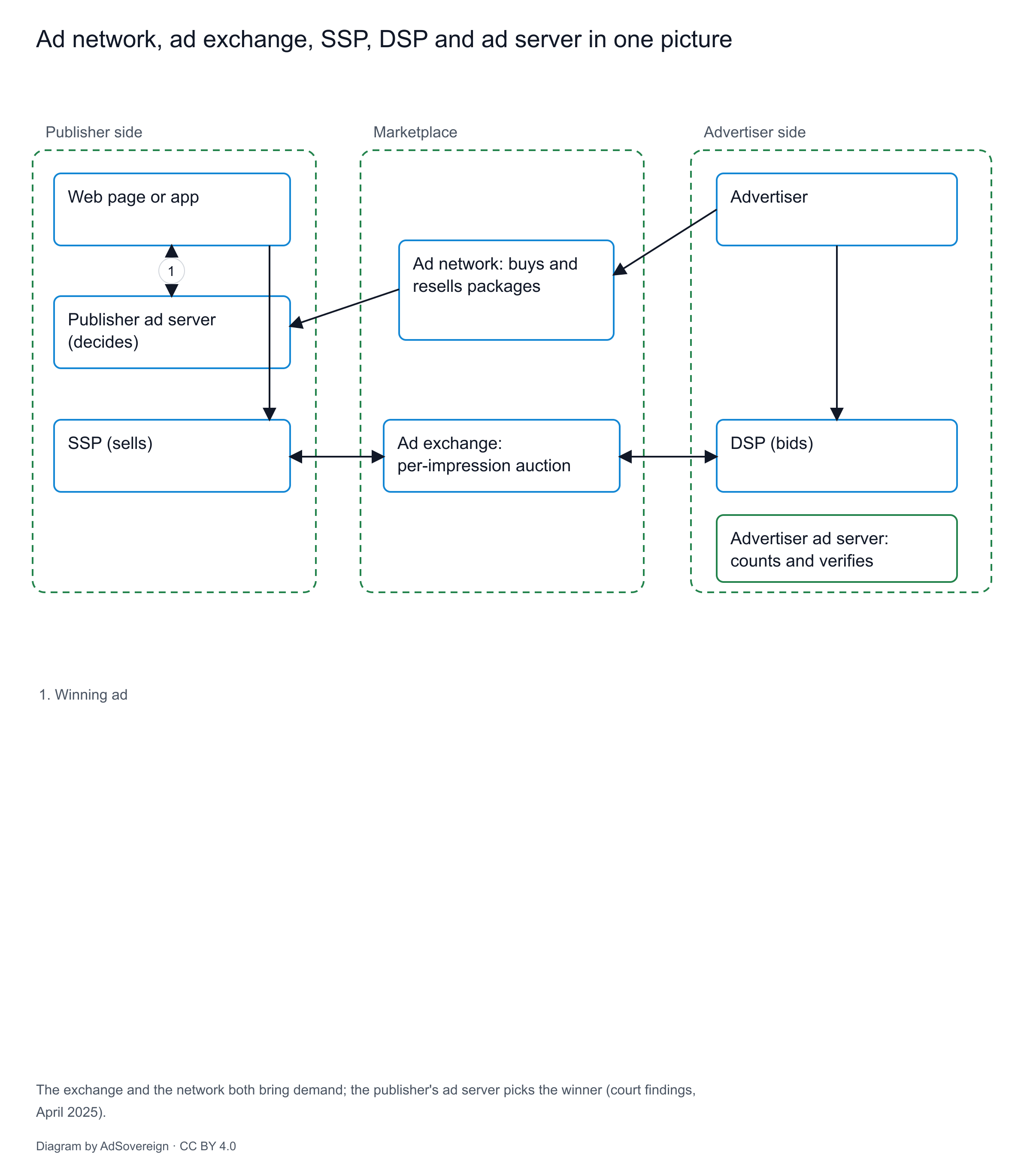
Where each one sits in a single ad request
Follow one impression on a recipe site to see the roles in order:
- The reader opens a page. The page calls the publisher's ad server and, if the site uses header bidding, a wrapper that asks several SSPs for bids at the same time.
- The SSPs build bid requests. Each SSP adds the site, the slot and consent signals, then sends the request into its exchange and to connected DSPs.
- Buyers bid. DSPs evaluate the impression for their advertisers and return bids. The exchange picks its highest bid above the floor.
- An ad network may also compete. If the publisher uses a network tag or app mediation, the network offers its own price for the slot.
- The ad server decides. It weighs direct campaigns, the best exchange bid and any network price, then picks the winner.
- The ad renders and gets counted. The publisher's ad server logs the impression, and the advertiser's ad server or verification tag counts it too.
Steps 2 and 3 can collapse into one company. Step 5 is where most of the money question sits, because whoever runs the ad server sets the rules for everyone else. That is why the court treated the ad server and the exchange as separate markets (PPC Land, 17 April 2025).

Diagram by AdSovereign, CC BY 4.0.
How the roles merged over time
The neat four-box picture blurred long ago. Owners bought across the boxes, and new products cut out steps. This timeline shows the main moves.
9 of 9 rows
2008 | Google buys DoubleClick for $3.1 billion | Ad server and exchange under one owner | |
2011 | Google buys Admeld, a tool for choosing among ad networks | Publisher software starts managing networks | |
2014 to 2015 | Header bidding spreads | SSPs compete before the ad server decides | |
19 Dec 2019 | Rubicon Project agrees to merge with Telaria; the company is later renamed Magnite | Display SSP joins a video SSP | |
2021 | Magnite buys SpotX, a CTV SSP, and SpringServe, a CTV ad server | SSP and ad server in one company | |
3 Feb 2025 | Outbrain consolidates Teads, then renames itself Teads Holding Co. | Two networks become one platform | |
17 Apr 2025 | Court rules Google monopolized ad server and exchange markets | Law separates the two roles | |
28 Feb 2026 | Microsoft shuts down its DSP, Microsoft Invest | Buy side consolidates | |
2 Sep 2026 | Remedies order: AdX bids must reach rival ad servers and Prebid | Exchange separated from ad server by court order |
2008
- Event
Google buys DoubleClick for $3.1 billion
- What it shows
Ad server and exchange under one owner
- Source
2011
- Event
Google buys Admeld, a tool for choosing among ad networks
- What it shows
Publisher software starts managing networks
- Source
2014 to 2015
- Event
Header bidding spreads
- What it shows
SSPs compete before the ad server decides
- Source
19 Dec 2019
- Event
Rubicon Project agrees to merge with Telaria; the company is later renamed Magnite
- What it shows
Display SSP joins a video SSP
- Source
2021
- Event
Magnite buys SpotX, a CTV SSP, and SpringServe, a CTV ad server
- What it shows
SSP and ad server in one company
- Source
3 Feb 2025
- Event
Outbrain consolidates Teads, then renames itself Teads Holding Co.
- What it shows
Two networks become one platform
- Source
17 Apr 2025
- Event
Court rules Google monopolized ad server and exchange markets
- What it shows
Law separates the two roles
- Source
28 Feb 2026
- Event
Microsoft shuts down its DSP, Microsoft Invest
- What it shows
Buy side consolidates
- Source
2 Sep 2026
- Event
Remedies order: AdX bids must reach rival ad servers and Prebid
- What it shows
Exchange separated from ad server by court order
- Source
Table by AdSovereign, CC BY 4.0.
Four patterns stand out. First, SSPs that run exchanges now also run ad servers, mostly in CTV. Magnite's SpringServe platform combines its streaming SSP and ad server, and Magnite says CTV competition for demand is built into the ad server rather than run as header bidding (Magnite 10-K, FY2025).
Second, buyers go straight to publishers. The Trade Desk's OpenPath gives its clients what it calls a simplified, direct connection to publishers (The Trade Desk 10-K, FY2025). Third, sellers court buyers directly. Magnite's ClearLine gives buyers direct access to CTV inventory with built-in curation, while Magnite says it does not run a DSP of its own (Magnite 10-K, FY2025).
Fourth, networks buy programmatically. Teads says it bids on media partners' inventory, often programmatically, alongside its revenue-share and guaranteed deals (Teads 10-K, FY2025). Taboola sells through integrations with leading DSPs (Taboola 10-K, FY2025). The old split, with networks off to one side and exchanges in the middle, no longer holds.
The court case is now pulling the other way. The remedies order requires AdX to bid into rival ad servers and Prebid on the same terms it gives Google's own ad server (AdExchanger, September 2026). If that holds through appeal, the exchange role and the ad server role will be easier to buy separately than at any time since 2008.
Three mix-ups to avoid
"Our SSP is our ad network." An SSP does not buy your inventory or promise a price. It runs or joins auctions on your behalf and takes a fee from each sale. If a partner pays you a fixed CPM whatever happens, it is acting as a network, whatever its sales deck says.
"Programmatic means open auction." Exchanges and SSPs also carry private marketplaces and programmatic guaranteed deals. In those, the price and the buyer are agreed in advance and only the delivery is automated. Our guide to programmatic guaranteed vs private marketplace (PMP) vs open auction explains each deal type.
"The ad server brings the buyers." A publisher ad server brings no demand of its own. It referees the demand you plug into it: direct campaigns, exchanges, SSPs and networks. Switching ad servers changes the rules of the auction, not the list of buyers, unless a buyer bids through only one ad server. The best-known case is AdX, whose real-time bids have gone only to Google's own ad server. The remedies order requires Google to offer them to rival ad servers on the same terms (AdExchanger, September 2026).
Which one do you need?
For a publisher, the answer depends on size and sales team:
- A small site with no ad sales staff usually starts with a network such as AdSense. One tag, one payment, and the network finds the buyers.
- A mid-sized site adds an ad server and two or more SSPs through header bidding, so exchanges compete for every impression.
- A large publisher with direct sales runs its own ad server, several SSPs, private deals and curated packages, and audits which paths add value.
- A streaming or CTV publisher often picks an ad server with SSP features built in, because CTV demand competition happens inside the ad server.
For an advertiser, the logic flips. A DSP buys across exchanges and SSPs with your own data and rules. A network sells you a packaged result, such as clicks on content recommendations. Your own ad server or verification tag checks what you actually received from both. Our programmatic advertising guide shows how these choices fit a full media plan, and the RTB architecture hub collects every page on the plumbing.
Where to go next
- DSP vs SSP: the difference: the two platforms at either end of the auction.
- Header bidding explained: how SSPs compete before the ad server decides.
- Google Ad Manager alternatives: rival publisher ad servers compared.
- How to set up a private ad exchange: when running the exchange role yourself makes sense.
- DSP pricing explained: what the buy side pays on top of media.
FAQ
What is the difference between an ad network and an ad exchange?
Is an SSP the same as an ad exchange?
What is the difference between an ad server and an ad network?
Is Google AdSense an ad network?
Do I need an SSP if I already use an ad network?
What does SSP mean in advertising?
How this works on owned infrastructure
The decision behind this page is which roles you rent and which you run. Most publishers rent all four: a network, two or more SSPs with their exchanges, and an ad server, each with its own fee and its own copy of the auction data. A retailer, bank or large publisher building its own media business can instead run the exchange and ad server roles itself and invite DSPs to bid directly. AdSovereign is an enterprise real-time bidding stack (SSP, exchange, DSP and data layers) designed to be deployed on infrastructure the operator controls, so auction logs and buyer connections stay with the seller. The architecture page shows how those roles fit together, and use cases explains where that model suits and where renting remains the better choice.
Sources
- PPC Land, "Court rules Google monopolized digital ad tech markets" (17 April 2025). https://ppc.land/court-rules-google-monopolized-digital-ad-tech-markets/
- PPC Land, proposed final judgment in US v. Google, Document 1861, with figures from the memorandum opinion (October 2026). https://ppc.land/doj-seeks-6-months-google-12-to-open-its-ad-exchange-to-rivals/
- AdExchanger, "The Court Just Unsealed Judge Brinkema's Remedies Decision In The Google Ad Tech Antitrust Case. Here's Your TL;DR" (September 2026). https://www.adexchanger.com/platforms/the-court-just-unsealed-judge-brinkemas-remedies-decision-in-the-google-ad-tech-antitrust-case-heres-your-tldr/
- Magnite, Inc., Form 10-K for fiscal year 2025 (filed 25 February 2026). https://www.sec.gov/Archives/edgar/data/1595974/000159597426000007/mgni-20251231.htm
- PubMatic, Inc., Form 10-K for fiscal year 2025 (filed 26 February 2026). https://www.sec.gov/Archives/edgar/data/1422930/000142293026000010/pubm-20251231.htm
- Alphabet Inc., Form 10-K for fiscal year 2025 (2026). https://www.sec.gov/Archives/edgar/data/1652044/000165204426000018/goog-20251231.htm
- Google AdSense Help, "AdSense revenue share" (accessed 9 November 2026). https://support.google.com/adsense/answer/180195?hl=en
- Taboola.com Ltd., Form 10-K for fiscal year 2025 (filed 25 February 2026). https://www.sec.gov/Archives/edgar/data/1840502/000184050226000004/tbla-20251231.htm
- Teads Holding Co. (formerly Outbrain Inc.), Form 10-K for fiscal year 2025 (filed 16 March 2026). https://www.sec.gov/Archives/edgar/data/1454938/000145493826000015/tead-20251231.htm
- The Trade Desk, Inc., Form 10-K for fiscal year 2025 (filed 27 February 2026). https://www.sec.gov/Archives/edgar/data/1671933/000167193326000014/ttd-20251231.htm
More sources (7)
- Google Ad Manager Help, "Introduction to Open Bidding" (accessed 9 November 2026). https://support.google.com/admanager/answer/7128453?hl=en
- Integral Ad Science, release on TikTok Pangle measurement, describing Pangle as the ad network for TikTok for Business (28 October 2025). https://integralads.com/news/tiktok-selects-ias-for-brand-safety-measurement-for-tiktok-pangle-advertisers/
- Media Rating Council, accredited digital services (accessed 9 November 2026). https://mediaratingcouncil.org/accreditation/digital
- OpenX, company website (accessed 9 November 2026). https://www.openx.com/
- Kevel, company website (accessed 9 November 2026). https://www.kevel.com/
- Equativ, company website (accessed 9 November 2026). https://equativ.com/
- MediaPost, "Microsoft to shutter DSP formerly Xandr" (2025; closure effective 28 February 2026). https://www.mediapost.com/publications/article/405873/microsoft-to-shutter-dsp-formerly-xandr-replace.html
Changelog
- 9 November 2026: first draft. FY2025 10-K figures, AdSense revenue share and the US v. Google record checked on this date.