
RTB Architecture
Programmatic DOOH Platforms and Companies Compared: DSPs, SSPs and How Screens Are Bought
Published · Last updated
Next scheduled review:
Programmatic DOOH platforms let advertisers buy digital out-of-home screens, such as billboards, station panels and store displays, through software instead of insertion orders. A buyer's DSP bids on a screen's ad play through a DOOH supply-side platform. The seller converts one play into an audience estimate, and most trades run as private deals.
Contents
Key facts
- Digital is a large share of out-of-home. US out-of-home revenue rose 10.7% to $3.16 billion in Q2 2026. Digital screens took 38.4% of it and grew 18.5% year over year (OAAA, 18 August 2026).
- Programmatic is expected to become the main route. A MAGNA forecast cited by the Out of Home Advertising Association of America (OAAA) projects programmatic rising from 24% of DOOH spend in 2024 to about 65% by 2029 (forecast) (OAAA, 5 November 2025).
- The standard has a DOOH object. OpenRTB release 2.6-202211, published on 17 November 2022, added a DOOH object and an impression multiplier for screens seen by many people at once (IAB Tech Lab on GitHub).
- Almost everything trades through deals. Private marketplace deals made up 96% of programmatic OOH spend on Place Exchange in H1 2025 (OAAA, 4 August 2025). JCDecaux says it sells programmatic inventory only through deals (JCDecaux, accessed 9 November 2026).
- The specialists have consolidated. T-Mobile completed its purchase of Vistar Media on 3 February 2025 for about $600 million (T-Mobile, 5 March 2025). Perion bought Hivestack in December 2023, and Broadsign bought Place Exchange in November 2025 (Perion 6-K, 12 December 2023; Broadsign, 25 November 2025).
- Media owners are growing fast here. JCDecaux calls itself the world's number one outdoor advertising company (JCDecaux, 12 June 2018). It reported programmatic revenue of €102.8 million in H1 2026, up 30.9% on an organic basis and 12.3% of its digital revenue (JCDecaux H1 2026 results, 30 July 2026).
Definition
Programmatic digital out-of-home (pDOOH): the automated sale of ad plays on networked public screens, priced per thousand estimated viewers and traded through OpenRTB bid requests that carry a DOOH object and an impression multiplier.
Key terms on this page: digital out-of-home (DOOH) · supply-side platform (SSP) · demand-side platform (DSP) · private marketplace (PMP) · programmatic guaranteed · deal ID · OpenRTB · bid request · in-store media · floor price
Programmatic DOOH meaning: how a screen gets sold by software
Out-of-home (OOH) means advertising people see outside their homes: billboards, bus shelters, airports, malls, gyms and shop floors. Digital out-of-home (DOOH) is the part that runs on screens, so the ad can change by hour, by weather or by audience. Programmatic DOOH adds the same buying software used for websites and apps. A buyer picks screens, sets a price and a schedule in a demand-side platform (DSP), and the software books the plays.
Three things make DOOH different from buying a banner. First, one play is seen by many people, so the seller has to estimate how many. Second, screens sit on private networks and often download their playlists in advance, so the "real time" can be an hour or more. Third, the media owner usually approves each creative before it runs, because a screen in a station or a supermarket is a public space. The IAB Tech Lab implementation notes for OpenRTB describe all three.
Here is a simple example. A coffee chain wants morning ads near its stores on weekdays, only when the temperature is below 10°C. In a DOOH-enabled DSP it selects transit and roadside screens within a set distance of each store. It adds a weather rule and buys through deals the media owners offer. The software then bids on plays that match. A traditional OOH buy would book fixed weeks on fixed panels through a sales team instead. The wider mechanics of programmatic buying are covered in what is programmatic advertising.
How a programmatic DOOH auction works, step by step
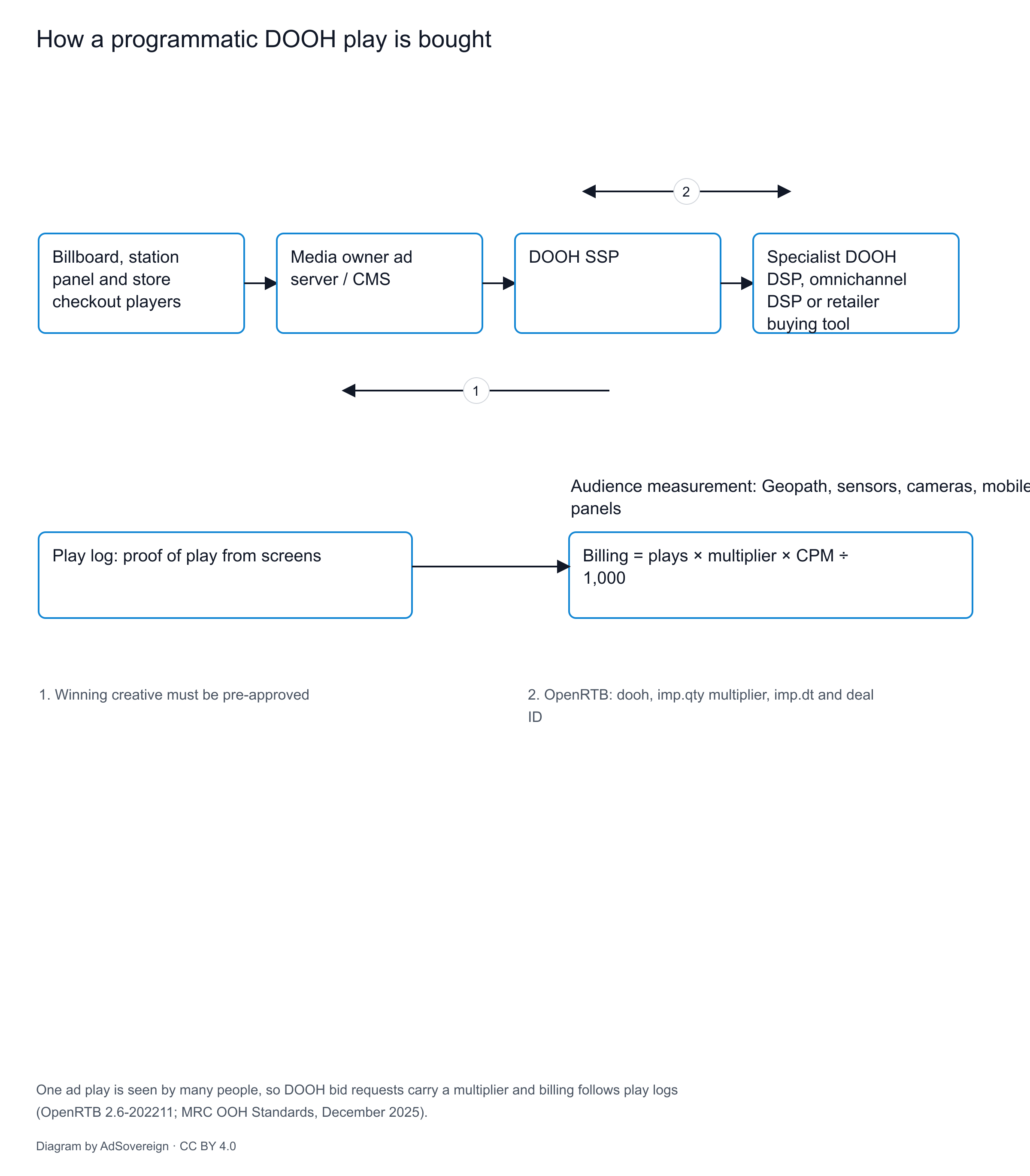
The flow follows the usual auction, with extra steps for playlists, approvals and proof that the ad ran. The steps below follow the OpenRTB 2.6 specification and its DOOH implementation notes (IAB Tech Lab, OpenRTB 2.6).
- The screen asks ahead. The screen's player or the media owner's ad server requests ads for upcoming slots in its loop. Bids may be requested in advance so the screen can pre-buffer, and the accepted lead time from confirmation to display can be one to two hours (OpenRTB implementation notes).
- The SSP describes the slot. The bid request carries a
doohobject for the screen and venue, animp.qtyobject with the audience multiplier, and animp.dttimestamp for when the play is expected to happen. - DSPs bid. Each DSP checks the venue, location, time and deal against its campaigns, then bids a price per thousand impressions.
- The creative must already be approved. On large commercial networks, the publisher reviews each ad by hand before any bid carrying it can be accepted. That review typically takes working days (OpenRTB implementation notes).
- The screen plays the ad. The player logs the play with a timestamp. These play logs are the proof of play.
- Billing follows the multiplier. The buyer pays for the plays that ran, times the impressions per play agreed in the bid request.

Diagram by AdSovereign, CC BY 4.0.
Impression multipliers: why one play counts as many impressions
On a phone, one ad shown to one person is one impression. A station screen may play an ad to dozens of people at once, or to none. OpenRTB handles this with the qty object. Its multiplier field is the number of billable impressions deemed to occur if the item is bought, and the spec's own example is 14.2 (OpenRTB 2.6). A sourcetype field says who supplied the number: a measurement vendor, the publisher or the exchange (AdCOM 1.0).
Below is an annotated example bid request for one checkout screen in a grocery store. The values are illustrative. The field names and the venue code retail.grocery come from OpenRTB 2.6 and the OpenOOH Venue Taxonomy 1.0.
{
  "id": "b7c1e0a2-dooh",
  "imp": [
    {
      "id": "1",
      "banner": { "w": 1080, "h": 1920 },
      "qty": { "multiplier": 14.2, "sourcetype": 1, "vendor": "measurementvendor.example" },
      "dt": 1794470400000,
      "exp": 3600,
      "bidfloor": 9.0,
      "bidfloorcur": "USD",
      "pmp": {
        "private_auction": 1,
        "deals": [ { "id": "grocer-checkout-q4", "bidfloor": 9.0, "bidfloorcur": "USD" } ]
      }
    }
  ],
  "dooh": {
    "id": "screen-4471",
    "name": "Checkout screen, store 212",
    "venuetype": ["retail.grocery"],
    "venuetypetax": 1,
    "publisher": { "id": "pub-88", "name": "Example Grocer Media" }
  },
  "device": { "geo": { "lat": 41.8781, "lon": -87.6298, "country": "USA" } },
  "tmax": 500
}
7 of 7 rows
| This is a screen, not a website or app; a request carries |
| The venue, here |
| 14.2 impressions will be billed for one play |
| 1 means a measurement vendor supplied the multiplier; |
| Expected play time in milliseconds since 1 January 1970 (here 12 November 2026, 08:00 UTC) |
| Seconds that may pass between the auction and the play, here one hour |
| The deal ID and floor agreed in advance; most DOOH trades this way |
dooh
- What it tells the buyer
This is a screen, not a website or app; a request carries
site,appordooh, never two (OpenRTB 2.6)
dooh.venuetype, venuetypetax
- What it tells the buyer
The venue, here
retail.grocery; taxonomy 1 is OpenOOH 1.0 (AdCOM 1.0)
imp.qty.multiplier
- What it tells the buyer
14.2 impressions will be billed for one play
imp.qty.sourcetype, vendor
- What it tells the buyer
1 means a measurement vendor supplied the multiplier;
vendornames its domain
imp.dt
- What it tells the buyer
Expected play time in milliseconds since 1 January 1970 (here 12 November 2026, 08:00 UTC)
imp.exp
- What it tells the buyer
Seconds that may pass between the auction and the play, here one hour
pmp.deals
- What it tells the buyer
The deal ID and floor agreed in advance; most DOOH trades this way
Table by AdSovereign, CC BY 4.0.
Now the money. Suppose the DSP wins at a $12.00 CPM. One play is worth 14.2 impressions, so it costs $12.00 × 14.2 ÷ 1,000, or about $0.17. The spec warns that multiplying decimals can cause billing gaps when the buy side and the sell side truncate at different places, so both should agree the rounding rule at account level (OpenRTB implementation notes). Our planned OpenRTB bid request builder will include a DOOH template, and OpenRTB 2.6 explained walks through the rest of the request.
Programmatic DOOH companies compared by role
Programmatic DOOH companies fall into four groups. Specialist platforms run both sides for out-of-home. Omnichannel DSPs add screens to web, app and TV buying. SSPs and media owners supply the inventory. Measurement firms estimate the audience behind each play. The table lists 14 companies, each described from its own filings, releases or website, or from a named trade report such as AdExchanger, checked on 9 November 2026 and linked in the last column. "n/d" means not disclosed in the sources we found.
14 of 14 rows
Vistar Media | DSP, SSP, ad server and player for OOH | T-Mobile; deal announced 13 Jan 2025, about $600M; closed 3 Feb 2025 | More than 1.1M digital screens from nearly 370 media owners and 3,000+ advertisers at the time of the deal | |
Hivestack | Ad server, SSP, header bidder and DSP for DOOH | Perion Network (Nasdaq: PERI); completed 12 Dec 2023 for $100M cash plus up to $25M in retention and performance pay | Founded 2017 in Montreal; deployed in 32 countries at acquisition; Perion's DOOH revenue grew 36% in 2025 | |
Broadsign | Screen software and ad server for media owners; SSP (Broadsign Reach); buyer tools including OutMoove | Private; Montreal | Says more than 2.8M static and digital signs run on its platform (company figure, June 2026) | |
Place Exchange | SSP for out-of-home | Broadsign, announced 25 Nov 2025, with a minority investment from Crestline Investors; price n/d | Started inside Intersection and spun out in 2021; CEO said more than 95% of its programmatic buys use deal IDs | |
VIOOH | SSP and marketplace | Launched by JCDecaux on 12 Jun 2018, then 93.5% JCDecaux and 6.5% Veltys; current split n/d | JCDecaux's exclusive SSP; 49 third-party media owners connected in H1 2026 | |
Displayce | DSP for DOOH; powers JCDecaux's data platform | JCDecaux majority stake since 2022 | Founded 2014; says it reaches 2M+ screens in 80 countries (company claim) | |
Google Display & Video 360 | Omnichannel DSP with DOOH | Alphabet | DOOH opened to all users on 25 Aug 2022, with Hivestack, Magnite, Place Exchange, Ströer SSP, VIOOH and Vistar as exchange partners | |
The Trade Desk | Omnichannel DSP with DOOH | Public (Nasdaq: TTD) | Buys from 430+ integrated exchanges, publishers and SSPs, across devices that include DOOH | |
Viant | Omnichannel DSP with DOOH | Public (Nasdaq: DSP) | Lists DOOH among its channels and offers DOOH lift reporting | |
Magnite | SSP with DOOH supply | Public (Nasdaq: MGNI) | Named a DOOH exchange partner of DV360 in Aug 2022; current DOOH scale n/d | |
Ströer SSP | SSP with DOOH supply | Ströer; details n/d | Named a DOOH exchange partner of DV360 in Aug 2022 | |
JCDecaux | Media owner selling programmatically | Public (Euronext Paris: DEC) | Programmatic revenue €102.8M in H1 2026; 350,000+ screens reachable through its stack, including 35,000+ of its own, across 46 countries | |
Geopath | US out-of-home audience measurement | n/d | Says the units it measures can deliver about 101.5 billion impressions a week (company claim) | |
Quividi | Camera-based audience measurement for retail and DOOH | n/d | Since 2006; says it measures 2 billion audience impressions a month in 80 countries (company claim) |
Vistar Media
- Role in programmatic DOOH
DSP, SSP, ad server and player for OOH
- Ownership
T-Mobile; deal announced 13 Jan 2025, about $600M; closed 3 Feb 2025
- Facts with dates
More than 1.1M digital screens from nearly 370 media owners and 3,000+ advertisers at the time of the deal
Hivestack
- Role in programmatic DOOH
Ad server, SSP, header bidder and DSP for DOOH
- Ownership
Perion Network (Nasdaq: PERI); completed 12 Dec 2023 for $100M cash plus up to $25M in retention and performance pay
- Facts with dates
Founded 2017 in Montreal; deployed in 32 countries at acquisition; Perion's DOOH revenue grew 36% in 2025
Broadsign
- Role in programmatic DOOH
Screen software and ad server for media owners; SSP (Broadsign Reach); buyer tools including OutMoove
- Ownership
Private; Montreal
- Facts with dates
Says more than 2.8M static and digital signs run on its platform (company figure, June 2026)
Place Exchange
- Role in programmatic DOOH
SSP for out-of-home
- Ownership
Broadsign, announced 25 Nov 2025, with a minority investment from Crestline Investors; price n/d
- Facts with dates
Started inside Intersection and spun out in 2021; CEO said more than 95% of its programmatic buys use deal IDs
VIOOH
- Role in programmatic DOOH
SSP and marketplace
- Ownership
Launched by JCDecaux on 12 Jun 2018, then 93.5% JCDecaux and 6.5% Veltys; current split n/d
- Facts with dates
JCDecaux's exclusive SSP; 49 third-party media owners connected in H1 2026
Displayce
- Role in programmatic DOOH
DSP for DOOH; powers JCDecaux's data platform
- Ownership
JCDecaux majority stake since 2022
- Facts with dates
Founded 2014; says it reaches 2M+ screens in 80 countries (company claim)
Google Display & Video 360
- Role in programmatic DOOH
Omnichannel DSP with DOOH
- Ownership
Alphabet
- Facts with dates
DOOH opened to all users on 25 Aug 2022, with Hivestack, Magnite, Place Exchange, Ströer SSP, VIOOH and Vistar as exchange partners
- Source
The Trade Desk
- Role in programmatic DOOH
Omnichannel DSP with DOOH
- Ownership
Public (Nasdaq: TTD)
- Facts with dates
Buys from 430+ integrated exchanges, publishers and SSPs, across devices that include DOOH
- Source
Viant
- Role in programmatic DOOH
Omnichannel DSP with DOOH
- Ownership
Public (Nasdaq: DSP)
- Facts with dates
Lists DOOH among its channels and offers DOOH lift reporting
- Source
Magnite
- Role in programmatic DOOH
SSP with DOOH supply
- Ownership
Public (Nasdaq: MGNI)
- Facts with dates
Named a DOOH exchange partner of DV360 in Aug 2022; current DOOH scale n/d
- Source
Ströer SSP
- Role in programmatic DOOH
SSP with DOOH supply
- Ownership
Ströer; details n/d
- Facts with dates
Named a DOOH exchange partner of DV360 in Aug 2022
- Source
JCDecaux
- Role in programmatic DOOH
Media owner selling programmatically
- Ownership
Public (Euronext Paris: DEC)
- Facts with dates
Programmatic revenue €102.8M in H1 2026; 350,000+ screens reachable through its stack, including 35,000+ of its own, across 46 countries
- Source
Geopath
- Role in programmatic DOOH
US out-of-home audience measurement
- Ownership
n/d
- Facts with dates
Says the units it measures can deliver about 101.5 billion impressions a week (company claim)
Quividi
- Role in programmatic DOOH
Camera-based audience measurement for retail and DOOH
- Ownership
n/d
- Facts with dates
Since 2006; says it measures 2 billion audience impressions a month in 80 countries (company claim)
Table by AdSovereign, CC BY 4.0.
Three patterns stand out. The independent specialists now sit inside larger owners: a mobile carrier, a public ad tech group and a screen software company. JCDecaux, which calls itself the world's leading outdoor company, runs its own SSP and a buyer-side data business through Displayce. And the exchanges Google named for DV360's DOOH launch are the same specialists that sell to other DSPs, so supply overlaps more than the platform count suggests.
Programmatic DOOH DSP: specialist or omnichannel?
A programmatic DOOH DSP is any buying platform that can bid on screen inventory. The choice is between a specialist built for out-of-home and a general DSP you may already use for web, app and connected TV.
Specialist DSPs, such as Vistar's and Hivestack's, are built around maps, venues and play schedules. They expose controls specific to out-of-home, such as venue types, dayparts and proof-of-play reports. OAAA lists data triggers such as audience, location, time and weather among the things programmatic OOH can act on (OAAA, accessed 9 November 2026). Vistar described its platform at the time of the T-Mobile deal as serving more than 3,000 brand advertisers (T-Mobile, 13 January 2025). Specialists suit buyers for whom out-of-home is a planned channel with its own team.
Omnichannel DSPs add DOOH to an existing workflow. Google opened DOOH to all Display & Video 360 users in August 2022. The Trade Desk and Viant list DOOH among their channels in their 2025 annual reports (Google, 25 August 2022; The Trade Desk 10-K, FY2025; Viant 10-K, FY2025). They suit buyers who want one frequency cap, one audience and one report across screens.
A worked example shows the trade-off. Google described how ASOS used Display & Video 360 to pick digital billboards on a map and set up programmatic guaranteed deals with Intersection in the US and JCDecaux in the UK. A geo experiment found a 14% rise in brand awareness in exposed areas against control areas (company-reported result) (Google, 25 August 2022). A specialist DSP could have run the same buy. The deciding question is where the rest of the campaign lives.
DOOH SSP companies and what the sell side does
On the sell side, a DOOH SSP packages screens from media owners and offers them to many DSPs. Most DOOH SSPs also sell the software that runs the screens, which is unusual in programmatic. Broadsign started in 2003 as a Montreal digital signage company, built content management and proof-of-performance software, then launched its Broadsign Reach SSP (Broadsign, accessed 9 November 2026). Hivestack sells an ad server, an SSP and a header bidder to media owners, and Perion launched a DOOH Player integrated with them in late 2025 (Perion 20-F, FY2025).
That bundling matters for media owners. The SSP often sits next to the ad server that decides between direct campaigns and programmatic demand on each screen, much as a publisher's ad server does online. A network owner choosing a platform is often choosing its screen operating system too. Switching later can mean touching every player.
Venue data is the other job. The OAAA released an updated OpenOOH venue taxonomy on 9 February 2026, with finer classes for retail and entertainment venues, where screens have spread fastest (OAAA, 10 February 2026). Consistent venue codes let a buyer target "grocery checkout" once instead of mapping each SSP's labels by hand.
Deals, not open auctions: how programmatic DOOH is bought
Open auction DOOH barely exists. On Place Exchange in H1 2025, private marketplace deals took 96% of spend. Custom PMPs were 62% of that, always-on PMPs 29%, and programmatic guaranteed deals more than doubled to 5% (OAAA, 4 August 2025). JCDecaux says it makes its inventory available only through PMP deals, guaranteed or non-guaranteed (JCDecaux, accessed 9 November 2026).
Why deals? Media owners want to know who will appear on a public screen before the auction, and buyers want a known price for an estimated audience. A deal ID carries both. The differences between deal types are covered in programmatic guaranteed vs PMP. For DOOH, the practical rule is simple: ask the SSP which deals exist for your venues, because open-market bids will see little supply.
Spend follows venues and formats. In the same H1 2025 data, outdoor venues such as billboards and street furniture took 51% of programmatic spend, retail 15%, entertainment 11% and transit 10%. Fifteen seconds was the most common video length, at 62% of video spend (OAAA, 4 August 2025). These figures describe one platform, not the whole market.
Measurement: proof of play, audience and the MRC standards
Out-of-home has to prove two things that online ads prove with a tag: that the ad ran, and who could have seen it. The Media Rating Council (MRC) covers both in its Out-of-Home Measurement Standards. Phase 1 was final in April 2024, Phase 2 was released for comment in July 2025, and the combined standard was final in December 2025 (MRC OOH Standards, December 2025). An earlier MRC standard for digital place-based advertising dates from March 2017 (MRC standards list).
Proof of play. The standard requires strong evidence that an ad played before impressions or audience can be reported. For digital screens, player logs can provide it, but their accuracy must be tested before use, monitored and independently audited (MRC OOH Standards, December 2025).
Audience. The standard builds up in steps: traffic near the screen, gross impressions, viewable impressions and likelihood to see. A viewable impression needs 100% of the ad on screen for one second, or two continuous seconds for video. A person must also be in the screen's exposure zone (MRC OOH Standards, December 2025). That is stricter than the 50% rule for online ads explained in our guide to viewability, attention and brand safety.
Accreditation status. The MRC's out-of-home accredited list showed no services when we checked on 9 November 2026, and JCDecaux's proof-of-play metric was under review (MRC OOH accredited; MRC OOH under review). In practice, multipliers come from audience firms such as Geopath in the US, from camera sensors such as Quividi's, or from the media owner's own models. The sourcetype field in the bid request tells you which.
Industry pledge. On 5 November 2025 the OAAA launched a Programmatic OOH Transparency Pledge with Broadsign, Perion, Place Exchange, VIOOH and Vistar Media. It asks platforms to represent impression multipliers and data sources truthfully, and it prohibits hidden fees, undisclosed arbitrage and bid caching. It relies on voluntary self-attestation, not audits (OAAA, 5 November 2025).
How retail in-store screens connect to programmatic DOOH
Stores are now one of the fastest-growing screen networks. Retail venues took 15% of programmatic OOH spend on Place Exchange in H1 2025 (OAAA, 4 August 2025). The OAAA's 2026 taxonomy update split retail into finer classes for the same reason (OAAA, 10 February 2026).
A retailer can sell its screens in two ways. It can sell them as in-store media inside its retail media network, using its own shopper data and sales measurement. Or it can open them to programmatic DOOH buyers through an SSP, where any brand can bid through deals. Many do both. T-Mobile's in-store network covers 35,000 screens in more than 10,000 T-Mobile and Metro stores, and with Vistar it also offers retailers tools to build their own in-store networks (T-Mobile, 12 January 2026). The T-Mobile Advertising Solutions profile and our guide to telecom media networks cover that case.
The two worlds are joining in software. On 24 June 2026 Broadsign and Mirakl Ads announced a partnership to sell a retailer's online placements and in-store screens under one campaign brief and one report. Mirakl handles the retail media logic and Broadsign delivers to screens (PPC Land, 27 June 2026). Our guides to in-store retail media and to onsite vs offsite vs in-store retail media explain the retailer's side, and the retail media hub links the rest.
How to choose a programmatic DOOH platform: a checklist
- Map your screens or venues first. List the venue types and regions you need, then ask each platform for supply by OpenOOH venue code.
- Ask where the multiplier comes from. Check the
sourcetypeand vendor for each media owner, and how often the numbers are updated. - Agree rounding and billing rules. Decide in writing how decimal multipliers are rounded, as the OpenRTB notes advise.
- Request play logs. Make proof-of-play data a deliverable, at screen and hour level.
- Check the deal set. Confirm which PMP and programmatic guaranteed deals exist for your venues, since open-market supply is thin.
- Plan creative approval time. Large networks review every creative by hand, typically over working days, and screens buffer ahead, so build in lead time (OpenRTB implementation notes).
- Decide where the campaign lives. Choose a specialist DSP for OOH-led plans, an omnichannel DSP when one frequency cap and one report matter more.
- Ask about the pledge. Check whether the platform has signed the OAAA transparency pledge and what it discloses about fees.
Where to go next
- In-store retail media: screens, audience measurement and how retailers sell them.
- Programmatic guaranteed vs PMP vs preferred deal: the deal types DOOH runs on.
- OpenRTB 2.6 explained: every field in a bid request.
- Retail media network architecture: where screens sit in a retailer's stack.
- Viewability, attention metrics and brand safety: how online viewability differs from out-of-home.
- RTB architecture hub: the rest of the programmatic plumbing.
FAQ
What does programmatic DOOH mean?
What is the best programmatic DOOH DSP?
Which companies are DOOH SSPs?
How are DOOH impressions counted?
imp.qty.multiplier, with a field saying who supplied it (OpenRTB 2.6). Billing then follows play logs times the multiplier.Can you buy DOOH in the open auction?
Is programmatic DOOH measurement accredited by the MRC?
How this works on owned infrastructure
The decision on this page is who runs the auction for a screen network and who keeps the play logs. A retailer or venue owner that rents a full DOOH stack gets an SSP, an ad server and a player from one vendor, and sees the data that vendor chooses to share. When the exchange and ad decisioning run on infrastructure the owner controls, it can connect several DOOH SSPs and DSPs as demand sources. It can set its own multiplier rules and keep play logs and shopper data in one place for measurement. AdSovereign is an enterprise real-time bidding stack designed to run that exchange layer inside the operator's environment, next to existing screen software. The use cases page describes retail and network scenarios, and the architecture page shows the components.
Sources
- IAB Tech Lab, OpenRTB 2.6 specification, GitHub (accessed 9 November 2026). https://github.com/InteractiveAdvertisingBureau/openrtb2.x/blob/main/2.6.md
- IAB Tech Lab, OpenRTB 2.x implementation notes, section 7.9 Digital Out-Of-Home, GitHub (accessed 9 November 2026). https://github.com/InteractiveAdvertisingBureau/openrtb2.x/blob/main/implementation.md
- IAB Tech Lab, "OpenRTB v2.6-202211" release (17 November 2022). https://github.com/InteractiveAdvertisingBureau/openrtb2.x/releases/tag/2.6-202211
- IAB Tech Lab, AdCOM 1.0, DOOH lists, GitHub (accessed 9 November 2026). https://github.com/InteractiveAdvertisingBureau/AdCOM/blob/main/AdCOM%20v1.0%20FINAL.md
- OpenOOH, "Venue Taxonomy, specification 1.0", GitHub (accessed 9 November 2026). https://github.com/openooh/venue-taxonomy/blob/main/specification-1.0.md
- OAAA, "OOH Revenue Surges 10.7% to $3.16 Billion as Digital, Technology and Live Events Fuel Growth" (18 August 2026). https://oaaa.org/news/from-coca-cola-to-openai-brands-are-betting-bigger-on-ooh/
- OAAA, "OAAA and Industry Leaders Launch First-Ever Transparency Pledge" (5 November 2025). https://oaaa.org/news/oaaa-and-industry-leaders-launch-first-ever-transparency-pledge-to-underscore-high-levels-of-trust-in-programmatic-out-of-home-advertising/
- OAAA, "Programmatic OOH Shows Continued Momentum in H1 2025" (4 August 2025). https://oaaa.org/blog-posts/programmatic-ooh-shows-continued-momentum-in-h1-2025/
- OAAA, "OAAA Releases Updated OpenOOH Taxonomy" (9 February 2026; published 10 February 2026). https://oaaa.org/news/oaaa-releases-updated-openooh-taxonomy-to-advance-industry-standardization-transparency/
- Media Rating Council, "Out-of-Home Measurement Standards, Phase 1 and 2 Combined", final (December 2025). https://mediaratingcouncil.org/sites/default/files/Standards/MRC%20OOH%20Standards%20Combined_FINAL.pdf
More sources (22)
- Media Rating Council, Standards and Guidelines list (accessed 9 November 2026). https://www.mediaratingcouncil.org/standards-and-guidelines
- Media Rating Council, accredited out-of-home services (accessed 9 November 2026). https://mediaratingcouncil.org/accreditation/out-of-home
- Media Rating Council, out-of-home services under review (accessed 9 November 2026). https://mediaratingcouncil.org/accreditation/services-under-review/out-of-home
- T-Mobile, "T-Mobile to Acquire Vistar Media" (13 January 2025). https://www.t-mobile.com/news/business/t-mobile-to-acquire-vistarmedia-dooh-advertising
- T-Mobile, "T-Mobile Enhances Marketing Capabilities and Expands Advertising Solutions with Close of Vistar Media and Announcement of Blis Acquisitions" (5 March 2025). https://www.t-mobile.com/news/business/t-mobile-advertising-acquires-blis-and-closes-vistar-media
- T-Mobile, "T-Mobile Advertising Solutions and Samsung partner on next-gen in-store retail media" (12 January 2026). https://www.t-mobile.com/news/business/t-mobile-advertising-solutions-and-samsung-partner-on-next-gen-in-store-retail-media
- Perion Network Ltd., Form 6-K, exhibit 99.1, "Perion Acquires Hivestack" (12 December 2023). https://www.sec.gov/Archives/edgar/data/1338940/000117891323003889/exhibit_99-1.htm
- Perion Network Ltd., Form 20-F for fiscal year 2025 (filed 16 March 2026). https://www.sec.gov/Archives/edgar/data/1338940/000117891326000927/zk2634522.htm
- Broadsign, "Broadsign Announces Acquisition of Place Exchange" (25 November 2025). https://www.placeexchange.com/news/broadsign_acquisition
- AdExchanger, "Broadsign Acquires Place Exchange As The DOOH Category Hits Its Stride" (25 November 2025). https://www.adexchanger.com/digital-out-of-home/broadsign-acquires-place-exchange-as-the-dooh-category-hits-its-stride/
- Broadsign, "Our story" (accessed 9 November 2026). https://broadsign.com/our-story/
- PPC Land, "Broadsign and Mirakl Ads want to end the online vs in-store retail media split" (27 June 2026). https://ppc.land/broadsign-and-mirakl-ads-want-to-end-the-online-vs-in-store-retail-media-split/
- JCDecaux SA, "JCDecaux launches VIOOH" (12 June 2018), via AMF filing. https://echanges.dila.gouv.fr/OPENDATA/AMF/CNS/2018/06/FCCNS164852_20180612.pdf
- JCDecaux, "Programmatic at JCDecaux" (accessed 9 November 2026). https://www.jcdecaux.com/brands/programmatic-jcdecaux
- JCDecaux, Half-Year Results 2026 presentation (30 July 2026). https://d3k1k88y44k0jy.cloudfront.net/wwwjcdecauxcom/s3fs-public/blocks/downloadable_file/2026-07/2026%2007%2030%20-%20Half-Year%20Results%202026.pdf
- Displayce, "About us" (accessed 9 November 2026). https://www.displayce.com/about-us/
- Google, "Digital out-of-home ads now in Display & Video 360" (25 August 2022). https://blog.google/products/marketingplatform/360/digital-out-of-home-ads-now-in-display-video-360/
- The Trade Desk, Inc., Form 10-K for fiscal year 2025 (filed 27 February 2026). https://www.sec.gov/Archives/edgar/data/1671933/000167193326000014/ttd-20251231.htm
- Viant Technology Inc., Form 10-K for fiscal year 2025 (filed 11 March 2026). https://www.sec.gov/Archives/edgar/data/1828791/000182879126000019/dsp-20251231.htm
- Geopath, homepage (accessed 9 November 2026). https://geopath.org/
- Quividi, homepage (accessed 9 November 2026). https://quividi.com/
- OAAA, "OAAA Programmatic OOH Transparency Pledge" page (accessed 9 November 2026). https://oaaa.org/oaaa-programmatic-ooh-transparency-pledge/
Changelog
- 9 November 2026: first draft. Company ownership, MRC lists, OAAA data and OpenRTB fields checked on this date.