
RTB Architecture
Viewability, Attention Metrics and Brand Safety Explained: Definitions, Standards and Vendors
Published · Last updated
Next scheduled review:
Viewability, attention and brand safety are three checks on an ad that has already been bought. Viewability asks whether the ad could be seen: half its pixels on screen for one second, or two seconds for video. Attention estimates whether a person actually looked. Brand safety asks whether the content around the ad was acceptable.
Contents
Key facts
- The viewability rule has not changed since 2016. The Media Rating Council (MRC) counts a display ad as viewable when at least 50% of its pixels are in view for one continuous second. Video needs two continuous seconds. Its desktop guidelines date from 18 August 2015 and its mobile guidelines from 28 June 2016 (MRC standards list, accessed 9 November 2026).
- Attention now has an industry standard. The IAB and the MRC published version 1.0 of their Attention Measurement Guidelines in November 2025. Public comment ran from 12 May to 12 July 2025 (IAB, 12 May 2025; IAB and MRC, November 2025).
- One third-party attention service is accredited. On 9 November 2026 the MRC listed DoubleVerify's Quality Analytics Platform as accredited for attention metrics on desktop, mobile web and in-app. Adelaide's pre-audit was reviewed in May 2026 and its audit had not begun (MRC accredited digital services; MRC services under review).
- Video is seen more often than display. Integral Ad Science (IAS) reported global video viewability of 79.7% against 67.9% for display in its July 2026 Media Quality Report (company data) (IAS, 9 July 2026).
- GARM is gone for good. The World Federation of Advertisers (WFA) closed its Global Alliance for Responsible Media on 9 August 2024. When it settled X Corp.'s lawsuit on 29 July 2026, WFA said it will not restart GARM or a similar initiative (WFA, 29 July 2026).
- Content-level brand safety accreditation is rare. Only two services held MRC accreditation for content-level brand safety and suitability on 9 November 2026, both for YouTube: Google's own and Zefr's (MRC accredited digital services).
Definition
Media quality verification: independent measurement, against MRC, IAB and IAB Tech Lab standards, of whether a served ad could be seen, whether a person noticed it and whether it ran beside acceptable content.
Key terms on this page: viewability · attention metrics · brand safety · invalid traffic (IVT) · Open Measurement SDK (OM SDK) · vCPM · made-for-advertising (MFA) site · contextual targeting · connected TV (CTV) · sophisticated invalid traffic (SIVT)
Viewability vs attention vs brand safety: the comparison table
Each metric answers a different question, comes from a different document and is audited separately. The table sets them side by side, with accreditation status as the MRC listed it on 9 November 2026. Invalid traffic sits in the last row because every other metric depends on removing it first.
8 of 8 rows
Display viewability | MRC and IAB, Viewable Ad Impression Measurement Guidelines v2.0 (18 Aug 2015); mobile guidelines (28 Jun 2016) | 50% or more of pixels in view for one continuous second; 30% for ads of 242,500 pixels or more | Verification vendors, ad servers, DSPs, platforms | Accredited services include Adform, Adloox, DoubleVerify, Google Ad Manager, HUMAN, IAS, Pixalate, Protected Media and Snap (MRC) | vCPM buying, viewability floors in deals, supply optimisation |
Video viewability | Same documents (MRC, 2015) | 50% of the ad's pixels in view while two continuous seconds play | Same | DoubleVerify and IAS accreditation covers CTV only for certified apps or traffic (MRC) | Video and CTV guarantees |
Measured rate | MRC, same guidelines (2015) | Share of rendered impressions whose viewable status could be determined | Same | Reported alongside accredited viewability | Judging how much of a viewability rate to trust |
Out-of-home viewable impression (OTS) | MRC Out-of-Home Measurement Standards (Dec 2025) | 100% of the ad on screen for one second (static) or two continuous seconds (video), with a person in the exposure zone | OOH audience measurers | No accredited out-of-home services listed (MRC) | Digital out-of-home audience estimates |
Attention | IAB and MRC Attention Measurement Guidelines v1.0 (Nov 2025) | Whether a person saw or heard the ad, and how deeply | Adelaide, Lumen, IAS, DoubleVerify, XPLN and others | DoubleVerify accredited for desktop, mobile web and in-app; Adelaide pre-audit reviewed 5/2026; XPLN audit reviewed 8/2026 (MRC) | Planning, pre-bid segments, media quality guarantees |
Brand safety, property level | IAB and MRC Guidelines for the Conduct of Ad Verification (Feb 2012) (MRC list) | Whether a site or app as a whole fits the advertiser's rules | DoubleVerify, IAS, Protected Media | Accredited: DoubleVerify (desktop, mobile web, in-app, CTV), IAS (desktop, mobile web), Protected Media (desktop, mobile web) (MRC) | Block lists, avoidance categories |
Brand safety and suitability, content level | MRC supplement on content-level context and brand safety (Sep 2018) | Whether the specific video, post or article beside the ad fits | Platforms and specialist vendors | Accredited: Google YouTube Brand Safety, Zefr for YouTube; IAS YouTube audit in process since 4/2023 (MRC) | Social and user-generated video |
Invalid traffic (IVT) | MRC IVT Guidelines, updated June 2020 and April 2024 (MRC list) | Impressions not from a real person who could see the ad | Verification and fraud vendors | Six third-party vendors accredited for SIVT (see ad fraud detection tools) | Filtering, refunds; a precondition for the rows above |
Display viewability
- Standard body and document
MRC and IAB, Viewable Ad Impression Measurement Guidelines v2.0 (18 Aug 2015); mobile guidelines (28 Jun 2016)
- What it counts
50% or more of pixels in view for one continuous second; 30% for ads of 242,500 pixels or more
- Who measures
Verification vendors, ad servers, DSPs, platforms
- MRC accreditation status (9 Nov 2026)
Accredited services include Adform, Adloox, DoubleVerify, Google Ad Manager, HUMAN, IAS, Pixalate, Protected Media and Snap (MRC)
Video viewability
Measured rate
- Standard body and document
MRC, same guidelines (2015)
- What it counts
Share of rendered impressions whose viewable status could be determined
- Who measures
Same
- MRC accreditation status (9 Nov 2026)
Reported alongside accredited viewability
Out-of-home viewable impression (OTS)
- Standard body and document
MRC Out-of-Home Measurement Standards (Dec 2025)
- What it counts
100% of the ad on screen for one second (static) or two continuous seconds (video), with a person in the exposure zone
- Who measures
OOH audience measurers
- MRC accreditation status (9 Nov 2026)
No accredited out-of-home services listed (MRC)
Attention
- Standard body and document
IAB and MRC Attention Measurement Guidelines v1.0 (Nov 2025)
- What it counts
Whether a person saw or heard the ad, and how deeply
- Who measures
Adelaide, Lumen, IAS, DoubleVerify, XPLN and others
- MRC accreditation status (9 Nov 2026)
DoubleVerify accredited for desktop, mobile web and in-app; Adelaide pre-audit reviewed 5/2026; XPLN audit reviewed 8/2026 (MRC)
Brand safety, property level
- Standard body and document
IAB and MRC Guidelines for the Conduct of Ad Verification (Feb 2012) (MRC list)
- What it counts
Whether a site or app as a whole fits the advertiser's rules
- Who measures
DoubleVerify, IAS, Protected Media
- MRC accreditation status (9 Nov 2026)
Accredited: DoubleVerify (desktop, mobile web, in-app, CTV), IAS (desktop, mobile web), Protected Media (desktop, mobile web) (MRC)
Brand safety and suitability, content level
- Standard body and document
MRC supplement on content-level context and brand safety (Sep 2018)
- What it counts
Whether the specific video, post or article beside the ad fits
- Who measures
Platforms and specialist vendors
- MRC accreditation status (9 Nov 2026)
Accredited: Google YouTube Brand Safety, Zefr for YouTube; IAS YouTube audit in process since 4/2023 (MRC)
Invalid traffic (IVT)
- Standard body and document
MRC IVT Guidelines, updated June 2020 and April 2024 (MRC list)
- What it counts
Impressions not from a real person who could see the ad
- Who measures
Verification and fraud vendors
- MRC accreditation status (9 Nov 2026)
Six third-party vendors accredited for SIVT (see ad fraud detection tools)
Table by AdSovereign, CC BY 4.0.
Viewability definition: what the MRC standard says
Viewability is the oldest of the three checks. The MRC wrote the rules with the IAB, and almost every vendor and platform measures against them. The core definition sits in the desktop guidelines, version 2.0, dated 18 August 2015 (MRC, 2015).
For a display ad, at least 50% of the ad's pixels must sit in the visible part of an in-focus browser tab. The ad must stay there for at least one continuous second after it renders. For a video ad, the same pixel rule applies while two continuous seconds of the ad play. Those two seconds need not be the first two. Large display ads get a lower bar: a unit of 242,500 pixels or more, the size of a 970x250 billboard, counts at 30% of pixels (MRC, 2015).
Mobile got its own document on 28 June 2016. It applies the same 50% and one-second test to mobile web and apps and replaced the interim guidance of May 2015 (MRC mobile guidelines, 2016). Google uses the same thresholds in its Active View reporting for Google Ads and YouTube (Google Ads Help, accessed 9 November 2026).
Has anything changed since? Not in the core rule. The MRC's standards list on 9 November 2026 still showed the 2015 and 2016 documents as the current viewability guidance (MRC, accessed 9 November 2026). Two newer documents use stricter versions for other purposes. The Out-of-Home Measurement Standards of December 2025 require 100% of the ad on screen (MRC OOH Standards, December 2025). The attention guidelines of November 2025 build on viewability rather than replacing it, as the attention section below explains.
How viewability rate is calculated
The MRC asks vendors to sort every rendered impression into three buckets: viewable, not viewable, and undetermined. Undetermined means the tag could not tell, for example because it never loaded. From those buckets come three numbers that should always be read together (MRC, 2015).
3 of 3 rows
Measured rate | (viewable + not viewable) ÷ rendered | (300 + 200) ÷ 1,000 = 50% |
Viewable rate | viewable ÷ (viewable + not viewable) | 300 ÷ 500 = 60% |
Impression distribution | each bucket ÷ rendered | 30% viewable, 20% not viewable, 50% undetermined |
Measured rate
- Formula
(viewable + not viewable) ÷ rendered
- MRC worked example: 1,000 rendered impressions
(300 + 200) ÷ 1,000 = 50%
Viewable rate
- Formula
viewable ÷ (viewable + not viewable)
- MRC worked example: 1,000 rendered impressions
300 ÷ 500 = 60%
Impression distribution
- Formula
each bucket ÷ rendered
- MRC worked example: 1,000 rendered impressions
30% viewable, 20% not viewable, 50% undetermined
Table by AdSovereign, CC BY 4.0.
The trap is in the last row. A seller can quote a 60% viewable rate while half of its impressions were never measured. The MRC says vendors should not call the 30% figure the viewable rate, because that assumes every unmeasured impression failed (MRC, 2015). Buyers should ask for both rates in every report.
Unmeasured supply is a real cost. In the Association of National Advertisers (ANA) benchmark for Q2 2026, lower-performing advertisers lost 22.7% of programmatic spend to non-measurable inventory, against 10.4% for higher performers. Spend on non-viewable impressions fell from 13.3% to 10.1% across the benchmark in one quarter (ANA via Fiducia, 6 August 2026). The working media benchmark tracks the series.
What is a good viewability rate? No standard body sets a target. Benchmarks come from vendors. IAS reported 67.9% for display and 79.7% for video globally in July 2026, based on its own measurement (company data) (IAS, 9 July 2026). Many buyers write a viewability floor into deals, or pay only for viewable impressions on a vCPM basis.
Here is what that means in money, using the MRC's example rates. A buyer pays a $5.00 CPM for 1,000,000 impressions, or $5,000. With a 50% measured rate and a 60% viewable rate, 300,000 impressions are confirmed viewable. The cost per thousand confirmed viewable impressions is $5,000 ÷ 300, or $16.67. Our CPM and vCPM converter runs the same sum on your own figures. The $5.00 price is illustrative; the rates come from the MRC example.
How viewability is measured: tags, OM SDK and certified apps
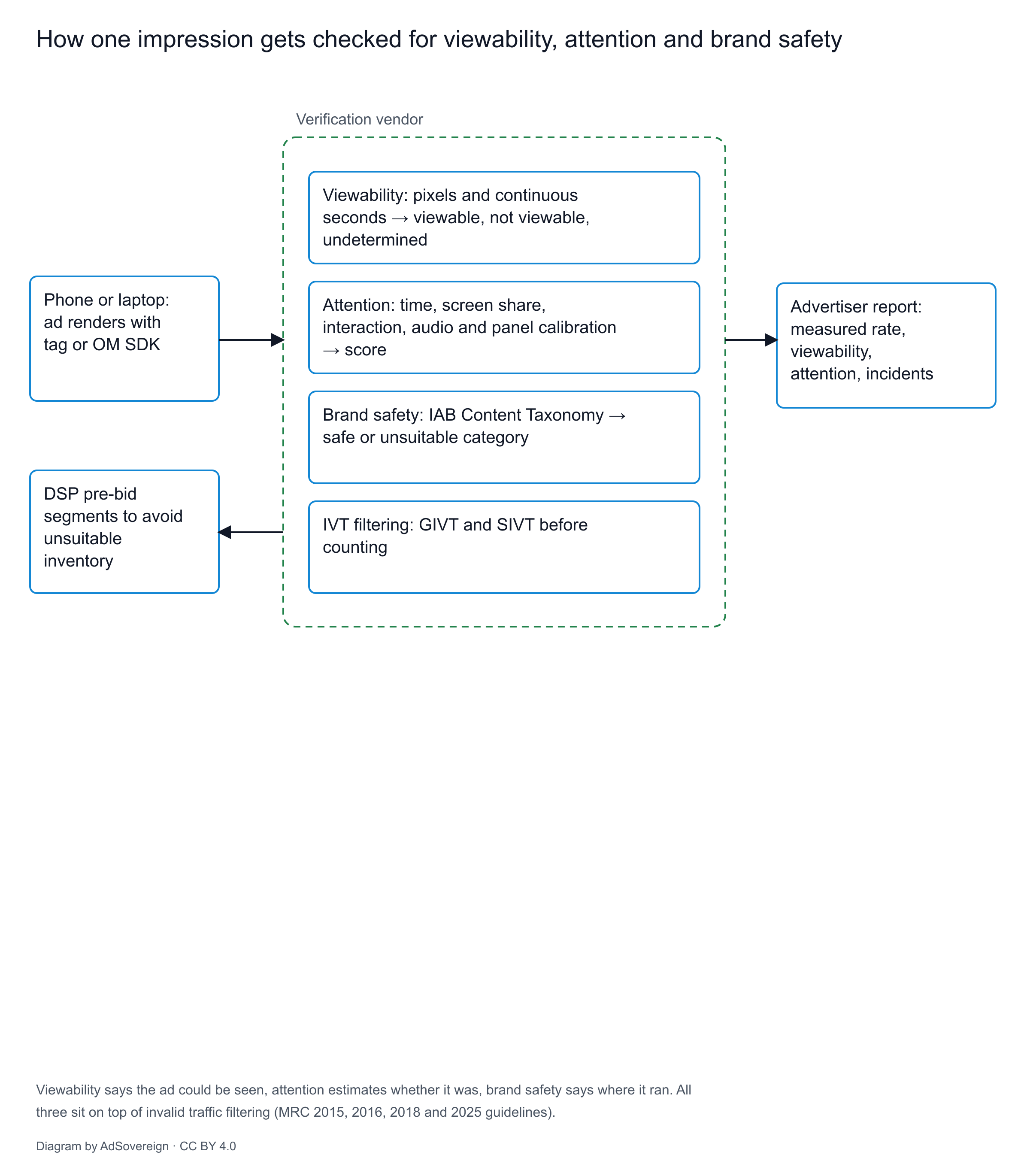
On a web page, a vendor measures with a script that loads with the ad. The script checks where the ad sits in the browser window, how much of it shows and for how long, then reports events to the vendor's servers. The verification vendor, not the publisher, decides whether the impression met the rule.
Apps are harder, because a script cannot see the screen the way a browser lets it. The IAB Tech Lab released the Open Measurement SDK (OM SDK) on 10 April 2018 to solve this for mobile apps. App owners build in one software kit, and many verification vendors read its signals, instead of each vendor shipping its own kit (IAB Tech Lab, 10 April 2018). A web video version followed in December 2020, and later releases added CTV platforms, including Samsung and LG TVs in version 1.5 (IAB Tech Lab, page updated 4 November 2025).
Platforms are moving to the same kit. Google said it would switch web video viewability measurement in Active View to OM SDK from June 2023 (Google Ads Help, accessed 9 November 2026). In connected TV (CTV), coverage is still partial. The MRC's accreditation of DoubleVerify's CTV video viewability applies to certified applications only, and IAS's to certified traffic only (MRC accredited digital services). Our page on CTV measurement companies covers the TV side in depth.

Diagram by AdSovereign, CC BY 4.0.
Who is accredited for viewability
MRC accreditation means an auditor checked a vendor's method against the guidelines. Each accreditation names the metric and the screens it covers, so one vendor can be accredited on desktop but not on CTV. On 9 November 2026, the MRC's display viewability list included six verification vendors: Adloox, DoubleVerify, HUMAN, IAS, Pixalate and Protected Media. It also named ad servers and buying tools from Adform and Google, and platforms such as Amazon DSP, Instacart and Snap (MRC accredited digital services).
Scope differs in ways that matter. DoubleVerify's display viewability accreditation includes pre-bid data. IAS holds a separate accreditation for pre-bid viewability segments, used to target likely viewable inventory before a bid (MRC accredited digital services). Retail media is catching up. Walmart Connect's onsite display audit, covering viewable impressions, had been in process since November 2025, and Kevel's pre-audit was reviewed in September 2026 (MRC services under review). Our guide to retail media measurement standards covers that side.
Attention metrics in advertising: what they measure
Viewability is a test of the ad's condition, not of the person. A fully viewable ad can sit on a screen while the user reads a text message. The IAB and MRC guidelines draw the line clearly. Viewability measures the opportunity to see. Attention measures whether the ad was seen or heard, and to what depth (IAB and MRC, November 2025).
Before 2025 each vendor defined attention its own way. An IAB task force of more than 200 members drafted shared guidelines, released for comment on 12 May 2025 (IAB, 12 May 2025). Version 1.0 was published in November 2025. It groups attention measurement into four methods (IAB and MRC, November 2025):
- Data signals. Impression-level signals such as time in view, share of screen, scrolling, playback and interaction.
- Visual tracking. Eye tracking and facial coding, usually with consenting panel members.
- Physiological and neurological observation. Heart rate, brain activity and similar responses.
- Panel or survey methods. Asking people what they noticed and remembered.
The guidelines set three conditions that matter to buyers. First, the MRC treats attention as a measure of people, so accredited attention needs a base of viewable impressions, full SIVT filtering and some sign that a user was present. Second, attention measured before or without viewability may be reported, but only as a separate, labelled diagnostic. Third, attention is not an outcome. The document says it should not be used on its own to judge campaign results such as sales or brand lift (IAB and MRC, November 2025).
Attention metrics vendors compared: Adelaide, Lumen, IAS and DoubleVerify
The four names people search for take different routes to the same question. Two model attention from signals and train against outcomes or eye tracking. One started as an eye-tracking research firm. The table uses each vendor's own description and the MRC's lists, checked on 9 November 2026.
5 of 5 rows
Adelaide | AU, a 0 to 100 score from a machine learning model trained to outcomes; activated through DSPs as pre-bid segments, custom bidding and PMPs | Pre-audit reviewed 5/2026, audit not begun; scope covers display, video, audio, linear TV, cinema and digital OOH | |
Lumen Research | Patented eye-tracking technology, founded 2013; Lumen Attention Model used for planning and buying; says a 2023 PwC audit validated the model (company claim) | Not listed | |
Integral Ad Science (IAS) | Quality Attention: combines visibility, situation (for example ad clutter and share of screen) and interaction signals, with eye-tracking data from Lumen | No attention accreditation listed | |
DoubleVerify | DV Authentic Attention: more than 50 exposure and engagement data points, near real time; Universal Attention Segments updated daily | Accredited for attention metrics on desktop, mobile web and in-app (direct indexed impressions, per DV) | |
XPLN | n/d beyond the MRC entry | Audit reviewed 8/2026 for display and video viewability and attention metrics, mobile web and in-app |
Adelaide
- Metric and method (company description)
AU, a 0 to 100 score from a machine learning model trained to outcomes; activated through DSPs as pre-bid segments, custom bidding and PMPs
- MRC status (9 Nov 2026)
Pre-audit reviewed 5/2026, audit not begun; scope covers display, video, audio, linear TV, cinema and digital OOH
- Source
Lumen Research
- Metric and method (company description)
Patented eye-tracking technology, founded 2013; Lumen Attention Model used for planning and buying; says a 2023 PwC audit validated the model (company claim)
- MRC status (9 Nov 2026)
Not listed
Integral Ad Science (IAS)
- Metric and method (company description)
Quality Attention: combines visibility, situation (for example ad clutter and share of screen) and interaction signals, with eye-tracking data from Lumen
- MRC status (9 Nov 2026)
No attention accreditation listed
- Source
DoubleVerify
- Metric and method (company description)
DV Authentic Attention: more than 50 exposure and engagement data points, near real time; Universal Attention Segments updated daily
- MRC status (9 Nov 2026)
Accredited for attention metrics on desktop, mobile web and in-app (direct indexed impressions, per DV)
- Source
XPLN
- Metric and method (company description)
n/d beyond the MRC entry
- MRC status (9 Nov 2026)
Audit reviewed 8/2026 for display and video viewability and attention metrics, mobile web and in-app
- Source
Table by AdSovereign, CC BY 4.0.
Adelaide. Its AU score predicts how likely a placement is to capture attention and drive results, rather than measuring one viewer's gaze. Adelaide said on 4 November 2026 that its partner programme had reached 100 members, adding video curators such as Cadent, Pixability, Sightly and Silverpush (company claim) (Adelaide, 4 November 2026). A concrete use: Duolingo began selling in-app ads with a contractual minimum AU score in September 2026. An earlier Adelaide audit found Duolingo's in-app video inventory scored 34% above Adelaide's benchmark (company claim) (Adelaide, 15 September 2026).
Lumen, IAS and DoubleVerify. Lumen's roots are panel eye tracking, and IAS uses Lumen data as one input to its score (IAS, accessed 9 November 2026). DoubleVerify builds its score from more than 50 exposure and engagement data points and is the only one of the four with MRC accreditation for attention on 9 November 2026 (MRC accredited digital services). Detailed profiles of DoubleVerify and Integral Ad Science are planned.
How should a buyer use these scores? Treat them as a ranking tool, then test. A brand might move 20% of a video budget toward placements with high attention scores and hold out a matched group. If sales or brand lift do not follow, the score is not helping that brand. The guidelines themselves recommend reporting attentive time relative to viewable time, which keeps the two metrics connected (IAB and MRC, November 2025).
Brand safety and suitability: from GARM to the IAB Tech Lab taxonomy
The MRC defines brand safety as the practices and tools that keep an ad from appearing next to, or in, a context that can damage the advertiser's brand. Its September 2018 supplement added guidance for judging single pieces of content, such as one video on a platform, rather than whole sites (MRC supplement, September 2018). The same document notes that different buyers have different tolerance for risk. That is the idea behind suitability: a floor everyone avoids, and a band above it that each brand sets for itself.
GARM, 2019 to 2024. The WFA set up the Global Alliance for Responsible Media in 2019, after the Christchurch mosque attack was livestreamed on Facebook. Its tools were the Brand Safety Floor and the Adjacency Standards Framework. WFA said they helped cut ads beside harmful content on social media from 6.1% in 2020 to 1.7% in 2023 (WFA claim) (WFA, 9 August 2024).
The closure and the lawsuit. X Corp. sued the WFA in federal court in Texas on 6 August 2024. It alleged that GARM coordinated an advertiser boycott (Claims Journal via Bloomberg, 7 August 2024). Three days later, on 9 August 2024, the WFA discontinued GARM. It said allegations had drained the small non-profit's resources (WFA, 9 August 2024). On 29 July 2026 the WFA and X said they were putting the litigation behind them. The WFA added that it would not form or restart GARM or a similar initiative (WFA, 29 July 2026).
The taxonomy that remains. The IAB Tech Lab Content Taxonomy is the shared list of content categories, and the Tech Lab names contextual targeting and brand safety as its typical uses. Version 3.0, released in June 2022, grew the list from about 400 to more than 1,500 categories, and version 3.1 followed in December 2024. In February 2026 the Tech Lab published a free tool, donated by Mixpeek, that maps old 2.x codes to 3.0 (IAB Tech Lab, updated 11 February 2026).
One detail trips up many integrations. In an OpenRTB 2.6 bid request, the cattax field names the taxonomy behind a site's or app's categories. If a seller leaves it out, the default is Content Taxonomy 1.0 (OpenRTB 2.6). AdCOM marks that version as deprecated and lists value 7 for version 3.0 and 9 for version 3.1 (AdCOM 1.0). A buyer's suitability rules can misfire if the two sides read the codes from different versions. OpenRTB 2.6 explained shows where the fields sit.
Brand safety solutions in programmatic advertising: how controls run
A brand safety solution in programmatic buying works at three points. Each point catches different problems.
- Before the bid. The buyer's DSP applies block lists, allow lists and pre-bid segments from a verification vendor, so it never bids on pages or apps that break its rules. DoubleVerify's MRC accreditation for property-level verification includes pre-bid data on desktop, mobile web, in-app and CTV (MRC accredited digital services).
- At the seller. Publishers and SSPs block advertiser categories they do not want, using the OpenRTB
bcatfield (OpenRTB 2.6). This protects the publisher's audience rather than the advertiser's brand. - After the ad serves. A tag classifies the page where the ad ran. It can block the creative from rendering, log an incident and feed the report that supports a refund or a makegood.
Accreditation is thinner here than for viewability. Property-level verification, which judges a site or app as a whole, was accredited for DoubleVerify, IAS and Protected Media on 9 November 2026. Protected Media's scope covered English, Spanish and Portuguese only (MRC accredited digital services). Content-level accreditation covered only YouTube, through Google and Zefr. IAS's YouTube audit had been in process since April 2023, and Meta's third-party suitability data pipeline had its audit reviewed in August 2026 (MRC services under review).
Where is the risk concentrated? IAS's July 2026 report found mobile web display carried 45.1% of the impressions it measured but 54.9% of brand suitability violations (company data) (IAS, 9 July 2026). The same environment held most made-for-advertising (MFA) site impressions, a quality problem covered in our guide to made-for-advertising sites.
The common failure is over-blocking. A keyword list that bans "shoot" or "attack" also removes football reports and cybersecurity news. A news publisher then loses revenue on safe pages, and the advertiser loses reach among readers it wanted. Suitability tiers and content-level classification exist to replace blunt keyword lists with graded categories.
What each metric proves, and what it does not
Each of the three numbers is useful, and each is easy to over-read. The list below sets out the limits a buyer should keep in mind before acting on a report.
- Viewability proves an opportunity to see, on measured impressions. It does not prove a person was present, looked at the ad or remembered it. It says nothing about the unmeasured share, which is why the measured rate comes first (MRC, 2015).
- Attention is an estimate of human exposure and engagement. Most products model it from signals and calibrate on panels. It is not a sales measure, and the IAB and MRC guidelines say so directly (IAB and MRC, November 2025).
- Brand safety proves classification against a rule set at a point in time. It does not prove how readers felt about the adjacency, and a page can change after it is classified. Accuracy depends on the taxonomy version and the classifier.
- None of them proves the traffic was human. That is the job of invalid traffic filtering, and accredited viewability and attention both require it. Our page on ad fraud detection tools compares the vendors.
A simple test keeps the metrics honest. Pick one campaign outcome you trust, such as incremental sales from a holdout test. Then check whether moving budget toward higher viewability, higher attention or stricter suitability changes that outcome. If it does not, the metric is a hygiene check for that campaign, not a lever.
How to use viewability, attention and brand safety together: a buyer's checklist
- Remove invalid traffic first. Use a vendor accredited for SIVT on every screen type you buy.
- Ask for measured rate and viewable rate together, by seller and by environment, never a single blended percentage.
- Set viewability terms in the deal, either a floor or payment on a vCPM basis, and agree whose numbers count.
- Check accreditation scope, metric by metric and screen by screen, in each vendor's accreditation letter.
- Treat attention as a test variable. Run it against a holdout before shifting large budgets.
- Write suitability tiers, not keyword lists, and confirm which Content Taxonomy version your sellers send in
cattax. - Keep impression-level logs so you can rebuild any vendor's rate from your own data.
Where to go next
- Ad fraud detection tools and companies compared: the invalid traffic layer underneath all three metrics.
- Made-for-advertising sites: why cluttered sites pass viewability and still waste money.
- CTV measurement companies compared: viewability and attention on streaming TV.
- CPM, CPC, CPA and vCPM converter: price viewable impressions on your own numbers.
- What is programmatic advertising?: where verification fits in the buying chain.
- RTB architecture hub: the rest of the plumbing.
FAQ
What is a good viewability rate?
What is the viewability definition for video ads?
What are attention metrics in advertising?
Is Adelaide's attention metric accredited by the MRC?
What is the best brand safety solution?
What replaced GARM?
How this works on owned infrastructure
The question on this page is whose numbers you trust: the seller's, the vendor's or your own. In a rented stack, viewability, attention and suitability arrive as separate vendor dashboards, each summarised differently. When the bidder and the ad server run on infrastructure you control, you can apply a vendor's pre-bid viewability or suitability segments inside your own bidding logic. You also keep impression-level logs, so measured rate and viewable rate can be rebuilt from your data. AdSovereign is an enterprise real-time bidding stack designed to join verification vendor signals to the operator's own logs, inside the operator's environment, alongside accredited vendors rather than instead of them. The integrations page lists the connection points, and the architecture page shows where measurement data lands.
Sources
- Media Rating Council, "Viewable Ad Impression Measurement Guidelines (Desktop)", version 2.0 (18 August 2015). https://mediaratingcouncil.org/sites/default/files/Standards/081815%20Viewable%20Ad%20Impression%20Guideline_v2.0_Final.pdf
- Media Rating Council, "Mobile Viewable Ad Impression Measurement Guidelines", final (28 June 2016). https://mediaratingcouncil.org/sites/default/files/Standards/062816%20Mobile%20Viewable%20Guidelines%20Final.pdf
- IAB and Media Rating Council, "Attention Measurement Guidelines", final version 1.0 (November 2025). https://mediaratingcouncil.org/sites/default/files/Standards/IAB_MRC_Attention_Measurement_Guidelines_November_2025.pdf
- IAB, "IAB and MRC Release Attention Measurement Guidelines for Public Comment" (12 May 2025). https://www.iab.com/news/attention-measurement-guidelines-public-comment/
- Media Rating Council, Standards and Guidelines list (accessed 9 November 2026). https://www.mediaratingcouncil.org/standards-and-guidelines
- Media Rating Council, accredited digital services (accessed 9 November 2026). https://mediaratingcouncil.org/accreditation/digital
- Media Rating Council, digital services under review (accessed 9 November 2026). https://mediaratingcouncil.org/accreditation/services-under-review/digital
- Media Rating Council, accredited out-of-home services (accessed 9 November 2026). https://mediaratingcouncil.org/accreditation/out-of-home
- Media Rating Council, "Supplement to IAB Guidelines for the Conduct of Ad Verification: Enhanced Content Level Context and Brand Safety" (September 2018). https://mediaratingcouncil.org/sites/default/files/Standards/MRC%20Ad%20Verification%20Supplement-%20Enhanced%20Content%20Level%20Context%20and%20Brand%20Safety%20%28Final%29.pdf
- Media Rating Council, "Out-of-Home Measurement Standards, Phase 1 and 2 Combined", final (December 2025). https://mediaratingcouncil.org/sites/default/files/Standards/MRC%20OOH%20Standards%20Combined_FINAL.pdf
More sources (18)
- IAB Tech Lab, "IAB Tech Lab Releases Open Measurement Software Development Kit for Market Adoption" (10 April 2018). https://iabtechlab.com/press-releases/iab-tech-lab-releases-open-measurement-software-development-kit-for-market-adoption-launches-compliance-program-to-facilitate-its-proper-use/
- IAB Tech Lab, "Open Measurement SDK" (page last updated 4 November 2025). https://iabtechlab.com/standards/open-measurement-sdk/
- Google Ads Help, "Understanding viewability and Active View reporting metrics" (accessed 9 November 2026). https://support.google.com/google-ads/answer/7029393?hl=en
- Fiducia, ANA Q2 2026 Programmatic Transparency Benchmark release (6 August 2026). https://www.fiducia.eco/post/ana-programmatic-transparency-benchmark-q2-2026-working-media-efficiency-reaches-a-record-45
- Integral Ad Science, "IAS's 21st Media Quality Report" (9 July 2026). https://integralads.com/news/ias-21st-media-quality-report/
- Integral Ad Science, "Quality Attention" solution page (accessed 9 November 2026). https://integralads.com/solutions/attention/
- DoubleVerify, "DV Authentic Attention" product page (accessed 9 November 2026). https://doubleverify.com/products/advertisers/verify/authentic-attention
- Adelaide, company homepage (accessed 9 November 2026). https://adelaidemetrics.com/
- Adelaide, "Adelaide's AU Ecosystem Reaches 100 Partners With Expansion Into Video Curation" (4 November 2026). https://adelaidemetrics.com/blog/au-ecosystem-100-partners-video-curation
- Adelaide, "Duolingo Launches Attention Guarantees for Advertisers, Powered by Adelaide" (15 September 2026). https://adelaidemetrics.com/blog/duolingo-launches-attention-guarantees-for-advertisers-powered-by-adelaide
- Lumen Research, "About us" (accessed 9 November 2026). https://lumen-research.com/about-us/
- Lumen Research, "Attention technology" (accessed 9 November 2026). https://lumen-research.com/attention-technology/
- World Federation of Advertisers, "Statement on the Global Alliance for Responsible Media (GARM)" (9 August 2024). https://wfanet.org/leadership/garm/about-garm
- World Federation of Advertisers, "WFA and X settle over GARM litigation" (29 July 2026). https://wfanet.org/knowledge/item/2026/07/29/wfa-and-x-settle-over-garm-litigation
- Claims Journal (Bloomberg), "Musk's X Sues Group Over Ad Boycott That Cost Billions" (7 August 2024). https://www.claimsjournal.com/news/national/2024/08/07/325547.htm
- IAB Tech Lab, "Content Taxonomy" (page last updated 11 February 2026). https://iabtechlab.com/standards/content-taxonomy/
- IAB Tech Lab, OpenRTB 2.6 specification, GitHub (accessed 9 November 2026). https://github.com/InteractiveAdvertisingBureau/openrtb2.x/blob/main/2.6.md
- IAB Tech Lab, AdCOM 1.0, "List: Category Taxonomies", GitHub (accessed 9 November 2026). https://github.com/InteractiveAdvertisingBureau/AdCOM/blob/main/AdCOM%20v1.0%20FINAL.md
Changelog
- 9 November 2026: first draft. MRC standards, accredited and under-review lists, vendor pages and the WFA statements checked on this date.