
RTB Architecture
MFA Sites Explained: What Made-for-Advertising Sites Are, Examples, and How Exchanges Detect Them
Published · Last updated
Next scheduled review:
Made-for-advertising (MFA) sites are websites that buy cheap visitors and resell their attention as ad impressions. Their pages carry many fast-refreshing ad slots, thin or copied content and mostly paid traffic. The visitors are real and the ads are often viewable, so MFA sites pass basic checks while giving advertisers little value.
Contents
Key facts
- MFA took 15% of spend in the ANA's 2023 study. MFA sites carried 21% of impressions and 15% of spend, and every advertiser had some MFA exposure, from 0.13% to 42% of spend (ANA Complete Report, December 2023).
- Four trade groups wrote the working definition. The ANA, the 4A's, ISBA and the WFA agreed five characteristics in September 2023, including an ad-to-content ratio of 30% or more on desktop (Digiday, 3 October 2023).
- Exposure fell, then ticked up. MFA spend in the ANA benchmark was 0.39% in Q3 2025 and 1.1% in Q1 2026, after staying between 0.4% and 0.6% through 2025 (ANA, 5 November 2025; ANA, 27 May 2026).
- AI "slop" now overlaps with MFA. An ANA, TAG and Fiducia analysis put AI slop at 1.3% to 2.4% of open-web programmatic spend, and found 88% of it was also identified as MFA (Fiducia, 10 August 2026).
- Mobile web is where MFA lives. Integral Ad Science (IAS) found mobile web display held 71.9% of the MFA impressions it measured, at four times the desktop MFA rate (company data) (IAS, 9 July 2026).
- No technical standard defines MFA. IAB Tech Lab's Programmatic Best Practices draft of 16 September 2026 instead asks sellers to declare ad refresh truthfully in OpenRTB (IAB Tech Lab, 16 September 2026).
Definition
Made-for-advertising (MFA) site: a website whose business depends on buying visitors for less than it earns from their ad impressions. It is recognised by some mix of high ad density, rapid refresh, paid traffic and templated content.
Key terms on this page: made-for-advertising (MFA) site · invalid traffic (IVT) · viewability · brand safety · private marketplace (PMP) · open auction · curation · supply path optimization (SPO) · sellers.json · log-level data
What MFA sites are: the arbitrage in one example
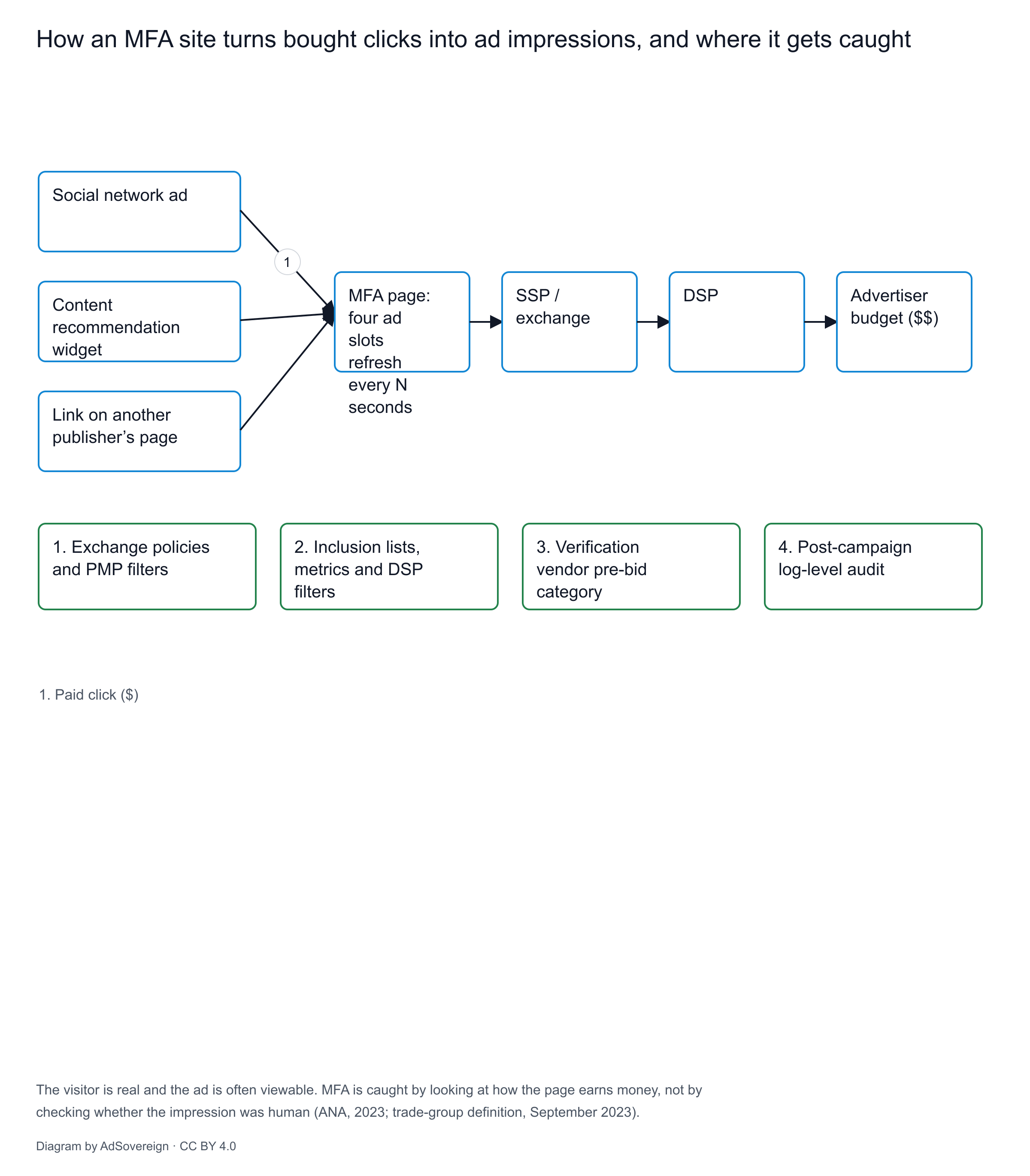
An MFA site is a business built on a price gap. The operator buys clicks on social networks, content-recommendation widgets or other publishers' pages. Each visitor lands on a page built to show as many ads as possible. The operator then sells those impressions through programmatic exchanges and keeps the difference.
Here is how the sums can work. The figures are illustrative, not taken from any real site. An operator pays 2 cents per click for a slideshow headline such as "25 hotel pools you have to see". Each visitor clicks through eight slides, and each slide shows four ad slots that refresh every 30 seconds. If the visitor stays two minutes, that is about 32 impressions. At a $1.00 CPM, they earn 3.2 cents against a 2-cent click cost. Multiply by millions of visits and the gap pays for the whole operation.
The ANA describes the same pattern in plainer terms. MFA sites draw visits with sensational headlines and clickbait, then add pop-ups, autoplay video and intrusive ads to lift revenue (ANA, December 2023). Its study also found a trick that hides the problem from buyers. Many MFA sites show few ads to someone who types the address directly, but flood the page for visitors arriving from social media or recommendation widgets, according to DeepSee.io's research cited in the report.

Diagram by AdSovereign, CC BY 4.0.
The MFA definition: five characteristics and how each is measured
Until 2023 every company used its own test. After the ANA's June 2023 study, four trade bodies agreed a shared description. They were the ANA, the American Association of Advertising Agencies (4A's), the Incorporated Society of British Advertisers (ISBA) and the World Federation of Advertisers (WFA). They leaned on earlier work by Jounce Media and DeepSee.io (ANA, December 2023). The definition says MFA sites usually show "some combination" of five traits.
5 of 5 rows
| Usually at least twice the internet average, for example 30% or more on desktop (ANA, Dec 2023) | Share of the rendered page area covered by ads | Short news pages and recipe pages with long ad rails |
| Many refreshing banners, autoplay video, slideshows that force clicks through pages with multiple ads (ANA, Dec 2023) | Refresh interval, auctions per page view, pagination depth | Sticky units that refresh on long reads, galleries |
| Little or no organic audience; buying traffic is the main cost of an MFA business (ANA, Dec 2023) | Referrer mix: social and native ads versus direct and search | Publishers that buy promotion for a launch or a big story |
| Non-editorial, templated, syndicated, dated or regurgitated articles (ANA, Dec 2023) | Duplicate-text checks, originality and AI-content classifiers | Wire copy and licensed syndication |
| Template layouts repeated across domains (ANA, Dec 2023) | Template fingerprints shared across many domains | Small publishers on common themes |
- High ad-to-content ratio
- What the definition says
Usually at least twice the internet average, for example 30% or more on desktop (ANA, Dec 2023)
- Signal a vendor can measure
Share of the rendered page area covered by ads
- Why a legitimate publisher can trip it
Short news pages and recipe pages with long ad rails
- Rapidly auto-refreshing ad placements
- What the definition says
Many refreshing banners, autoplay video, slideshows that force clicks through pages with multiple ads (ANA, Dec 2023)
- Signal a vendor can measure
Refresh interval, auctions per page view, pagination depth
- Why a legitimate publisher can trip it
Sticky units that refresh on long reads, galleries
- High share of paid traffic
- What the definition says
Little or no organic audience; buying traffic is the main cost of an MFA business (ANA, Dec 2023)
- Signal a vendor can measure
Referrer mix: social and native ads versus direct and search
- Why a legitimate publisher can trip it
Publishers that buy promotion for a launch or a big story
- Generic content
- What the definition says
Non-editorial, templated, syndicated, dated or regurgitated articles (ANA, Dec 2023)
- Signal a vendor can measure
Duplicate-text checks, originality and AI-content classifiers
- Why a legitimate publisher can trip it
Wire copy and licensed syndication
- Poorly designed, templated sites
- What the definition says
Template layouts repeated across domains (ANA, Dec 2023)
- Signal a vendor can measure
Template fingerprints shared across many domains
- Why a legitimate publisher can trip it
Small publishers on common themes
Table by AdSovereign, CC BY 4.0.
The definition is loose on purpose. The ANA's Bill Duggan said a site should show "certainly at least three" of the traits. The 4A's said it kept the wording broad so that small and minority-owned publishers would not be penalised by default (Digiday, 3 October 2023). That leaves the exact thresholds to each vendor and each buyer. The 4A's also calls these sites "made for arbitrage".
How much ad spend goes to MFA sites: the ANA data, 2023 to 2026
The ANA's study put a number on MFA for the first time. It covered 21 advertisers and about $123 million of spend, matched against 4,500 MFA domains from DeepSee.io (ANA, December 2023). Since 2024 the ANA has tracked the share each quarter in its Programmatic Transparency Benchmark, built with TAG TrustNet and Fiducia on impression-level log data.
7 of 7 rows
2023 study | Share of impressions on MFA sites | 21% | |
2023 study | Share of spend on MFA sites (range by advertiser) | 15% (0.13% to 42%) | |
2023 study | MFA share of spend in PMP deals vs open market | 14% vs 19% | |
Q2 2025 | Median MFA spend; top-quartile maximum | 0.8% (from 2.3%); up to 28.7% | |
Q3 2025 | MFA share of spend | 0.39% | |
Q1 2026 | MFA exposure | 1.1% (0.4% to 0.6% through 2025) | |
Q1 2026 data | AI slop share of open-web spend; overlap with MFA | 1.3% to 2.4%; 88% |
2023 study
- MFA measure
Share of impressions on MFA sites
- Value
21%
2023 study
- MFA measure
Share of spend on MFA sites (range by advertiser)
- Value
15% (0.13% to 42%)
2023 study
- MFA measure
MFA share of spend in PMP deals vs open market
- Value
14% vs 19%
Q2 2025
- MFA measure
Median MFA spend; top-quartile maximum
- Value
0.8% (from 2.3%); up to 28.7%
- Source
Q3 2025
- MFA measure
MFA share of spend
- Value
0.39%
- Source
Q1 2026
- MFA measure
MFA exposure
- Value
1.1% (0.4% to 0.6% through 2025)
- Source
Q1 2026 data
- MFA measure
AI slop share of open-web spend; overlap with MFA
- Value
1.3% to 2.4%; 88%
- Source
Table by AdSovereign, CC BY 4.0.
Read the series with care. The 2023 study and the later benchmark used different advertiser groups and methods, so the fall from 15% to about 1% is not a like-for-like trend. The Q2 2026 release of 6 August 2026 did not state an MFA share, and the Q3 2026 results were not published on 9 November 2026 (Fiducia, 6 August 2026). The ANA counts MFA impressions as waste in its TrueAdSpend measure, which our guide to working media vs non-working media explains.
The averages also hide a wide spread. In Q2 2025 the median advertiser spent 0.8% on MFA, while top-quartile marketers on this measure spent up to 28.7% (ANA, 14 August 2025). A brand that never checks its own logs cannot know which end it sits at.
Why MFA sites pass viewability and fraud checks
MFA is not fraud in the usual sense. The ANA found MFA sites show high measurability, good viewability, low invalid traffic (IVT) and usually brand-safe content. They also post high video completion rates, often from muted autoplay, and their CPMs were 25% lower than on other sites (ANA, December 2023). Cheap, viewable and human is exactly what many bidding algorithms reward.
The outcome is what suffers. The same report quotes Jounce Media: ads on MFA sites are at least 50% less likely to be credited with a sale than the internet average. It also cites Jounce data showing MFA supply grew from about 5% of web auctions in early 2020 to nearly 30% by mid-2023 (ANA, December 2023).
AI-generated "slop" sites behave the same way. In the 2026 analysis, slop had an IVT rate of 0.05% against 0.32% for clean supply, and viewability of 77.2% against 74.9%. It still graded as premium more than 70% of the time (Fiducia, 10 August 2026). This is why viewability and fraud filters alone cannot catch MFA. Our guides to viewability, attention and brand safety and to ad fraud detection tools explain what those checks do measure.
How exchanges and SSPs detect and exclude MFA
Supply-side platforms (SSPs) and exchanges sell the inventory, so they were first in line after June 2023. Most acted on curated products first, such as private marketplace (PMP) deals and packages, rather than on their whole open market. Sharethrough's product chief explained why to Digiday: if one exchange turns off MFA everywhere, the spend simply moves to its competitors (Digiday, 19 July 2023). The table lists public statements only, with the date each was made.
6 of 6 rows
Sharethrough | SSP | Removed MFA domains from off-the-shelf deals and custom PMPs created after 1 July 2023, using Jounce Media data (as quoted by Adalytics) | |
PubMatic | SSP | Said it was removing MFA inventory from the auction packages it sells | |
Magnite | SSP | Blocks MFA and unsafe traffic-acquisition inventory from its auction packages and Magnite-sourced deal IDs; tags MFA sites with Jounce Media, Similarweb and others; leaves open-market choices to buyers | |
Index Exchange | Exchange | Said it blocks low-quality inventory with high ad density and high social or display traffic, "common criteria of MFA content" | |
OpenX | SSP | With buyer MiQ, merged MiQ's list with Jounce's to remove MFA from MiQ's deals; said a wider technical fix was in progress | |
Google (AdSense, Ad Manager) | Ad network and exchange | Publisher Policies bar Google-served ads on screens with low-value or replicated content, or with more ads than publisher content |
Sharethrough
- Role
SSP
- Public MFA policy or statement
Removed MFA domains from off-the-shelf deals and custom PMPs created after 1 July 2023, using Jounce Media data (as quoted by Adalytics)
- Date and source
PubMatic
- Role
SSP
- Public MFA policy or statement
Said it was removing MFA inventory from the auction packages it sells
- Date and source
Magnite
- Role
SSP
- Public MFA policy or statement
Blocks MFA and unsafe traffic-acquisition inventory from its auction packages and Magnite-sourced deal IDs; tags MFA sites with Jounce Media, Similarweb and others; leaves open-market choices to buyers
- Date and source
Index Exchange
- Role
Exchange
- Public MFA policy or statement
Said it blocks low-quality inventory with high ad density and high social or display traffic, "common criteria of MFA content"
- Date and source
OpenX
- Role
SSP
- Public MFA policy or statement
With buyer MiQ, merged MiQ's list with Jounce's to remove MFA from MiQ's deals; said a wider technical fix was in progress
- Date and source
Google (AdSense, Ad Manager)
- Role
Ad network and exchange
- Public MFA policy or statement
Publisher Policies bar Google-served ads on screens with low-value or replicated content, or with more ads than publisher content
- Date and source
Table by AdSovereign, CC BY 4.0.
Two limits apply to every row. First, these are company statements, and the table does not test whether they work. Second, the ANA found the share of MFA spend varied from under 1% to 70% between SSPs in its 2023 data, which it read as a sign of different publisher acceptance standards (ANA, December 2023). Policies differ, and so do results.
How DSPs and buyers exclude MFA
Demand-side platforms (DSPs) see the bid request, not the page. They exclude MFA with lists and metrics bought or built from outside the auction. Digiday reported in July 2023 that The Trade Desk and Basis refuse to buy MFA inventory (Digiday, 19 July 2023). The Trade Desk's 2025 annual report describes OpenSincera, a free tool with metadata on ad experiences across 400,000 publishers, and OpenPath, its direct route to publishers (The Trade Desk 10-K, FY2025).
Other buyers use opt-out filters. Marketing Dive reported that AdTheorent worked with Jounce Media to remove MFA from campaigns unless the advertiser asks otherwise (Marketing Dive, 11 March 2024). Agencies built their own lists too. The ANA report cites GroupM's protections against MFA domains announced in 2023 (ANA, December 2023).
The ANA's own advice to advertisers is blunter. Use inclusion lists, not exclusion lists, because new MFA domains appear daily and AI makes them cheaper to build. Then pull log-level data from your DSP or ad server, run it against a current MFA list, and cut what the filters missed (ANA, December 2023). Our guide to log-level data shows what those files contain. The report also warns that leaving MFA will raise CPMs, since MFA was cheaper.
Curated deals are the other route. A private marketplace (PMP) limits a buy to named sellers or packages, which is why most SSPs filtered MFA there first. Deals are not a cure, though: in the 2023 study, 14% of spend in PMP deals still went to MFA sites (ANA, December 2023). Our comparison of programmatic guaranteed vs PMP explains the deal types.
How verification vendors classify MFA
The two largest verification companies sell MFA categories that advertisers can switch on for reporting and for pre-bid avoidance in their DSP. Both changed owner recently. Novacap completed its purchase of IAS on 23 December 2025 (IAS 8-K, 23 December 2025). Nielsen agreed to acquire DoubleVerify on 6 August 2026 at $13.60 a share in cash, stockholders approved on 29 October 2026, and closing was pending on 9 November 2026 (DoubleVerify 8-K, 6 August 2026).
DoubleVerify. DV launched MFA monitoring and pre-bid avoidance in beta for all advertisers from 20 September 2023. It defines MFA sites as those whose sole purpose is to deliver ads, judged on ad density against content, frequent refresh and dependence on paid traffic (DoubleVerify via CMSWire, 14 September 2023). DV says a site with many ads but high direct and search traffic would not meet its definition (company statement). In February 2024 it split the category into MFA High, Medium and Low tiers (PPC Land, 7 March 2024). See the DoubleVerify profile.
Integral Ad Science. IAS announced an AI-driven MFA detection and avoidance product on 17 October 2023. It said the model uses ad-to-content ratio, ad refresh rate and traffic source, and was trained on Jounce Media's MFA list with signals from Sincera (company description) (ExchangeWire, 17 October 2023). IAS planned general availability for early 2024. See the Integral Ad Science profile.
Vendor lists disagree at the edges, and that is by design. DoubleVerify's product chief said in 2023 that without a standard it is hard to compare MFA lists between companies (Digiday, 3 October 2023). A buyer who switches vendors should expect the blocked set to change.
Do MFA controls work? What independent audits found
Independent researchers have tested the pledges. Adalytics, a research firm, reported in March 2024 that ads from many ANA member brands still appeared on sites meeting the trade-group MFA definition in January 2024. It said 80% of the SSPs invited to the ANA's 7 March 2024 SSP showcase served such ads (Adalytics, March 2024). The report named SSPs, DSPs and retail media networks, including Amazon's, as routes.
The companies named did not all accept the findings. Marketing Dive reported that Amazon defended its DSP, saying it makes it easier for advertisers to reach third-party exchanges on the open web (Marketing Dive, 11 March 2024). The fair reading is narrow: the 2024 audit showed that MFA filters were not applied everywhere, often because buyers had not switched them on. The ANA benchmark's later fall to below 1% suggests that many buyers did switch them on in 2025.
What IAB Tech Lab and the standards say about MFA
IAB Tech Lab, which writes OpenRTB and ads.txt, has not published an MFA definition that we could find on 9 November 2026. Its work touches the behaviours behind MFA instead. The Programmatic Governance Council's Programmatic Best Practices, released for public comment on 16 September 2026, cover ad refresh, placement IDs and duplicated bid requests (IAB Tech Lab, 16 September 2026).
On refresh, the draft asks sellers to declare it truthfully in the OpenRTB Refresh object. It also asks them to time auctions to their minimum refresh interval, rather than running auctions every few seconds before the ad changes. The Refresh and RefSettings objects arrived in OpenRTB 2.6-202303, released on 5 April 2023 (IAB Tech Lab on GitHub). Here is how an honest declaration looks inside an impression object, with illustrative values:
{
  "id": "1",
  "banner": { "w": 300, "h": 250 },
  "tagid": "article-sidebar-1",
  "refresh": {
    "count": 2,
    "refsettings": [
      { "reftype": 3, "minint": 30 }
    ]
  }
}
4 of 4 rows
| Times this slot has refreshed since the page loaded, here twice (OpenRTB 2.6) |
| What triggers the refresh; 3 means time-based in AdCOM's "Auto Refresh Triggers" list (AdCOM 1.0) |
| Minimum seconds the creative stays on screen before the next one, here 30 |
| One stable placement ID per slot; the draft best practices ask sellers not to create more IDs than there are placements |
refresh.count
- Meaning in OpenRTB 2.6
Times this slot has refreshed since the page loaded, here twice (OpenRTB 2.6)
refsettings.reftype
- Meaning in OpenRTB 2.6
What triggers the refresh; 3 means time-based in AdCOM's "Auto Refresh Triggers" list (AdCOM 1.0)
refsettings.minint
- Meaning in OpenRTB 2.6
Minimum seconds the creative stays on screen before the next one, here 30
tagid
- Meaning in OpenRTB 2.6
One stable placement ID per slot; the draft best practices ask sellers not to create more IDs than there are placements
Table by AdSovereign, CC BY 4.0.
The standards that prove who is selling still matter. Ads.txt, sellers.json and the SupplyChain object let a buyer trace a request back to the site owner, which is how resold MFA supply gets spotted. Our explainer on the SupplyChain object, ads.txt and sellers.json covers them, and OpenRTB 2.6 explained walks through the rest of the request.
What publishers that are not MFA should check
Legitimate publishers can be caught by MFA filters. Publishers in the Brand Safety Institute's council told Digiday in May 2024 that they did not know how vendors classified them. Jounce Media's chief executive said published criteria were being used by publishers to see how close to the line they could get (Digiday, 30 May 2024). The group proposed a publisher portal run by the BSI. We could not confirm on 9 November 2026 whether it launched.
There is no appeal button in OpenRTB, so the practical answer is to look like what you are. Use this self-check, which follows the trade-group traits and the IAB Tech Lab draft.
- Measure ad-to-content ratio on your top templates, desktop and mobile. The 2023 definition uses 30% on desktop as an example threshold.
- Declare refresh honestly in the
refreshobject, and do not run auctions faster than yourminint. - Keep one placement ID per slot. Do not rotate IDs or send extra request-generating IDs.
- Know your traffic mix. Track the share of sessions from paid social and native ads against direct and search, by section.
- Watch campaign landing pages. If you buy promotion, keep the ad load on those pages the same as for direct visitors.
- Avoid forced pagination of short content into slideshows with ads on every slide.
- Show original work. The AI slop analysis judged content quality, not whether AI helped write it (Fiducia, 10 August 2026).
- Fix your supply records. Check ads.txt, OWNERDOMAIN and sellers.json entries with our ads.txt and sellers.json validator.
- Ask your SSPs and verification vendors how your domains are classified and which signal caused it.
- Review public metrics about your site, such as OpenSincera's ad-experience data, which buyers may consult.
A short scenario shows the stakes. A regional news site runs a sticky footer that refreshes every 15 seconds and buys social promotion for a viral story. That one week of paid traffic and fast refresh can tip it over a vendor's threshold. Both habits are cheap to change.
Where to go next
- Ad fraud detection tools and companies compared: what invalid traffic filters catch, and why MFA is a separate problem.
- Viewability, attention metrics and brand safety: the quality metrics MFA sites tend to pass.
- Working media vs non-working media: how the ANA counts MFA as waste.
- Log-level data 101: the files you need to audit your own MFA exposure.
- SupplyChain object, ads.txt and sellers.json together: how to trace who sold an impression.
- RTB architecture hub: the rest of the programmatic plumbing.
FAQ
What are MFA sites?
What is an example of an MFA site?
Is MFA ad fraud?
How much ad spend goes to MFA sites?
How can a publisher find out if it is flagged as MFA?
Do MFA sites ever work for advertisers?
How this works on owned infrastructure
The decision on this page is whose list decides what counts as MFA, and whether you can check it. In a rented stack, the DSP's filter, the SSP's package rules and the verification vendor's category each apply their own threshold, and the advertiser sees only the result. When the bidding layer runs on infrastructure the advertiser or retailer controls, inclusion lists and vendor MFA segments are applied inside its own decision logic. Every bid and win is also logged in its own environment. MFA exposure can then be recomputed against any list, old or new, without asking a vendor for a report. AdSovereign is an enterprise real-time bidding stack designed for that pattern. The use cases page shows buyer and retailer setups, and the integrations page lists verification connections.
Sources
- ANA, "Programmatic Media Supply Chain Transparency Study: Complete Report" (December 2023), hosted by Adslot. https://www.adslot.com/wp-content/uploads/2023/12/ana-programmatic-media-supply-chain-transparency-study.pdf
- Digiday, "There is a new definition for MFAs, but it's meant to be open to interpretation" (3 October 2023). https://digiday.com/media/there-is-a-new-definition-for-mfas-but-its-meant-to-be-open-to-interpretation
- ANA, "The ANA Q2 2025 Programmatic Transparency Benchmark Finds $26.8B in Wasted Programmatic Spend" (14 August 2025). https://www.ana.net/content/show/id/pr-2025-08-programmatictrans
- ANA, "The ANA Q3 2025 Programmatic Transparency Benchmark Reveals $13.6B in Efficiency Gains" (5 November 2025). https://www.ana.net/content/show/id/pr-2025-11-transparency
- ANA, "ANA Programmatic Transparency Benchmark Reveals Widening Gap Between Top and Bottom Advertisers" (27 May 2026). https://www.ana.net/content/show/id/pr-2026-05-programmatic
- Fiducia, "ANA Programmatic Transparency Benchmark: Q2 2026 Working-Media Efficiency Reaches a Record 45%" (6 August 2026). https://www.fiducia.eco/post/ana-programmatic-transparency-benchmark-q2-2026-working-media-efficiency-reaches-a-record-45
- Fiducia, "ANA/TAG/Fiducia Analysis Quantifies Level of 'AI Slop' in Digital Advertising Supply Chain for First Time" (10 August 2026). https://www.fiducia.eco/post/ana-tag-fiducia-analysis-quantifies-level-of-ai-slop-in-digital-advertising-supply-chain-for-first
- Integral Ad Science, "IAS's 21st Media Quality Report" (9 July 2026). https://integralads.com/news/ias-21st-media-quality-report/
- IAB Tech Lab Programmatic Governance Council, "Programmatic Best Practices, Version 1.0, Public Comment" (16 September 2026). https://iabtechlab.com/wp-content/uploads/2026/09/Public-Comment-Programmatic-Best-Practices-v1-1.pdf
- IAB Tech Lab, OpenRTB 2.x releases, GitHub (2.6-202303 released 5 April 2023; accessed 9 November 2026). https://github.com/InteractiveAdvertisingBureau/openrtb2.x/releases
More sources (14)
- IAB Tech Lab, OpenRTB 2.6 specification, sections 3.2.33 and 3.2.34, GitHub (accessed 9 November 2026). https://github.com/InteractiveAdvertisingBureau/openrtb2.x/blob/main/2.6.md
- IAB Tech Lab, AdCOM 1.0, GitHub (accessed 9 November 2026). https://github.com/InteractiveAdvertisingBureau/AdCOM/blob/main/AdCOM%20v1.0%20FINAL.md
- Digiday, "Ad tech industry gears up to combat MFAs" (19 July 2023). https://digiday.com/marketing/ad-tech-industry-gears-up-to-combat-mfas
- Magnite, "How Magnite Helps Buyers Navigate Made-For-Advertising to Drive Brand Impact" (12 July 2023). https://magnite.com/blog/how-magnite-helps-buyers-navigate-made-for-advertising-to-drive-brand-impact
- Google, "Google Publisher Policies", Publisher Policies Help (accessed 9 November 2026). https://support.google.com/publisherpolicies/answer/10502938?hl=en
- The Trade Desk, Inc., Form 10-K for fiscal year 2025 (filed 27 February 2026). https://www.sec.gov/Archives/edgar/data/1671933/000167193326000014/ttd-20251231.htm
- Marketing Dive, "Ad tech, agency firms continue to prop up MFAs despite crackdown pledges" (11 March 2024, updated 15 March 2024). https://www.marketingdive.com/news/adalytics-report-MFA-programmatic-advertising-crackdown/709888/
- Adalytics, "Are Amazon and other ad tech vendors serving ANA members' ads on 'Made for Arbitrage' websites in 2024?" (March 2024). https://adalytics.io/blog/ads-observed-on-made-for-advertising-sites-in-january-2024
- DoubleVerify via Business Wire on CMSWire, "DoubleVerify to Protect Advertisers Against Made for Advertising Content with Industry-First Holistic Solution" (14 September 2023). https://www.cmswire.com/the-wire/doubleverify-to-protect-advertisers-against-made-for-advertising-content-with-industry-first-holistic-solution/
- PPC Land, "DoubleVerify launches new tiered 'Made for Advertising' (MFA) categories" (7 March 2024). https://ppc.land/doubleverify-launches-new-tiered-made-for-advertising-mfa-categories/
- ExchangeWire, "IAS Launches New Made for Advertising (MFA) AI-Driven Site Detection & Avoidance Technology" (17 October 2023). https://www.exchangewire.com/blog/2023/10/17/ias-launches-new-made-for-advertising-mfa-ai-driven-site-detection-avoidance-technology/
- Integral Ad Science Holding Corp., Form 8-K on completion of the merger with Novacap (23 December 2025). https://www.sec.gov/Archives/edgar/data/1842718/000114036125046475/ef20061707_8k.htm
- DoubleVerify Holdings, Inc., Form 8-K, Exhibit 99.1, agreement to be acquired by Nielsen (6 August 2026). https://www.sec.gov/Archives/edgar/data/1819928/000110465926092121/tm2621904d1_ex99-1.htm
- Digiday, "A brand safety watchdog wants to galvanize ad tech vendors to save publishers from MFA classification" (30 May 2024). https://digiday.com/media/a-brand-safety-watchdog-wants-to-galvanize-ad-tech-vendors-to-save-publishers-from-mfa-classification
Changelog
- 9 November 2026: first draft. ANA releases, IAB Tech Lab draft, OpenRTB releases, vendor and SSP statements and ownership filings checked on this date.