
RTB Architecture
Ad Fraud Detection Tools and Companies Compared: How IVT Detection Works and Who Is Accredited
Published · Last updated
Next scheduled review:
Ad fraud detection tools find invalid traffic (IVT): bots, faked sites and apps, hidden ads and spoofed TV views. Buyers use them before the bid, to avoid bad inventory, and after the ad runs, to measure and recover spend. The key credential is accreditation by the Media Rating Council (MRC) for sophisticated invalid traffic.
Contents
Key facts
- The MRC defines two classes of invalid traffic. Its standards, first issued in October 2015 and updated in June 2020, split IVT into general (GIVT) and sophisticated (SIVT) (MRC interim update memo, April 2024).
- CTV spoofing got its own rules. The MRC's interim update, published in final form on 24 April 2024, added requirements on domain and inventory mismatch and bundle ID spoofing in connected TV (CTV) (MRC, April 2024).
- Six third-party vendors hold SIVT accreditation. On 9 November 2026 the MRC listed Adloox, DoubleVerify, HUMAN, Integral Ad Science, Pixalate and Protected Media for sophisticated IVT detection, each for named environments (MRC accredited digital services).
- The largest listed vendor is growing. DoubleVerify reported 2025 revenue of $748.3 million, up 14%, and more than 2,500 customers (DoubleVerify 10-K, FY2025).
- Both large vendors are changing owners. Integral Ad Science (IAS) agreed on 24 September 2025 to be acquired by the private equity firm Novacap for about $1.9 billion (IAS, 24 September 2025), and the deal closed on 23 December 2025 (IAS 8-K, 23 December 2025). Nielsen agreed on 6 August 2026 to acquire DoubleVerify for $13.60 a share in cash; DoubleVerify stockholders approved the deal on 29 October 2026, and closing was pending on 9 November 2026 (DoubleVerify 8-K, 6 August 2026).
- CTV schemes are large. DoubleVerify said in February 2024 that the CycloneBot scheme could fake up to 250 million ad requests and spoof about 1.5 million devices a day (company claim) (DoubleVerify, 28 February 2024).
Definition
Invalid traffic (IVT): any ad impression, click or view that does not come from a real person able to see the ad, whether routine filters catch it (GIVT) or only advanced analysis does (SIVT).
"Ad fraud" is the everyday term; "invalid traffic" is the measurement term, and it is wider. It includes harmless crawlers that nobody meant to bill, as well as criminal schemes. That is why vendors report IVT rates rather than fraud rates. The short definition lives on our IVT glossary page; this page covers the tools and the companies that sell them.
Key terms on this page: invalid traffic (IVT) · made-for-advertising (MFA) site · ads.txt · app-ads.txt · sellers.json · SupplyChain object · ads.cert · server-side ad insertion (SSAI) · brand safety · viewability
GIVT vs SIVT: the MRC's two classes of invalid traffic
The MRC is the US industry body that audits and accredits media measurement. Its invalid traffic standards are the reference that buyers, sellers and vendors share. The June 2020 update sets out two classes and a list of examples for each (MRC IVT standards addendum, June 2020).
General invalid traffic (GIVT) is traffic you can catch with routine filters, such as lists and standard checks on each request. The MRC's examples include known data-center traffic, declared bots, spiders and crawlers, and sessions that cannot display images. A search engine crawler that loads a page full of ads is a typical case. Nobody is cheating, but nobody should pay for those impressions either.
Sophisticated invalid traffic (SIVT) is harder. In the MRC's words, it needs advanced analytics, cross-checking of many signals or significant human review to find (MRC, June 2020). The examples read like a catalogue of ad fraud. They include emulators and automation tools, hijacked devices, paid click farms, and forced clicks and redirects. They also include faked impressions or viewability events, misrepresented domains and apps, hidden or stacked ads, and proxy traffic built to mislead.
The split matters when you read a vendor's claims. Filtering GIVT is the minimum for any accredited measurement. SIVT accreditation is a separate, harder audit, granted per metric and per environment. When a vendor says it is "MRC accredited", ask three things: for which metric, for which class of IVT, and on which screens.
The main types of ad fraud, in plain English
Most schemes fall into a handful of patterns. This table maps each one to the MRC class it belongs to and to the check that usually catches it.
7 of 7 rows
Known bots and data-center traffic | Servers and crawlers load ads | GIVT | Search and monitoring crawlers (MRC, 2020) | Bot lists and data-center IP lists |
Hijacked devices and residential proxies | Malware turns real devices into bots or traffic relays | SIVT | BADBOX 2.0, a botnet of compromised streaming boxes and other devices (FBI, 5 June 2025) | Behaviour analysis, device and proxy signals |
Domain and app spoofing | A seller claims to be a premium site or app it is not | SIVT | Misrepresented domains and app IDs (MRC, 2020) | ads.txt, app-ads.txt, sellers.json and the SupplyChain object |
Hidden and stacked ads | Ads are layered, shrunk or made invisible | SIVT | Z-order stacking and pixel stuffing (MRC, 2020) | Post-bid measurement tags |
Click fraud and incentivised activity | Bots or paid people click ads | SIVT | Click farms (MRC, 2020) | Click-pattern analysis, click-fraud tools |
CTV and SSAI spoofing | Fake servers claim to be TVs playing ads | SIVT | CycloneBot (DoubleVerify, Feb 2024) | Device watermarks, bundle ID checks, server-to-server verification |
Made-for-advertising sites | Real readers, but cluttered pages built to resell traffic | Not IVT: a quality issue | Mobile web display held 71.9% of MFA impressions in IAS data (IAS, 9 July 2026) | Inclusion lists, curation, MFA classifiers |
Known bots and data-center traffic
- What happens
Servers and crawlers load ads
- MRC class
GIVT
- Real example
Search and monitoring crawlers (MRC, 2020)
- What usually catches it
Bot lists and data-center IP lists
Hijacked devices and residential proxies
- What happens
Malware turns real devices into bots or traffic relays
- MRC class
SIVT
- Real example
BADBOX 2.0, a botnet of compromised streaming boxes and other devices (FBI, 5 June 2025)
- What usually catches it
Behaviour analysis, device and proxy signals
Domain and app spoofing
- What happens
A seller claims to be a premium site or app it is not
- MRC class
SIVT
- Real example
Misrepresented domains and app IDs (MRC, 2020)
- What usually catches it
ads.txt, app-ads.txt, sellers.json and the SupplyChain object
Hidden and stacked ads
- What happens
Ads are layered, shrunk or made invisible
- MRC class
SIVT
- Real example
Z-order stacking and pixel stuffing (MRC, 2020)
- What usually catches it
Post-bid measurement tags
Click fraud and incentivised activity
- What happens
Bots or paid people click ads
- MRC class
SIVT
- Real example
Click farms (MRC, 2020)
- What usually catches it
Click-pattern analysis, click-fraud tools
CTV and SSAI spoofing
- What happens
Fake servers claim to be TVs playing ads
- MRC class
SIVT
- Real example
CycloneBot (DoubleVerify, Feb 2024)
- What usually catches it
Device watermarks, bundle ID checks, server-to-server verification
Made-for-advertising sites
- What happens
Real readers, but cluttered pages built to resell traffic
- MRC class
Not IVT: a quality issue
- Real example
Mobile web display held 71.9% of MFA impressions in IAS data (IAS, 9 July 2026)
- What usually catches it
Inclusion lists, curation, MFA classifiers
Table by AdSovereign, CC BY 4.0.
Bots and hijacked devices
A bot is software that pretends to be a person. Simple bots run from data centres and are easy to filter. The harder kind runs on real home devices, so its traffic comes from a real home address. In June 2025 the FBI warned about BADBOX 2.0, a botnet of millions of infected devices such as TV streaming boxes, digital projectors and picture frames (FBI public service announcement, 5 June 2025). The FBI said criminals sell access to the compromised home networks as residential proxies. HUMAN Security was one of the companies credited for contributing to the warning.
Domain and app spoofing
Spoofing is lying about where an ad will run. A seller labels cheap inventory as a famous news site or a top-ranked app, and buyers pay premium prices for it. The defence is a public record of who may sell each site's inventory, which is the job of ads.txt and sellers.json. We cover how those checks work in the detection section below.
Hidden and stacked ads
Here the ad is real but no one can see it. Several ads are piled on top of each other in one slot, or an ad is squeezed into a single pixel. Each one still records an impression. The MRC lists stacked, covered, transparent and invisible ad serving among SIVT examples (MRC, June 2020). Measurement tags that check the ad's position and size on screen catch most of it.
CTV and SSAI spoofing
Connected TV (CTV) is a natural target because prices are high and the device is hard to inspect. Many streaming apps use server-side ad insertion (SSAI): a server stitches the ad into the video stream, so the ad request comes from that server rather than from the TV. A fraudster can run servers that pretend to be SSAI servers for thousands of TVs that do not exist.
DoubleVerify's CycloneBot report is the clearest public example. DoubleVerify said the scheme could produce up to 250 million falsified ad requests and spoof about 1.5 million devices a day. It put the cost to unprotected advertisers at up to $7.5 million a month (company claims) (DoubleVerify, 28 February 2024). DoubleVerify confirmed the spoofing with Roku's Advertising Watermark, a Roku technology aimed at device and app spoofing. Roku said it was not affected. The two companies had already worked together against an earlier scheme, SmokeScreen (DoubleVerify, 13 July 2023).
The MRC responded with its 2024 interim update, which added requirements for SIVT vendors on domain and inventory mismatch and bundle ID spoofing in CTV (MRC, 24 April 2024). A bundle ID is the identifier of a CTV app. When the bundle ID in a bid request does not match the app that actually plays the ad, something in the chain is lying. Our engineering page on SSAI and CTV ad serving explains the headers that SSAI servers should pass on.
Made-for-advertising sites: a quality problem, not fraud
A made-for-advertising (MFA) site is built to resell cheap traffic at a profit, with many ads per page and little original content. The readers are usually real, so MFA is not IVT by the MRC's definition. It is still waste for most brands. In its July 2026 Media Quality Report, IAS said mobile web display carried 45.1% of the impressions it measured but 71.9% of MFA impressions (company data) (IAS, 9 July 2026). Our guide to made-for-advertising sites covers how exchanges detect them.
How IVT detection works: pre-bid, post-bid and supply-chain checks
IVT detection happens at three points: before the bid, after the ad is served, and in the public records that say who may sell what. Good protection uses all three, because each catches what the others miss.

Diagram by AdSovereign, CC BY 4.0.
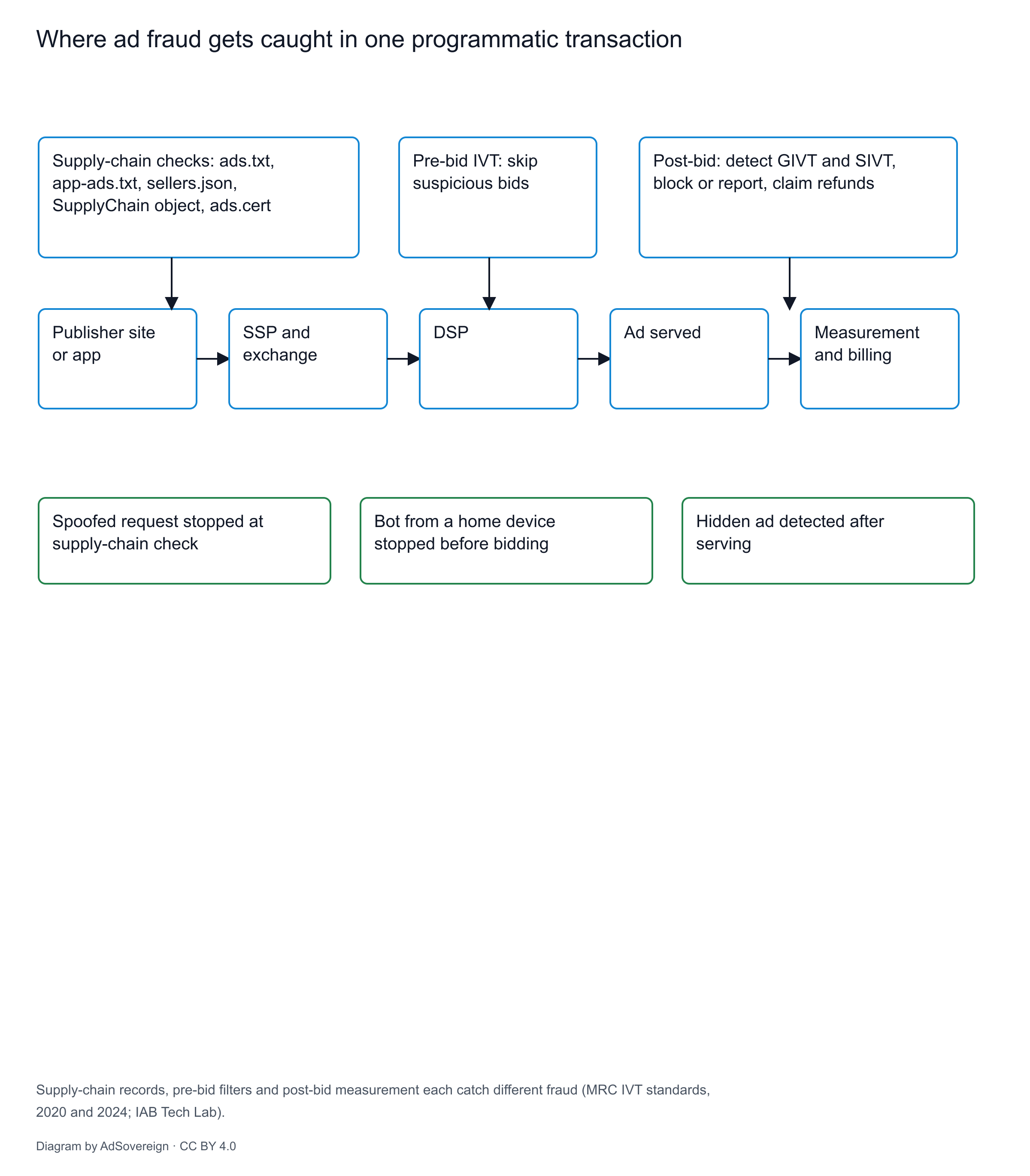
Pre-bid: avoid the impression
Pre-bid tools run inside the buyer's demand-side platform (DSP) or the seller's supply-side platform (SSP). They score each impression before anyone bids and skip the ones that look invalid. This is the cheapest protection because you never pay for the bad impression. DoubleVerify's annual report shows how central DSPs are: two programmatic partner platforms collected about 24% and 12% of its 2025 revenue on behalf of advertisers (DoubleVerify 10-K, FY2025).
The MRC accredits pre-bid IVT detection as its own category. On 9 November 2026 it listed DoubleVerify and HUMAN for desktop, mobile web, in-app and CTV. It listed IAS for desktop, mobile web and in-app, limited to segments based on internet (IP) addresses and browser user agents, plus a fraud IP list (MRC accredited digital services). Pixalate's pre-bid data feeds and fraud application programming interface (API) were under audit (MRC services under review).
Post-bid: measure, block and recover
Post-bid tools run with the ad itself, through a measurement tag or a server-to-server feed. They see what actually happened: where the ad loaded, whether it was visible, how the device behaved. That makes them better at catching hidden ads, faked events and new bot patterns. They can block the creative from rendering on a flagged page and produce the reports that refunds and makegoods depend on. Speed of updates matters here. DoubleVerify says it pushes new fraud signatures to its serving systems and partners nearly 100 times a day (company claim) (DoubleVerify 10-K, FY2025).
Supply-chain checks: who is allowed to sell
The IAB Tech Lab, the standards arm of the Interactive Advertising Bureau, built three public records against spoofing. Each one answers a different question.
- ads.txt lets a publisher list, in a text file on its own domain, every company authorised to sell its ad space. The IAB Tech Lab launched it on 17 May 2017 (IAB Tech Lab, 17 May 2017). app-ads.txt does the same for apps and CTV apps.
- sellers.json lets each SSP or exchange publish who its sellers are, and the SupplyChain object lists every company that touched a bid request. Both were finalised on 31 July 2019 (IAB Tech Lab, accessed 9 November 2026).
- ads.cert adds cryptographic signatures, so a receiver can confirm which company sent a server-to-server request. Version 2.0, called Authenticated Connections, is ready for adoption (IAB Tech Lab, accessed 9 November 2026).
Here is a worked check. A bid request says it comes from a news site through an SSP with seller ID 1234. You open the site's ads.txt and look for that SSP and that ID. Then you open the SSP's sellers.json and confirm that ID 1234 belongs to the news site's owner. If either record is missing or names someone else, the request is suspect. Our free ads.txt and sellers.json validator runs these lookups, and our engineering page on the SupplyChain object, ads.txt and sellers.json shows the fields.
These records stop lies about who is selling. They do not stop a bot from visiting a real, authorised site. That is why supply-chain checks sit next to pre-bid and post-bid detection rather than replacing them.
What MRC accreditation tells you, and what it does not
MRC accreditation means an independent auditor checked the vendor's methods, controls and disclosures against the MRC's standards. It is granted per metric and per environment: desktop, mobile web, mobile in-app and CTV. Vendors renew it each year through audits (DoubleVerify 10-K, FY2025).
It does not mean the vendor catches all fraud, or that two accredited vendors will report the same IVT rate. Methods differ, and so does coverage. Adloox's SIVT accreditation covers desktop and mobile web; Pixalate's and Protected Media's also cover in-app and CTV (MRC accredited digital services). Always read the scope notes in the accreditation letter.
The big platforms hold accreditation for their own numbers too. The MRC lists SIVT accreditation for Google Ads, Google DV360, Google Campaign Manager 360, Meta's Facebook and Instagram ads, Microsoft Advertising and Amazon Ads Sponsored Products (MRC accredited digital services). That covers the platform's own reporting. Many buyers still add an independent vendor so that one company is not grading its own homework.
Two other credentials appear in vendor pitches. The Trustworthy Accountability Group (TAG) runs a Certified Against Fraud programme; DoubleVerify says it has held the seal every year since the programme began in 2016 (DoubleVerify, accessed 9 November 2026). In Japan, the Japan Joint Industry Committee for Digital Advertising Quality (JICDAQ) certifies against fraud, and DoubleVerify and Spider AF both display it.
Ad fraud detection companies compared
The table covers 11 companies whose main products detect invalid traffic or click fraud. Six hold MRC accreditation for sophisticated IVT. Five sell to performance marketers or platforms and do not appear on the MRC list. Every cell comes from the company's own pages, its filings or the MRC's accredited services list, as checked on 9 November 2026. "Not listed" means the company did not appear on the MRC's accredited digital list that day.
11 of 11 rows
DoubleVerify | Verification and performance platform: fraud, brand suitability, viewability, attention | Public (NYSE: DV); 2025 revenue $748.3M; 2,500+ customers (10-K) | Desktop, mobile web, in-app, CTV (MRC) | Desktop, mobile web, in-app, CTV | PepsiCo Philippines (DV, 12 Aug 2026); Roku, fraud research partner (DV, 13 Jul 2023) |
Integral Ad Science (IAS) | Media quality measurement and optimisation: IVT, brand safety, viewability | Desktop, mobile web, in-app, CTV (MRC) | Desktop, mobile web, in-app (IP and user-agent segments) | TikTok Pangle, IVT and brand safety measurement (IAS, 28 Oct 2025) | |
HUMAN Security | Protection against bots, fraud and abuse for advertising and enterprises; 20 trillion+ interactions a week (company claim) (PR Newswire, 25 Jan 2024) | n/d | Desktop, mobile web, in-app, CTV, for back-end detection and IVT predictions (MRC) | Desktop, mobile web, in-app, CTV | Named as SIVT provider in Walmart Connect's MRC audit, in process (MRC) |
Pixalate | Fraud, privacy and compliance analytics for CTV, apps and websites; says it detects 46+ IVT types (Pixalate) | n/d | Desktop, mobile web, in-app, CTV (MRC) | Under audit since 9/2025 (MRC) | Yahoo, Criteo, LinkedIn quoted on its homepage (Pixalate) |
Protected by Mediaocean (Protected Media) | Ad verification: IVT, viewability, attention (Protected) | Part of Mediaocean; deal date n/d | Desktop, mobile web, in-app, CTV (MRC) | Not listed | Adobe, Bayer, Onetag logos on its site (Protected) |
Adloox | Ad verification and insights | Acquired by Peer39 from Scope3, reported 2 Jun 2026 (PPC Land, 2 June 2026) | Desktop, mobile web (MRC) | Not listed | n/d |
CHEQ | Traffic and identity security: bots, AI agents, fake leads, paid media protection (CHEQ) | n/d; says 15,000+ companies use it (company claim) | Not listed | Not listed | Dell Technologies, Paycor logos on its site (CHEQ) |
Fraudlogix | IP risk scoring, bot and click fraud detection, live IP blocklists; founded 2010 (Fraudlogix) | Founder-led since 2010 (Fraudlogix) | Not listed | Not listed | Dentsu, Comcast, Publicis Groupe, ZoomInfo named on its site (Fraudlogix) |
TrafficGuard | Click and install fraud protection for search, Performance Max, social, affiliate and app campaigns (TrafficGuard) | n/d | Not listed | Not listed | Tabcorp logo; Lottomart case study (TrafficGuard) |
Anura | Ad fraud detection for web, lead generation and affiliate traffic; advertises a 99.999% accuracy guarantee (company claim) (Anura) | n/d | Not listed | Not listed | MGID, QuinStreet, EverQuote logos (Anura) |
Spider AF | Click, lead and affiliate fraud prevention; shows JICDAQ certification (Spider AF) | n/d | Not listed | Not listed | n/d |
DoubleVerify
- What it does (company description)
Verification and performance platform: fraud, brand suitability, viewability, attention
- Ownership and scale
Public (NYSE: DV); 2025 revenue $748.3M; 2,500+ customers (10-K)
- MRC SIVT accreditation
Desktop, mobile web, in-app, CTV (MRC)
- MRC pre-bid IVT accreditation
Desktop, mobile web, in-app, CTV
Integral Ad Science (IAS)
- What it does (company description)
Media quality measurement and optimisation: IVT, brand safety, viewability
- Ownership and scale
Private; Novacap deal at about $1.9B announced 24 Sep 2025 (IAS); closed 23 Dec 2025 (IAS 8-K)
- MRC SIVT accreditation
Desktop, mobile web, in-app, CTV (MRC)
- MRC pre-bid IVT accreditation
Desktop, mobile web, in-app (IP and user-agent segments)
HUMAN Security
- What it does (company description)
Protection against bots, fraud and abuse for advertising and enterprises; 20 trillion+ interactions a week (company claim) (PR Newswire, 25 Jan 2024)
- Ownership and scale
n/d
- MRC SIVT accreditation
Desktop, mobile web, in-app, CTV, for back-end detection and IVT predictions (MRC)
- MRC pre-bid IVT accreditation
Desktop, mobile web, in-app, CTV
Pixalate
Protected by Mediaocean (Protected Media)
Adloox
- What it does (company description)
Ad verification and insights
- Ownership and scale
Acquired by Peer39 from Scope3, reported 2 Jun 2026 (PPC Land, 2 June 2026)
- MRC SIVT accreditation
Desktop, mobile web (MRC)
- MRC pre-bid IVT accreditation
Not listed
CHEQ
- What it does (company description)
Traffic and identity security: bots, AI agents, fake leads, paid media protection (CHEQ)
- Ownership and scale
n/d; says 15,000+ companies use it (company claim)
- MRC SIVT accreditation
Not listed
- MRC pre-bid IVT accreditation
Not listed
Fraudlogix
- What it does (company description)
IP risk scoring, bot and click fraud detection, live IP blocklists; founded 2010 (Fraudlogix)
- Ownership and scale
Founder-led since 2010 (Fraudlogix)
- MRC SIVT accreditation
Not listed
- MRC pre-bid IVT accreditation
Not listed
TrafficGuard
- What it does (company description)
Click and install fraud protection for search, Performance Max, social, affiliate and app campaigns (TrafficGuard)
- Ownership and scale
n/d
- MRC SIVT accreditation
Not listed
- MRC pre-bid IVT accreditation
Not listed
Anura
- What it does (company description)
Ad fraud detection for web, lead generation and affiliate traffic; advertises a 99.999% accuracy guarantee (company claim) (Anura)
- Ownership and scale
n/d
- MRC SIVT accreditation
Not listed
- MRC pre-bid IVT accreditation
Not listed
Spider AF
- What it does (company description)
Click, lead and affiliate fraud prevention; shows JICDAQ certification (Spider AF)
- Ownership and scale
n/d
- MRC SIVT accreditation
Not listed
- MRC pre-bid IVT accreditation
Not listed
Table by AdSovereign, CC BY 4.0.
Three things stand out. First, the accredited group is small: six third-party names, most of them accredited for all four screen types. Second, accreditation scope differs more than marketing suggests, especially for pre-bid and CTV. Third, the click-fraud tools solve a different problem. They protect search, social and lead-generation budgets from fake clicks and form fills, where the advertiser owns the landing page and can inspect each visit directly.
Which ad fraud detection software fits which buyer
The right tool depends on where you spend and what you control:
- A brand buying programmatic display, video and CTV needs an accredited verification vendor with pre-bid filters in its DSP and post-bid measurement with CTV coverage. Check the accreditation letter for each screen you buy.
- A performance marketer on search and social gets more from a click-fraud tool that watches the landing page, blocks bad sources and feeds exclusions back to the ad platforms.
- A publisher or SSP screens supply before it reaches buyers, using pre-bid IVT scoring and IP reputation, so that buyers do not discount or refuse its inventory.
- A retail media network needs IVT filtering inside its own measurement. Walmart Connect's onsite display audit, in process at the MRC, includes SIVT filtering performed by HUMAN (MRC services under review).
Whatever you choose, keep your own records. Log-level data from your DSP or SSP lets you check a vendor's IVT rate against your own view of the same impressions. Our guide to log-level data explains what to request.
Ad fraud prevention checklist
Use these eight steps as a starting point for a programmatic buy. Each one closes a gap that the others leave open.
- Buy only from authorised sellers. Reject impressions whose seller is not in the publisher's ads.txt or app-ads.txt.
- Require a complete SupplyChain object. Check each node against sellers.json and prefer the shortest paths.
- Turn on pre-bid IVT filtering in your DSP, with a vendor accredited for the screens you buy.
- Measure post-bid with an independent vendor and compare its IVT rate with your platform's own figure.
- Write refunds into contracts. Agree in advance how SIVT that is found after delivery will be credited.
- In CTV, ask how devices are verified. Look for device signals such as watermarks, consistent bundle IDs and SSAI headers that are passed on intact.
- Treat MFA separately from fraud. Use inclusion lists or curated deals to avoid cluttered sites that pass IVT checks.
- Review the numbers monthly. Track IVT rate by seller, app and supply path, and cut paths that stay above your threshold.
Fraud is one part of the gap between what you pay and what reaches real people. Our working media benchmark puts it next to fees and other losses, and the RTB architecture hub collects the rest of the plumbing.
Where to go next
- Made-for-advertising sites: how exchanges detect MFA and why it is not IVT.
- SupplyChain object, ads.txt and sellers.json together: the fields behind the supply-chain checks.
- ads.txt and sellers.json validator: run the authorisation check on any domain.
- Viewability, attention metrics and brand safety: the other half of media quality.
- CTV measurement companies compared: who measures streaming TV and how.
FAQ
What is the best ad fraud detection tool?
What is the difference between GIVT and SIVT?
How much money is lost to ad fraud?
Is MFA ad fraud?
Which ad fraud detection companies are MRC accredited?
Does ads.txt stop ad fraud?
How this works on owned infrastructure
The decision on this page is where fraud checks run and who keeps the evidence. In a rented stack, the SSP, the DSP and the verification vendor each apply their own filters, and you see their summaries. When the exchange and bidder run on infrastructure you control, you can apply pre-bid rules, such as ads.txt and sellers.json checks or vendor IVT scores, before a bid leaves your system. You also keep the raw logs that let you test any vendor's IVT rate against your own data. AdSovereign is an enterprise real-time bidding stack designed to run those filters and keep those logs inside the operator's own environment, alongside independent verification vendors rather than instead of them. The security page describes the controls, and the architecture page shows where the filters sit.
Sources
- Media Rating Council, "Invalid Traffic Detection and Filtration Standards Addendum, Update (Final)" (June 2020). https://mediaratingcouncil.org/sites/default/files/Standards/IVT%20Addendum%20Update%20062520.pdf
- Media Rating Council, "2024 IVT Interim Updates" memo (originally authored January 2024, published final 24 April 2024). https://mediaratingcouncil.org/sites/default/files/Standards/2024_IVT_Interim_Updates_FINAL.pdf
- Media Rating Council, accredited digital services (accessed 9 November 2026). https://mediaratingcouncil.org/accreditation/digital
- Media Rating Council, digital services under review (accessed 9 November 2026). https://mediaratingcouncil.org/accreditation/services-under-review/digital
- DoubleVerify Holdings, Inc., Form 10-K for fiscal year 2025 (filed 26 February 2026). https://www.sec.gov/Archives/edgar/data/1819928/000110465926020499/dv-20251231x10k.htm
- DoubleVerify, "DV Fraud Verification" product page (accessed 9 November 2026). https://doubleverify.com/products/advertisers/verify/fraud
- DoubleVerify, "DoubleVerify Unmasks CTV Ad Fraud Scheme CycloneBot" (28 February 2024). https://doubleverify.com/newsroom/doubleverify-unmasks-ctv-ad-fraud-scheme-cyclonebot/
- DoubleVerify, "After Stopping SmokeScreen, DoubleVerify and Roku to Continue Joint Investigations into Ad Fraud Schemes in Streaming" (13 July 2023). https://doubleverify.com/newsroom/after-stopping-smokescreen-doubleverify-and-roku-to-continue-joint-investigations-into-ad-fraud-schemes-in-streaming/
- DoubleVerify, "DoubleVerify Strengthens PepsiCo Philippines' Brand Suitability on TikTok with Pre-Bid Controls" (12 August 2026). https://doubleverify.com/company/newsroom/doubleverify-strengthens-pepsico-philippines-brand-suitability-on-tiktok-with-pre-bid-controls
- Integral Ad Science, "IAS to be Acquired by Novacap for $1.9 Billion" (24 September 2025). https://integralads.com/news/ias-to-be-acquired-by-novacap-for-1-9-billion-to-further-support-its-strategic-goals/
More sources (18)
- Integral Ad Science, "Bob Lord and Krishan Bhatia Join IAS Board of Directors" (28 January 2026). https://integralads.com/news/bob-lord-and-krishan-bhatia-join-ias-new-board-of-directors/
- Integral Ad Science, TikTok Pangle brand safety, viewability and IVT measurement (28 October 2025). https://integralads.com/news/tiktok-selects-ias-for-brand-safety-measurement-for-tiktok-pangle-advertisers/
- Integral Ad Science, "IAS's 21st Media Quality Report" (9 July 2026). https://integralads.com/news/ias-21st-media-quality-report/
- PR Newswire, "HUMAN Security Announces Strategic Leadership Transition" (25 January 2024). https://www.prnewswire.com/news-releases/human-security-announces-strategic-leadership-transition-tamer-hassan-to-become-executive-chairman-stu-solomon-appointed-to-ceo-302045046.html
- Federal Bureau of Investigation, Internet Crime Complaint Center, public service announcement I-060525-PSA on BADBOX 2.0 (5 June 2025). https://www.ic3.gov/PSA/2025/PSA250605
- IAB Tech Lab, "IAB Tech Lab Launches Assault on Illicit Advertising Inventory" (ads.txt launch, 17 May 2017). https://iabtechlab.com/press-releases/iab-tech-lab-launches-assault-on-illicit-advertising-inventory/
- IAB Tech Lab, "sellers.json and the SupplyChain object" (finalised 31 July 2019; accessed 9 November 2026). https://iabtechlab.com/sellers-json/
- IAB Tech Lab, "ads.cert" (accessed 9 November 2026). https://iabtechlab.com/ads-cert/
- Pixalate, company website (accessed 9 November 2026). https://www.pixalate.com/
- Protected by Mediaocean, company website (accessed 9 November 2026). https://www.protected.media/
- CHEQ, company website and About page (accessed 9 November 2026). https://cheq.ai/about-us/
- Fraudlogix, company website and About page (accessed 9 November 2026). https://www.fraudlogix.com/about/
- TrafficGuard, company website (accessed 9 November 2026). https://www.trafficguard.ai/
- Anura, company website (accessed 9 November 2026). https://www.anura.io/
- Spider AF, company website (accessed 9 November 2026). https://spideraf.com/
- Integral Ad Science Holding Corp., Form 8-K (23 December 2025). https://www.sec.gov/Archives/edgar/data/1842718/000114036125046475/ef20061707_8k.htm
- DoubleVerify Holdings, Inc., Form 8-K, Exhibit 99.1, "Nielsen to Acquire DoubleVerify" (6 August 2026). https://www.sec.gov/Archives/edgar/data/1819928/000110465926092121/tm2621904d1_ex99-1.htm
- PPC Land, "Peer39 snaps up Adloox from Scope3 to challenge DoubleVerify and IAS" (2 June 2026). https://ppc.land/peer39-snaps-up-adloox-from-scope3-to-challenge-doubleverify-and-ias/
Changelog
- 9 November 2026: first draft. MRC accredited and under-review lists, vendor ownership and every company description checked on this date.