
RTB Architecture
FAST Channels Advertising: Platforms, Inventory, Ad Loads and Revenue Models
Published · Last updated
Next scheduled review:
FAST channels advertising means buying the ad breaks on free ad-supported streaming TV channels: scheduled, linear streams on smart TVs and apps such as Samsung TV Plus, The Roku Channel, Pluto TV and Tubi. A server stitches the ads into the stream. Most breaks sell through programmatic deals, and the platform and the channel owner split the money.
Contents
Key facts
- Two of the largest FAST services now share an owner. Fox Corporation completed its acquisition of Roku on 6 November 2026, putting Tubi and The Roku Channel in one new division (Fox, 6 November 2026).
- FAST services hold real TV time. The Roku Channel took 2.9% of all US TV viewing in August 2026 in Nielsen's Media Distributor Gauge (Nielsen, accessed 9 November 2026). Tubi averaged about 2.2% over Fox's fiscal year to June 2026 (Fox 10-K, FY2026).
- The biggest TV-maker service is global. Samsung says Samsung TV Plus passed 100 million monthly active users and carries about 4,300 channels in 30 countries (company claim) (Samsung, 13 February 2026).
- Ad loads run at about half of cable. Roku says The Roku Channel runs about 8 minutes of ads an hour, against 14 to 16 minutes on linear cable (company claim) (Roku, 16 July 2026).
- Most breaks sell through software. More than 80% of Roku's in-stream video ad impressions were delivered programmatically in Q3 2026 (Roku shareholder letter, 2 November 2026).
Definition
FAST channel advertising: the sale of video ad slots inside scheduled, free-to-view internet TV channels, where the distributing platform and the channel's content owner divide the ad inventory or its revenue under a carriage agreement.
Key terms on this page: FAST channel · connected TV (CTV) · server-side ad insertion (SSAI) · pod bidding · VAST · ACR data · deal ID · private marketplace (PMP) · app-ads.txt · household graph
What FAST channels are, and how they differ from AVOD and cable
FAST stands for free ad-supported streaming television. Roku's own filing defines it as free, ad-supported linear streaming that excludes on-demand content (Roku 10-Q, Q3 2026). The viewer opens a guide, picks a channel and joins whatever is playing. Nobody chooses an episode or pays a fee.
That makes FAST the streaming version of a cable channel. AVOD, or ad-supported video on demand, is different: the viewer picks a title from a library and ads play around it. Most services now mix the two. Tubi offers more than 340 linear channels next to a library of over 350,000 movies and episodes (Fox 10-K, FY2026). The Roku Channel carries 550+ live linear channels in the US and more than 80,000 free titles (company figures) (Roku, 16 July 2026).
For a buyer, the difference matters in two places. Linear breaks arrive on a schedule, so supply spikes at fixed times and many viewers see the same break together. And many channels are built around one show or brand. Roku's Q3 2026 letter, for example, mentions a Law & Order FAST channel recently added by NBCUniversal (Roku, 2 November 2026). Channel-level targeting therefore works much like buying a TV network. The connected TV (CTV) device is the same in both cases.
A simple example shows the buy. A home-improvement retailer wants weekend reach among homeowners. It could buy a home-renovation FAST channel by name through a private deal, then add household audience targeting on top. A cable buy would have bought the whole network schedule instead.
FAST channel platforms compared: owners, scale and how to buy
FAST platforms come in three kinds. TV makers build a service into the set, such as Samsung, LG and VIZIO. Operating-system owners do the same on their devices, such as Roku and Amazon. Media companies run their own services that appear on every device, such as Tubi and Pluto TV. The table uses each owner's filings, releases and ad sales pages, checked on 9 November 2026.
7 of 7 rows
Samsung TV Plus | Samsung Electronics; launched 2015 | Samsung TVs, Galaxy phones and other Samsung devices | About 4,300 channels across 30 countries | 100 million monthly active users worldwide (company claim) | Samsung Ads, which says it reaches 3 in 4 US TV households (company claim) |
The Roku Channel | Roku, owned by Fox Corporation since 6 Nov 2026 | Roku devices and Roku TVs; also other platforms | 550+ live linear channels in the US | 2.9% of US TV viewing, August 2026 (Nielsen) | Roku says it integrates with every major DSP and SSP; Amazon Ads and The Trade Desk named |
Tubi | Fox Corporation (Tubi Media Group) | Most streaming platforms, web and mobile, US and select countries | 340+ linear channels, including 100+ local station feeds | About 2.2% of US TV viewing over fiscal 2026; 13 billion+ hours | Tubi's ad sales team; Tubi says it has 110 million+ monthly active users (company claim) |
Pluto TV | Skydance Corporation (formerly Paramount Skydance), which completed its Warner Bros. Discovery merger on 6 Oct 2026 | Smart TVs, streaming devices, consoles, web and mobile | "Hundreds" of live channels; exact count n/d | Measured inside Paramount in the Nielsen Gauge, per Roku | n/d in the sources read |
Fire TV Channels and Prime Video free channels | Amazon; Freevee brand phased out from November 2024 | Fire TV devices; Prime Video app | 900+ channels across 30+ categories on Fire TV Channels | n/d | Amazon's DSP, renamed within Amazon Ads Agent on 29 Sep 2026 |
LG Channels | LG Electronics | LG smart TVs (webOS) | 400+ channels in the US | LG Ad Solutions cites 49 million US and 216 million global LG smart TVs (company claim) | LG Ad Solutions |
VIZIO WatchFree+ | Walmart, which completed its VIZIO purchase on 3 Dec 2024 | VIZIO TVs | 400+ live channels and 45,000+ on-demand titles | VIZIO says its OS reaches 100 million+ people in US households with a VIZIO device (company claim) | VIZIO Ads; Walmart Connect audiences via Yahoo DSP and Magnite in a closed proof of concept (28 May 2026) |
Samsung TV Plus
- Owner (dated)
Samsung Electronics; launched 2015
- Where it runs
Samsung TVs, Galaxy phones and other Samsung devices
- Channels (company figure)
About 4,300 channels across 30 countries
- Scale signal
100 million monthly active users worldwide (company claim)
The Roku Channel
- Owner (dated)
Roku, owned by Fox Corporation since 6 Nov 2026
- Where it runs
Roku devices and Roku TVs; also other platforms
- Channels (company figure)
550+ live linear channels in the US
- Scale signal
2.9% of US TV viewing, August 2026 (Nielsen)
Tubi
- Owner (dated)
Fox Corporation (Tubi Media Group)
- Where it runs
Most streaming platforms, web and mobile, US and select countries
- Channels (company figure)
340+ linear channels, including 100+ local station feeds
- Scale signal
About 2.2% of US TV viewing over fiscal 2026; 13 billion+ hours
Pluto TV
- Owner (dated)
Skydance Corporation (formerly Paramount Skydance), which completed its Warner Bros. Discovery merger on 6 Oct 2026
- Where it runs
Smart TVs, streaming devices, consoles, web and mobile
- Channels (company figure)
"Hundreds" of live channels; exact count n/d
- Scale signal
Measured inside Paramount in the Nielsen Gauge, per Roku
Fire TV Channels and Prime Video free channels
- Owner (dated)
Amazon; Freevee brand phased out from November 2024
- Where it runs
Fire TV devices; Prime Video app
- Channels (company figure)
900+ channels across 30+ categories on Fire TV Channels
- Scale signal
n/d
LG Channels
- Owner (dated)
LG Electronics
- Where it runs
LG smart TVs (webOS)
- Channels (company figure)
400+ channels in the US
- Scale signal
LG Ad Solutions cites 49 million US and 216 million global LG smart TVs (company claim)
VIZIO WatchFree+
- Owner (dated)
Walmart, which completed its VIZIO purchase on 3 Dec 2024
- Where it runs
VIZIO TVs
- Channels (company figure)
400+ live channels and 45,000+ on-demand titles
- Scale signal
VIZIO says its OS reaches 100 million+ people in US households with a VIZIO device (company claim)
Table by AdSovereign, CC BY 4.0.
The figures are not comparable with one another. Samsung counts monthly users worldwide, Nielsen measures share of US TV time, and the channel counts come from each owner's own pages. Use the table to see who owns what and where the door is, not to rank size.
Three changes in 2026 reshaped the ownership column. Fox now owns Tubi and Roku and placed both in a new Fox Digital Platforms division (Fox, 6 November 2026). Pluto TV's parent took over Warner Bros. Discovery and renamed itself Skydance Corporation (Skydance 8-K, 6 October 2026). And Walmart, which owns VIZIO, completed its purchase of the self-serve streaming TV platform Vibe.co on 4 August 2026 (Walmart via Vibe.co, 4 August 2026). For buyers this means fewer sales doors and more first-party data behind each one.
How a FAST ad break gets filled
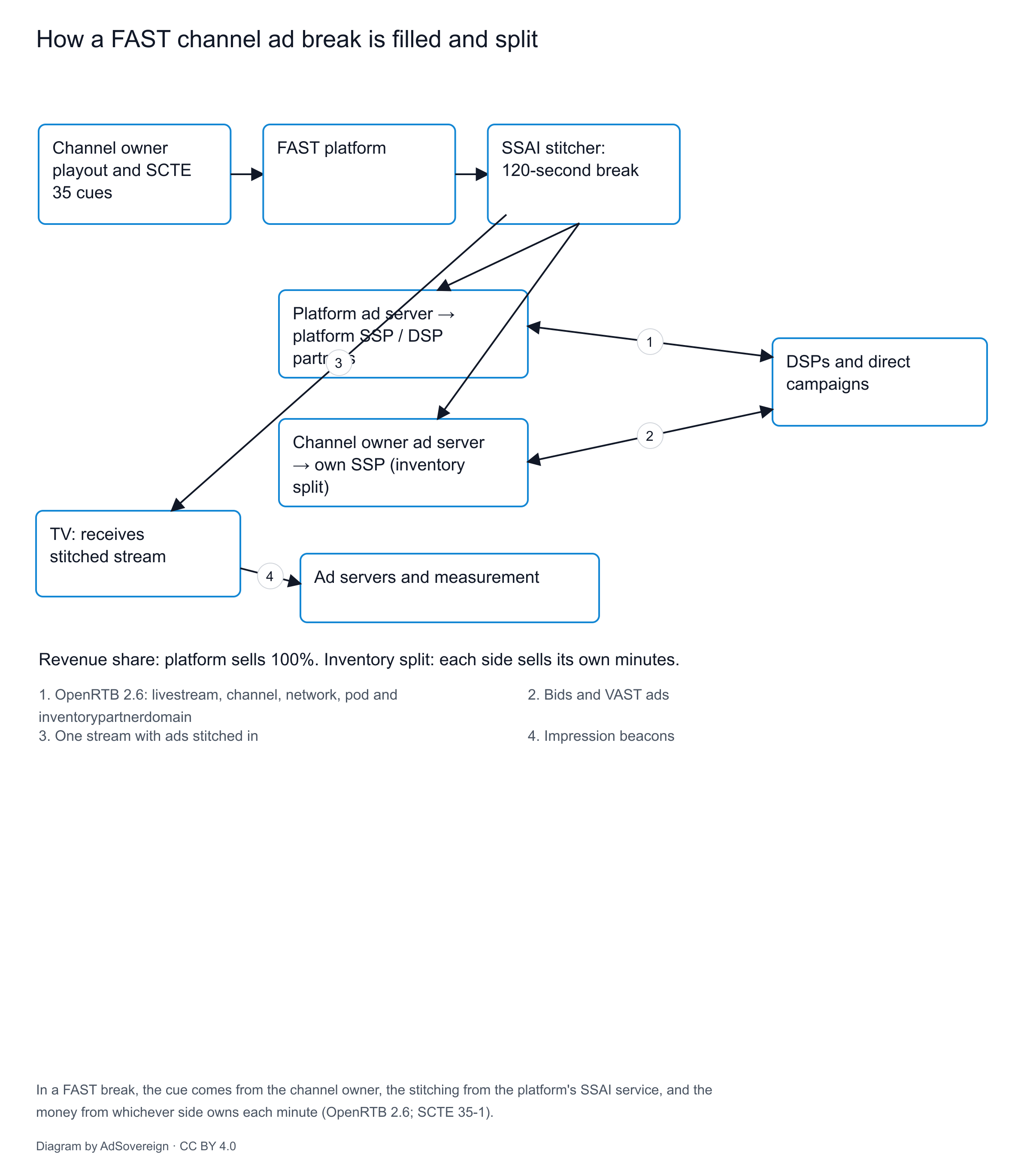
A FAST channel starts as a playout: a scheduled stream assembled from a content library. The channel owner marks each break with a cue. The common format is SCTE 35, which its standards body calls the core signalling standard for advertising breaks (SCTE 35-1 2023r2, accessed 9 November 2026). When a viewer's stream reaches a cue, a server-side ad insertion (SSAI) service asks an ad server what to play and stitches the ads into the video.
- The viewer tunes in. The TV app requests the channel's stream from the platform.
- A cue arrives. The stream signals a break of, say, two minutes.
- The ad server decides. Whoever controls that break, the platform or the channel owner, runs a decision across direct campaigns and programmatic demand.
- Programmatic demand bids. An SSP sends an OpenRTB request describing the pod, the channel and the device to DSPs, which bid for one or more slots.
- The stitcher inserts the ads. Ads arrive as VAST responses, are transcoded to match the stream, and play without a gap.
- Beacons fire. The SSAI service or the player reports impressions back to the ad server and to measurement vendors.
The engineering details of step 5, including how beacons and device data pass through the stitcher, are covered in SSAI and CTV ad serving. Choosing the ad server for step 3 is the subject of our comparison of CTV ad server options.

Diagram by AdSovereign, CC BY 4.0.
What a FAST ad request looks like in OpenRTB 2.6
OpenRTB 2.6 added the fields a FAST break needs. The content.livestream value 1 marks a scheduled broadcast, and new Channel and Network objects name the channel and its parent company (OpenRTB 2.6). Pod fields describe the break, and inventorypartnerdomain tells crawlers which content owner may sell part of an app's supply. The latest release of the specification is 2.6-202606, published on 11 June 2026 (IAB Tech Lab on GitHub).
The example below is an illustrative excerpt for one slot in a two-minute break. Identifiers and domains are placeholders; field names and values follow OpenRTB 2.6 and AdCOM 1.0.
{
  "id": "fast-break-7f3a",
  "imp": [
    {
      "id": "1",
      "video": {
        "mimes": ["video/mp4"],
        "plcmt": 1,
        "podid": "break-2026-11-09-2030",
        "podseq": 0,
        "poddur": 120,
        "maxseq": 4,
        "rqddurs": [15, 30]
      },
      "pmp": {
        "private_auction": 0,
        "deals": [{ "id": "classic-tv-q4", "bidfloor": 18.0, "bidfloorcur": "USD" }]
      }
    }
  ],
  "app": {
    "bundle": "com.example.fastplatform",
    "inventorypartnerdomain": "exampleclassictv.com",
    "content": {
      "livestream": 1,
      "channel": { "id": "ch-114", "name": "Example Classic TV", "domain": "exampleclassictv.com" },
      "network": { "id": "net-9", "name": "Example Media Group", "domain": "examplemedia.com" }
    }
  },
  "device": { "devicetype": 3 }
}
6 of 6 rows
| The content is scheduled, linear viewing rather than on demand (OpenRTB 2.6) |
| The channel being watched and the company that owns or licenses it, so a buyer can target or block by channel |
| This slot belongs to a 120-second dynamic pod that holds at most four ads (OpenRTB implementation notes, 7.6) |
| Only 15- or 30-second ads fit; the spec created this field for live TV, where an inexact length leaves dead air |
| The content owner whose own ads.txt authorises its sellers, used in inventory-sharing deals (OpenRTB 2.6) |
| A connected TV, per AdCOM's device list (AdCOM 1.0) |
content.livestream: 1
- What it tells the buyer
The content is scheduled, linear viewing rather than on demand (OpenRTB 2.6)
content.channel, content.network
- What it tells the buyer
The channel being watched and the company that owns or licenses it, so a buyer can target or block by channel
video.podid, poddur, maxseq
- What it tells the buyer
This slot belongs to a 120-second dynamic pod that holds at most four ads (OpenRTB implementation notes, 7.6)
video.rqddurs
- What it tells the buyer
Only 15- or 30-second ads fit; the spec created this field for live TV, where an inexact length leaves dead air
app.inventorypartnerdomain
- What it tells the buyer
The content owner whose own ads.txt authorises its sellers, used in inventory-sharing deals (OpenRTB 2.6)
device.devicetype: 3
- What it tells the buyer
A connected TV, per AdCOM's device list (AdCOM 1.0)
Table by AdSovereign, CC BY 4.0.
The Channel and Network objects are optional in the specification, so ask each SSP which fields it populates. The planned OpenRTB bid request builder will include a CTV template, and OpenRTB 2.6 explained walks through the rest of the request.
FAST channel ads: how many minutes per hour
FAST services advertise lighter breaks than cable, and that promise is part of the pitch to viewers. There is no audited, cross-platform ad-load figure. What exists are company statements and vendor compilations, so the table labels each by type.
5 of 5 rows
The Roku Channel | About 8 | Company statement | |
US linear cable, for comparison | 14 to 16 | Company statement (Roku) | |
Samsung TV Plus (US) | 6 to 8 | Vendor compilation (broadpeak.io, an SSAI provider) | |
Xumo (US) | 7 to 10 | Vendor compilation | |
Tubi (US) | 4 to 6, a break every 12 to 15 minutes, 3 to 5 ads per pod | Vendor compilation |
The Roku Channel
- Ad minutes per hour
About 8
- Type of source
Company statement
- Source and date
US linear cable, for comparison
- Ad minutes per hour
14 to 16
- Type of source
Company statement (Roku)
- Source and date
Samsung TV Plus (US)
- Ad minutes per hour
6 to 8
- Type of source
Vendor compilation (broadpeak.io, an SSAI provider)
- Source and date
Xumo (US)
- Ad minutes per hour
7 to 10
- Type of source
Vendor compilation
- Source and date
Tubi (US)
- Ad minutes per hour
4 to 6, a break every 12 to 15 minutes, 3 to 5 ads per pod
- Type of source
Vendor compilation
- Source and date
Table by AdSovereign, CC BY 4.0.
Two cautions apply. The vendor figures date from August 2023 and may have moved since. And a stated load describes the size of the break, not how many paid ads actually ran in it. Buyers who care about clutter should ask for the average pod length and ad count actually delivered on the channels in their plan.
Why does ad load matter to a buyer? A shorter pod means each ad has fewer neighbours, which can help recall. It also means fewer slots to sell, so platforms with lighter loads need higher prices or more viewing hours to earn the same revenue.
FAST channel ad revenue: revenue share vs inventory split
Every FAST channel runs under a carriage agreement between the content owner and the platform. The ad money is divided in one of two ways. Amagi, a FAST technology vendor that runs a marketplace for these deals, calls both "industry-standard" models (Amagi, accessed 9 November 2026).
2 of 2 rows
Revenue share | The platform (or a vendor such as Amagi) sells the whole break and pays the channel owner a percentage | Mostly the platform | Content owners without an ad sales team or with channels in many countries |
Inventory split | Each side gets a share of the ad minutes and sells its own share | Each side sees its own share; the platform still sees more | Broadcasters and large media owners with their own sales and ad servers |
Revenue share
- Who sells the ads
The platform (or a vendor such as Amagi) sells the whole break and pays the channel owner a percentage
- Who gets the data
Mostly the platform
- Suits
Content owners without an ad sales team or with channels in many countries
Inventory split
- Who sells the ads
Each side gets a share of the ad minutes and sells its own share
- Who gets the data
Each side sees its own share; the platform still sees more
- Suits
Broadcasters and large media owners with their own sales and ad servers
Table by AdSovereign, CC BY 4.0.
Public filings show the inventory side of the bargain. Roku says its ad inventory includes video inventory in The Roku Channel and ad inventory it obtains as consideration from distribution agreements with content partners (Roku 10-Q, Q3 2026). In plain terms, apps and channels that want carriage give the platform some of their ad minutes. The percentages in individual deals are not disclosed.
Inventory splits also need supply-chain plumbing. When a content owner sells minutes inside a platform's app, the app's ads.txt file lists the content owner as an inventory partner, and the content owner publishes its own authorised sellers. OpenRTB 2.6 carries that domain in inventorypartnerdomain and points to ads.txt 1.1 for the rules (OpenRTB 2.6). Our guide to the SupplyChain object, ads.txt and sellers.json shows how buyers check those files.
A worked example. Take a classic-TV channel with 50,000 viewing hours a month on one platform. At the 8 ad minutes an hour that Roku reports for its channel, those hours hold 400,000 ad minutes, or 800,000 thirty-second slots (Roku, 16 July 2026). Every other number below is illustrative.
- Revenue share. The platform fills 60% of the slots at a $12 CPM. That is 480,000 impressions and $5,760 of revenue. At a 50% share, the channel owner receives $2,880.
- Inventory split. The channel owner keeps 2 of the 8 minutes, or 200,000 slots, and sells them itself. To match $2,880, it must earn $14.40 per thousand slots, for example 80% fill at an $18 CPM.
The arithmetic explains the market's habits. A broadcaster with strong direct sales can beat a revenue share on its own minutes. A small library owner usually cannot fill its slots at that rate, so it takes the share and the platform's sales team. The broadpeak.io analysis adds a data point: channels push for inventory deals partly to see more about their own audience (broadpeak.io, 18 August 2023).
How buyers reach FAST channels programmatically
There are four main doors, and most large buyers use more than one.
- The platform's own sales and DSP. Amazon sells Fire TV Channels through its DSP. On 29 September 2026 it folded the DSP into Amazon Ads Agent, where programmatic campaigns are now called DVA+ (Amazon Ads, accessed 9 November 2026; PPC Land, 29 October 2026). Our Amazon DSP profile covers the buying side.
- Open DSP integrations. Roku says it integrates with every major DSP and SSP and planned to expand its DV360 integration in the coming months (company statement) (Roku shareholder letter, 2 November 2026).
- Retail data on TV supply. Walmart Connect opened VIZIO inventory to its audiences through Yahoo DSP, using Magnite's supply-side technology, in a closed proof of concept announced on 28 May 2026 (Walmart Connect, 28 May 2026). The Walmart Connect profile tracks that programme.
- Channel owners' own supply. Under an inventory split, the content owner sells its minutes through its own ad server and SSP. Buyers reach these through deals with the network, often across several platforms at once.
A deal ID lets a buyer agree a price and a channel list in advance, then bid in real time. The differences between a private marketplace (PMP), a preferred deal and programmatic guaranteed are set out in programmatic guaranteed vs PMP.
Self-serve tools are spreading too. Walmart describes Vibe.co, which it now owns, as a self-service platform that has helped thousands of businesses buy connected TV (Walmart via Vibe.co, 4 August 2026). For a small brand, that is often the first route into FAST breaks.
Before buying, check the supply path. The same channel can appear on several platforms, each with its own sellers: Amagi alone lists 400+ channels and 50+ platforms in its marketplace (company figure) (Amagi, accessed 9 November 2026). Confirm the app in app-ads.txt, the seller in sellers.json and the channel name in the bid request. If the channel fields are empty, ask the seller why.
Measuring FAST: what buyers can see and what they cannot
At platform level, measurement is maturing. Nielsen reports The Roku Channel separately in its Media Distributor Gauge, while Pluto TV sits inside Paramount's total (Nielsen, accessed 9 November 2026; Roku, 16 July 2026). Nielsen notes that the Gauge does not reflect its currency TV ratings.
TV makers add their own data. VIZIO says its Inscape ACR data comes from more than 28 million opt-in devices (company claim) (VIZIO Ads, accessed 9 November 2026). LG Ad Solutions and Samsung Ads both sell deterministic data from their sets (company descriptions) (LG Ad Solutions; Samsung Ads). That data can build a household graph for targeting and for matching exposure to outcomes.
The weak point is the channel. Because the channel and network fields are optional, a bid request can arrive without them. A buyer may know it reached a household on Samsung TV Plus without knowing which channel ran the ad. Our comparison of CTV measurement companies covers the vendors that verify CTV delivery and audiences.
A buyer's checklist for FAST channels advertising
- List channels, not just platforms. Ask each seller for a channel list with genres and the share of your impressions each channel delivered.
- Ask who sells each minute. Find out whether the platform or the channel owner holds the inventory you are buying, so you know whose data and rules apply.
- Check pod length and position. Ask for average ads per pod and whether first-in-pod positions can be bought.
- Insist on channel fields. Require
content.channelandcontent.networkin bid requests, or channel-level reporting in direct deals. - Confirm authorisation. Check app-ads.txt, sellers.json and any inventory partner domain before scaling spend.
- Plan frequency across services. The same channel often runs on several FAST platforms, so cap frequency at household level.
- Measure outcomes. Use ACR or retailer data where offered, and hold out a control group before judging results.
Where to go next
- SSAI and CTV ad serving: how stitching, beacons and pod bidding work under the hood.
- Independent CTV ad server options compared: the ad servers that decide what fills a FAST break.
- CTV measurement companies compared: verification and audience measurement for streaming TV.
- Programmatic guaranteed vs PMP: the deal types most FAST supply trades on.
- RTB architecture hub: the rest of the programmatic plumbing.
FAQ
What are FAST channels in advertising?
How many ads per hour run on FAST channels?
How much ad revenue does a FAST channel make?
What is the difference between revenue share and inventory split?
Can you buy FAST channels programmatically?
Which FAST platform is the biggest?
How this works on owned infrastructure
The choice this page turns on is who sells each minute of a FAST break, and who keeps the record of what ran. A channel owner on an inventory split, or a platform selling its own share, needs an ad decision service, connections to SSPs and DSPs, and impression logs it can reconcile against the stitcher's beacons. Renting that layer often means the logs and the auction rules sit with the vendor. AdSovereign is an enterprise real-time bidding stack designed to run the decisioning and exchange layer inside the operator's own cloud or data centre, next to the SSAI service it already uses. Channel and pod signals stay in the operator's logs. The integrations page lists the supported connection points, and the pilot page explains how a first channel can be tested.
Sources
- Fox Corporation, Form 8-K, exhibit 99.1, "FOX Corporation Completes Acquisition of Roku" (6 November 2026). https://www.sec.gov/Archives/edgar/data/1754301/000119312526451888/d141597dex991.htm
- Roku, Inc., Form 8-K on completion of the merger with Fox Corporation (6 November 2026). https://www.sec.gov/Archives/edgar/data/1428439/000119312526451874/d181620d8k.htm
- Roku, Inc., Q3 2026 Shareholder Letter, Form 8-K exhibit 99.1 (2 November 2026). https://www.sec.gov/Archives/edgar/data/1428439/000162828026068877/a04fy2026q3exhibit991.htm
- Roku, Inc., Form 10-Q for the quarter ended 30 September 2026 (2 November 2026). https://www.sec.gov/Archives/edgar/data/1428439/000162828026068887/roku-20260930.htm
- Roku Advertising, "Everything advertisers want to know about FAST TV, answered" (16 July 2026). https://advertising.roku.com/learn/resources/everything-advertisers-want-to-know-about-fast-tv-answered
- Fox Corporation, Form 10-K for fiscal year ended 30 June 2026 (6 August 2026). https://www.sec.gov/Archives/edgar/data/1754301/000162828026053960/fox-20260630.htm
- Tubi, corporate site "Advertise With Us" (accessed 9 November 2026). https://corporate.tubitv.com/
- Nielsen, The Gauge and Media Distributor Gauge, August 2026 data (accessed 9 November 2026). https://www.nielsen.com/data-center/the-gauge/
- Samsung Electronics, "From Hardware Roots to Global Media Platform: How Samsung TV Plus Reached 100 Million Users" (13 February 2026). https://news.samsung.com/global/from-hardware-roots-to-global-media-platform-how-samsung-tv-plus-reached-100-million-users
- Samsung Ads, US home page (accessed 9 November 2026). https://www.samsung.com/us/business/samsungads/
More sources (20)
- Paramount Skydance Corporation, Form 10-K for fiscal year 2025 (25 February 2026). https://www.sec.gov/Archives/edgar/data/2041610/000204161026000011/psky-20251231.htm
- Skydance Corporation (formerly Paramount Skydance Corporation), Form 8-K on completion of the Warner Bros. Discovery merger (6 October 2026). https://www.sec.gov/Archives/edgar/data/2041610/000110465926113913/tm2626659d7_8k.htm
- Pluto TV, home page (accessed 9 November 2026). https://corporate.pluto.tv/
- Amazon Ads, "Streaming TV ads" (accessed 9 November 2026). https://advertising.amazon.com/solutions/products/streaming-tv-ads
- Amazon Ads, "Amazon DSP is now part of Amazon Ads Agent" (accessed 9 November 2026). https://advertising.amazon.com/solutions/products/amazon-dsp
- TV Tech, "Amazon To Shut Down Freevee" (13 November 2024). https://www.tvtechnology.com/news/amazon-to-shut-down-freevee
- PPC Land, "Amazon Ads Agent: the agent is still closed beta" (29 October 2026). https://ppc.land/amazon-calls-its-ad-platform-an-agent-but-the-agent-is-still-closed-beta/
- LG Electronics USA, "LG Channels" (accessed 9 November 2026). https://www.lg.com/us/lg-channels
- LG Ad Solutions, home page (accessed 9 November 2026). https://www.lgads.tv/
- Walmart, "Walmart Completes Acquisition of VIZIO" (3 December 2024). https://corporate.walmart.com/news/2024/12/03/walmart-completes-acquisition-of-vizio
- VIZIO, "VIZIO Ads" (accessed 9 November 2026). https://www.vizio.com/en/ads
- Walmart Connect, "Expanding access to Walmart first-party data across leading platforms" (28 May 2026). https://www.walmartconnect.com/resources/articles/2026/expanding-access-to-walmart-first-party-data-across-leading-platforms
- Walmart, "Walmart Completes Acquisition of Vibe.co", republished by Vibe.co (4 August 2026). https://www.vibe.co/blog/whats-new/walmart-completes-acquisition-of-vibeco
- IAB Tech Lab, OpenRTB 2.6 specification, GitHub (accessed 9 November 2026). https://github.com/InteractiveAdvertisingBureau/openrtb2.x/blob/main/2.6.md
- IAB Tech Lab, OpenRTB 2.x implementation notes, section 7.6 "Pod Bidding for Video and Audio", GitHub (accessed 9 November 2026). https://github.com/InteractiveAdvertisingBureau/openrtb2.x/blob/main/implementation.md
- IAB Tech Lab, "OpenRTB 2.6-202606" release (11 June 2026). https://github.com/InteractiveAdvertisingBureau/openrtb2.x/releases/tag/2.6-202606
- IAB Tech Lab, AdCOM 1.0, "List: Device Types", GitHub (accessed 9 November 2026). https://github.com/InteractiveAdvertisingBureau/AdCOM/blob/main/AdCOM%20v1.0%20FINAL.md
- SCTE, "ANSI/SCTE 35-1 2023r2, Digital Program Insertion Cueing Message Part 1" (accessed 9 November 2026). https://www.scte.org/standards/library/catalog/scte-35-digital-program-insertion-cueing-message/
- broadpeak.io, "Monetizing a FAST Channel: The FAST Blog Series" (18 August 2023). https://www.broadpeak.io/monetizing-a-fast-channel/
- Amagi, "Amagi CONNECT" FAQ (accessed 9 November 2026). https://www.amagi.com/products/amagi-connect
Changelog
- 9 November 2026: first draft. Ownership (Fox and Roku, Skydance and WBD, Walmart and VIZIO), Nielsen Gauge, platform pages and OpenRTB fields checked on this date.