
RTB Architecture
Independent CTV Ad Server Options Compared: FreeWheel, SpringServe, Publica, Google Ad Manager, Equativ and Self-Hosted Routes
Published · Last updated
Next scheduled review:
A CTV ad server decides which ads fill each slot in a streaming TV ad break. A server-side ad insertion (SSAI) service then stitches those ads into the video stream. The main commercial options are FreeWheel, SpringServe, Publica, Google Ad Manager with Dynamic Ad Insertion and Equativ, plus self-built stacks on open-source tools and managed stitchers.
Contents
Key facts
- Most specialist CTV ad servers now belong to larger ad tech groups. Comcast bought FreeWheel in 2014, Magnite bought SpringServe on 1 July 2021, and Integral Ad Science bought Publica on 9 August 2021 (FreeWheel, accessed 9 November 2026; Magnite, 1 July 2021; IAS 10-K, FY2021).
- Publica's parent went private. Novacap completed its purchase of Integral Ad Science on 23 December 2025 (IAS 8-K, 23 December 2025).
- Google's stitching is a premium feature. Dynamic Ad Insertion is available to Google Ad Manager 360 publishers and partners with an advanced contract (Google Ad Manager Help, accessed 9 November 2026).
- Stitching has public prices; ad servers do not. AWS Elemental MediaTailor lists $0.25 per 1,000 VOD ad insertions and $0.50 per 1,000 live insertions in US East (AWS, accessed 9 November 2026). Google Cloud's Video Stitcher API lists $0.50 CPM (Google Cloud, accessed 9 November 2026).
- The bid request now describes whole ad breaks. OpenRTB 2.6 added pod bidding for structured, dynamic and hybrid pods; the latest release, 2.6-202606, was published on 11 June 2026 (OpenRTB implementation notes; IAB Tech Lab on GitHub).
- CTV is the growth line for sell-side platforms. Magnite's CTV revenue rose $21.0 million, or 24%, in Q3 2026 against a year earlier (Magnite 10-Q, 4 November 2026).
Definition
CTV ad server: the system that picks a direct campaign or a programmatic bid for each slot in a streaming TV ad break and returns the chosen ads as VAST to a player or stitcher.
Key terms on this page: ad server · server-side ad insertion (SSAI) · client-side ad insertion (CSAI) · VAST · VPAID · pod bidding · connected TV (CTV) · Prebid Server · supply-side platform (SSP) · fill rate
What a CTV ad server does that a web ad server does not
A web ad server fills one slot on a page at a time. A CTV ad server fills a commercial break, a pod, which may hold four or five ads that must add up to an exact length. That one difference drives most of the features buyers and sellers compare.
- Pods, not slots. The server builds the break: how many ads, in what order, with no two ads from competing brands side by side. Magnite lists ad podding for commercial breaks among SpringServe's tools (Magnite 10-K, FY2025).
- Server-side delivery. TV apps usually receive ads already stitched into the stream. Google says stitching removes the ad request and response from the player SDK and so reduces client-side errors (Google Ad Manager Help).
- Video files that can be re-encoded. A stitcher must transcode each ad to match the stream. Google's DAI therefore accepts only VAST ads that can be transcoded and does not support VPAID (Google Ad Manager Help).
- Live breaks with fixed lengths. In live TV, an ad that runs a few seconds short leaves dead air. OpenRTB 2.6 added the
rqddursfield for exactly this case (OpenRTB 2.6). - TV-style controls. Broadcasters expect audio levels, creative review and household frequency caps. SpringServe's list includes audio normalisation, frequency capping and creative review (Magnite 10-K, FY2025).
A short scenario makes it concrete. A sports streamer sells a 120-second break in a live match. It has one sponsor guaranteed the first slot, a direct campaign for a 30-second spot, and room for programmatic demand in the rest. The ad server must honour the guarantee, keep a beer brand away from a rival beer brand, and fill the remaining seconds exactly. A web ad server was not built for that job.
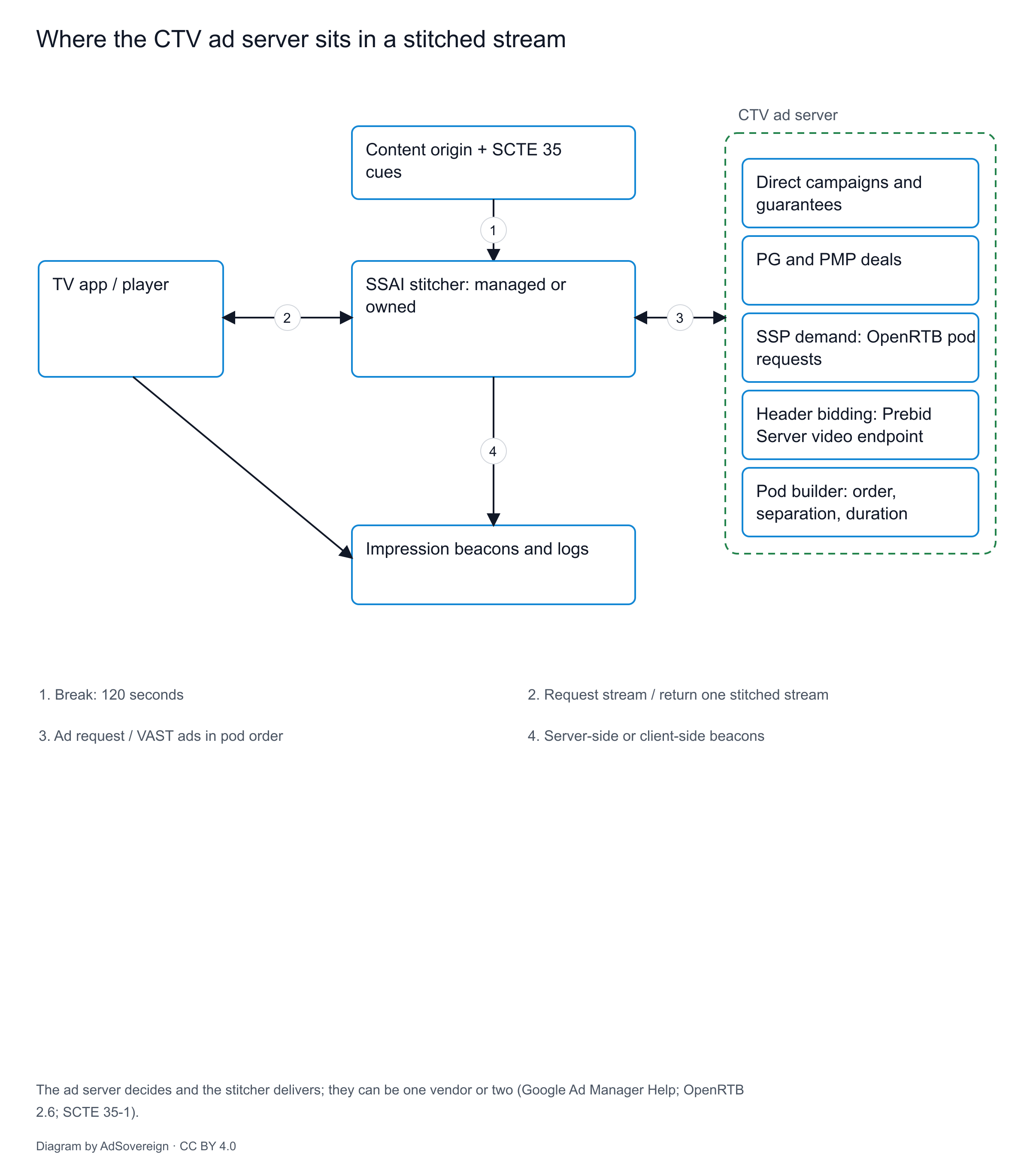
How CTV ad serving works with SSAI, step by step
The ad server and the stitcher are separate jobs, and they can come from different companies. Google notes that its DAI service can stitch ad breaks from Ad Manager and from third-party ad servers (Google Ad Manager Help). AWS describes MediaTailor as an ad insertion and channel assembly service for HLS and DASH streams, live and on demand (AWS MediaTailor documentation, accessed 9 November 2026).
- The viewer presses play. The TV app asks the SSAI service for a stream.
- The stream reaches a break. In live TV the break is marked with a cue, commonly in the SCTE 35 format (SCTE 35-1 2023r2).
- The stitcher calls the ad server. It passes the break length, the device and any audience signals.
- The ad server runs its decision. It weighs direct campaigns, programmatic guaranteed and private deals, and open bids from SSPs or a header bidding wrapper.
- The ad server returns VAST. The response lists the ads in pod order.
- The stitcher transcodes and inserts. It swaps the break's placeholder for the ads, so the viewer sees one stream.
- Impressions are reported. Either the stitcher fires beacons from the server or the player fires them, and the ad server records delivery.
Our engineering guide to SSAI and CTV ad serving covers beacons, device headers and pod bidding in depth. This page focuses on choosing the decision layer.

Diagram by AdSovereign, CC BY 4.0.
CTV ad server options compared
The table sets the five commercial options beside the self-built route. Each cell reflects what the company publishes in filings, releases, help pages or product pages, checked on 9 November 2026. Where a company does not publish a detail, the cell says n/d. Detailed profiles of each vendor are linked in the last column.
6 of 6 rows
FreeWheel | Comcast; acquired 2014; founded 2007 (FreeWheel) | Ad server plus FreeWheel SSP; "Streaming Hub" combines both (FreeWheel) | n/d on public pages | n/d on public pages | Integrates DSPs and SSPs; supports programmatic guaranteed and PMP deals; SSP usable with or without the ad server (FreeWheel) |
SpringServe | Magnite (Nasdaq: MGNI); acquired 1 Jul 2021 for about $31M (Magnite) | CTV ad server; a new platform announced in April 2025 combines it with Magnite's streaming SSP (Magnite 10-K) | Dynamic ad insertion for live events listed among tools (Magnite 10-K) | Ad podding for commercial breaks (Magnite 10-K) | Unified auction across multiple programmatic demand sources (Magnite 10-K) |
Publica | Integral Ad Science; acquired 9 Aug 2021; IAS owned by Novacap since 23 Dec 2025 (IAS 8-K) | CTV ad server for channels, networks and TV makers (Publica) | Lists ad stitching (Publica) | Lists ad podding and ad pod automation (Publica) | Server-to-server video header bidding; unified auction; Viant Direct Access integration from 8 Jul 2026 (IAS) |
Google Ad Manager 360 with DAI | Alphabet | Ad server with Dynamic Ad Insertion for live and on-demand video (Google) | DAI, for Ad Manager 360 or advanced-contract partners; also stitches third-party ad servers' breaks | Optimised pods with "ad buffet" fallback (Google) | Ad Exchange for video (Google) |
Equativ | Private; Bridgepoint named primary investor in 2023; merged with Sharethrough, announced 13 Jun 2024 (Advanced Television) | CTV ad server and SSP; born as Smart AdServer; bought Serverside.AI for CTV ad serving in 2022 (Equativ) | Dynamic Ad Insertion, which Equativ also calls SSAI (Equativ) | Says it replaces fixed pods with audience-targeted campaigns (company description) (Equativ) | Equativ SSP; its SSAI works with a publisher's existing ad server and demand partners (Equativ) |
Self-built | The publisher | Open-source parts plus a managed or own stitcher | AWS MediaTailor, Google Cloud Video Stitcher API, or own | Prebid Server video endpoint builds pods for a primary ad server (Prebid) | Any SSP the publisher integrates through OpenRTB |
FreeWheel
SpringServe
- Owner (dated)
Magnite (Nasdaq: MGNI); acquired 1 Jul 2021 for about $31M (Magnite)
- What it is
CTV ad server; a new platform announced in April 2025 combines it with Magnite's streaming SSP (Magnite 10-K)
- SSAI
Dynamic ad insertion for live events listed among tools (Magnite 10-K)
- Pod handling
Ad podding for commercial breaks (Magnite 10-K)
Publica
Google Ad Manager 360 with DAI
Equativ
- Owner (dated)
Private; Bridgepoint named primary investor in 2023; merged with Sharethrough, announced 13 Jun 2024 (Advanced Television)
- What it is
CTV ad server and SSP; born as Smart AdServer; bought Serverside.AI for CTV ad serving in 2022 (Equativ)
- SSAI
Dynamic Ad Insertion, which Equativ also calls SSAI (Equativ)
- Pod handling
Says it replaces fixed pods with audience-targeted campaigns (company description) (Equativ)
Self-built
- Owner (dated)
The publisher
- What it is
Open-source parts plus a managed or own stitcher
- SSAI
AWS MediaTailor, Google Cloud Video Stitcher API, or own
- Pod handling
Prebid Server video endpoint builds pods for a primary ad server (Prebid)
Table by AdSovereign, CC BY 4.0.
Read the table as a map of who publishes what, not as a ranking. An n/d means the company does not describe that feature on the public pages we read, not that the feature is missing. Ask each vendor for documentation before you shortlist.
FreeWheel, SpringServe, Publica, Google and Equativ: what each one says about itself
FreeWheel. FreeWheel describes itself as a Comcast company that runs as a standalone ad tech unit. It was founded in 2007 and bought StickyADS.tv in 2016 and Beeswax in 2021 (company history) (FreeWheel, accessed 9 November 2026). Its Publisher Suite pairs an ad server with FreeWheel SSP. Sellers can take the SSP alone or combine both as Streaming Hub. The FreeWheel profile covers its customers and products in detail.
SpringServe. Magnite bought SpringServe for about $31 million, net of an earlier $2 million stake. At the time it named Pluto TV, Sinclair, Univision and VIZIO among SpringServe's clients (Magnite, 1 July 2021). In April 2025 Magnite announced a new SpringServe platform that combines the ad server and its streaming SSP behind a single interface (Magnite 10-K, FY2025). Magnite says that in CTV, header-bidding-style competition has largely been built inside the ad server. See the SpringServe profile.
Publica. IAS paid $171.4 million in cash plus about 2.9 million shares for Publica in August 2021 (IAS 10-K, FY2021). Publica pitches its product as an ad server built for CTV broadcasters, with ad stitching, podding, a unified auction and an "inventory split" feature for shared breaks (company description) (Publica, accessed 9 November 2026). In July 2026 it connected to Viant's Direct Access supply path, naming Philo as a participating publisher (IAS, 8 July 2026). See the Publica profile and, for its parent, the Integral Ad Science profile.
Google Ad Manager 360 with DAI. Google's Dynamic Ad Insertion stitches ads into live linear and on-demand streams. Ads must be VAST, must be transcoded into HLS variants before or at first serve, and should sit in DAI-specific ad units (Google Ad Manager Help). Google also notes that on platforms using the DAI API rather than its IMA SDK, Open Measurement viewability tracking is not yet MRC accredited. See the Google Ad Manager profile, and for the wider choice, our guide to Google Ad Manager alternatives.
Equativ. Equativ began as Smart AdServer and lists the purchase of Serverside.AI in 2022 for CTV ad serving (Equativ, accessed 9 November 2026). Its CTV page offers a Dynamic Ad Insertion service that works with a publisher's existing ad server, plus its own ad server and SSP (Equativ, accessed 9 November 2026). At the Sharethrough merger, the combined group cited more than 720 employees in 18 countries (company figures) (Advanced Television, 13 June 2024). See the Equativ profile.
Measurement is the other point to check. IAS says advertisers buying Publica inventory can add IAS Total TV, which reports at show, genre and rating level, with publisher and app coverage in the US (IAS, 8 July 2026). Every option should state which verification vendors can measure inside the stitched stream. It should also say whether impression beacons fire from the server or from the device, because that choice changes what a verification tag can see.
One pattern runs through all five. Each ad server now sits next to a sell-side exchange owned by the same group: FreeWheel SSP, Magnite's SSP, Publica's header bidding, Google Ad Exchange and Equativ's SSP. That bundling can simplify integration. It also means a publisher should ask how demand from rival exchanges competes inside the ad server.
Pod handling: structured, dynamic and hybrid pods in OpenRTB 2.6
OpenRTB 2.6 gives sellers three ways to describe a break (OpenRTB implementation notes, 7.6):
- Structured pod. The seller fixes the number of slots, their order and each length in advance.
- Dynamic pod. The seller fixes the total length and the maximum number of ads, and lets bidders fill it.
- Hybrid pod. A mix: some fixed slots plus a dynamic remainder.
The notes ask sellers to offer dynamic pods where they can, so bidders can choose the best mix of ads. They also warn buyers that the seller builds the final pod and may take none, some or all of a buyer's bids. Here is an illustrative hybrid pod for a 120-second live break, with a guaranteed 30-second first slot and a 90-second dynamic remainder. Identifiers are placeholders; field names follow OpenRTB 2.6.
{
  "id": "live-break-0412",
  "imp": [
    {
      "id": "1",
      "video": {
        "mimes": ["video/mp4"],
        "plcmt": 1,
        "podid": "pod_1",
        "podseq": 0,
        "slotinpod": 1,
        "rqddurs": [30]
      },
      "bidfloor": 25.0,
      "bidfloorcur": "USD"
    },
    {
      "id": "2",
      "video": {
        "mimes": ["video/mp4"],
        "plcmt": 1,
        "podid": "pod_1",
        "podseq": 0,
        "poddur": 90,
        "maxseq": 3,
        "rqddurs": [15, 30],
        "mincpmpersec": 0.5,
        "poddedupe": [1, 2]
      },
      "bidfloorcur": "USD"
    }
  ],
  "app": { "content": { "livestream": 1 } },
  "device": { "devicetype": 3 }
}
6 of 6 rows
| Both impressions belong to the same break (OpenRTB 2.6) |
| The seller guarantees the first position for impression 1; the notes say to send this only when the position can be guaranteed |
| The dynamic part is 90 seconds with at most three ads |
| Exact lengths only, to avoid dead air in live TV |
| A floor per second of ad: a 30-second ad must bid at least $15.00 CPM and a 15-second ad at least $7.50 |
| Values 1 and 2 tell bidders the seller removes duplicate ads by advertiser domain and by content category; the field is marked provisional (AdCOM 1.0) |
podid
- Meaning in this break
Both impressions belong to the same break (OpenRTB 2.6)
slotinpod: 1
- Meaning in this break
The seller guarantees the first position for impression 1; the notes say to send this only when the position can be guaranteed
poddur: 90, maxseq: 3
- Meaning in this break
The dynamic part is 90 seconds with at most three ads
rqddurs
- Meaning in this break
Exact lengths only, to avoid dead air in live TV
mincpmpersec: 0.5
- Meaning in this break
A floor per second of ad: a 30-second ad must bid at least $15.00 CPM and a 15-second ad at least $7.50
poddedupe
- Meaning in this break
Values 1 and 2 tell bidders the seller removes duplicate ads by advertiser domain and by content category; the field is marked provisional (AdCOM 1.0)
Table by AdSovereign, CC BY 4.0.
The floor maths in the table is simple multiplication: $0.50 × 30 seconds = $15.00 CPM. The notes tell buyers to use mincpmpersec when it is present and fall back to bidfloor otherwise (OpenRTB implementation notes, 7.6).
Header bidding works differently in CTV. Prebid Server's /openrtb2/video endpoint lets an SSAI server request bids for a pod, then returns key-values for a primary ad server such as FreeWheel or Google Ad Manager. A key-value of hb_pb_cat_dur = 1200_399_30s means a $12.00 price bucket, industry category 399 and a 30-second ad, which lets the ad server keep competing brands apart (Prebid, accessed 9 November 2026).
What CTV ad serving costs: published prices only
None of the five commercial ad servers publishes a price list on the pages we read. Magnite's annual report describes its general revenue model: usually a percentage of ad spend, sometimes a fixed CPM, and in some cases fixed monthly fees for the platform (Magnite 10-K, FY2025). Contract terms for CTV ad serving are negotiated.
Stitching is different, because cloud providers publish rates.
5 of 5 rows
AWS Elemental MediaTailor, ad insertion | $0.25 per 1,000 VOD insertions; $0.50 per 1,000 live insertions | Ad delivery data transfer per GB; ad transcodes beyond 10 per 1,000 insertions | |
AWS Elemental MediaTailor, channel assembly | $0.10 per hour (basic channel); $0.35 per hour (standard channel) | Same | |
Google Cloud Video Stitcher API | $0.50 CPM for ad insertions | Not listed on the pricing page | |
Eyevinn Channel Engine, Eyevinn Test Adserver | Free open-source licence (Apache 2.0) | Your own hosting | |
Revive Adserver | Free open-source licence (GPL v2) | Your own hosting |
AWS Elemental MediaTailor, ad insertion
- Published rate (US East or list)
$0.25 per 1,000 VOD insertions; $0.50 per 1,000 live insertions
- What else is billed
Ad delivery data transfer per GB; ad transcodes beyond 10 per 1,000 insertions
- Source
AWS Elemental MediaTailor, channel assembly
- Published rate (US East or list)
$0.10 per hour (basic channel); $0.35 per hour (standard channel)
- What else is billed
Same
- Source
Google Cloud Video Stitcher API
- Published rate (US East or list)
$0.50 CPM for ad insertions
- What else is billed
Not listed on the pricing page
Eyevinn Channel Engine, Eyevinn Test Adserver
- Published rate (US East or list)
Free open-source licence (Apache 2.0)
- What else is billed
Your own hosting
Revive Adserver
- Published rate (US East or list)
Free open-source licence (GPL v2)
- What else is billed
Your own hosting
Table by AdSovereign, CC BY 4.0.
A worked example. A FAST channel owner stitches 2,000,000 live ad insertions a month on MediaTailor in US East. At $0.50 per 1,000, insertion costs $1,000 a month. If it also assembles the channel itself as a standard channel, 720 hours at $0.35 adds $252, before data transfer (AWS, accessed 9 November 2026). On Google's Video Stitcher API, the same 2,000,000 insertions at $0.50 CPM also cost $1,000 (Google Cloud). The ad server's fee and the SSP's take come on top, and those are the numbers to request in writing.
Open-source and self-hosted routes
No mainstream open-source project offers a complete, production CTV ad server with pods, SSAI and programmatic demand in one package. A self-built route assembles parts instead.
5 of 5 rows
Programmatic pod demand | Prebid Server | Takes a pod request from an SSAI server, gathers bids from SSPs, returns price, category and duration keys | |
Linear channel assembly | Eyevinn Channel Engine (Apache 2.0) | Builds a FAST channel from on-demand files; supports server-guided HLS interstitial ad breaks | |
Testing ad insertion | Eyevinn Test Adserver (Apache 2.0) | Always returns VAST ads and logs tracking, for testing SSAI and CSAI workflows | |
Stitching | AWS MediaTailor or Google Cloud Video Stitcher API (managed, published prices) | Inserts ads into HLS and DASH streams | |
Direct campaign trafficking | Revive Adserver (GPL v2), a general-purpose ad server | Manages campaigns and delivery; its README does not describe CTV pod or SSAI features |
Programmatic pod demand
- Open-source or published-price option
Prebid Server
/openrtb2/videoendpoint- What it does
Takes a pod request from an SSAI server, gathers bids from SSPs, returns price, category and duration keys
- Source
Linear channel assembly
- Open-source or published-price option
Eyevinn Channel Engine (Apache 2.0)
- What it does
Builds a FAST channel from on-demand files; supports server-guided HLS interstitial ad breaks
- Source
Testing ad insertion
- Open-source or published-price option
Eyevinn Test Adserver (Apache 2.0)
- What it does
Always returns VAST ads and logs tracking, for testing SSAI and CSAI workflows
- Source
Stitching
- Open-source or published-price option
AWS MediaTailor or Google Cloud Video Stitcher API (managed, published prices)
- What it does
Inserts ads into HLS and DASH streams
- Source
Direct campaign trafficking
- Open-source or published-price option
Revive Adserver (GPL v2), a general-purpose ad server
- What it does
Manages campaigns and delivery; its README does not describe CTV pod or SSAI features
- Source
Table by AdSovereign, CC BY 4.0.
The missing piece is usually the pod decision itself: combining direct campaigns, deals and bids into one ordered break with competitive separation. Teams that build it own the logic and the logs, and they also own the operations. Running Prebid Server is covered in our Prebid Server self-hosting guide, and the general-purpose option is profiled at Revive Adserver.
A test is a sensible first step. A publisher can stand up Channel Engine and the Eyevinn test ad server, point a managed stitcher at them, and check that beacons and durations behave before any real demand is connected.
How to choose a CTV ad server: seven questions
- Do you need stitching from the same vendor? Google and Equativ offer their own dynamic ad insertion; others may pair with a separate stitcher. Ask for the list of stitchers each ad server supports.
- Do you sell live breaks? Ask how the server handles SCTE 35 cues, exact durations and last-minute schedule changes.
- How are pods built? Ask for structured, dynamic and hybrid pod support, competitive separation rules and first-slot guarantees.
- Which demand can compete? Ask whether rival SSPs and header bidding demand compete on equal terms with the owner's exchange.
- Who owns the logs? Ask for impression-level log access, retention and export, and whether pricing changes with volume.
- What does it cost in total? Request the ad serving fee, any SSP take rate and stitching costs separately, and compare them with the published stitching rates above.
- How hard is it to leave? Ask how line items, creatives and deals can be exported. Our guide to switching ad servers without losing AdX demand covers migration on the web side.
The questions matter more for some sellers than others. A FAST channel owner on a revenue share may never run an ad server at all, because the platform sells the break, as our guide to FAST channels advertising explains. A broadcaster with live sport and its own sales team will use every item on the list. For the wider case for publisher-controlled stacks, see the publisher independence hub.
Where to go next
- SSAI and CTV ad serving: stitching, beacons and pod bidding in engineering detail.
- FAST channels advertising: who sells FAST breaks and how the money is split.
- Google Ad Manager alternatives: the wider ad server choice, web and app included.
- Prebid Server self-hosting guide: running the open-source auction yourself.
- RTB architecture hub: how the rest of the programmatic chain fits together.
FAQ
What is a CTV ad server?
What is the difference between SSAI and CSAI?
Does Google Ad Manager support SSAI for CTV?
How much does a CTV ad server cost?
What is the best CTV ad server?
Can you self-host a CTV ad server?
How this works on owned infrastructure
This page compares who makes the pod decision for a streaming break. Renting a CTV ad server bundles that decision with the vendor's exchange, its fee and its copy of the logs. Building one means writing pod logic, deal handling and bidder connections, then operating them at broadcast scale. AdSovereign is an enterprise real-time bidding stack designed as a third route: the publisher runs the decision and exchange layer on infrastructure it controls, connects any stitcher and any SSP or DSP through OpenRTB 2.6, and keeps impression-level logs in its own environment. It can sit beside an existing CTV ad server during a migration. The architecture page shows where pod decisions run, and the TCO page sets out how to compare the cost of renting, building and owning.
Sources
- FreeWheel, "About" (accessed 9 November 2026). https://www.freewheel.com/about
- FreeWheel, "Publisher Suite" (accessed 9 November 2026). https://www.freewheel.com/publishersuite
- Magnite, Inc., Form 8-K exhibit 99.1, "Magnite Acquires SpringServe, A Leader in CTV Ad Serving Technology" (1 July 2021). https://www.sec.gov/Archives/edgar/data/1595974/000159597421000042/a991springservepressrelease.htm
- Magnite, Inc., Form 10-K for fiscal year 2025 (25 February 2026). https://www.sec.gov/Archives/edgar/data/1595974/000159597426000007/mgni-20251231.htm
- Magnite, Inc., Form 10-Q for the quarter ended 30 September 2026 (4 November 2026). https://www.sec.gov/Archives/edgar/data/1595974/000159597426000041/mgni-20260930.htm
- Integral Ad Science Holding Corp., Form 10-K for fiscal year 2021 (3 March 2022). https://www.sec.gov/Archives/edgar/data/1842718/000162828022004899/ias-20211231.htm
- Integral Ad Science Holding Corp., Form 8-K on completion of the merger with Novacap (23 December 2025). https://www.sec.gov/Archives/edgar/data/1842718/000114036125046475/ef20061707_8k.htm
- Publica, home page (accessed 9 November 2026). https://getpublica.com/
- Integral Ad Science, "Viant Integrates with Publica by IAS to Expand Premium Connected TV Access" (8 July 2026). https://integralads.com/news/viant-integrates-with-publica-by-ias-to-expand-premium-connected-tv-access/
- Google Ad Manager Help, "Learn about Dynamic Ad Insertion (DAI)" (accessed 9 November 2026). https://support.google.com/admanager/answer/6147120?hl=en
More sources (15)
- Equativ, "About us" (accessed 9 November 2026). https://equativ.com/about-us/
- Equativ, "CTV Ad Server" (accessed 9 November 2026). https://equativ.com/publishers/ctv
- Advanced Television, "Equativ merges with Sharethrough" (13 June 2024). https://www.advanced-television.com/2024/06/13/equativ-sharethrough-merge/
- IAB Tech Lab, OpenRTB 2.6 specification, GitHub (accessed 9 November 2026). https://github.com/InteractiveAdvertisingBureau/openrtb2.x/blob/main/2.6.md
- IAB Tech Lab, OpenRTB 2.x implementation notes, section 7.6 "Pod Bidding for Video and Audio", GitHub (accessed 9 November 2026). https://github.com/InteractiveAdvertisingBureau/openrtb2.x/blob/main/implementation.md
- IAB Tech Lab, "OpenRTB 2.6-202606" release (11 June 2026). https://github.com/InteractiveAdvertisingBureau/openrtb2.x/releases/tag/2.6-202606
- IAB Tech Lab, AdCOM 1.0, GitHub (accessed 9 November 2026). https://github.com/InteractiveAdvertisingBureau/AdCOM/blob/main/AdCOM%20v1.0%20FINAL.md
- SCTE, "ANSI/SCTE 35-1 2023r2, Digital Program Insertion Cueing Message Part 1" (accessed 9 November 2026). https://www.scte.org/standards/library/catalog/scte-35-digital-program-insertion-cueing-message/
- Prebid.org, "Prebid Server, Endpoints, /openrtb2/video" (accessed 9 November 2026). https://docs.prebid.org/prebid-server/endpoints/openrtb2/pbs-endpoint-video.html
- AWS, "AWS Elemental MediaTailor Pricing" (accessed 9 November 2026). https://aws.amazon.com/mediatailor/pricing/
- AWS, "What is AWS Elemental MediaTailor?", user guide (accessed 9 November 2026). https://docs.aws.amazon.com/mediatailor/latest/ug/what-is.html
- Google Cloud, "Video Stitcher API pricing" (accessed 9 November 2026). https://cloud.google.com/video-stitcher/pricing
- Eyevinn Technology, "Channel Engine", GitHub (accessed 9 November 2026). https://github.com/Eyevinn/channel-engine
- Eyevinn Technology, "Test Adserver", GitHub (accessed 9 November 2026). https://github.com/Eyevinn/test-adserver
- Revive Adserver, GitHub repository and licence (accessed 9 November 2026). https://github.com/revive-adserver/revive-adserver
Changelog
- 9 November 2026: first draft. Vendor ownership, SEC filings, help pages, published SSAI prices and OpenRTB pod fields checked on this date.