
RTB Architecture
Programmatic Audio Platforms Compared: Spotify, iHeartMedia, SiriusXM and How Audio Ads Are Bought
Published · Last updated
Next scheduled review:
Programmatic audio platforms let advertisers buy ads in music streams, online radio and podcasts through automated auctions and deals. Most US supply runs through a few owners: Spotify, iHeartMedia with Triton Digital, and SiriusXM with Pandora and AdsWizz. Buyers bid from a DSP, and the ad arrives as a VAST file, the video standard that absorbed audio's DAAST format.
Contents
Key facts
- Spotify opened an ad exchange in 2025. Spotify says it announced the Spotify Ad Exchange (SAX) on 1 April 2025. Its Ad-Supported revenue was €1,836 million in 2025, down 1%, while automated sales channels grew by €103 million (Spotify 20-F, FY2025).
- Podcasting is the growth line. US podcast advertising reached $2.9 billion in 2025, up 17.6%, in the IAB and PwC annual report (IAB, 16 April 2026).
- iHeartMedia's podcast revenue rose 25.6%. It reached $563.7 million in 2025, inside a Digital Audio Group that earned $1,329.4 million (iHeartMedia 10-K, FY2025).
- Pandora's ad business is flat but steady. SiriusXM reported Pandora and Off-platform advertising revenue of $1,615 million in 2025, up 1%, helped by podcasts and programmatic (SiriusXM 10-K, FY2025).
- Audio uses the video standard. VAST 4.1, released in November 2018, merged the Digital Audio Ad Serving Template (DAAST) into VAST (IAB Tech Lab, VAST 4.1).
- Podcast counting rules were updated in September 2026. IAB Tech Lab finalised version 2.3 of its Podcast Technical Measurement Guidelines on 29 September 2026, now covering video episodes too (PPC Land, 29 September 2026).
Definition
Programmatic audio: the automated sale of ad slots in music streams, online radio and podcasts. An SSP offers each slot in an OpenRTB request with an audio object, and the winning DSP returns a VAST response that is stitched into the stream.
Key terms on this page: demand-side platform (DSP) · supply-side platform (SSP) · VAST · server-side ad insertion (SSAI) · OpenRTB · private marketplace (PMP) · programmatic guaranteed · deal ID · CPM · frequency capping
Programmatic audio ads: what is for sale
Audio inventory comes in four kinds, and each trades differently. The ad itself is a short audio spot whose accepted lengths the seller lists in each bid request, sometimes with a clickable companion banner on the phone screen.
- Music streaming. Free tiers of services like Spotify and Pandora play ads between songs. The listener is logged in, so the seller knows age, location and device.
- Live and online radio. Broadcasters stream their stations online and replace the on-air ads with digital ones for streaming listeners. Timing matters here, because a 28-second ad in a 30-second gap leaves dead air.
- Podcasts. Ads are either "baked in", recorded into the episode file, or inserted dynamically by an ad server when someone downloads or streams the episode. Only dynamic slots can be sold programmatically.
- Video in audio apps. Spotify and others also sell video and display formats inside the app, alongside audio.
A short example shows how a buyer uses these. A sports-drink brand wants morning commuters in five US cities. In its DSP it targets streaming music and live sports-radio streams between 6 and 9 a.m., caps frequency at three plays a week, and adds a podcast deal for fitness shows. The DSP bids on each slot as it comes up. The basics of the auction are in what is programmatic advertising.
How a programmatic audio ad is served, step by step
Audio follows the same auction as display and video, with extra rules about timing and stitching. The steps below use the OpenRTB 2.6 audio object and VAST 4.1 (OpenRTB 2.6; VAST 4.1).
- The player reaches an ad break. A music app, a radio stream or a podcast server signals an upcoming slot.
- The publisher's ad server decides direct or programmatic. Sold campaigns and sponsorships fill first; open slots go to an SSP.
- The SSP sends a bid request. The request carries an
audioobject with allowed durations, the feed type and whether the ad will be stitched into the content. - DSPs bid. Each bid points to a VAST document that holds the audio file and tracking URLs.
- The ad is stitched or played. In server-side ad insertion (SSAI), the server joins the ad into the stream so ad blockers cannot separate it. In client-side playback, the app plays the file itself.
- Tracking fires. The player or server reports impressions and quartiles, which become the basis for billing.

Diagram by AdSovereign, CC BY 4.0.
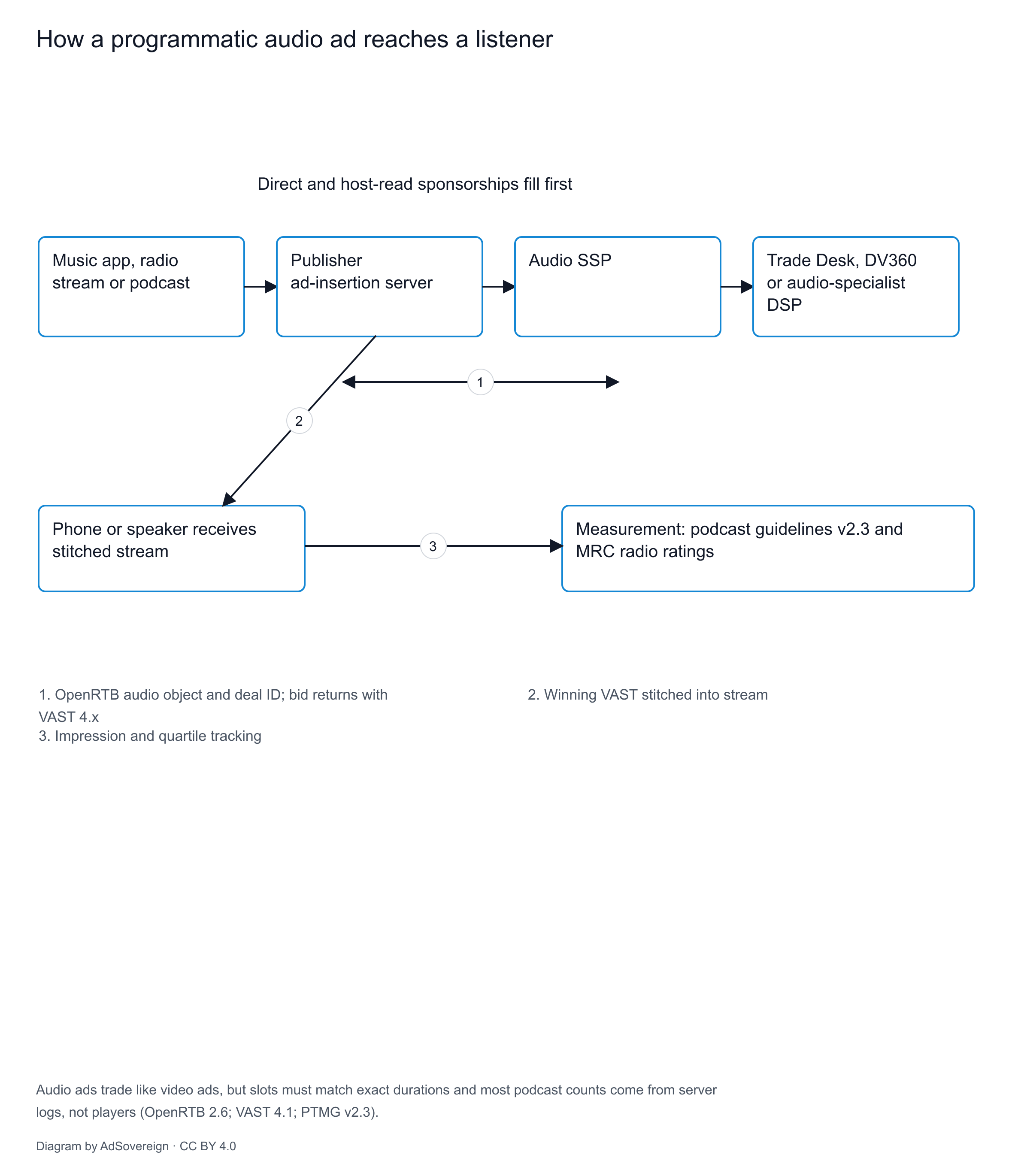
The engineering of stitching, pods and VAST tracking is covered in detail in our guide to SSAI and CTV ad serving. Audio uses the same mechanics with simpler creatives.
Programmatic audio platforms compared by owner
A handful of companies control most US programmatic audio supply, and several own both the content and the ad technology. The table describes each from its own filings or releases, or from named trade reports, checked on 9 November 2026. "n/d" means not disclosed in the sources we found.
8 of 8 rows
Spotify | Publisher; own exchange (SAX); podcast marketplace (SPAN) with Megaphone; self-serve Spotify Ads Manager | Public (NYSE: SPOT) | 476 million Ad-Supported MAUs at 31 Dec 2025; Ad-Supported revenue €1,836M in 2025; €482M in Q3 2026, up 10% | |
Spotify Ad Exchange (SAX) | Programmatic marketplace for Spotify's music, video and display inventory | Spotify | At launch: The Trade Desk, Display & Video 360 and Magnite, with Yahoo DSP and Adform to follow; podcasts "coming soon" | |
iHeartMedia | Publisher (860+ stations, iHeartRadio, podcasts); ad tech (Triton, Voxnest, Omny Studio); SmartAudio data products | Public (Nasdaq: IHRT) | Digital Audio Group revenue $1,329.4M and podcast revenue $563.7M in 2025; number one US podcast publisher per Podtrac (company citation) | |
Triton Digital | Audio measurement and ad tech; Triton Audio Marketplace, an open audio exchange across broadcast, podcast and streaming | iHeartMedia; bought from E.W. Scripps for $230M, closed 31 Mar 2021 | Scripps had bought it in 2018 for $150M | |
SiriusXM | Publisher (SiriusXM, Pandora, SiriusXM Podcast Network); SiriusXM Media ad sales | Public (Nasdaq: SIRI); current structure since 9 Sep 2024 Liberty Media transactions | About 170 million monthly listeners (company figure); Pandora and Off-platform ad revenue $1,615M in 2025 | |
Pandora | Ad-supported music streaming | SiriusXM since 1 Feb 2019 | Revenue mainly from audio, display and video ads | |
AdsWizz | Audio ad tech: AudioMax SSP, AudioMatic DSP, AudioGO self-serve, dynamic ad insertion; Simplecast podcast hosting | Pandora (SiriusXM) | Third-party customers include music platforms, podcasts and broadcasters (company description) | |
Audacy | Publisher (200+ radio stations, podcasts) | Private since its restructuring of 30 Sep 2024; majority owned by Soros Fund Management | Shed about $1.6B of debt in restructuring; programmatic routes n/d |
Spotify
- Role in programmatic audio
Publisher; own exchange (SAX); podcast marketplace (SPAN) with Megaphone; self-serve Spotify Ads Manager
- Ownership (dated)
Public (NYSE: SPOT)
- Facts with dates
476 million Ad-Supported MAUs at 31 Dec 2025; Ad-Supported revenue €1,836M in 2025; €482M in Q3 2026, up 10%
- Source
Spotify Ad Exchange (SAX)
- Role in programmatic audio
Programmatic marketplace for Spotify's music, video and display inventory
- Ownership (dated)
Spotify
- Facts with dates
At launch: The Trade Desk, Display & Video 360 and Magnite, with Yahoo DSP and Adform to follow; podcasts "coming soon"
- Source
iHeartMedia
- Role in programmatic audio
Publisher (860+ stations, iHeartRadio, podcasts); ad tech (Triton, Voxnest, Omny Studio); SmartAudio data products
- Ownership (dated)
Public (Nasdaq: IHRT)
- Facts with dates
Digital Audio Group revenue $1,329.4M and podcast revenue $563.7M in 2025; number one US podcast publisher per Podtrac (company citation)
- Source
Triton Digital
- Role in programmatic audio
Audio measurement and ad tech; Triton Audio Marketplace, an open audio exchange across broadcast, podcast and streaming
- Ownership (dated)
iHeartMedia; bought from E.W. Scripps for $230M, closed 31 Mar 2021
- Facts with dates
Scripps had bought it in 2018 for $150M
SiriusXM
- Role in programmatic audio
Publisher (SiriusXM, Pandora, SiriusXM Podcast Network); SiriusXM Media ad sales
- Ownership (dated)
Public (Nasdaq: SIRI); current structure since 9 Sep 2024 Liberty Media transactions
- Facts with dates
About 170 million monthly listeners (company figure); Pandora and Off-platform ad revenue $1,615M in 2025
- Source
Pandora
- Role in programmatic audio
Ad-supported music streaming
- Ownership (dated)
SiriusXM since 1 Feb 2019
- Facts with dates
Revenue mainly from audio, display and video ads
- Source
AdsWizz
- Role in programmatic audio
Audio ad tech: AudioMax SSP, AudioMatic DSP, AudioGO self-serve, dynamic ad insertion; Simplecast podcast hosting
- Ownership (dated)
Pandora (SiriusXM)
- Facts with dates
Third-party customers include music platforms, podcasts and broadcasters (company description)
Audacy
- Role in programmatic audio
Publisher (200+ radio stations, podcasts)
- Ownership (dated)
Private since its restructuring of 30 Sep 2024; majority owned by Soros Fund Management
- Facts with dates
Shed about $1.6B of debt in restructuring; programmatic routes n/d
Table by AdSovereign, CC BY 4.0.
Three patterns stand out. First, the large publishers own their pipes: Spotify built its own exchange, iHeartMedia owns Triton, and SiriusXM owns AdsWizz. Second, two of those pipes, Triton and AdsWizz, also serve rival publishers, so buying "open audio" often means buying through a competitor's technology. Third, omnichannel DSPs reach most of this supply, so a buyer rarely needs an audio-only DSP to start.
Spotify and the Spotify Ad Exchange
Spotify sells three ways: direct deals, the self-serve Spotify Ads Manager and, since April 2025, its own exchange. Its 20-F describes SAX as a programmatic marketplace for real-time biddable buying (Spotify 20-F, FY2025). At launch it was available in markets including the US, Canada, Europe, Australia, India, Brazil and Mexico (Spotify, 2 April 2025).
Podcasts sit in a separate marketplace. The Spotify Audience Network (SPAN) sells ads across Spotify's own podcasts, enterprise publishers hosted on Megaphone and creators on Spotify for Creators. Spotify also uses streaming ad insertion, which counts real impressions rather than downloads. It warns investors that the effect of that shift on revenue is uncertain (Spotify 20-F, FY2025).
How has SAX done? A Spotify spokesperson told Digiday that monthly active programmatic advertisers rose 222% in the year after launch (company claim). Digiday reported SAX was reachable through just under 50 DSPs (Digiday, 2 April 2026). Buyers in the same report were more cautious. One said SAX simplified the supply path without raising its programmatic spend, and another said host-read podcast ads are still bought direct.
The financials match that mixed picture. Spotify's Ad-Supported revenue fell 1% in 2025 as direct and podcast sales dropped, while automated channels grew (Spotify 20-F, FY2025). In Q3 2026 Ad-Supported revenue rose 10% to €482 million (Spotify 6-K, Q3 2026).
iHeartMedia and Triton Digital
iHeartMedia owns more than 860 radio stations and, by its own account citing Podtrac, is the largest US podcast publisher. Its podcasts drew 167 million global monthly downloads and streams in 2025, according to Podtrac figures it cites (iHeartMedia 10-K, FY2025). The company sells radio, streaming and podcasts together, and says programmatic, data and attribution products are a growing share of its ad buying.
Its ad tech came mostly through acquisitions. Triton Digital, bought from E.W. Scripps in March 2021, measures digital audio and runs the Triton Audio Marketplace, which iHeartMedia calls an open audio exchange across broadcast, podcast and streaming (Scripps 8-K, 31 March 2021; iHeartMedia 10-K, FY2025). Voxnest adds podcast programmatic tools and ad serving, and Omny Studio hosts podcasts.
For broadcast radio, iHeartMedia sells SmartAudio. The 10-K says it supports impression-based planning and dynamic messages triggered by weather, pollen counts or sports scores. That is programmatic in spirit, though much of it is sold through iHeartMedia's own sales teams rather than open auctions.
SiriusXM, Pandora and AdsWizz
SiriusXM completed its purchase of Pandora on 1 February 2019 (SiriusXM, 1 February 2019). Pandora's free tier is the advertising engine; SiriusXM's satellite service is mostly paid. SiriusXM Media sells across both and its podcast network, reaching about 170 million monthly listeners (company figure) (SiriusXM 10-K, FY2025).
AdsWizz is the technology layer. SiriusXM's 10-K describes it as an end-to-end audio ad platform, from dynamic ad insertion to programmatic marketplaces, used by Pandora and by outside music services, podcasts and broadcasters. Its own site lists the AudioMax SSP, the AudioMatic DSP and the AudioGO self-serve tool (AdsWizz, accessed 9 November 2026). Simplecast, part of AdsWizz, adds podcast hosting and analytics.
The 10-K is candid about the headwind. Pandora's ad-supported listener base has shrunk, which means fewer spots to sell. Ad revenue still grew 1% in 2025 thanks to podcasts, programmatic and higher technology fees (SiriusXM 10-K, FY2025).
Audacy
Audacy, the former Entercom, owns more than 200 radio stations (Philadelphia Inquirer, 1 October 2024). It emerged from Chapter 11 at the end of September 2024 after shedding about $1.6 billion of debt, and went private (Philadelphia Inquirer, 1 October 2024). Radio & Television Business Report described it in December 2024 as majority owned by Soros Fund Management (RBR, 24 December 2024).
As a private company, Audacy publishes little about its ad technology. We could not confirm which SSPs or exchanges carry its streaming and podcast inventory on 9 November 2026. Buyers should ask its sales team which deals and DSPs it supports.
Podcast ad insertion and how podcast ads are counted
Podcasts are the hardest audio format to measure, because most listening happens in apps that send publishers no playback data. Apple Podcasts and Spotify, for example, typically do not report plays back to the host. So the industry counts downloads from server logs, using rules written by IAB Tech Lab (PPC Land, 29 September 2026).
Version 2.3 of the Podcast Technical Measurement Guidelines, finalised on 29 September 2026, sets these rules. It now applies to video episodes delivered through open RSS feeds as well as audio (IAB Tech Lab on GitHub). The table summarises the core counting logic as reported by PPC Land.
5 of 5 rows
A valid download needs enough data to play one minute of content | Very short partial requests do not count |
Unique consumers are identified by IP address plus user agent | Households behind one IP can be undercounted or overcounted |
Bots, data-centre traffic, malformed user agents and Apple Watch duplicates are filtered | Raw server hits overstate audience |
Baked-in ads reach everyone who downloads; dynamic ads are chosen at request time | Only dynamic slots can be targeted and sold programmatically |
True client-side streaming is outside the guidelines | Streaming counts follow other methods, such as Spotify's |
A valid download needs enough data to play one minute of content
- What it means for a buyer
Very short partial requests do not count
Unique consumers are identified by IP address plus user agent
- What it means for a buyer
Households behind one IP can be undercounted or overcounted
Bots, data-centre traffic, malformed user agents and Apple Watch duplicates are filtered
- What it means for a buyer
Raw server hits overstate audience
Baked-in ads reach everyone who downloads; dynamic ads are chosen at request time
- What it means for a buyer
Only dynamic slots can be targeted and sold programmatically
True client-side streaming is outside the guidelines
- What it means for a buyer
Streaming counts follow other methods, such as Spotify's
Table by AdSovereign, CC BY 4.0.
Sources for the table: PPC Land, 29 September 2026; IAB Tech Lab on GitHub.
A worked example shows why the rules matter. The numbers are illustrative. A show logs 120,000 episode requests in a month. After removing partial requests under one minute, bots and duplicates, 90,000 count as valid downloads. Two dynamic mid-roll slots per episode give 180,000 sellable impressions, not 240,000. A buyer paying on raw requests would overpay by a third.
Podcast video is adding a new layer. PPC Land reported that Apple launched HLS video podcasts with dynamic ad insertion on 16 February 2026, and the v2.3 guidelines treat HLS delivery as a form of download (PPC Land, 29 September 2026). IAB Tech Lab plans a version 3.0, aimed at measurement beyond downloads, for public comment in mid-2027.
Programmatic audio specs: VAST, DAAST and the OpenRTB audio object
Audio ads used to have their own template. IAB Tech Lab created DAAST, the Digital Audio Ad Serving Template, in 2014 as a spin-off of VAST 3.0. VAST 4.1, released in November 2018, merged DAAST back into VAST and added an optional adType attribute so a response can declare itself audio (IAB Tech Lab, VAST 4.1). DAAST 1.0 still has its own protocol codes in AdCOM, values 9 and 10, but new work uses VAST 4.x (AdCOM 1.0).
In the bid request, an audio object tells the buyer what it can send. Here is an annotated example for one podcast mid-roll slot. The IDs and floor are illustrative; the field names and codes come from OpenRTB 2.6 and AdCOM 1.0.
{
  "id": "aud-7f21",
  "imp": [
    {
      "id": "1",
      "audio": {
        "mimes": ["audio/mpeg", "audio/mp4"],
        "rqddurs": [15, 30],
        "protocols": [11, 12],
        "startdelay": -1,
        "feed": 3,
        "stitched": 1,
        "nvol": 3,
        "companionad": [ { "w": 300, "h": 250 } ]
      },
      "bidfloor": 12.0,
      "bidfloorcur": "USD",
      "pmp": { "private_auction": 0, "deals": [ { "id": "fitness-shows-q4" } ] }
    }
  ],
  "app": { "bundle": "com.example.podcasts", "content": { "title": "Example episode 112" } },
  "tmax": 400
}
7 of 7 rows
| Only 15- or 30-second ads fit; OpenRTB added it for live audio, where a wrong length leaves "dead air" (OpenRTB 2.6) |
| VAST 4.1 and VAST 4.1 wrapper (AdCOM 1.0) |
| A generic mid-roll |
| Podcast; 1 is music streaming, 2 is AM/FM broadcast, 5 is web radio |
| The ad will be joined into the content server-side |
| Ad loudness will be normalised to the content |
| A deal ID agreed in advance; |
rqddurs
- What it tells the buyer
Only 15- or 30-second ads fit; OpenRTB added it for live audio, where a wrong length leaves "dead air" (OpenRTB 2.6)
protocols 11, 12
- What it tells the buyer
VAST 4.1 and VAST 4.1 wrapper (AdCOM 1.0)
startdelay -1
- What it tells the buyer
A generic mid-roll
feed 3
- What it tells the buyer
Podcast; 1 is music streaming, 2 is AM/FM broadcast, 5 is web radio
stitched 1
- What it tells the buyer
The ad will be joined into the content server-side
nvol 3
- What it tells the buyer
Ad loudness will be normalised to the content
pmp.deals
- What it tells the buyer
A deal ID agreed in advance;
private_auction0 also allows open bids
Table by AdSovereign, CC BY 4.0.
Sellers can also price by length. OpenRTB 2.6-202309, released on 28 September 2023, added DurFloors, so a seller can set one floor for 15-second spots and a higher one for 30-second spots (IAB Tech Lab on GitHub). Our planned OpenRTB bid request builder will include an audio template, and OpenRTB 2.6 explained covers the rest of the request.
Measurement: what is counted, and who audits it
Audio measurement splits by format. For broadcast radio, the Media Rating Council (MRC) listed Nielsen Audio's Portable People Meter service as accredited in named markets on 9 November 2026. Its diary-based local service was on hiatus from 23 June 2026 (MRC accredited radio services; MRC radio services under review).
For digital audio, the picture is thinner. We found no podcast or streaming-audio measurement service on the MRC's accredited digital list on 9 November 2026 (MRC accredited digital services). Podcast counts instead rely on IAB Tech Lab's guidelines and its compliance programme for hosts and measurement firms. Rankings such as Podtrac's, which iHeartMedia cites, are company measurements, not audited ratings.
What should a buyer measure? Delivery first: valid downloads or streamed impressions, by the rules above. Then outcomes, through brand lift studies, site-visit attribution or sales matching. The IAB has also published guidance on using audio in media mix models, most recently in October 2026 (IAB, accessed 9 November 2026).
How to buy programmatic audio: a checklist
- Start in the DSP you already use. Check which audio exchanges it connects to, such as SAX, Triton or AdsWizz.
- Choose formats deliberately. Music, radio streams and podcasts reach different moments and price differently.
- Use deals for podcasts. Ask publishers for PMP or programmatic guaranteed deals on the shows you want; open-auction podcast supply is broad but less predictable.
- Match durations. Supply 15- and 30-second versions, loudness-normalised, so you can bid on
rqddursslots. - Ask how impressions are counted. For podcasts, confirm PTMG v2.3 compliance; for streaming, ask for impression and quartile tracking.
- Add a companion banner where the app shows one; it gives you a click path.
- Plan for host reads separately. Host-read ads are still mostly bought direct.
- Measure outcomes, with brand lift or a holdout, not just completion rates.
Where to go next
- SSAI and CTV ad serving: stitching, pods and VAST tracking in depth.
- OpenRTB 2.6 explained: every field of the bid request.
- Programmatic guaranteed vs PMP vs preferred deal: the deal types audio runs on.
- FAST channels advertising: another channel where ads are stitched into a stream.
- In-game advertising platforms and programmatic DOOH platforms: the other emerging programmatic channels.
- RTB architecture hub: the rest of the programmatic plumbing.
FAQ
What are programmatic audio platforms?
Can you buy Spotify ads programmatically?
What are the specs for programmatic audio ads?
Is podcast advertising programmatic?
How are podcast ads measured?
What happened to DAAST?
adType attribute marking them as audio (IAB Tech Lab, VAST 4.1). AdCOM keeps DAAST codes for older systems.How this works on owned infrastructure
This page turns on a simple question for an audio publisher: who runs the auction for your ad breaks, and who keeps the logs that prove what played. Selling through a large rival's SSP is convenient, but that rival also sees your fill, prices and audience. When ad decisioning and the exchange run on infrastructure the publisher controls, it can connect SAX-style demand, audio DSPs and direct campaigns side by side. Duration floors and loudness rules are then set in one place. Download and impression logs stay with the publisher, so counts can be checked against IAB Tech Lab rules before an invoice goes out. AdSovereign is an enterprise real-time bidding stack designed to run that layer next to existing hosting or streaming systems. The architecture page shows the components, and the pilot page explains how a trial works.
Sources
- Spotify Technology S.A., Form 20-F for fiscal year 2025 (filed 10 February 2026). https://www.sec.gov/Archives/edgar/data/1639920/000162828026006874/ck0001639920-20251231.htm
- Spotify Technology S.A., Form 6-K, interim report for the quarter ended 30 September 2026 (filed 22 October 2026). https://www.sec.gov/Archives/edgar/data/1639920/000162828026066889/spot-20260930x6xk.htm
- Spotify, "The three key takeaways for advertisers from our Spotify Advance event" (2 April 2025). https://newsroom.spotify.com/2025-04-02/the-three-key-takeaways-for-advertisers-from-our-spotify-advance-event/
- Digiday, "Spotify's ad exchange grew its programmatic ad base, but buyers want more" (2 April 2026). https://digiday.com/media-buying/spotifys-ad-exchange-grew-its-programmatic-ad-base-but-buyers-want-more/
- iHeartMedia, Inc., Form 10-K for fiscal year 2025 (filed 2 March 2026). https://www.sec.gov/Archives/edgar/data/1400891/000162828026013221/ihrt-20251231.htm
- The E.W. Scripps Company, Form 8-K, sale of Triton to iHeartMedia (31 March 2021). https://www.sec.gov/Archives/edgar/data/832428/000083242821000023/ssp-20210331.htm
- Sirius XM Holdings Inc., Form 10-K for fiscal year 2025 (filed 5 February 2026). https://www.sec.gov/Archives/edgar/data/908937/000090893726000006/siri-20251231.htm
- Sirius XM Holdings Inc., Form 8-K, Exhibit 99.1, "SiriusXM Completes Acquisition of Pandora" (1 February 2019). https://www.sec.gov/Archives/edgar/data/908937/000093041319000260/c92896_ex99-1.htm
- AdsWizz, homepage (accessed 9 November 2026). https://www.adswizz.com/
- The Philadelphia Inquirer, "Audacy to go private after emerging from bankruptcy and completing financial restructuring" (1 October 2024). https://www.inquirer.com/business/audacy-private-bankruptcy-financial-restructuring-fcc-20241001.html
More sources (12)
- Radio & Television Business Report, "Audacy Ready to Finalize Last Chapter 11 Case" (24 December 2024). https://rbr.com/audacy-ready-to-finalize-last-chapter-11-case/
- IAB, "Digital Ad Revenue Climbs to Nearly $300B as IAB Celebrates 30-Year Anniversary" (16 April 2026). https://www.iab.com/news/digital-ad-revenue-climbs-to-nearly-300b-as-iab-celebrates-30-year-anniversary/
- IAB Tech Lab, "Video Ad Serving Template (VAST) Version 4.1" (November 2018, updated December 2018). https://iabtechlab.com/wp-content/uploads/2018/11/VAST4.1-final-Nov-8-2018.pdf
- IAB Tech Lab, OpenRTB 2.6 specification, section 3.2.8 "Object: Audio", GitHub (accessed 9 November 2026). https://github.com/InteractiveAdvertisingBureau/openrtb2.x/blob/main/2.6.md
- IAB Tech Lab, OpenRTB 2.x releases, GitHub (2.6-202309 released 28 September 2023; accessed 9 November 2026). https://github.com/InteractiveAdvertisingBureau/openrtb2.x/releases
- IAB Tech Lab, AdCOM 1.0, lists "Creative Subtypes - Audio/Video", "Feed Types", "Start Delay Modes" and "Volume Normalization Modes", GitHub (accessed 9 November 2026). https://github.com/InteractiveAdvertisingBureau/AdCOM/blob/main/AdCOM%20v1.0%20FINAL.md
- IAB Tech Lab, Podcast Technical Measurement Guidelines v2.3, GitHub repository (accessed 9 November 2026). https://github.com/IABTechLab/Podcast-Technical-Measurement
- PPC Land, "IAB Tech Lab finalises v2.3 podcast counting rules covering video" (29 September 2026). https://ppc.land/iab-tech-lab-finalises-v2-3-podcast-counting-rules-covering-video/
- Media Rating Council, accredited radio services (accessed 9 November 2026). https://mediaratingcouncil.org/accreditation/radio
- Media Rating Council, radio services under review (accessed 9 November 2026). https://mediaratingcouncil.org/accreditation/services-under-review/radio
- Media Rating Council, accredited digital services (accessed 9 November 2026). https://mediaratingcouncil.org/accreditation/digital
- IAB, "Amplifying Audio's Impact in MMM" (guideline page, updated 29 October 2026; accessed 9 November 2026). https://www.iab.com/guidelines/amplifying-audios-impact-in-mmm/
Changelog
- 9 November 2026: first draft. Company filings, Spotify newsroom, IAB and IAB Tech Lab documents, MRC lists and OpenRTB releases checked on this date.