
RTB Architecture
In-Game Advertising Platforms and Formats: Intrinsic, Rewarded and Roblox Ads Explained
Published · Last updated
Next scheduled review:
In-game advertising places ads inside video games, either in the game world itself, like a billboard beside a racetrack, or around play, like a rewarded video that grants an extra life. Mobile ad platforms such as Unity, AppLovin and Google AdMob sell most of it. Anzu, Frameplay and Roblox sell in-world placements, much of them programmatically.
Contents
Key facts
- The measurement rules date from 2022. The IAB, IAB Tech Lab and the Media Rating Council (MRC) released the Intrinsic In-Game (IIG) Measurement Guidelines 2.0 on 31 August 2022, replacing a 2009 standard (IAB, 31 August 2022).
- An in-game ad must be big enough to count. Under those rules a viewable intrinsic ad needs 50% of its pixels in view for one second and must cover at least 1.5% of the screen (MRC, August 2022).
- Mobile game ad networks are large businesses. AppLovin's revenue was $5.48 billion in 2025, up 70%, after it sold its own games to Tripledot on 30 June 2025 (AppLovin 10-K, FY2025).
- Unity's ad arm is recovering. Unity's Grow Solutions revenue, mostly ads, was $457.0 million in Q3 2026 against $318.3 million a year earlier (Unity 10-Q, Q3 2026).
- Roblox opened its ads to programmatic buyers in 2025. It launched rewarded video on 1 April 2025 and added Google Ad Manager to its stack (Roblox, 1 April 2025). It averaged 127 million daily active users in 2025 (Roblox 10-K, FY2025).
- No gaming ad vendor is MRC accredited. We found no in-game advertising service on the MRC's accredited or under-review digital lists on 9 November 2026 (MRC accredited digital services).
Definition
In-game advertising: paid brand or performance messages delivered inside a video game. Intrinsic ads are rendered into the game world; rewarded, interstitial and banner ads appear in the game's interface and follow the standard rules for apps.
Key terms on this page: viewability · invalid traffic (IVT) · demand-side platform (DSP) · supply-side platform (SSP) · private marketplace (PMP) · programmatic guaranteed · OpenRTB · waterfall · fill rate · eCPM
In-game advertising formats: intrinsic, rewarded and the rest
Game ads split into two families. Intrinsic ads live inside the game's 3D or 2D world, so the player sees them while playing. Interface ads sit around the gameplay, in breaks between levels or in menus, and look like ads in any other app. The difference decides how they are measured and sold, as the table shows.
6 of 6 rows
Intrinsic static or video | A billboard, poster or screen inside the game world | A drinks ad on a stadium hoarding in a football game | Anzu, Frameplay, Roblox (Billboards) | IIG Guidelines 2.0 (MRC, Aug 2022) |
Rewarded video or playable | A full-screen ad the player chooses to watch for a reward | An extra life after a lost level | AdMob, Unity, AppLovin, Roblox | Standard in-app video rules; IIG excludes interstitials (MRC, Aug 2022) |
Interstitial | A full-screen ad between levels, not chosen by the player | A video after each round of a puzzle game | Mobile ad networks | Standard in-app display and video rules |
Banner | A strip at the top or bottom of the screen | A banner under a word game | Mobile ad networks | Standard in-app display rules |
Sponsored item, portal or experience | A branded object, door or mini-world | A branded in-game jacket or a portal to a brand's world | Roblox, publishers' own sales teams | Platform metrics; hard-coded items fall outside IIG |
Hard-coded integration | A brand built permanently into the game | A real car model in a racing game | Publishers, direct deals | Outside IIG scope, which covers ad-served placements only |
Intrinsic static or video
- What the player sees
A billboard, poster or screen inside the game world
- Example
A drinks ad on a stadium hoarding in a football game
- Main sellers
Anzu, Frameplay, Roblox (Billboards)
- Measurement standard
IIG Guidelines 2.0 (MRC, Aug 2022)
Rewarded video or playable
- What the player sees
A full-screen ad the player chooses to watch for a reward
- Example
An extra life after a lost level
- Main sellers
AdMob, Unity, AppLovin, Roblox
- Measurement standard
Standard in-app video rules; IIG excludes interstitials (MRC, Aug 2022)
Interstitial
- What the player sees
A full-screen ad between levels, not chosen by the player
- Example
A video after each round of a puzzle game
- Main sellers
Mobile ad networks
- Measurement standard
Standard in-app display and video rules
Banner
- What the player sees
A strip at the top or bottom of the screen
- Example
A banner under a word game
- Main sellers
Mobile ad networks
- Measurement standard
Standard in-app display rules
Sponsored item, portal or experience
- What the player sees
A branded object, door or mini-world
- Example
A branded in-game jacket or a portal to a brand's world
- Main sellers
Roblox, publishers' own sales teams
- Measurement standard
Platform metrics; hard-coded items fall outside IIG
Hard-coded integration
- What the player sees
A brand built permanently into the game
- Example
A real car model in a racing game
- Main sellers
Publishers, direct deals
- Measurement standard
Outside IIG scope, which covers ad-served placements only
Table by AdSovereign, CC BY 4.0.
Rewarded ads deserve a note, because they are the format most players accept. Google's AdMob describes them as ads served only after a user explicitly chooses to watch, with a countdown of 5 to 30 seconds before the reward (Google AdMob Help, accessed 9 November 2026). Roblox reported completion rates above 80% in early tests of its own rewarded video (company data) (Roblox, 1 April 2025).
In-game advertising examples from 2025 and 2026
Three recent launches show where the market is heading.
- Roblox rewarded video. Players can opt in to full-screen videos of up to 30 seconds and receive power-ups or in-game currency from the game's creator. Roblox made the format buyable programmatically through Google and through direct insertion orders (Roblox, 1 April 2025).
- Anzu's click-enabled intrinsic ads. On 9 February 2026 Anzu launched intrinsic placements a player can tap, using double-tap or tap-and-hold gestures meant to avoid accidental clicks. It pitched them to performance DSPs as new supply (company announcement) (Anzu, 9 February 2026).
- AppLovin outside games. AppLovin's 2025 annual report says it has opened its ad platform to web-based advertisers such as e-commerce, a sign that game ad networks now sell their audiences well beyond game makers (AppLovin 10-K, FY2025).
A buyer's scenario makes the choice concrete. A snack brand wants teenagers in the US during the summer holidays. It can buy rewarded video on Roblox through Google's tools for reach and opt-in attention. It can add intrinsic billboards in mobile racing and sports games through an intrinsic specialist's private deals for repeated exposure. And it can leave interstitials to performance advertisers who pay per install. Note that Roblox says only users over 13 are eligible to see ads, which shapes any youth campaign (Roblox, 1 April 2025).
How in-game ads are served and sold
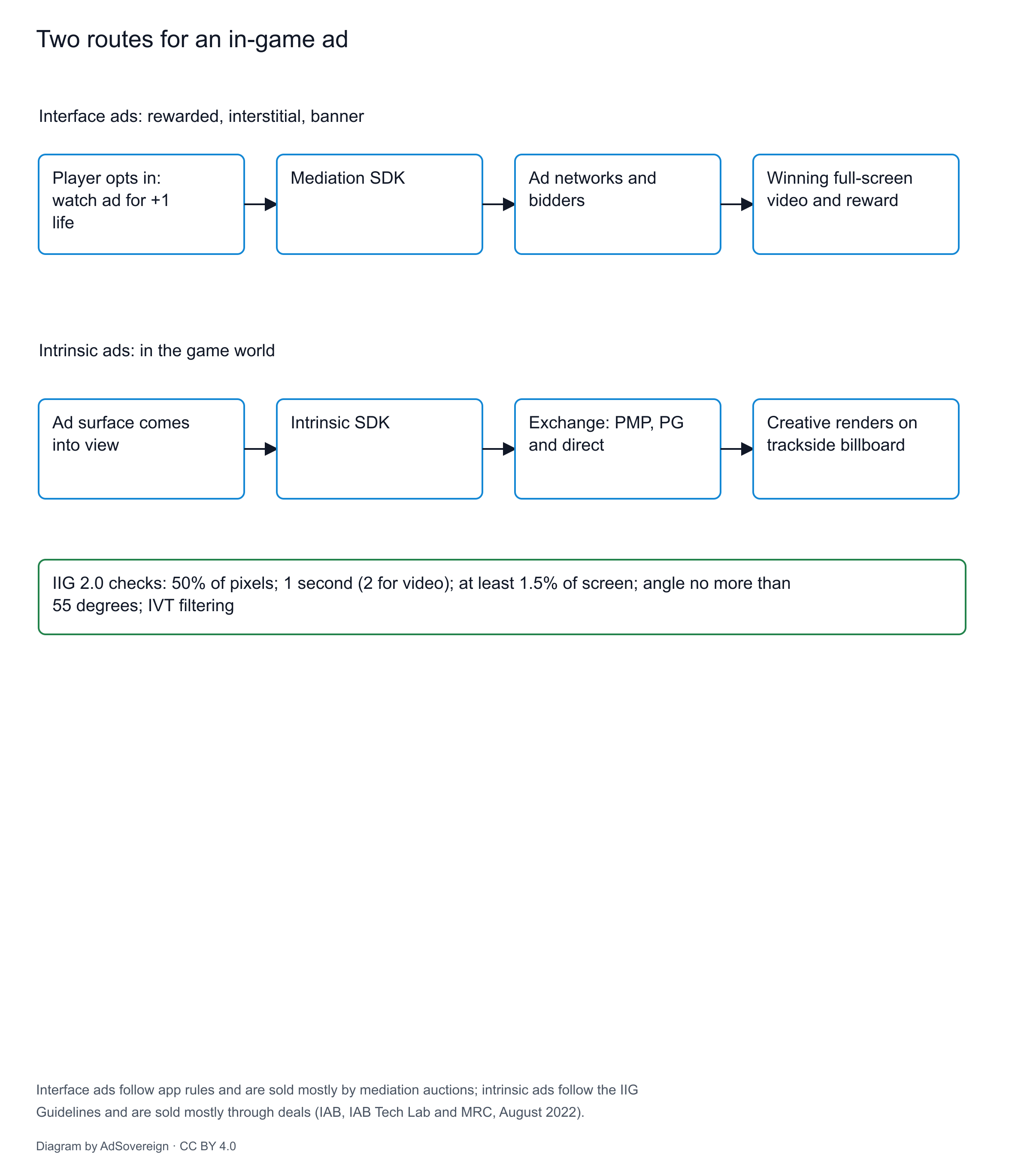
Most mobile games do not run their own auction. They install a mediation SDK, which asks several ad networks and bidders to compete for each slot. AppLovin's MAX, for example, runs what AppLovin calls a single real-time auction among bidding platforms for the publisher's inventory (AppLovin 10-K, FY2025). Unity sells mediation, its own ad networks and an offerwall (Unity 10-K, FY2025).
This in-app bidding replaced the older waterfall, where networks were called one after another in a fixed order. The idea mirrors header bidding on websites, explained in our guide to header bidding. Intrinsic ads work differently. The game integrates the specialist's SDK, which defines ad surfaces in the game world, measures what the player sees and pulls demand from DSPs and direct deals.

Diagram by AdSovereign, CC BY 4.0.
In OpenRTB 2.6, a rewarded video looks like any app video request with two extra signals. The instl field is set to 1 for full screen, and rwdd is set to 1 because the user receives a reward (OpenRTB 2.6). The example below uses illustrative IDs and floor values.
{
  "id": "game-req-5521",
  "imp": [
    {
      "id": "1",
      "instl": 1,
      "rwdd": 1,
      "video": {
        "mimes": ["video/mp4"],
        "minduration": 5,
        "maxduration": 30,
        "plcmt": 3,
        "protocols": [7, 11],
        "w": 1080,
        "h": 1920
      },
      "bidfloor": 8.0,
      "bidfloorcur": "USD"
    }
  ],
  "app": {
    "bundle": "com.example.racinggame",
    "cat": ["IAB9-30"],
    "publisher": { "id": "studio-42" }
  },
  "device": { "devicetype": 4, "os": "Android" },
  "tmax": 600
}
6 of 6 rows
| Full-screen placement (OpenRTB 2.6) |
| The player gets a reward for watching, such as an extra life |
| Interstitial video played without other video content (AdCOM 1.0) |
| VAST 4.0 and VAST 4.1 |
| The game's store ID, which buyers check against app-ads.txt |
| Phone |
instl 1
- What it tells the buyer
Full-screen placement (OpenRTB 2.6)
rwdd 1
- What it tells the buyer
The player gets a reward for watching, such as an extra life
video.plcmt 3
- What it tells the buyer
Interstitial video played without other video content (AdCOM 1.0)
video.protocols 7, 11
- What it tells the buyer
VAST 4.0 and VAST 4.1
app.bundle
- What it tells the buyer
The game's store ID, which buyers check against app-ads.txt
device.devicetype 4
- What it tells the buyer
Phone
Table by AdSovereign, CC BY 4.0.
There is no OpenRTB object for "a billboard inside a game", so intrinsic sellers usually describe placements in deal terms and their own SDK data. The cat value here uses an older content taxonomy code for video games and is illustrative. Our planned OpenRTB bid request builder and OpenRTB 2.6 explained cover the full request.
In-game advertising platforms compared
The table lists the main in-game advertising platforms named in this guide, described from their filings, releases or websites, checked on 9 November 2026. It does not rank them; scale figures are not comparable because the companies report different things.
7 of 7 rows
Unity (Unity Ads, ironSource Ads, LevelPlay) | Mobile ad networks, mediation, offerwall; Unity Vector machine-learning model since Q1 2025 | Public (NYSE: U); merged with ironSource on 7 Nov 2022 | Grow Solutions revenue $1,228.2M in 2025; $457.0M in Q3 2026, against $318.3M a year earlier | |
AppLovin (AppLovin Ads, Axon, MAX, Adjust) | Ad platform for app and web advertisers; MAX in-app bidding; Adjust measurement | Public (Nasdaq: APP); sold its Apps business to Tripledot on 30 Jun 2025 for $400M in cash plus about 20% of Tripledot's equity | Revenue $5,480.7M in 2025, up 70%; Q3 2026 revenue up 55% | |
Google AdMob | Mobile ad network and mediation; rewarded, interstitial, banner, native | Alphabet | Rewarded ads countdown of 5 to 30 seconds; added video formats to its immersive ads beta (per Roblox) | |
Roblox | Platform selling immersive ads (Rewarded Video, Billboards, Portals), sponsored experiences and items | Public (NYSE: RBLX) | 127M average DAUs in 2025; ad revenue described as insignificant; buyable via Google Ad Manager since 2025 | |
Anzu | Intrinsic in-game ad SDK and exchange for mobile, PC and console | Private; investors n/d | Calls itself the sole officially licensed in-game ad provider for Xbox (company claim); click-enabled formats from 9 Feb 2026 | |
Frameplay | Intrinsic in-game ad SDK and network | Private; ownership n/d | IAS measures its IVT and impression counts under a partnership announced 5 Oct 2023 | |
Microsoft (Xbox) | No in-game ad product announced that we could find | Microsoft | Xbox's strategy chief said in June 2026 that ads under discussion were ad-supported tiers, not in-game ads |
Unity (Unity Ads, ironSource Ads, LevelPlay)
- Type
Mobile ad networks, mediation, offerwall; Unity Vector machine-learning model since Q1 2025
- Ownership (dated)
Public (NYSE: U); merged with ironSource on 7 Nov 2022
- Facts with dates
Grow Solutions revenue $1,228.2M in 2025; $457.0M in Q3 2026, against $318.3M a year earlier
AppLovin (AppLovin Ads, Axon, MAX, Adjust)
- Type
Ad platform for app and web advertisers; MAX in-app bidding; Adjust measurement
- Ownership (dated)
Public (Nasdaq: APP); sold its Apps business to Tripledot on 30 Jun 2025 for $400M in cash plus about 20% of Tripledot's equity
- Facts with dates
Revenue $5,480.7M in 2025, up 70%; Q3 2026 revenue up 55%
- Source
Google AdMob
- Type
Mobile ad network and mediation; rewarded, interstitial, banner, native
- Ownership (dated)
Alphabet
- Facts with dates
Rewarded ads countdown of 5 to 30 seconds; added video formats to its immersive ads beta (per Roblox)
- Source
Roblox
- Type
Platform selling immersive ads (Rewarded Video, Billboards, Portals), sponsored experiences and items
- Ownership (dated)
Public (NYSE: RBLX)
- Facts with dates
127M average DAUs in 2025; ad revenue described as insignificant; buyable via Google Ad Manager since 2025
- Source
Anzu
- Type
Intrinsic in-game ad SDK and exchange for mobile, PC and console
- Ownership (dated)
Private; investors n/d
- Facts with dates
Calls itself the sole officially licensed in-game ad provider for Xbox (company claim); click-enabled formats from 9 Feb 2026
Frameplay
- Type
Intrinsic in-game ad SDK and network
- Ownership (dated)
Private; ownership n/d
- Facts with dates
IAS measures its IVT and impression counts under a partnership announced 5 Oct 2023
- Source
Microsoft (Xbox)
- Type
No in-game ad product announced that we could find
- Ownership (dated)
Microsoft
- Facts with dates
Xbox's strategy chief said in June 2026 that ads under discussion were ad-supported tiers, not in-game ads
Table by AdSovereign, CC BY 4.0.
Mobile game ad networks: Unity, AppLovin and AdMob
Mobile games are where most in-game ad money flows, and three groups dominate the tooling. Their business is mostly performance: advertisers, often other game makers, pay to acquire players who install and spend.
Unity. Unity merged with ironSource, an Israeli ad tech company, on 7 November 2022, with ironSource shareholders taking about 27% of the combined company (Unity 8-K, 7 November 2022). Unity now runs two ad networks. In Q4 2025 the Unity Ad Network, rebuilt on its Vector model, made up 56% of Grow Solutions revenue and the ironSource Ad Network 11% (Unity 10-K, FY2025). Unity says it earns most Grow revenue on revenue-share terms with publishers.
AppLovin. AppLovin has turned itself from a game maker into a pure ad platform. It sold its Apps business to Tripledot on 30 June 2025 and kept an equity stake (AppLovin 10-K, FY2025). Its 2025 revenue growth came mainly from a 72% rise in net revenue per installation, with install volume up 3%. Advertisers set return goals, and AppLovin charges dynamically against them rather than at a fixed price per impression.
Google AdMob. AdMob is Google's mobile app ad network and mediation tool, and its rewarded units can serve video, playable ads or surveys (Google AdMob Help, accessed 9 November 2026). Google's wider ad tech, including Ad Manager and Authorized Buyers, also sits behind Roblox's programmatic offer.
For a game publisher, the practical choice is which mediation layer runs the auction and which networks bid in it. Many publishers use one company's mediation and several companies' demand. Unity notes in its 10-K that it relies on third-party mediation platforms, some run by competitors, for much of its inventory.
Intrinsic specialists: Anzu and Frameplay
Intrinsic advertising is the part of gaming that looks most like brand media. The ads sit in the scenery, players do not have to stop playing, and buyers judge them on viewable time rather than installs.
Anzu. Anzu sells intrinsic placements across mobile, PC and console games. Its developer page calls it "the sole officially licensed in-game ad provider for Xbox" (company claim; we found no Microsoft statement confirming it) (Anzu, accessed 9 November 2026). Its February 2026 launch added clickable formats aimed at performance DSPs. Anzu says they lift click-through rates by 13% for video and 5% for display against online benchmarks (company data) (Anzu, 9 February 2026).
Frameplay. Frameplay offers an SDK for game developers and sells intrinsic placements to brands. In October 2023 it announced that Integral Ad Science would provide independent impression counts and IVT measurement across its network (Frameplay, 5 October 2023). IAS has been privately owned by Novacap since 23 December 2025 (IAS 8-K, 23 December 2025). See the Integral Ad Science profile.
Neither company held MRC accreditation for in-game measurement on 9 November 2026, based on the MRC's public lists. Independent checks therefore come from verification partners such as IAS, rather than from an MRC audit of the intrinsic metric itself.
Platforms: Roblox and Xbox
Roblox. Roblox is the clearest example of a game platform building its own ad business. Creators insert immersive ad units, such as Rewarded Video, Billboards and Portals, and Roblox serves ads into them programmatically, sharing revenue with creators as earned Robux (Roblox 10-K, FY2025). It added Google Ad Manager in April 2025 and planned to connect PubMatic and other DSPs through Google's Authorized Buyers. Cint, DoubleVerify, IAS, Kantar and Nielsen were named as measurement partners (Roblox, 1 April 2025).
The business is still small. Roblox's 10-K describes advertising and licensing together as an insignificant share of revenue, though it plans to keep investing in ads. Its age gate matters too: in April 2025 it said more than 61% of daily users, over 50 million people, were over 13 and eligible to see ads (company data) (Roblox, 1 April 2025). For DoubleVerify, see the DoubleVerify profile; Nielsen agreed to acquire DoubleVerify on 6 August 2026, with closing pending (DoubleVerify 8-K, 6 August 2026).
Microsoft and Xbox. Microsoft has not announced an in-game ad product for Xbox that we could find. In June 2026 Xbox's chief strategy officer, Matthew Ball, discussed ads as a way to offer cheaper options, then clarified that he did not mean in-game ads (Windows Central, updated 12 June 2026). Console in-game ads today come mainly through third parties such as Anzu, under their own claims.
In-game advertising measurement and the IAB guidelines
The IIG Guidelines 2.0 were written jointly by the IAB, IAB Tech Lab and MRC, and they adapt online viewability to a 3D world (MRC, August 2022). Four rules matter most to buyers:
- Pixels and time. At least 50% of the ad must be visible from the player's view for one continuous second, or two seconds for video.
- Minimum size. The visible part of the ad must cover at least 1.5% of the screen.
- Angle. Where it can be measured, the ad should face the player at no more than 55 degrees on any axis, though vendors may use other thresholds with evidence.
- One count per session. Seeing the same billboard again in the same session adds viewable time but not another viewable impression.
A worked example shows how strict the size rule is, using the guideline's own logic. A trackside billboard covers 2% of the screen when fully visible. If a car blocks half of it, the visible part covers 1%, below the 1.5% floor, so the impression is not viewable even though half its pixels show. The guidelines give a near-identical example.
The scope is narrower than many buyers assume. The IIG rules cover ad-served placements in games on desktop, mobile, console and AR or VR headsets. They do not cover interstitials, banners or in-stream video, which follow the normal MRC rules for apps, nor hard-coded brand integrations. The general MRC viewability rules are explained in our guide to viewability, attention and brand safety, and fraud filtering in ad fraud detection tools.
The IAB has since added buyer guidance. Its Gaming Measurement Framework, released on 26 June 2025, lists standard gaming formats across display, video, audio and custom units, with must-have and nice-to-have metrics for each (IAB, 26 June 2025). A Gaming Ad Formats Framework, dated 29 May 2025, describes the formats themselves (IAB, accessed 9 November 2026).
What is programmatic and what is direct in gaming
"Programmatic" means different things across gaming, and buyers who mix them up overpay or under-deliver. The table sorts the main routes.
5 of 5 rows
Rewarded, interstitial and banner ads in mobile games | Mediation auctions and in-app bidding; advertisers buy through ad networks' own tools or DSPs | Yes, mostly automated, often priced on installs or return goals (AppLovin 10-K) |
Intrinsic placements in mobile, PC and console games | PMP and programmatic guaranteed deals through DSPs, plus direct campaigns | Partly; deals dominate (company descriptions) |
Roblox Rewarded Video and Billboards | Google Ad Manager programmatic, including PG and PMP deals, or direct insertion orders | Yes, since April 2025 (Roblox) |
Roblox Premium Home takeovers, sponsored experiences | Direct with Roblox | No |
Hard-coded product placement and custom branded worlds | Direct with the publisher or an agency | No |
Rewarded, interstitial and banner ads in mobile games
- How it is usually bought
Mediation auctions and in-app bidding; advertisers buy through ad networks' own tools or DSPs
- Programmatic?
Yes, mostly automated, often priced on installs or return goals (AppLovin 10-K)
Intrinsic placements in mobile, PC and console games
- How it is usually bought
PMP and programmatic guaranteed deals through DSPs, plus direct campaigns
- Programmatic?
Partly; deals dominate (company descriptions)
Roblox Rewarded Video and Billboards
- How it is usually bought
Google Ad Manager programmatic, including PG and PMP deals, or direct insertion orders
- Programmatic?
Yes, since April 2025 (Roblox)
Roblox Premium Home takeovers, sponsored experiences
- How it is usually bought
Direct with Roblox
- Programmatic?
No
Hard-coded product placement and custom branded worlds
- How it is usually bought
Direct with the publisher or an agency
- Programmatic?
No
Table by AdSovereign, CC BY 4.0.
For brand buyers, the useful rule is this: use programmatic guaranteed or PMP deals for intrinsic and platform inventory, where volume is limited and quality varies by game. Leave open in-app auctions to campaigns judged on installs or sales.
How to choose an in-game advertising platform: a checklist
For advertisers:
- Decide brand or performance first. Intrinsic ads and Roblox suit reach and attention; mobile ad networks suit installs and sales.
- Ask which measurement standard applies. Intrinsic placements should report under IIG 2.0; interface ads under the normal in-app rules.
- Ask for IVT measurement by a third party, and check which vendor and what scope.
- Check the age rules of each platform and your own policy for audiences under 18.
- Get a game-level list of where ads ran, not just a network total.
- Test against a holdout before scaling, as for any new channel.
For game publishers:
- Pick the mediation layer deliberately, since it decides which demand competes for your slots.
- Design ad surfaces that meet the 1.5% size floor if you sell intrinsic inventory.
- Declare rewarded and full-screen slots accurately with
rwddandinstl, and keep app-ads.txt current. - Keep reward values balanced so ads add to play rather than replace it.
Where to go next
- Viewability, attention metrics and brand safety: the MRC rules that intrinsic viewability builds on.
- Ad fraud detection tools and companies compared: IVT filtering for apps and games.
- Header bidding explained: the web cousin of in-app bidding.
- Programmatic audio platforms and programmatic DOOH platforms: two more channels outside the browser.
- RTB architecture hub: how the auctions underneath fit together.
FAQ
What are some in-game advertising examples?
What is the difference between intrinsic and rewarded in-game ads?
How do you advertise on Roblox?
Does Xbox have in-game ads?
Is in-game advertising programmatic?
How are in-game ads measured?
How this works on owned infrastructure
The decision behind this page is who runs the auction for a game's ad slots, and who sees the player and spend data it produces. A studio that hands monetisation to one network's mediation layer gets convenience, but the network also learns which advertisers value its players most. When the auction and ad decisioning run on infrastructure the studio or publisher controls, it can let several networks, DSPs and direct brand deals compete in one place, under its own floors and reward rules. Impression, reward and viewability logs stay with the studio, ready to reconcile against each partner's report. AdSovereign is an enterprise real-time bidding stack designed for operators who want that control. The integrations page lists demand connections, and the TCO page sets out the cost model.
Sources
- IAB, "IAB Releases Intrinsic In-Game (IIG) Measurement Guidelines 2022" (31 August 2022). https://www.iab.com/insights/iab-releases-intrinsic-in-game-iig-measurement-guidelines/
- IAB, IAB Tech Lab and Media Rating Council, "In-Game Advertising Measurement Guidelines 2.0" (August 2022), hosted by the MRC. https://mediaratingcouncil.org/sites/default/files/Standards/In-Game%20Advertising%20Measurement%20Guidelines%2008-31-22.pdf
- IAB, "IAB Launches Gaming Measurement Framework to Standardize and Elevate Advertising in Gaming" (26 June 2025). https://www.iab.com/news/iab-launches-gaming-measurement-framework-to-standardize-and-elevate-advertising-in-gaming/
- IAB, "Gaming Ad Formats Framework" (29 May 2025; accessed 9 November 2026). https://www.iab.com/guidelines/gaming-ad-format-framework/
- Unity Software Inc., Form 8-K, completion of the merger with ironSource (7 November 2022). https://www.sec.gov/Archives/edgar/data/1810806/000119312522279161/d402948d8k.htm
- Unity Software Inc., Form 10-K for fiscal year 2025 (filed 11 February 2026). https://www.sec.gov/Archives/edgar/data/1810806/000181080626000011/unity-20251231.htm
- Unity Software Inc., Form 10-Q for the quarter ended 30 September 2026 (filed 5 November 2026). https://www.sec.gov/Archives/edgar/data/1810806/000181080626000055/unity-20260930.htm
- AppLovin Corporation, Form 10-K for fiscal year 2025 (filed 19 February 2026). https://www.sec.gov/Archives/edgar/data/1751008/000175100826000010/app-20251231.htm
- AppLovin Corporation, Form 10-Q for the quarter ended 30 September 2026 (filed 4 November 2026). https://www.sec.gov/Archives/edgar/data/1751008/000175100826000069/app-20260930.htm
- Google AdMob Help, "Overview of rewarded ad units" (accessed 9 November 2026). https://support.google.com/admob/answer/7372450?hl=en
More sources (11)
- Roblox, "Roblox Launches Rewarded Video Ads, Partners With Google to Scale Immersive Advertising" (1 April 2025). https://about.roblox.com/newsroom/2025/04/roblox-scales-video-ads-partners-with-google
- Roblox Corporation, Form 10-K for fiscal year 2025 (filed 11 February 2026). https://www.sec.gov/Archives/edgar/data/1315098/000131509826000024/rblx-20251231.htm
- Anzu, "Anzu Redefines In-Game Advertising With Performance-Driven Player-First Intrinsic Formats" (9 February 2026). https://www.anzu.io/news/anzu-redefines-in-game-advertising-with-performance-driven-player-first-intrinsic-formats
- Anzu, "PC and console game developers" page (accessed 9 November 2026). https://www.anzu.io/pc-console-game-developers
- Frameplay, "Frameplay and Integral Ad Science Partnership Brings Greater Transparency to Intrinsic In-Game Advertising" (5 October 2023). https://frameplay.com/resource/frameplay-and-integral-ad-science-partnership-brings-greater-transparency-to-intrinsic-in-game-advertising/
- Windows Central, "Xbox's chief strategist considers using ads to 'offer more affordable alternatives' for experiences" (updated 12 June 2026). https://www.windowscentral.com/gaming/xbox/oh-boy-xboxs-chief-strategist-is-floating-the-idea-of-in-game-ads
- Media Rating Council, accredited digital services (accessed 9 November 2026). https://mediaratingcouncil.org/accreditation/digital
- Integral Ad Science Holding Corp., Form 8-K on completion of the merger with Novacap (23 December 2025). https://www.sec.gov/Archives/edgar/data/1842718/000114036125046475/ef20061707_8k.htm
- DoubleVerify Holdings, Inc., Form 8-K, Exhibit 99.1, agreement to be acquired by Nielsen (6 August 2026). https://www.sec.gov/Archives/edgar/data/1819928/000110465926092121/tm2621904d1_ex99-1.htm
- IAB Tech Lab, OpenRTB 2.6 specification, section 3.2.4 "Object: Imp" and 3.2.7 "Object: Video", GitHub (accessed 9 November 2026). https://github.com/InteractiveAdvertisingBureau/openrtb2.x/blob/main/2.6.md
- IAB Tech Lab, AdCOM 1.0, list "Plcmt Subtypes - Video", GitHub (accessed 9 November 2026). https://github.com/InteractiveAdvertisingBureau/AdCOM/blob/main/AdCOM%20v1.0%20FINAL.md
Changelog
- 9 November 2026: first draft. Company filings, Roblox and Anzu releases, IAB and MRC documents, MRC lists and OpenRTB fields checked on this date.