
RTB Architecture
Ad Ops Explained: What Ad Operations Means, the Ad Trafficking Process, Tools and Salaries
Published · Last updated
Next scheduled review:
Ad ops, short for advertising operations, is the work of turning a sold or bought campaign into ads that actually serve. On the publisher side, ad ops sets up orders, line items and creatives in the ad server. On the buyer side, it builds campaigns in a DSP. Both sides test, watch pacing and reconcile reports.
Contents
Key facts
- Most of the job is running live campaigns. In the IAB's Digital Ad Operations Certification exam, managing live campaigns carries 37.5% of the weight and launching campaigns 33.75% (IAB Certification, accessed 9 November 2026).
- The ad server ranks campaigns by number. In Google Ad Manager, a Sponsorship line item has priority 4, a Standard line item 6, 8 or 10, programmatic and remnant types 12 and House 16. The lower number wins (Google Ad Manager Help, accessed 9 November 2026).
- Header bidding multiplies the setup work. Prebid's "medium" price granularity, in $0.10 steps up to $20, needs 201 line items per bidder; "high" granularity needs 2,001 (Prebid.org, accessed 9 November 2026).
- A 10% gap is the standard trigger for a dispute. Under the 4A's/IAB Standard Terms and Conditions, version 3.0, parties reconcile when the billing count and the other count differ by more than 10% over the invoice period (4A's/IAB T&Cs v3.0, 2010).
- Reported pay varies widely by source. Payscale shows an average base salary of $50,976 for an ad operations specialist, from 16 salary profiles last updated on 1 September 2026 (Payscale, accessed 9 November 2026). Talent.com shows $64,738 for the same title in 2026 (Talent.com, accessed 9 November 2026).
- There is no federal ad ops category. The US Bureau of Labor Statistics (BLS) publishes no separate ad operations occupation. Its nearest group, market research analysts and marketing specialists, had a median wage of $78,760 in May 2025 (BLS OEWS, May 2025).
Definition
Ad operations (ad ops): the function that configures, tests, delivers, monitors and reconciles advertising campaigns in ad servers and buying platforms, so that what serves matches what was sold or bought.
Key terms on this page: ad server · ad trafficking · header bidding · deal ID · frequency capping · VAST · floor price · fill rate · eCPM · log-level data
Ad ops meaning: what advertising operations covers
Sales teams sell ad space and media buyers plan where money goes. Ad ops makes both real. A signed order is only a promise until someone enters it into the systems that choose which ad appears in each slot. That someone is ad ops, and the entering is called ad trafficking.
The IAB, the trade body that certifies the role, describes the job as supporting clients through the whole campaign. That includes creative management, launch and pacing confirmation, quality assurance, traffic logging, placement reports and entering proposals (IAB Certification, accessed 9 November 2026). In plain terms: set it up, check it, keep it running, explain the numbers.
The same title means different work depending on which side of the trade you sit. The table compares the two sides.
5 of 5 rows
Works for | A website, app, streaming service or retail media network selling ad space | An advertiser, an agency or an in-house buying team |
Main systems | The publisher's ad server (for example Google Ad Manager, Kevel, Equativ, FreeWheel) and SSP consoles | A DSP (for example Display & Video 360, The Trade Desk), an advertiser ad server and verification tools |
Core objects | Orders, line items, creatives, ad units, key-values, floors | Campaigns, insertion orders, line items, creatives, audiences, deals |
Daily tasks | Traffic insertion orders, set priorities, manage header bidding and deals, fix delivery problems | Build campaigns, attach audiences and deals, apply brand safety, pace budgets |
Measured on | Delivery against the contract, fill rate, eCPM, revenue | Delivery and pacing against plan, cost, media quality |
Works for
- Publisher (sell-side) ad ops
A website, app, streaming service or retail media network selling ad space
- Buyer (agency or brand) ad ops
An advertiser, an agency or an in-house buying team
Main systems
- Publisher (sell-side) ad ops
The publisher's ad server (for example Google Ad Manager, Kevel, Equativ, FreeWheel) and SSP consoles
- Buyer (agency or brand) ad ops
A DSP (for example Display & Video 360, The Trade Desk), an advertiser ad server and verification tools
Core objects
- Publisher (sell-side) ad ops
Orders, line items, creatives, ad units, key-values, floors
- Buyer (agency or brand) ad ops
Campaigns, insertion orders, line items, creatives, audiences, deals
Daily tasks
- Publisher (sell-side) ad ops
Traffic insertion orders, set priorities, manage header bidding and deals, fix delivery problems
- Buyer (agency or brand) ad ops
Build campaigns, attach audiences and deals, apply brand safety, pace budgets
Measured on
- Publisher (sell-side) ad ops
Delivery against the contract, fill rate, eCPM, revenue
- Buyer (agency or brand) ad ops
Delivery and pacing against plan, cost, media quality
Table by AdSovereign, CC BY 4.0.
A short example shows both sides at once. A running-shoe brand books 2,000,000 homepage impressions on a fitness site for April. The site's ad ops team builds the order in its ad server. The brand's agency ad ops team builds tracking tags and checks that its own ad server counts the same impressions. At month end the two teams compare counts. The numbers here are illustrative; the counting rules come from the 4A's/IAB Standard Terms and Conditions.
Ad ops roles and job titles
Job titles vary between companies, and the IAB does not publish a single ladder. These are the titles people search for most, with the work they usually cover.
- Ad operations coordinator or associate. An entry role. Enters orders and creatives, runs pre-launch checks and pulls standard reports under supervision.
- Ad trafficker or ad operations specialist. Owns campaign setup and QA from start to finish. Troubleshoots delivery and answers questions from sales or the client.
- Ad ops manager. Runs the team and its processes, sets naming and QA standards, handles escalations and billing disputes, and works with sales on what can be sold.
- Programmatic or yield manager. Focuses on floors, deals, header bidding partners and demand paths, aiming to raise revenue per impression.
- Ad ops engineer or solutions specialist. Writes scripts against platform APIs, automates bulk setup and integrates new partners.
Many teams now sit inside retail media networks and streaming services as well as publishers and agencies. Our guides to retail media jobs and salaries and the in-house programmatic operating model cover those structures.
The ad trafficking process, step by step
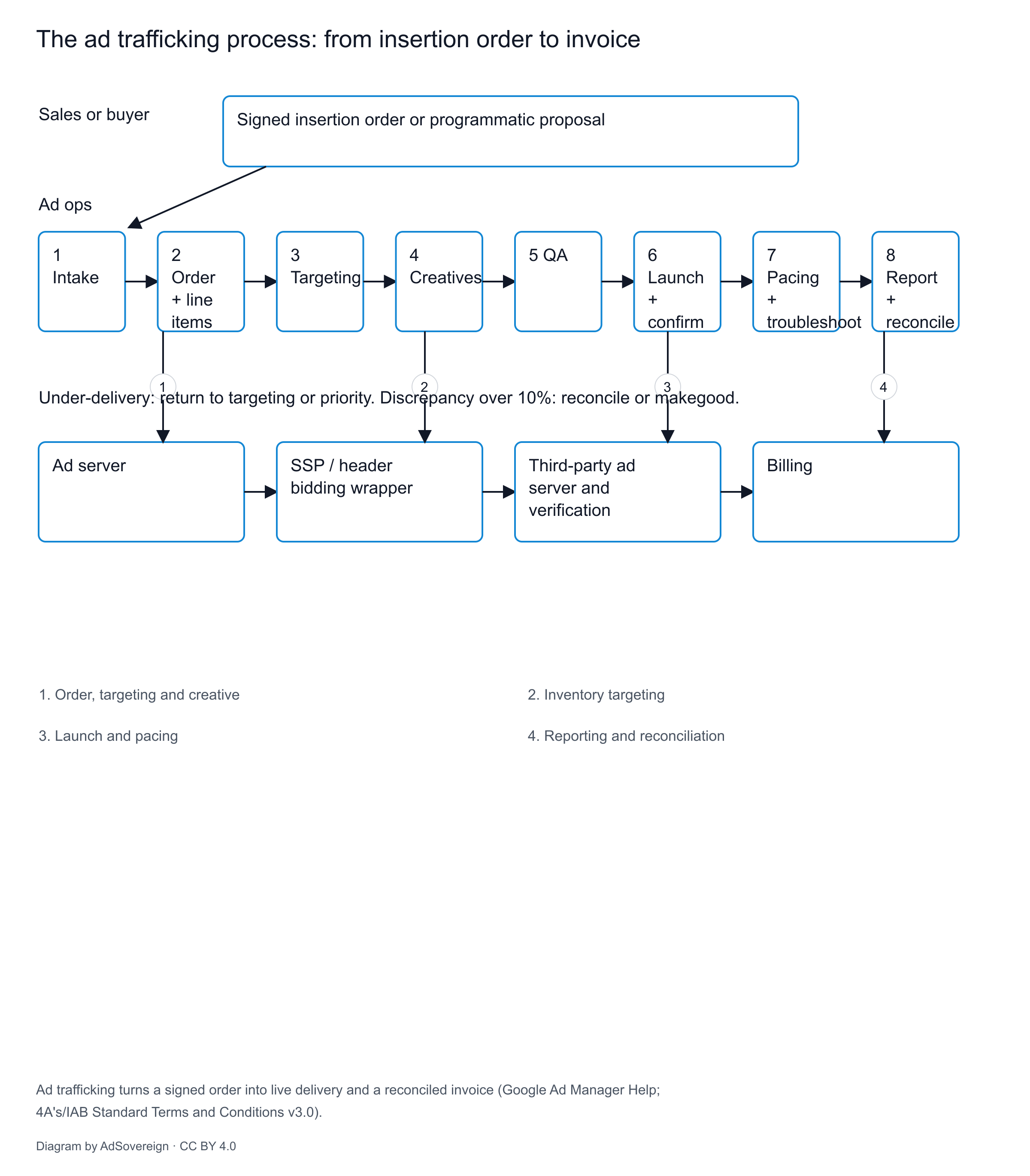
Ad trafficking is the setup work that puts a campaign into an ad server or a DSP. The eight steps below follow the publisher side in Google Ad Manager, the most widely documented ad server (Google Ad Manager Help, accessed 9 November 2026). Buyer-side teams follow the same pattern in a DSP.
- Take in the order. Read the insertion order or programmatic proposal: dates, volume, price, targeting and creative specs. Google notes that at larger organisations someone else usually negotiates these details, and the trafficker's job is to enter and manage them.
- Create the order and line items. An order belongs to one advertiser and holds one or more line items. Each line item carries a quantity, a price, start and end times and a type that sets its priority.
- Add targeting. Choose ad units, geography, devices, key-values and frequency capping. Google advises narrowing targeting for small goals to reduce over-delivery (Google Ad Manager Help).
- Take in and attach creatives. Check sizes, file weight, click-through links and third-party tags. Video ads usually arrive as VAST tags, the IAB Tech Lab's format for video ad responses.
- Run quality assurance. Preview on real devices, check that every tracking tag fires and confirm the ad appears where it should. The QA section below has the checklist.
- Launch and confirm. Activate, then confirm within the first hours that the line item is serving and the third-party counts are moving.
- Watch pacing and fix delivery. Compare delivered impressions with the goal each day. Use the ad server's troubleshooting tools when a line item falls behind.
- Report and reconcile. Send reports, compare counts with the buyer's ad server and settle discrepancies or makegoods before the invoice.
The pacing step is simpler than it sounds. Google's own example: a line item with 7,000 booked impressions running for 7 days, set to deliver evenly, gets 1,000 impressions a day. With "expected traffic shape" turned on, it delivers more at busy hours and less at quiet ones. Pacing changes can take up to 48 hours to apply (Google Ad Manager Help, accessed 9 November 2026).

Diagram by AdSovereign, CC BY 4.0.
Line item types and priorities: how the ad server decides
When a page loads, the ad server picks a line item for each slot. In Google Ad Manager, the line item type sets a starting priority, and a lower number means a higher priority. Type is only one input, alongside targeting, pacing and price (Google Ad Manager Help, accessed 9 November 2026).
7 of 7 rows
Sponsorship | 4 | Yes | Takeovers: a share of impressions for set dates | |
Standard | 6, 8 or 10 | Yes | A fixed number of impressions by an end date | |
Network | 12 | No | Partner ad networks without an impression goal | |
Bulk | 12 | No | Partners with an impression cap | |
Price priority | 12 | No | Unsold inventory, filled by the highest-paying line item | |
Ad Exchange and AdSense | 12 | No | Google's own demand | |
House | 16 | No | Fallback ads with no price, such as the publisher's own promotions |
Sponsorship
- Priority
4
- Guaranteed?
Yes
- Typical use
Takeovers: a share of impressions for set dates
- Source
Standard
- Priority
6, 8 or 10
- Guaranteed?
Yes
- Typical use
A fixed number of impressions by an end date
- Source
Network
- Priority
12
- Guaranteed?
No
- Typical use
Partner ad networks without an impression goal
- Source
Bulk
- Priority
12
- Guaranteed?
No
- Typical use
Partners with an impression cap
- Source
Price priority
- Priority
12
- Guaranteed?
No
- Typical use
Unsold inventory, filled by the highest-paying line item
- Source
Ad Exchange and AdSense
- Priority
12
- Guaranteed?
No
- Typical use
Google's own demand
- Source
House
- Priority
16
- Guaranteed?
No
- Typical use
Fallback ads with no price, such as the publisher's own promotions
- Source
Table by AdSovereign, CC BY 4.0.
A practical case: a site sells a one-day homepage takeover to a carmaker as a Sponsorship line item at priority 4. The same day, a Price priority line item from header bidding offers a high price at priority 12. The Sponsorship generally serves first. Google notes one exception: with dynamic allocation switched on, non-guaranteed demand can compete with guaranteed line items in real time (Google Ad Manager Help). Fixed-price programmatic deals sit in this order too; programmatic guaranteed vs PMP explains where each one lands.
Other ad servers use different names for the same ideas. The planned profiles of Google Ad Manager, Kevel, Equativ, FreeWheel and Adform show how each one ranks demand, and Google Ad Manager alternatives compares them.
Trafficking header bidding and programmatic deals
Header bidding adds a lot of line items. The page collects bids from several exchanges before the ad server runs. Each bid reaches the ad server as a key-value such as hb_pb, the price bucket. Ad ops then needs a line item for every bucket, so the ad server can compare that bid with everything else (Prebid.org, accessed 9 November 2026).
Prebid groups bids into buckets to keep the count manageable. The table shows its built-in settings (Prebid.org, accessed 9 November 2026).
5 of 5 rows
Low | $0.50 | $5.00 | 11 |
Medium | $0.10 | $20.00 | 201 |
High | $0.01 | $20.00 | 2,001 |
Auto | Sliding: $0.05 to $5, $0.10 to $10, $0.50 to $20 | $20.00 | 171 |
Dense | Sliding: $0.01 to $3, $0.05 to $8, $0.50 to $20 | $20.00 | 425 |
Low
- Increment
$0.50
- Cap
$5.00
- Line items per bidder
11
Medium
- Increment
$0.10
- Cap
$20.00
- Line items per bidder
201
High
- Increment
$0.01
- Cap
$20.00
- Line items per bidder
2,001
Auto
- Increment
Sliding: $0.05 to $5, $0.10 to $10, $0.50 to $20
- Cap
$20.00
- Line items per bidder
171
Dense
- Increment
Sliding: $0.01 to $3, $0.05 to $8, $0.50 to $20
- Cap
$20.00
- Line items per bidder
425
Table by AdSovereign, CC BY 4.0.
The arithmetic decides the workload. A publisher that sends all bids from six bidders at medium granularity needs 6 × 201, or 1,206 line items. That is why ad ops teams script this work through APIs rather than clicking. Prebid suggests a naming pattern such as "Prebid – banner – BidderA – 1.50" and placing these line items below direct-sold campaigns but above house and remnant ones (Prebid.org, accessed 9 November 2026). The mechanics of the auction itself are in header bidding explained.
This may change. The draft final judgment in the US case against Google, filed on 2 October 2026, would make Google's Header Bidding Trafficking feature available to every Ad Manager publisher within six months, whatever its size. It was still a draft with disputed terms when reported (PPC Land, 6 October 2026). Our guide to the Google ad tech remedies for publishers tracks its status.
Programmatic deals add their own setup. Each deal has a deal ID, a price and often a floor price, and the deal must be targeted to the right line item on both sides. Most "my deal is not spending" tickets come down to a mismatch between those settings.
Ad ops QA: what to check before launch
Quality assurance is the step that saves the most money. A missed check can cost a whole flight. Use this list before every launch:
- Creative specs. Size, file weight and format match the placement. Video tags return valid VAST; the IAB Tech Lab offers a VAST Tag Validator.
- Click-through. The landing page loads, the tracking parameters are present and the click macro records clicks.
- Tracking tags. Impression, click and third-party verification tags all fire. In apps and CTV, check that measurement uses the Open Measurement SDK, which lets several verification vendors read one set of signals.
- Targeting. Geography, device, ad units, key-values and audience segments match the order.
- Dates and time zone. Start and end times are in the right time zone, so the campaign does not start a day early or end a day late.
- Frequency and pacing. Caps and delivery settings match the plan.
- Brand safety and viewability terms. Any agreed verification, viewability floor or category blocks are in place. Our guide to viewability, attention and brand safety explains what each one measures.
- Supply authorisation. For programmatic sellers, the publisher's ads.txt lists every SSP selling the inventory. The free ads.txt and sellers.json validator checks this in seconds.
Here is a typical failure the list catches. A brand's European campaign is built with US Eastern time. It starts six hours late on launch day and the first morning's budget goes unspent. The fifth check on the list would have caught it in two minutes. The scenario is illustrative.
Pacing, delivery and discrepancies
Once live, ad ops watches two numbers: whether delivery is on schedule, and whether the publisher's count matches the buyer's. An under-pacing line item usually has targeting that is too narrow, a priority that is too low or a creative that failed review. Google Ad Manager's "Troubleshoot" tab lists reasons a line item is not delivering (Google Ad Manager Help, accessed 9 November 2026).
Discrepancies are normal, because two ad servers never count at exactly the same moment. The industry's standard contract terms set the tolerance (4A's/IAB T&Cs v3.0, 2010):
- Which count bills. When both sides use ad servers compliant with IAB measurement guidelines, the buyer's third-party ad server usually controls, if it offers automated daily reporting to the publisher.
- When to reconcile. If the two counts differ by more than 10% over the invoice period and the controlling count is lower, the parties reconcile (T&Cs, section on discrepant measurement).
- If it cannot be resolved. The agency may treat the gap as under-delivery and ask for a makegood, or pay on the controlling count plus a 10% upward adjustment.
- Over-delivery. With a third-party ad server in use, the publisher should not bonus more than 10% above the order without the agency's consent.
A worked example: the publisher counts 1,000,000 impressions and the agency's ad server counts 880,000. The controlling count is 12% lower, which is above the 10% threshold, so the teams compare logs. If they cannot explain the gap, the agency can pay for 968,000 impressions (880,000 plus 10%), or ask for a makegood. Many teams settle the cause with log-level data, which shows each impression on both sides.
Ad ops tools: ad servers, DSP and SSP consoles, verification, spreadsheets and APIs
Ad ops works across many systems at once. The table groups the common tools by job.
7 of 7 rows
Publisher ad server | Orders, line items, creatives, priorities, forecasting, delivery reports | Google Ad Manager, Kevel, Equativ, FreeWheel for TV and video |
DSP console | Buyer-side campaigns, insertion orders, line items, audiences, deals | Display & Video 360, The Trade Desk |
SSP console | Floors, deals, buyer access, blocks, revenue reports | Magnite, PubMatic, Index Exchange |
Header bidding wrapper | Bidders, timeouts, price granularity | Prebid.js and Prebid Server |
Advertiser ad server and verification | Tags, independent counts, viewability, brand safety, invalid traffic | Campaign Manager 360, DoubleVerify, Integral Ad Science |
Spreadsheets and scripts | Bulk uploads, naming checks, pacing trackers, reconciliation | Spreadsheet templates, SQL on log files |
Platform APIs | Automated setup and reporting | Google Ad Manager SOAP API and Ad Manager API (Beta); Display & Video 360 API |
Publisher ad server
- What ad ops uses it for
Orders, line items, creatives, priorities, forecasting, delivery reports
- Examples
Google Ad Manager, Kevel, Equativ, FreeWheel for TV and video
DSP console
- What ad ops uses it for
Buyer-side campaigns, insertion orders, line items, audiences, deals
- Examples
Display & Video 360, The Trade Desk
SSP console
- What ad ops uses it for
Floors, deals, buyer access, blocks, revenue reports
- Examples
Magnite, PubMatic, Index Exchange
Header bidding wrapper
- What ad ops uses it for
Bidders, timeouts, price granularity
- Examples
Prebid.js and Prebid Server
Advertiser ad server and verification
- What ad ops uses it for
Tags, independent counts, viewability, brand safety, invalid traffic
- Examples
Campaign Manager 360, DoubleVerify, Integral Ad Science
Spreadsheets and scripts
- What ad ops uses it for
Bulk uploads, naming checks, pacing trackers, reconciliation
- Examples
Spreadsheet templates, SQL on log files
Platform APIs
- What ad ops uses it for
Automated setup and reporting
- Examples
Google Ad Manager SOAP API and Ad Manager API (Beta); Display & Video 360 API
Table by AdSovereign, CC BY 4.0.
APIs are where the role is heading. Google's Ad Manager SOAP API lets developers manage inventory, create orders and pull reports, and a REST-style Ad Manager API is in beta (Google for Developers, accessed 9 November 2026). On the buy side, the Display & Video 360 API exposes campaigns, insertion orders, line items and creatives; its reference was last updated on 22 October 2026 (Google for Developers). A specialist who can script a bulk change saves hours on every large launch.
Skills an ad ops specialist needs
The IAB's exam blueprint is the most concrete public map of the skills. It splits the job into four domains with set weights (IAB Certification, accessed 9 November 2026).
4 of 4 rows
Executing campaign launch | 33.75% | Check inventory and availability, place tracking tags, enter order details, take in and implement creative assets, run QA and pre-launch tests, verify launch |
Managing live campaigns | 37.50% | Monitor delivery, troubleshoot live issues, investigate discrepancies, manage revisions, respond to malicious activity, reconcile monthly billing |
Supporting ad operations initiatives | 17.50% | Onboard new partners, QA new ad products, document bugs and workarounds, contribute to product strategy |
Managing incidents | 11.25% | Initial diagnostics, judge severity, communicate updates, write post-mortems |
Executing campaign launch
- Weight in the exam
33.75%
- Tasks it lists (selection)
Check inventory and availability, place tracking tags, enter order details, take in and implement creative assets, run QA and pre-launch tests, verify launch
Managing live campaigns
- Weight in the exam
37.50%
- Tasks it lists (selection)
Monitor delivery, troubleshoot live issues, investigate discrepancies, manage revisions, respond to malicious activity, reconcile monthly billing
Supporting ad operations initiatives
- Weight in the exam
17.50%
- Tasks it lists (selection)
Onboard new partners, QA new ad products, document bugs and workarounds, contribute to product strategy
Managing incidents
- Weight in the exam
11.25%
- Tasks it lists (selection)
Initial diagnostics, judge severity, communicate updates, write post-mortems
Table by AdSovereign, CC BY 4.0.
Beyond the blueprint, the work rewards three kinds of skill:
- Technical basics. Reading HTML and JavaScript tags, VAST XML and bid request fields; using browser developer tools to see which tags fire.
- Data handling. Spreadsheets for pacing and reconciliation, and increasingly SQL and simple scripts for log files and APIs.
- Communication. Explaining a delivery problem to a salesperson or a client in plain words, with a date for the fix.
The certification itself is optional. Candidates who apply have six months to pass a multiple-choice exam, and a retake costs $175 (IAB Certification, accessed 9 November 2026). Our guide to programmatic advertising courses and certifications compares it with free training.
Ad operations specialist salary and ad ops manager salary
Pay figures for ad ops vary a lot by source, city and company type, and none comes from a large official survey. The table shows every figure we could verify with its method and date. Read each figure as a rough range, not a benchmark.
6 of 6 rows
Ad operations specialist | Average base $50,976; range shown $36,000 to $79,000 | Self-reported salary profiles; 16 profiles | Last updated 1 Sep 2026 | |
Ad operations manager | Average base $67,852; range shown $44,000 to $87,000 | Self-reported salary profiles; 17 profiles | Last updated 1 Sep 2026 | |
Ad operations specialist | Average $64,738; $42,532 entry level to $118,900 experienced | States "based on 10000 salaries"; collection method not described on the page | 2026, accessed 9 Nov 2026 | |
Ad operations manager | Average $100,000; $60,375 to $136,773 | Same statement | 2026, accessed 9 Nov 2026 | |
Market research analysts and marketing specialists (SOC 13-1161), the nearest federal group | Median $78,760; 10th percentile $43,390; 90th percentile $155,480 | Employer survey, national estimates | May 2025 | |
Advertising and promotions managers (SOC 11-2011), a senior comparison | Median $133,660; 10th percentile $63,300; 90th percentile $286,240 | Employer survey, national estimates | May 2025 |
- Role
Ad operations specialist
- Figure
Average base $50,976; range shown $36,000 to $79,000
- Method the source states
Self-reported salary profiles; 16 profiles
- Date
Last updated 1 Sep 2026
- Role
Ad operations manager
- Figure
Average base $67,852; range shown $44,000 to $87,000
- Method the source states
Self-reported salary profiles; 17 profiles
- Date
Last updated 1 Sep 2026
- Role
Ad operations specialist
- Figure
Average $64,738; $42,532 entry level to $118,900 experienced
- Method the source states
States "based on 10000 salaries"; collection method not described on the page
- Date
2026, accessed 9 Nov 2026
- Role
Ad operations manager
- Figure
Average $100,000; $60,375 to $136,773
- Method the source states
Same statement
- Date
2026, accessed 9 Nov 2026
- Role
Market research analysts and marketing specialists (SOC 13-1161), the nearest federal group
- Figure
Median $78,760; 10th percentile $43,390; 90th percentile $155,480
- Method the source states
Employer survey, national estimates
- Date
May 2025
- Role
Advertising and promotions managers (SOC 11-2011), a senior comparison
- Figure
Median $133,660; 10th percentile $63,300; 90th percentile $286,240
- Method the source states
Employer survey, national estimates
- Date
May 2025
Table by AdSovereign, CC BY 4.0.
Why do the numbers disagree so much? Payscale's figures rest on fewer than 20 self-reported profiles per title, so a handful of answers moves the average. Talent.com does not say how its figures are collected. The BLS figures are large and well documented, but they describe broader occupations that include many people who never traffic an ad (BLS OEWS, May 2025; Payscale, accessed 9 November 2026).
A practical reading for someone weighing an offer: an entry-level US ad ops role often appears in the $40,000 to $65,000 band across these sources. Manager roles at larger platforms and agencies reach well above the Payscale range. Location matters too. Talent.com's state breakdown for specialists runs from $61,515 in Washington to $69,740 in Maryland among the five states it shows (Talent.com, accessed 9 November 2026). Check current job postings in your city before deciding.
How ad ops is changing in 2026
- Auction transparency standards. The Media Rating Council published Digital Advertising Auction Transparency Standards in January 2026, with a steer team led by Omnicom and including the ANA, WFA, 4A's and IAB Tech Lab. They set reporting and disclosure rules for ad auctions, which ad ops teams will be asked to evidence (MRC, January 2026).
- Logged routing at Google. The draft remedies judgment would let a publisher call Google's exchange directly or through Prebid for an impression, but not both, with logs showing which route was used (PPC Land, 6 October 2026).
- Platform migrations. Microsoft shut down its Invest DSP, formerly Xandr, on 28 February 2026, so buyer-side teams that used it had to move their campaigns to other DSPs (MediaPost). Our Microsoft Invest migration playbook covers the steps.
- Agents in the workflow. IAB Tech Lab published its Agentic Advertising Management Protocols (AAMP) framework, a set of standards for software agents in advertising workflows, on 16 March 2026 (PPC Land, August 2026). Setup and QA rules still need people who understand them.
Where to go next
- Header bidding explained: the auction behind most of those price-bucket line items.
- Programmatic guaranteed vs PMP vs preferred deal: how each deal type is set up and prioritised.
- Google Ad Manager alternatives: other ad servers and how they differ.
- Log-level data 101: the evidence behind reconciliation.
- Programmatic advertising courses and certifications: where to learn the tools.
- RTB architecture hub: how the systems ad ops touches fit together.
FAQ
What does ad ops mean?
What is the ad trafficking process?
How much does an ad operations specialist make?
What is the average ad ops manager salary?
What is the difference between ad ops and programmatic?
What tools do ad ops teams use?
How this works on owned infrastructure
This page described ad ops as the people who turn contracts into delivery rules: priorities, floors, deal targeting and pacing. In a rented stack, those rules live in each vendor's console, and the evidence for a discrepancy sits in someone else's logs. When the ad server and exchange run on infrastructure the operator controls, ad ops can apply one set of rules across direct and programmatic demand. It can script setup through APIs it owns and reconcile from complete impression logs. AdSovereign is an enterprise RTB stack (exchange, ad decisioning, DSP and SSP components) designed to run in the operator's own environment and connect to existing ad servers and SSPs during a move. The integrations page lists the connectors, and the pilot page describes how a team tests the setup on a slice of traffic.
Sources
- IAB Certification, "Digital Ad Operations Certification" (accessed 9 November 2026). https://iabcertification.com/digital-ad-operations/
- IAB Certification, "Digital Ad Operations Certification Exam Information" (accessed 9 November 2026). https://iabcertification.com/digital-ad-operations/exam-information/
- Google Ad Manager Help, "Line item types and priorities" (accessed 9 November 2026). https://support.google.com/admanager/answer/177279?hl=en
- Google Ad Manager Help, "About line items" (accessed 9 November 2026). https://support.google.com/admanager/answer/9405477?hl=en
- Google Ad Manager Help, "How line item delivery is paced" (accessed 9 November 2026). https://support.google.com/admanager/answer/2669484?hl=en
- Prebid.org, "Price Granularity" (accessed 9 November 2026). https://docs.prebid.org/adops/price-granularity.html
- Prebid.org, "Ad Ops: general step-by-step setup" (accessed 9 November 2026). https://docs.prebid.org/adops/adops-general-sbs.html
- 4A's and IAB, "Standard Terms and Conditions for Internet Advertising for Media Buys One Year or Less", version 3.0 (2010). https://www.iab.com/wp-content/uploads/2015/06/IAB_4As-tsandcs-FINAL.pdf
- IAB Tech Lab, "Open Measurement SDK" (page last updated 4 November 2025). https://iabtechlab.com/standards/open-measurement-sdk/
- IAB Tech Lab, "VAST Tag Validator" (accessed 9 November 2026; page refused scripted requests). https://iabtechlab.com/software/vast-tag-validator/
More sources (11)
- Google for Developers, "Ad Manager SOAP API: Get started" (accessed 9 November 2026). https://developers.google.com/ad-manager/api/start
- Google for Developers, "Display & Video 360 API reference" (last updated 22 October 2026). https://developers.google.com/display-video/api/reference/rest
- Payscale, "Ad Operations Specialist Salary" (last updated 1 September 2026; accessed 9 November 2026). https://www.payscale.com/research/US/Job=Ad_Operations_Specialist/Salary
- Payscale, "Ad Operations Manager Salary" (last updated 1 September 2026; accessed 9 November 2026). https://www.payscale.com/research/US/Job=Ad_Operations_Manager/Salary
- Talent.com, "Ad operations specialist: average salary in United States of America, 2026" (accessed 9 November 2026). https://www.talent.com/salary?job=ad+operations+specialist
- Talent.com, "Ad operations manager: average salary in United States of America, 2026" (accessed 9 November 2026). https://www.talent.com/salary?job=ad+operations+manager
- US Bureau of Labor Statistics, Occupational Employment and Wage Statistics, national estimates, May 2025 (series retrieved through the BLS public API on 9 November 2026). https://data.bls.gov/oes/#/area/0000000/2025
- Media Rating Council, "Digital Advertising Auction Transparency Standards" (January 2026). https://mediaratingcouncil.org/sites/default/files/Standards/MRC_Digital_Advertising_Auction_Transparency_Standards_FINAL_0.pdf
- PPC Land, "DOJ seeks 6 months, Google 12, to open its ad exchange to rivals" (6 October 2026). https://ppc.land/doj-seeks-6-months-google-12-to-open-its-ad-exchange-to-rivals/
- MediaPost, "Microsoft to shutter DSP formerly Xandr" (2025). https://www.mediapost.com/publications/article/405873/microsoft-to-shutter-dsp-formerly-xandr-replace.html
- PPC Land, "AAMP and AdCP overlap on 13 functions, IAB Tech Lab COO says" (August 2026). https://ppc.land/aamp-and-adcp-overlap-on-13-functions-iab-tech-lab-coo-says/